Executive Summary
- The News: Chinese automakers like BYD are establishing localized factories in Hungary and Turkey to bypass strict EU tariffs through China FTA loopholes, while simultaneously using Southeast Asian networks to flood the Indian market.
- The Hidden Link: These moves expose a critical weakness in global Free Trade Agreements (FTAs): “Rules of Origin” are easily and legally manipulated through minimal localized assembly or strategic routing.
- The Outlook: Expect a massive overhaul of origin-tracing regulations in the next six months as both the EU and India move from tariff-based defense to strict, localized supply-chain audits.
The ink was barely dry on the European Union’s 35% punitive tariffs on Chinese electric vehicles when the market adapted. Tariffs are designed to be a concrete wall. Beijing treats them as a roundabout.
But why does a local factory in Szeged, Hungary, matter to a trade policymaker in New Delhi? The answer lies in the weaponization of geography. What we are witnessing is not illegal smuggling, but a masterclass in regulatory arbitrage. By exploiting Free Trade Agreement (FTA) loopholes and “Rules of Origin” clauses, Chinese manufacturing is officially becoming “Made in Europe” and “Made in ASEAN”—allowing it to bypass billions in geopolitical friction.
What’s Going On From Budapest to New Delhi?
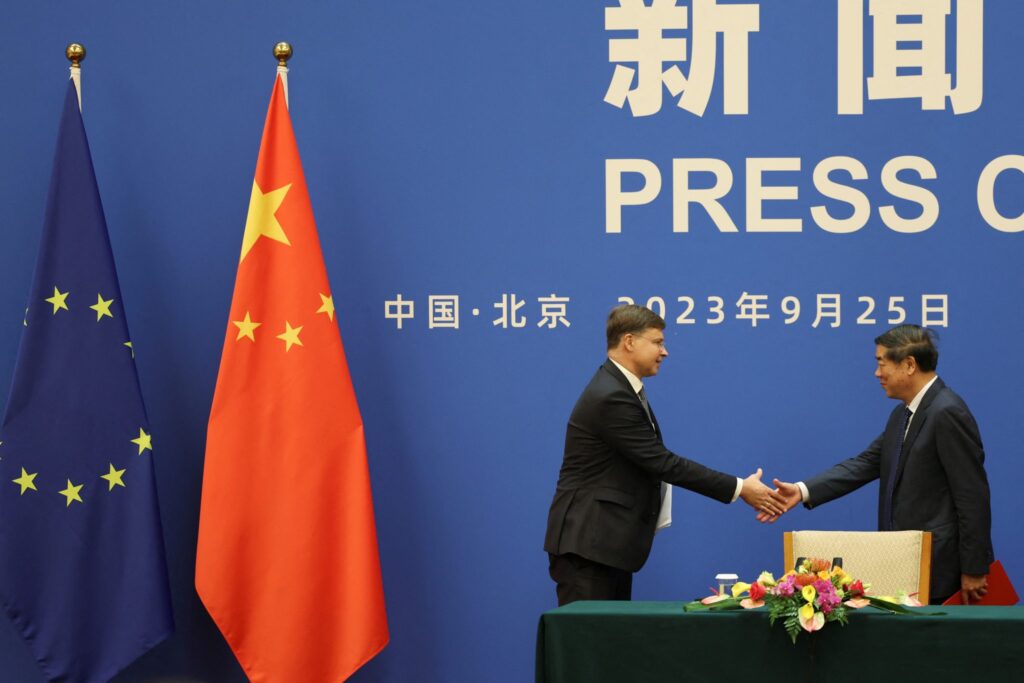
Let’s examine the mechanics of this strategy. In Europe, BYD faces a steep 17% anti-subsidy tariff on top of the standard 10% duty for imported EVs. The solution? Build inside the fortress.
BYD is rapidly constructing manufacturing hubs in Hungary (an EU member) and Turkey (which holds a lucrative customs union with the EU). Once a vehicle rolls off these assembly lines, it effectively sheds its Chinese origin. It earns the coveted “Made in Europe” tag. It can now be sold tariff-free across the continent, completely neutralizing Brussels’ protectionist wall.
This strategy is not confined to the West. It is actively reshaping the Asian subcontinent. India is currently grappling with a staggering $44 billion trade deficit with the Association of Southeast Asian Nations (ASEAN). Much of this deficit is not genuine Southeast Asian economic growth. It is rerouted Chinese capital. Through the ASEAN-India Free Trade Agreement (AITIGA), Chinese firms export near-finished goods or raw components to countries like Vietnam or Malaysia. After minor processing, these goods are rebranded under ASEAN’s origin rules and exported to India, bypassing New Delhi’s steep tariffs on direct Chinese imports.
What Other Countries Face?
The second-order effects of these China FTA loopholes are severe. Local industries in destination countries are being hollowed out by products that technically follow the rules but violate the spirit of free trade.
In India, domestic manufacturers of auto components, textiles, and electronics cannot compete with the artificially subsidized, ASEAN-routed goods. In Europe, the influx of “European-made” Chinese EVs forces legacy automakers like Volkswagen and Stellantis into a brutal price war on their home turf. Furthermore, because these new factories often rely entirely on imported Chinese battery cells, the host nations gain low-wage assembly jobs but miss out on the high-value technology transfer.
Comparing the Tariff Evasion Strategies
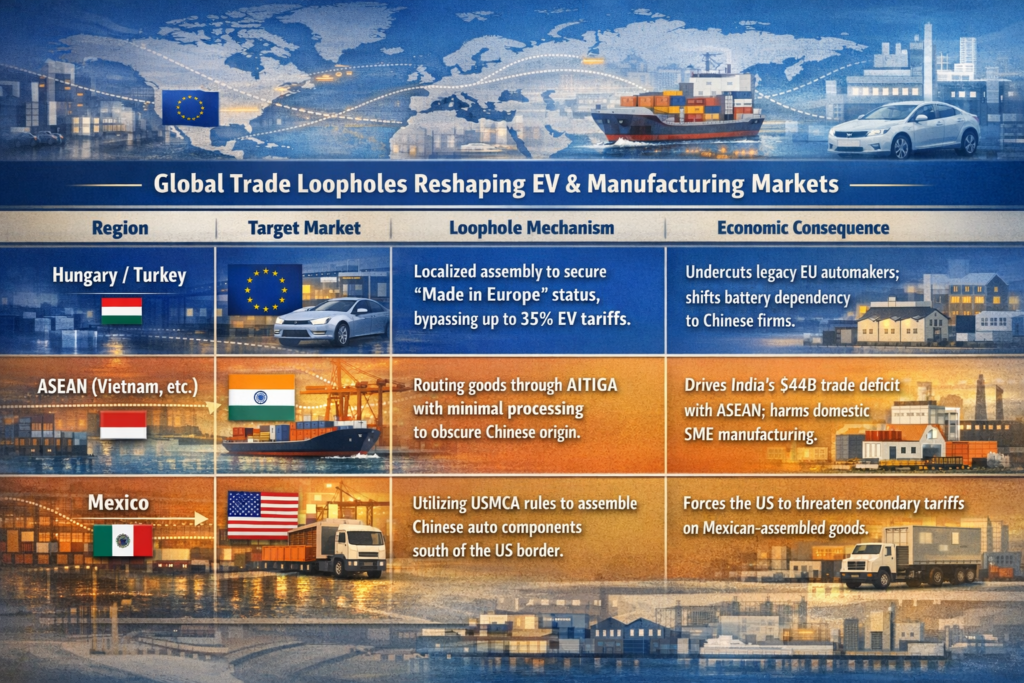
| Region | Target Market | The Loophole Mechanism | Economic Consequence |
| Hungary / Turkey | European Union | Localized assembly to secure “Made in Europe” status, bypassing up to 35% EV tariffs. | Undercuts legacy EU automakers; shifts battery dependency to Chinese firms. |
| ASEAN (Vietnam, etc.) | India | Routing goods through AITIGA with minimal processing to obscure Chinese origin. | Drives India’s $44B trade deficit with ASEAN; harms domestic SME manufacturing. |
| Mexico | United States | Utilizing USMCA rules to assemble Chinese auto components south of the US border. | Forces the US to threaten secondary tariffs on Mexican-assembled goods. |
Frequently Asked Questions
How does the “Rules of Origin” loophole actually work?
Rules of Origin determine the “economic nationality” of a product. If a Chinese company ships 80% of a car’s components to an ASEAN country, and local workers assemble the final 20%, the product can legally be classified as originating from that ASEAN country. This allows it to enter India under preferential, tariff-free terms, completely bypassing duties meant for China.
Why did the EU target pure electric vehicles but miss plug-in hybrids?
The initial EU anti-subsidy investigation focused exclusively on Battery Electric Vehicles (BEVs). Chinese manufacturers like BYD and MG immediately exploited this narrow focus by pivoting their export strategy to Plug-in Hybrid Electric Vehicles (PHEVs). These hybrids remain exempt from the punitive 17-35% duties, allowing Chinese firms to capture market share while their European factories are being built.
Also read – Cold War 2.0 Is Here , But The Weapons Are Silicon and Sand
Also read – US-IRAN Tension Makes A Big Impact On Global Energy Sector : The $70 Oil Barrel Hike

Kausar CY
Global Leadership | Europe & Gulf Expertise
Driving strategic growth and operational excellence at Global Angle, with extensive experience across the European and Gulf Political and Global sectors.