Executive Briefing
- The core event: A historic blizzard paralyzed the Northeastern seaboard, dumping over 36 inches of snow in Rhode Island and triggering sweeping statewide travel bans.
- The primary data point: The aviation sector suffered an immediate operational collapse, with airlines canceling over 5,700 domestic and international flights within a 24-hour window.
- The hidden economic impact: Massive power grid failures affecting 600,000 commercial and residential utility customers are severely disrupting localized distribution networks and halting retail operations.

The heaviest US East Coast snowstorm in nearly fifty years effectively severed the Northeastern logistics corridor this Monday. Atmospheric blocking patterns channeled immense moisture directly into sub-freezing Arctic air over the Atlantic seaboard.
Rhode Island absorbed a record-breaking 36 inches of snowfall, entirely obliterating the state’s previous 1978 record.
Municipalities from North Carolina to Maine immediately declared emergency conditions.
The Immediate Collapse of Aviation Networks
The storm systematically dismantled the regional aerospace infrastructure. Major metropolitan hubs initiated complete ground stops as visibility dropped to zero.
Carriers abandoned their flight schedules entirely.
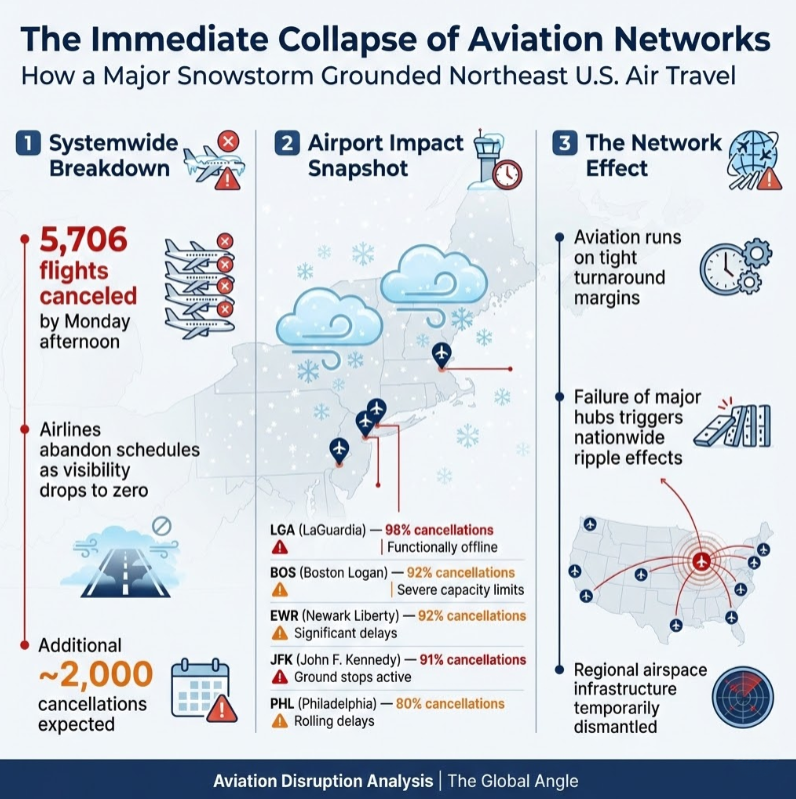
Commercial aviation operates on exceptionally tight turnaround margins. When a major geographic node fails, the ripple effects ground aircraft nationwide. Airlines canceled exactly 5,706 flights by Monday afternoon. Industry analysts anticipate an additional 2,000 cancellations bleeding into Tuesday operations.
| Airport Hub | Cancellation Rate | Local Snowfall Metric | Operational Status |
| New York LaGuardia (LGA) | 98% | >19 inches | Functionally offline |
| Boston Logan (BOS) | 92% | >20 inches | Severe capacity constraints |
| Newark Liberty (EWR) | 92% | >18 inches | Significant delays |
| JFK International (JFK) | 91% | >19 inches | Ground stops active |
| Philadelphia (PHL) | 80% | >12 inches | Rolling delays |
These bottlenecks instantly halt high-value freight.
Medical supplies, specialized electronics, and perishable goods relying on the bellies of passenger aircraft remain stranded on the tarmac.
Power Grid Fragility and Commercial Outages
Heavy, wet snow systematically snapped transmission lines across New England and the Mid-Atlantic. The structural integrity of local power grids failed under the immediate weight of the precipitation.
Over 600,000 homes and commercial enterprises lost electricity. Massachusetts and New Jersey sustained the most catastrophic utility infrastructure damage.
In Barnstable County, Massachusetts, 85% of utility customers went dark.
This represents more than a residential inconvenience. Prolonged commercial blackouts sever localized supply chains and halt all point-of-sale retail transactions. Small and medium businesses absorb heavy unrecoverable losses during these acute weather events.
Evaluating the Sub-Regional Travel Bans
State governments executed emergency executive powers to clear the highways.
Rhode Island and Connecticut initiated total bans on non-essential travel. Massachusetts Governor Maura Healey aggressively lowered speed limits and ordered residents off the roads to prevent mass vehicle strandings.
New York City temporarily shut down a metropolis of eight million people before lifting restrictions at noon.
| State/Municipality | Executive Action | Infrastructure Impact |
| Rhode Island | Non-essential travel ban | State highways restricted solely to emergency vehicles. |
| Massachusetts | Travel ban & speed reduction (40mph) | Total freeze on non-essential commercial trucking. |
| New York City | Temporary complete travel ban | Bridges, tunnels, and arterial roads closed until noon. |
| Connecticut | Non-essential travel ban | Immediate halt to localized distribution networks. |
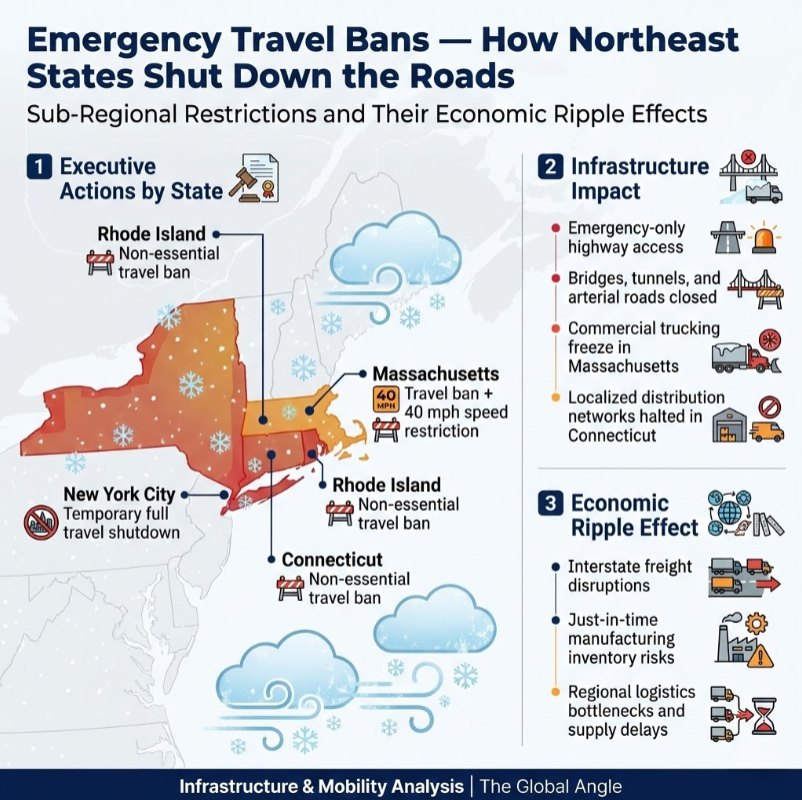
When interstate commercial transport halts, just-in-time manufacturing facilities quickly deplete their inventory reserves.
Navigating the Recovery Timeline
Meteorological data indicates the system will taper off by Tuesday morning. Coastal areas should expect an additional foot of accumulation before the precipitation ceases completely.
The physical clearance of highways will take roughly 48 hours.
Resetting the commercial aviation network, however, will require the remainder of the business week. Airlines must manually reposition flight crews and aircraft scattered across the continent.
Frequently Asked Questions
What is the current status of the US East Coast snowstorm?
The blizzard dropped over three feet of snow in parts of New England and paralyzed regional travel networks. Power grids remain severely damaged, with 600,000 outages reported. Most major Northeast airports are operating at less than 10% capacity.
When is the severe weather predicted to subside?
The National Weather Service anticipates the primary precipitation bands will clear the northern coastline by Tuesday morning. However, dangerously low temperatures will freeze the existing accumulation, heavily complicating physical recovery efforts through Wednesday.
ALSO READ: Analyzing the Escalating Mexico Cartel War and The Fall of El Mencho
ALSO READ: US-IRAN Tension Makes A Big Impact On Global Energy Sector : The $70 Oil Barrel Hike

The Complete History of Iran Israel Relations: From Secret Allies to Arch-Rivals
Executive Briefing The Dramatic Shift: Today, Iran and Israel are engaged in a sprawling, multi-front…

Russian vs Gulf Crude Oil: Price, Refining, and Efficiency Compared
Executive Briefing Two of the most heavily traded categories in the world are Russian vs…
Who is Winning the US Iran War 2026? Casualties, Costs, and the 2026 Timeline
Executive Briefing (Update: March 12, 2026) As the 2026 Middle East conflict reshapes the global…

Global Oil Price Hike 2026: Petrol Prices & Strategic Reserves by Country
Executive Briefing Global Oil Price Hike 2026 (Update: March 12, 2026) The Price Shock: Following…
Can Trump Be Impeached In Midterm Elections 2026? Odds, Stats, and the Process Explained
Executive Briefing (Update: March 2026) As the United States gears up for the pivotal 2026…

Who Was Arrested From the Epstein Files in 2026? Photos & Facts
Executive Briefing (Update: March 2026) If you are wondering exactly who was arrested from the…

Ibrahim is the Founder and Lead Analyst at The Global Angle, an independent digital platform dedicated to factual geopolitical analysis and international affairs. Based in India, he combines an engineering background with a deep focus on global markets, diplomacy, and strategic security. Ibrahim leverages a data-driven, analytical approach to break down complex international conflicts and economic shifts, helping readers see beyond standard news narratives. When he isn’t researching global policy, he focuses on digital publishing, search engine optimization, and platform architecture.