Executive Summary
- The News: In response to the escalating conflict in the Middle East and severe disruptions in the Strait of Hormuz, Indian Oil Imports Diversification is playing a crucial role, while flatly refusing an International Energy Agency (IEA) request to release its strategic petroleum reserves.
- The Hidden Link: The United States is actively weaponizing India’s market size. To prevent a catastrophic global price spike, Washington granted New Delhi a 30-day waiver to buy sanctioned Russian oil floating at sea, prioritizing short-term economic stability over its own geopolitical sanctions regime.
- The Outlook: Expect a massive influx of capital into India’s Phase II underground storage caverns. By Q4 2026, the cost of maritime insurance will force Indian refiners to lock in long-term contracts with Latin American and West African suppliers, permanently diluting the Middle East’s market share.
Energy security is no longer just a matter of procurement. It is a weapon of statecraft.
For decades, New Delhi accepted a geographic vulnerability: roughly half of its crude oil flowed through a 21-mile-wide chokepoint between Iran and Oman. But as the March 2026 US-Israeli strikes on Iranian leadership ignited a direct conflict, that chokepoint effectively closed. Tanker traffic stalled. Insurance premiums skyrocketed.
Yet, the Indian economy did not crash. Why? Because the architecture of India oil imports diversification had already been quietly rewired.
The Mechanics of the “India First” Energy Doctrine
To understand how India is navigating this crisis, you have to look at the math of survival. India consumes over 5 million barrels of oil per day, importing roughly 86% of it.
When the conflict erupted in late February, the Ministry of Petroleum and Natural Gas executed a pivot that shocked global markets. Within two weeks, non-Hormuz routing increased from 55% to 70% of total imports. Instead of panicking, state-run refiners like Indian Oil and BPCL began absorbing stranded cargoes from Angola, Nigeria, and the Republic of Congo.
But the most fascinating geopolitical twist came from Washington.
The US Treasury Department, terrified of Brent crude breaching $120 a barrel during an election year, issued a 30-day waiver allowing India to purchase Russian oil that was stranded at sea. The irony is staggering. The same sanctioned Russian Urals crude that Washington demanded India stop buying in late 2025 is now the exact buffer the US is relying on to prevent global energy inflation. Russia remains India’s top supplier, delivering over 1 million barrels per day, demonstrating that in 2026, pragmatism outranks ideology.
Economic & Geopolitical Ripple Effects
This deliberate distancing from the Middle East has profound second-order effects.
1. The Refining Margin Paradox
Securing alternative crude from the US Gulf Coast or West Africa requires longer transit times, which burns more fuel and drastically increases freight costs. However, because Indian refiners invested heavily in complex processing units over the last decade, they can refine the heavy, sour crude that other nations reject. They are buying discounted, harder-to-process oil, refining it, and exporting the finished diesel and aviation fuel back to Europe at a massive premium.
2. The Liquefied Petroleum Gas (LPG) Vulnerability
While crude oil gets the headlines, the actual Achilles heel of India’s energy grid is cooking gas. India imports up to 90% of its LPG from the Gulf. Anticipating a prolonged blockade, the government has preemptively curtailed the use of propane and butane in petrochemicals, redirecting all refinery output strictly to domestic LPG cylinders to prevent civil unrest.
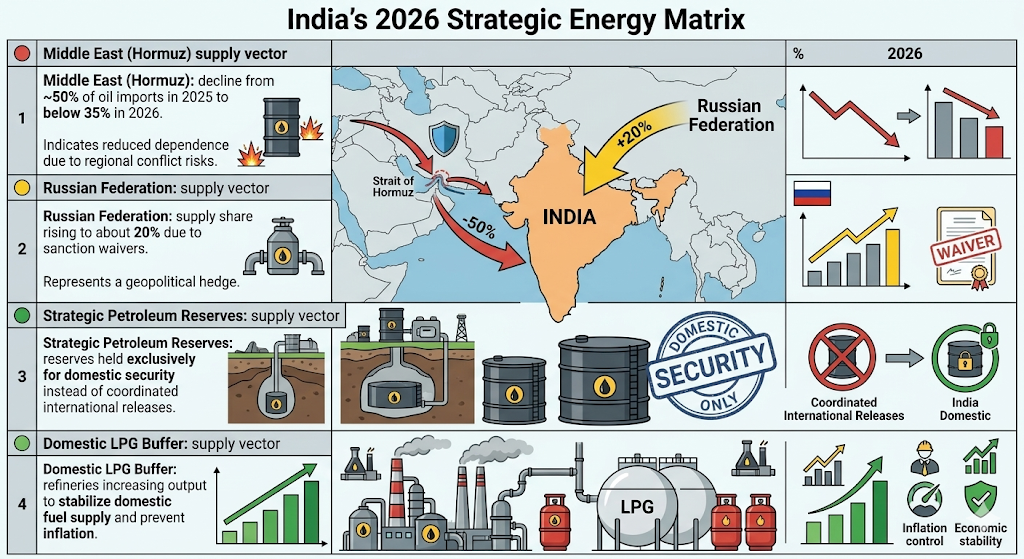
India’s 2026 Strategic Energy Matrix
| Supply Vector | Pre-Crisis Baseline (2025) | Current Posture (March 2026) | Strategic Consequence |
| Middle East (Hormuz) | 45% – 55% of total basket | Dropping below 35% | Reduced exposure to Iranian proxy warfare. |
| Russian Federation | Heavily sanctioned / Declining | Sanction waiver active (~20%) | Moscow remains an indispensable geopolitical hedge. |
| Strategic Reserves | Coordinated with IEA releases | Held strictly for domestic use | Asserts complete sovereign control over national buffers. |
| Domestic LPG Buffer | Just-in-time logistics | Refineries ordered to max output | Prevents localized panic buying and inflation. |
Future Outlook: The Next 6 Months
The current buffer cannot last indefinitely. If the Strait of Hormuz remains contested, the global energy map will permanently redraw itself.
- May 2026: The Cavern Push. Expect the Union Cabinet to fast-track “Phase II” of the Strategic Petroleum Reserves. The delays in acquiring land at Chandikhol in Odisha will vanish. India knows its current 74-day combined coverage (strategic plus commercial) falls short of the IEA’s 90-day standard. Capital will flood into domestic infrastructure.
- July 2026: The Venezuela Pivot. If the US revokes the Russian waiver once the immediate price shock subsides, India will aggressively pivot to Venezuelan heavy crude, demanding Washington turn a blind eye to Caracas in exchange for regional stability.
- September 2026: Retail Price Transmission. Currently, the Indian government is shielding consumers from the rising maritime insurance costs. By Q3, if crude remains above $95, state-run oil marketing companies will be forced to pass these costs down, triggering a minor inflationary spike in domestic logistics.
The era of easy, single-source energy is over. India is no longer just buying oil; it is buying geopolitical optionality.
Frequently Asked Questions
Does India have enough oil reserves if the Middle East stops supplying completely?
Currently, India holds approximately 74 days of net import coverage. This includes roughly 9.5 days in underground Strategic Petroleum Reserves (SPRs) managed by the government, plus about 65 days of commercial inventory held by state-run refiners like IOC, BPCL, and HPCL.
Why did the US allow India to buy Russian oil during a Middle East crisis?
The US issued a temporary 30-day waiver to prevent a global supply crunch. With Middle Eastern oil physically trapped behind maritime blockades in the Strait of Hormuz, millions of barrels of Russian oil floating near Asia were the fastest way to stabilize the global market and prevent a massive spike in gasoline prices in Western economies.
ALSO READ: Global Oil Price Hike 2026: Petrol Prices & Strategic Reserves by Country
ALSO READ: Russian vs Gulf Crude Oil: Price, Refining, and Efficiency Compared