Analysis: BJP Dominance in Maharashtra Civic Polls 2026
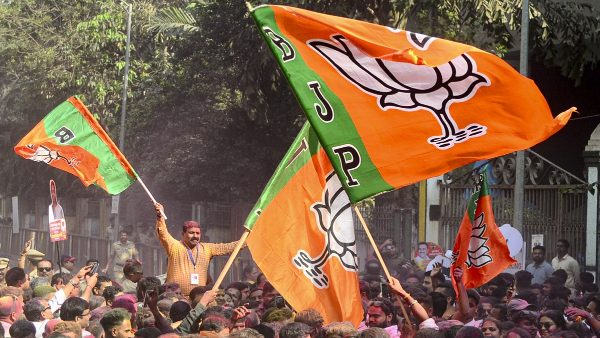
The political landscape of western India underwent a decisive transformation this Friday as the ruling Mahayuti alliance secured a sweeping victory in the Maharashtra local body elections. Winning 23 of the 29 municipal corporations that went to the polls, the Bharatiya Janata Party (BJP) has effectively ended a quarter-century of dominance by the Thackeray family over the Brihanmumbai Municipal Corporation (BMC). This verdict not only consolidates the BJP’s position as the principal force in urban Maharashtra but also serves as a critical endorsement of the state leadership’s development agenda.

The Fall of the Thackeray Citadel in Mumbai
For twenty-five years, the BMC—India’s richest civic body—served as the unshakeable fortress of the Shiv Sena and the Thackeray family. The 2026 results mark a historic departure from this trend. Despite a highly publicized reunion between Uddhav Thackeray and his cousin Raj Thackeray, and a campaign heavily reliant on Marathi nativism, the opposition failed to counter the BJP’s organizational machinery.
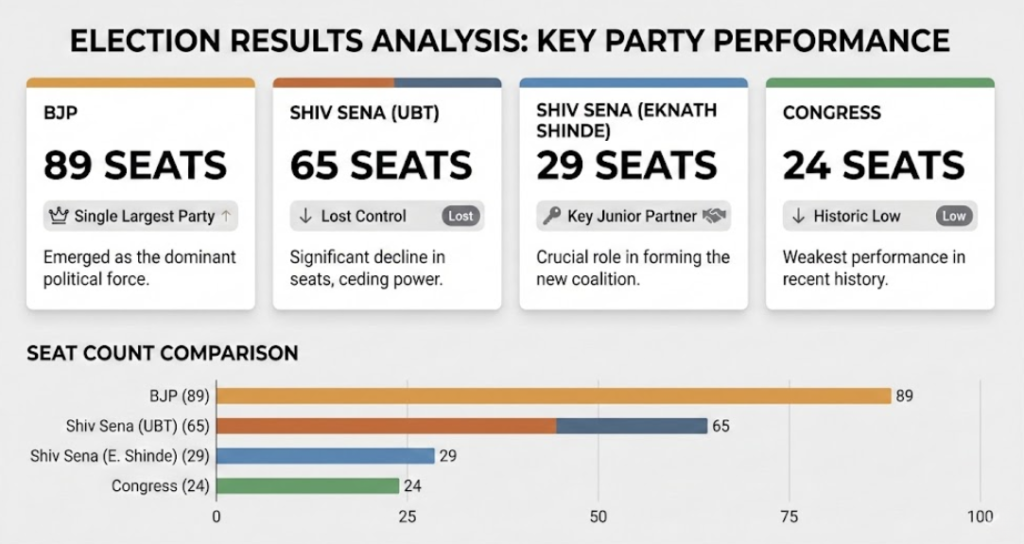
The data reveals a stark shift in voter sentiment. The BJP emerged as the single-largest party with 89 seats, decisively outpacing Uddhav Thackeray’s Shiv Sena (UBT), which secured 65 seats. While the Sena (UBT) managed to retain influence in its traditional strongholds of south-central Mumbai, stretching from Dadar to Byculla, it could not halt the BJP’s expansion into the suburbs. Eknath Shinde’s faction of the Shiv Sena also made significant inroads, winning 29 seats and further fragmenting the traditional Sena vote bank.
Mumbai BMC Election Results 2026
| Party | Seats Won | Change in Status |
| BJP | 89 | Single Largest Party |
| Shiv Sena (UBT) | 65 | Lost Control |
| Shiv Sena (Eknath Shinde) | 29 | Key Junior Partner |
| Congress | 24 | Historic Low |
Consolidation of the Urban Industrial Belt
Beyond Mumbai, the results underscore the BJP’s tightening grip on Maharashtra’s economic engine. The party achieved landslide victories in the Mumbai-Nashik-Pune triangle, a region that contributes approximately 7% to India’s national GDP.
In Pune, the BJP secured 96 out of 165 seats, while in Nagpur, the home turf of Deputy Chief Minister Devendra Fadnavis, the party won a commanding 102 out of 151 seats. This dominance extends to Pimpri-Chinchwad and Nashik, effectively placing the state’s most vital urban infrastructure under a single political command structure. This consolidation is likely to streamline decision-making regarding large-scale infrastructure projects, such as metro lines and trans-harbor links, which were central to the Mahayuti’s campaign pitch.
Fragmentation of the Opposition
The 2026 mandate exposes deep structural weaknesses within the opposition Maha Vikas Aghadi (MVA). The Congress, which had shown signs of resurgence in the 2024 general elections, collapsed in urban centers. In Mumbai, the party was reduced to 24 seats, its lowest tally since 1992. Its strategic decision to align with Prakash Ambedkar’s Vanchit Bahujan Aghadi (VBA) yielded no electoral dividends, as the VBA failed to open its account in the capital.
Furthermore, the reunification efforts between the Nationalist Congress Party (NCP) factions of Sharad Pawar and Ajit Pawar did not translate into electoral gains in their traditional western Maharashtra bastions. The loss of Pimpri-Chinchwad to the BJP suggests that the traditional cooperative-sector patronage networks that once sustained the NCP are losing relevance in an increasingly urbanized electorate.
Future Outlook: The “Double Engine” Endorsement
The comprehensive nature of this victory significantly boosts the political capital of Prime Minister Narendra Modi and Maharashtra Chief Minister Devendra Fadnavis. Fadnavis, who spearheaded the campaign in the absence of other major national figures, has framed the result as a victory for “inclusive Hindutva” and urban modernization.
Looking ahead, this result is likely to accelerate the centralization of urban planning in Maharashtra. With the BJP controlling both the state government and the vast majority of municipal corporations, including the financially potent BMC, the friction between state and local authorities that often hampered Mumbai’s development is expected to dissipate. For the opposition, particularly the Thackeray family, the path to political relevance now requires a fundamental rethinking of their outreach strategy beyond emotive identity politics.
Regional Performance Overview
| Region | Dominant Party | Strategic Implication |
| Mumbai Metro Region (MMR) | Mahayuti (BJP+Sena) | Control of Financial Hub |
| Western Maharashtra (Pune/Solapur) | BJP | Breach of NCP Bastion |
| Vidarbha (Nagpur) | BJP | Consolidation of Base |
| Marathwada (Latur/Sambhajinagar) | Mixed | Congress retains Latur pocket |
Who won the maximum seats in the 2026 BMC elections?
The BJP emerged as the single largest party in the BMC with 89 seats, followed by the Shiv Sena (UBT) with 65.
Did the Thackeray family lose control of the BMC?
Yes, for the first time in over 25 years, the Thackeray-led Shiv Sena (UBT) lost its majority to the BJP-led Mahayuti alliance.
Which alliance is set to rule Maharashtra’s municipal corporations?
The Mahayuti alliance, comprising the BJP, Eknath Shinde-led Shiv Sena, and Ajit Pawar-led NCP, is set to rule 25 of the 29 municipal corporations.
What was the performance of the Congress in the 2026 civic polls?
The Congress won 324 seats statewide but suffered its worst-ever performance in Mumbai with only 24 seats.