Analysis: Sheikh Hasina Delhi Statement & Bangladesh Crisis 2026
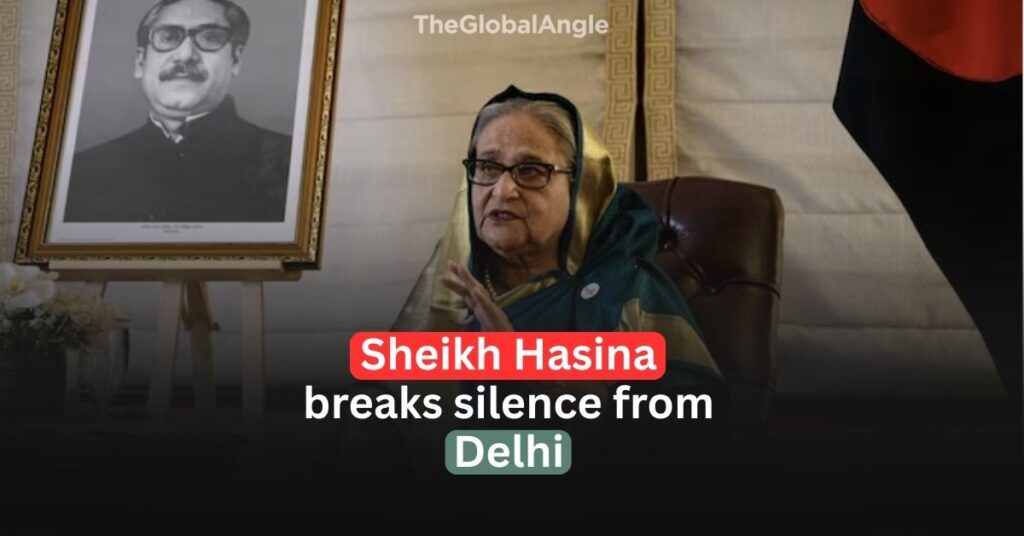
The political volatility in South Asia intensified this Friday as former Bangladesh Prime Minister Sheikh Hasina broke her silence with a scathing audio message delivered at an event in New Delhi. Living in exile since her ouster in August 2024, Hasina described her homeland as a “vast prison” and an “execution ground,” launching a direct rhetorical assault on the interim government led by Nobel laureate Muhammad Yunus.
This intervention comes at a critical geopolitical juncture. Bangladesh is just weeks away from its first general election since the “July Revolution,” scheduled for February 12, 2026. Hasina’s characterization of the nation as being on the “edge of an abyss” underscores the deep polarization threatening the stability of the region.
The “Valley of Death” Accusation
In her address, Sheikh Hasina painted a dystopian picture of post-revolution Bangladesh. She argued that the nation, liberated by her father Sheikh Mujibur Rahman, has been “ravaged by the monstrous onslaught of extremist communal forces.” Her choice of words was deliberate and incendiary, designed to delegitimize the current administration in the eyes of the international community.
“Our once serene and fertile land has been reduced to a wounded, blood-soaked landscape,” Hasina stated. She specifically targeted Chief Advisor Muhammad Yunus, labeling him a “murderous fascist,” “usurer,” and “money launderer.” These accusations attack Yunus’s global reputation as a pioneer of microfinance and civil society, reframing his governance as a “reign of terror” rather than a democratic transition.
The Election Dilemma: A Democracy without Opposition?
The backdrop to this war of words is the controversial upcoming general election. The interim government has banned Hasina’s party, the Awami League, from contesting the polls, citing the need to dismantle the “fascist structure” of the previous regime. This decision has created a political vacuum that the Bangladesh Nationalist Party (BNP) and the Jamaat-e-Islami are racing to fill.
Campaigning officially began on January 22, 2026, but the absence of the country’s largest political force raises serious questions about the election’s inclusivity. Hasina’s message reinforced the narrative that the current process is not a restoration of democracy but a consolidation of power by unelected entities. “Democracy is now in exile,” she claimed, positioning herself not as a deposed autocrat but as a “directly elected representative” ousted by conspiracy.
Bangladesh 2026 Election Snapshot
| Feature | Status/Detail |
| Election Date | February 12, 2026 |
| Key Exclusion | Awami League (Banned) |
| Main Contenders | BNP (Tarique Rahman), Jamaat-e-Islami Alliance |
| Concurrent Event | Constitutional Referendum on “July Charter” |
| Security Concerns | High (Reports of violence & minority targeting) |
The Minority Rights Crisis
A central theme of the Sheikh Hasina Delhi Statement was the alleged persecution of religious minorities. Hasina claimed that “mob violence, looting, and extremism” are spreading nationwide, a narrative that resonates with concerns raised by India and several international human rights bodies.
Reports from organizations like Human Rights Watch have flagged serious failures by the interim government in protecting Hindus and other minorities. However, the Yunus administration has pushed back, releasing data in January 2026 claiming that out of 645 reviewed incidents, only 71 were “communal” in nature, with the vast majority being “criminal” disputes. This tug-of-war over the narrative is critical; Hasina is using it to frame the interim government as an enabler of fundamentalism, hoping to erode its Western support.
Future Outlook: Legitimacy at Stake
The timing of Hasina’s intervention suggests a strategy to cast a shadow of illegitimacy over the February 12 polls before the first vote is cast. By calling for “resistance” against the “unelected regime,” she may be signaling her supporters—who remain numerous despite the ban—to disrupt the electoral process or boycott it entirely.
For the interim government, the challenge is twofold: conducting a peaceful election without the participation of the Awami League and managing the optics of a “one-sided” contest. If violence escalates or if voter turnout collapses, the Yunus administration may face a crisis of credibility that no amount of reformist rhetoric can fix. The international community, particularly India and the US, will be watching closely to see if the “New Bangladesh” can survive its birth pangs without descending into the chaos Hasina has predicted.
FAQ
Where is Sheikh Hasina currently living?
Sheikh Hasina has been living in exile in New Delhi, India, since fleeing Bangladesh on August 5, 2024.
Why is the Awami League banned from the 2026 election?
The interim government suspended the Awami League’s registration and banned it from contesting, citing its role in the violent suppression of the 2024 student uprising and alleged “fascist” governance.
What did Sheikh Hasina say about Muhammad Yunus?
In her January 2026 statement, she called Muhammad Yunus a “usurer,” “money launderer,” and “murderous fascist,” accusing him of destroying the nation.
When are the Bangladesh general elections?
The general elections are scheduled for February 12, 2026, alongside a referendum on constitutional reforms.
ALSO READ: How Trump’s ‘Board of Peace’ aims to reshape international diplomacy beyond Gaza
ALSO READ: Historic First Trilateral Talks Ukraine Russia US 2026 is set in Abu Dhabi to end the war.