Key Takeaways
- The Core Concept: A No Confidence Motion is a formal parliamentary procedure used to test whether the current government (executive) still holds the support of the majority of elected representatives.
- The Power: It is one of the most significant tools in a democracy, granting the legislature the power to remove a government mid-term if it fails to maintain a majority.
- The Outcome: If the motion passes, the government must resign or face new elections. If it fails, the government continues, often with reaffirmed authority.
In any parliamentary democracy, the government’s authority is not absolute; it is conditional. It relies on the “confidence” of the House (the elected assembly). When that trust erodes, the opposition can trigger a constitutional mechanism known as the No Confidence Motion.
This procedure is the ultimate “check and balance.” It ensures that the executive branch remains accountable to the legislative branch—and by extension, to the people. But how exactly does it work, and what makes it effective?
What is a No Confidence Motion?
A No Confidence Motion (or Vote of No Confidence) is a formal proposal moved by a member of the legislative body (usually the Opposition) stating that the House “has no confidence” in the Council of Ministers or the Prime Minister/Chief Minister.
Unlike other motions that might focus on specific policies or laws, this motion targets the legitimacy of the government itself. It asks a simple, binary question: Does the current administration still command a majority?
The Purpose: Why is it Used?
The primary purpose of a No Confidence Motion is Accountability. In a parliamentary system, the executive is born from the legislature. Therefore, it must answer to it.
- Testing the Majority: It forces the ruling party to prove, on the floor of the House, that they still have the numbers to govern.
- Highlighting Failures: Even if the opposition knows they might lose the vote, moving the motion allows for a dedicated debate. This provides a platform to highlight the government’s alleged failures, policy paralysis, or economic mismanagement on a national stage.
- Checking Power: It prevents a government from becoming autocratic. The constant possibility of being removed keeps the administration responsive to the needs of the assembly.
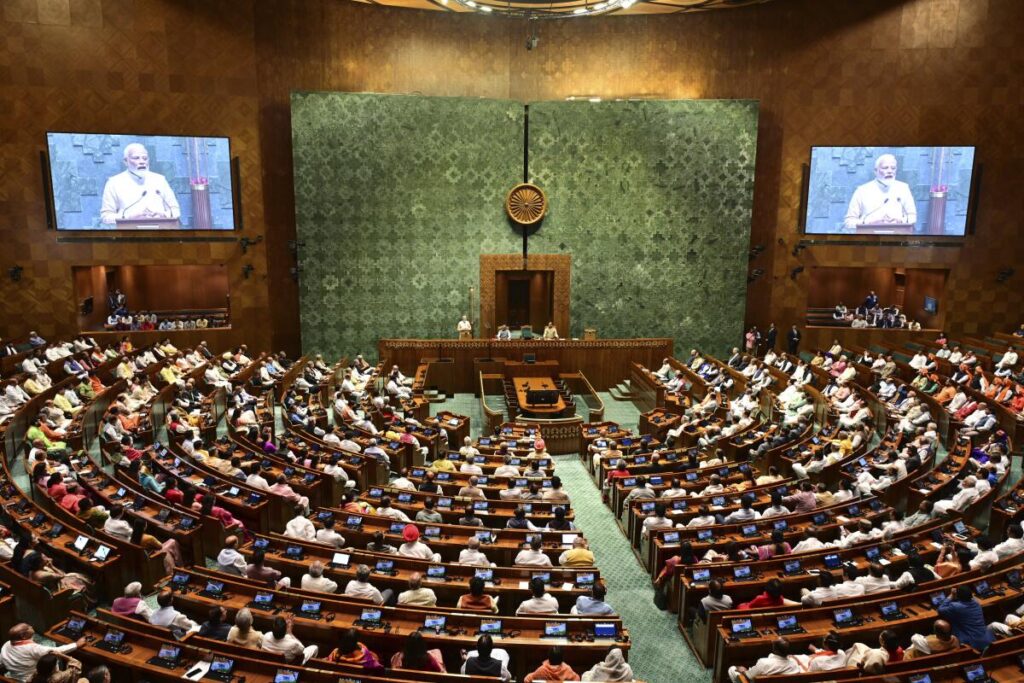
How the Process Works (General Framework)
While specific rules vary by country (e.g., India, UK, Canada, Japan), the general procedural flow remains consistent:
- The Proposal: A member of the House seeks leave (permission) to move the motion. Usually, a minimum number of members (e.g., 50 members in some Parliaments) must support the request for it to be admitted.
- The Debate: Once admitted, the Speaker allots time for a debate. This is often the most high-profile session in a parliamentary calendar. The Opposition charges the government with failures, and the Prime Minister/Government responds with a defense of their record.
- The Vote: After the debate, a vote is held. This can be a voice vote (Ayes vs. Noes) or a division vote (recorded electronic or paper voting).
[Diagram showing the flow of a No Confidence Motion from proposal to vote]
The Effectiveness: Outcomes and Consequences
The effectiveness of a No Confidence Motion lies in its binary outcome. It brings decisive clarity to political uncertainty.
Scenario A: The Motion Passes (Government Loses)
If the majority of the House votes “Yes” to the motion (meaning they have no confidence):
- Resignation: The Government is constitutionally bound to resign immediately.
- New Alliances or Elections: The Head of State (President or Monarch) may ask the opposition if they can form a majority, or they may dissolve the House and call for fresh general elections.
Scenario B: The Motion Fails (Government Wins)
If the majority votes “No” (meaning they have confidence):
- Survival: The government remains in power.
- Reaffirmed Mandate: Surviving the vote often strengthens the government’s position, as it has mathematically proven its support.
- Immunity Period: In many systems, once a No Confidence Motion fails, the opposition cannot bring another one for a specific period (e.g., 6 months) to ensure stability.
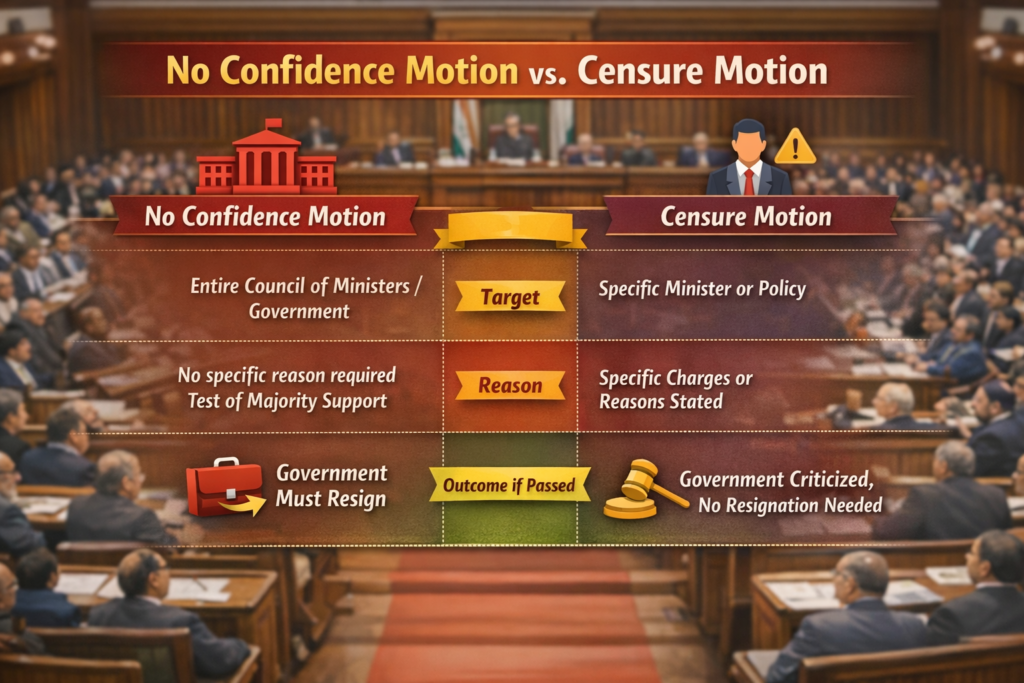
Difference Between ‘No Confidence’ and ‘Censure’ Motions
It is crucial to distinguish between these two often-confused terms:
Conclusion
The No Confidence Motion is the “nuclear button” of parliamentary procedure. It is not used lightly, as it disrupts the legislative agenda and places the country’s political future in the balance. Whether it results in the fall of a government or the strengthening of one, its mere existence ensures that democracy remains dynamic and that power is never unchecked.
Frequently Asked Questions
What happens if a Prime Minister loses a No Confidence vote?
By convention and constitutional law, the Prime Minister and the entire Council of Ministers must resign immediately. The Head of State will then either invite another leader to form the government or dissolve the assembly for new elections.
Can a No Confidence Motion be moved against an individual minister?
No. A No Confidence Motion is strictly against the entire Cabinet/Government. To target an individual minister, the opposition would move a “Censure Motion” instead.
Does the Upper House (Senate/Rajya Sabha) vote on No Confidence Motions?
Generally, no. In most parliamentary systems, the government is only responsible to the directly elected Lower House (e.g., House of Commons, Lok Sabha). Therefore, only the Lower House can remove the government via a No Confidence vote.
Also Read – https://theglobalangle.com/munich-security-conference-2026-facts-outcomes/