Rajya Sabha Elections 2026
- The News: The Election Commission has scheduled biennial elections for 37 Rajya Sabha seats across 10 states for March 16, 2026.
- The Hidden Link: This election cycle is the mathematical tipping point that could finally hand the NDA a standalone majority in the Upper House, ending years of reliance on “friendly” neutral parties.
- The Outlook: Expect aggressive constitutional amendments—specifically “One Nation, One Election”—to be tabled in the Monsoon Session if the BJP secures its targeted 28+ seats.

On March 16, the political gaze of New Delhi will shift from the raucous Lower House to the often-sedate Rajya Sabha. But make no mistake: “sedate” is the last word one should use for the upcoming biennial elections.
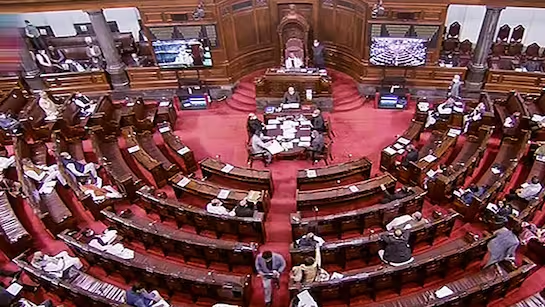
For over a decade, the “House of Elders” has acted as the primary brake on the Modi government’s most ambitious legislative projects. While the NDA dominates the Lok Sabha, the Upper House has forced them into a perennial negotiation with neutral players like the Biju Janata Dal (BJD) and YSR Congress. That era of negotiation may be ending. With 37 vacancies opening up in April 2026, the arithmetic is poised for a decisive shift. The “cooling chamber” of Indian democracy is about to become its engine room.
Rajya Sabha Elections 2026: The Mathematics of Control
The Rajya Sabha has a current strength of 245 members. The magic number for a simple majority is 123.
For the past two terms, the BJP-led NDA has hovered tantalizingly close to this mark but never quite crossed it comfortably without external help.
Why does this specific cycle matter?
The vacancies are concentrated in states where the political landscape has shifted violently since the last cycle in 2020.
- Maharashtra (7 seats): The epicenter of the battle. In 2020, the MVA was in power. Today, the state is ruled by the Mahayuti coalition (BJP + Shinde Sena + Ajit Pawar NCP). The legislative math suggests the ruling alliance should sweep, but internal friction makes this the most volatile contest.
- West Bengal (5 seats): A fortress for the Trinamool Congress (TMC). Saket Gokhale is among those retiring. Here, the numbers are static, but the political messaging will be fierce.
- The Hindi Heartland: In Bihar (5) and Uttar Pradesh (where by-polls often align), the NDA’s consolidated strength ensures a smooth sail.
The goal isn’t just a simple majority. It is establishing a “super-majority” buffer that allows the government to push through constitutional amendment bills that require a two-thirds presence.
Why Rajya Sabha Elections Matter
Unlike Lok Sabha elections, Rajya Sabha elections do not change power overnight. Instead, they gradually reshape the balance of power in Parliament, influencing how easily the government can pass laws over time.
Why Most Seats Were Uncontested
A large number of seats were decided unopposed because party strength in state assemblies clearly determined the outcome. This highlights how Rajya Sabha elections are often predictable based on existing political alignments.
State Politics Drives Rajya Sabha Outcomes
Since MLAs vote in these elections, the results reflect recent state election outcomes. This means that victories in state assemblies directly translate into influence in the Upper House.
The Himachal “Cross-Voting” Shock (2024)
To understand the tension brewing in Mumbai and Patna, rewind to February 2024.
In a stunning upset, the Congress government in Himachal Pradesh—despite having a clear numerical majority—lost a Rajya Sabha seat to the BJP. Six Congress MLAs cross-voted, proving that the “whip” in Rajya Sabha elections is more of a suggestion than an iron law for determined dissenters.
This “Himachal Model” haunts the 2026 cycle.
In states with fractured coalitions like Maharashtra, the threat of “conscience voting” is real. The Rajya Sabha uses an Open Ballot system, meaning MLAs must show their vote to a party agent. However, history shows that rebellious MLAs often court disqualification willingly if the political price is right. March 16 will test whether the coalition glue in Maharashtra is strong enough to withstand the opposition’s attempts to poach disgruntled legislators.
How Can This Impact Us Globally
Why should a foreign investor care about 37 seats in India’s Upper House?
Because legislative gridlock is a risk premium.
- Policy Velocity: A hostile Rajya Sabha slows down reforms. A compliant one accelerates them. If the NDA crosses the 123 mark decisively, expect the Uniform Civil Code (UCC) and labor code implementations to move from “discussion” to “notification” within months.
- The “One Nation, One Election” Bill: This is the big fish. Implementing simultaneous polls requires a constitutional amendment. Without a commanding Rajya Sabha majority, this bill is dead on arrival. A win on March 16 resurrects it.
- Foreign Direct Investment (FDI): Stability sells. Global capital prefers a government that can enact policy without diluting it in committee stages. A strong Upper House consolidation signals policy continuity until 2029.
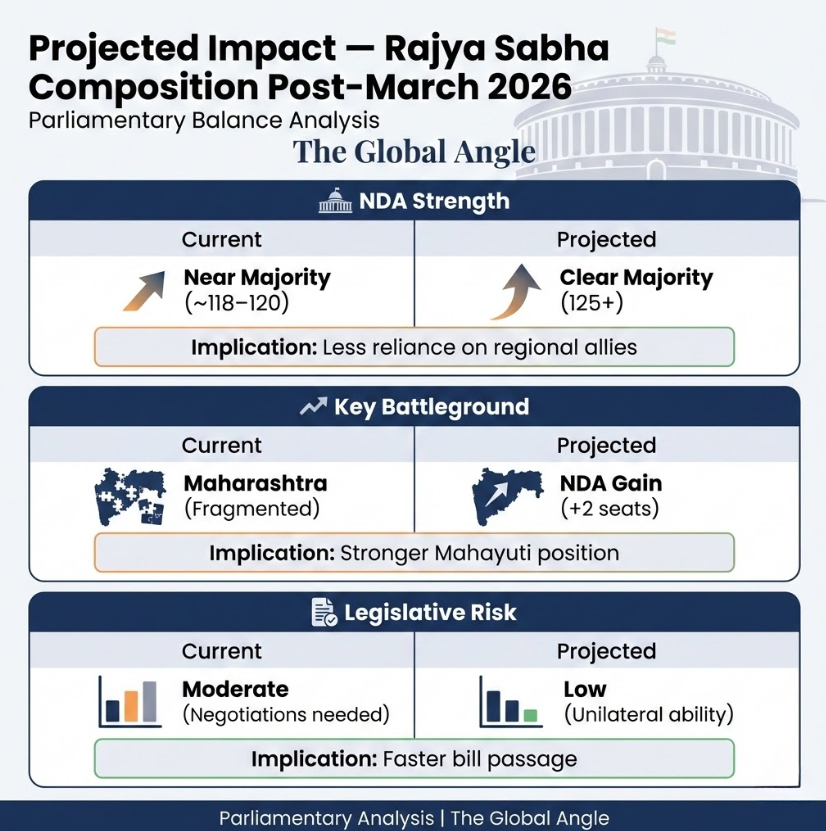
Projected Impact: Rajya Sabha Composition Post-March 2026
| Metric | Current Status (Pre-Poll) | Projected Status (Post-Poll) | Strategic Implication |
| NDA Strength | Near Majority (~118-120) | Clear Majority (125+) | End of reliance on BJD/YSRCP. |
| Key Battleground | Maharashtra (Fractured) | NDA Gain (+2 seats) | Consolidates Mahayuti power. |
| Legislative Risk | Moderate (Negotiation needed) | Low (Unilateral ability) | Faster passage of controversial bills. |
Wait of March 16
The counting of votes on the evening of March 16 will trigger a chain reaction.
- The “July Blitz”: If the numbers hold, the Monsoon Session of Parliament (typically July-August) will likely be the most productive in history. The government will move to clear the legislative backlog before the state election cycles heat up.
- The Maharashtra Test: The results will serve as a bellwether for the Maharashtra Assembly elections later in 2026. If the Mahayuti coalition can transfer votes seamlessly between BJP, Sena, and NCP candidates, it signals invincibility. If they fumble, it exposes cracks the opposition MVA will exploit.
- Institutional Reforms: Watch for the revival of the Delimitation Commission discussions. A strong Rajya Sabha is a prerequisite for managing the geopolitical fallout of redrawing constituency boundaries, which will disproportionately affect southern states.
Final Verdict: These 37 seats are the difference between a government that proposes and a government that disposes. On March 16, the legislative brakes likely come off.
Sources:
Economic Times – Election Commission announces Rajya Sabha polls for 37 seats
Business Standard – Rajya Sabha elections 2026 voting details
NDTV – NDA advantage in Rajya Sabha elections
Economic Times – NDA gains in Rajya Sabha after elections
Frequently Asked Questions
Q1: Why is there a fear of cross-voting if parties issue a whip?
While parties issue whips, the anti-defection law applies differently in Rajya Sabha polls. An MLA can be disqualified after the vote, but the vote itself may still count depending on the Speaker’s interpretation and judicial review. Often, MLAs who plan to switch parties use this vote as their exit ticket.
Q2: What is the “Magic Number” for the Rajya Sabha?
The current strength is 245 seats. The simple majority mark is 123. However, for constitutional amendments, a “special majority” (two-thirds of members present and voting) is required, making every single seat crucial for the ruling coalition.
ALSO READ: India BRICS Presidency 2026: Leadership in an Era of Global Uncertainty
ALSO READ: French President Macron India visit 2026 agenda: AI, Defense, and the Innovation Agenda
Russia China trade relations 2026: Sanctions Evasion, Dual-Use Tech, and the Putin-Xi Summit
Russia China trade relations 2026: Sanctions Evasion, Dual-Use Tech, and the Putin-Xi Summit Executive Briefing…

What is Hantavirus Outbreak 2026: Symptoms, Vaccine Status, and the Climate Vector
What is Hantavirus Outbreak 2026: Symptoms, Vaccine Status, and the Climate Vector The Immediate Trigger:…

Starlink & SpaceX IPO 2026: Everything You Need to Know
Starlink & SpaceX IPO 2026: Everything You Need to Know The Valuation: According to Institutional…
What is OPEC? How the Oil Cartel Functions and Why It’s Fracturing in 2026
What is OPEC? How the Oil Cartel Functions and Why It’s Fracturing in 2026 The…

Why the UAE Quit OPEC and the Birth of the Petro-Rupee
Why the UAE Quit OPEC and the Birth of the Petro-Rupee The Rupture: The United…

Microsoft OpenAI Partnership Ends: Why Microsoft is Dropping OpenAI’s Exclusive License
Microsoft OpenAI Partnership Ends: Why Microsoft is Dropping OpenAI’s Exclusive License The Announcement: On April…

Ibrahim is the Founder and Lead Analyst at The Global Angle, an independent digital platform dedicated to factual geopolitical analysis and international affairs. Based in India, he combines an engineering background with a deep focus on global markets, diplomacy, and strategic security. Ibrahim leverages a data-driven, analytical approach to break down complex international conflicts and economic shifts, helping readers see beyond standard news narratives. When he isn’t researching global policy, he focuses on digital publishing, search engine optimization, and platform architecture.