Executive Summary AI Summit Congress Shirtless Protest
- The News: Prime Minister Narendra Modi used the inauguration of the Meerut Metro to launch a blistering attack on the Congress party, condemning a recent “shirtless” protest by its youth wing at the India AI Impact Summit.
- The Hidden Link: This clash highlights the ruling party’s strategy of contrasting its high-tech governance narrative (AI summits and rapid transit) directly against the opposition’s reliance on disruptive, street-level political theater.
- The Political Calculus: By framing the protest as an embarrassment in front of foreign dignitaries, the BJP successfully forced even opposition allies to distance themselves from the Congress’s tactical disruption.

Political messaging is rarely subtle. But Sunday’s events offered a masterclass in the weaponization of contrast.
While flagging off ₹12,930 crore worth of infrastructure projects—including India’s fastest metro in Meerut and the fully completed Namo Bharat rapid rail corridor—Prime Minister Narendra Modi did not stick to a standard development script. Instead, he pivoted sharply. He targeted the Indian Youth Congress (IYC) for their February 20 protest at the India AI Impact Summit in New Delhi. Modi accused the main opposition of turning a prestigious global stage into a platform for “dirty and naked politics.”
But why did an infrastructure rally in Uttar Pradesh become the staging ground for a counter-attack regarding a tech summit in Delhi? The answer reveals how modern political narratives are constructed.
The Anatomy of the AI Summit Protest
To understand the Prime Minister’s fury, you have to look at the disruption itself.
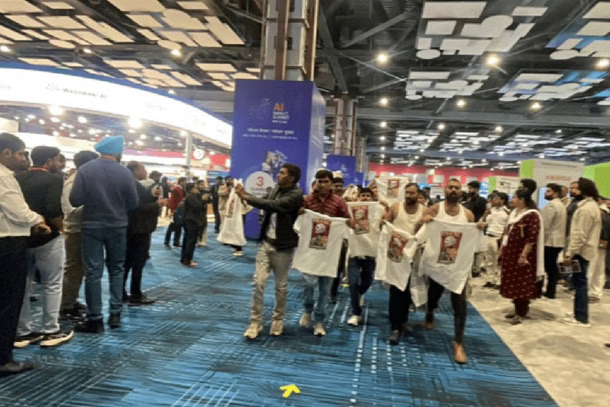
On Friday, Exhibition Hall No 5 at Bharat Mandapam was hosting delegates from over 80 countries. Heads of state and global tech executives were gathered to discuss the future of artificial intelligence. Suddenly, a group of Indian Youth Congress workers bypassed security protocols. They removed their shirts, revealing underneath garments bearing images of PM Modi and US President Donald Trump.
Their core accusation? That the Prime Minister was “compromised” over a looming India-US trade deal. They chanted slogans alleging that national interests were being sacrificed for corporate gains. The Delhi Police moved quickly, arresting four individuals—Krishna Hari, Kundan Yadav, Ajay Kumar, and Narasimha Yadav—on charges ranging from hate speech to criminal conspiracy.
The Congress defended the stunt. They claimed the flashy tech summit was a smokescreen masking the struggles of unemployed youth and farmers. But the optics of shirtless protesters among foreign dignitaries provided the ruling party with immediate ammunition.
The “Dirty and Naked” Counter-Offensive
Modi’s response in Meerut was calculated to maximize political damage. By juxtaposing the successful hosting of a global AI conference against the IYC’s stunt, he effectively cornered the opposition.
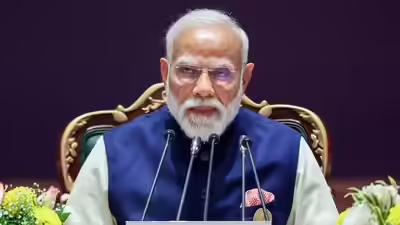
“The entire country was filled with pride,” Modi told the crowd, referencing the 80-nation summit. “But what did the Congress and its ecosystem do? The Congress leaders reached the venue naked in front of foreign guests.” He then delivered the viral soundbite of the weekend: “The country knows that you are already naked, then why did you feel the need to take off your clothes?”
This was not just a rhetorical jab. It was a strategic framing designed to isolate the Congress. And it worked. The disruption crossed a line for many of Congress’s own partners within the INDIA bloc. Key allies, including Samajwadi Party chief Akhilesh Yadav, publicly rebuked the tactic, stating that political fights should not bring shame to the country in front of international delegates.
By executing this counter-offensive during the launch of the Namo Bharat train—a symbol of hyper-modernity boasting speeds of 180 km/h—the Prime Minister physically anchored his argument. He presented the BJP as the party building rapid transit and hosting global AI summits, while painting the Congress as an ideologically bankrupt entity tearing off its shirts in desperation.
Frequently Asked Questions AI Summit Congress Shirtless Protest
Why were the Youth Congress workers protesting the India-US trade deal?
The protesters allege that the upcoming trade framework heavily favors American corporate interests, specifically at the expense of Indian farmers and the domestic manufacturing sector. They used the AI Summit as a high-visibility venue to amplify this specific grievance.
What is the Namo Bharat train launched in Meerut?
It is India’s first Regional Rapid Transit System (RRTS). Designed for a top speed of 180 km/h, the newly completed 82-km Delhi-Meerut corridor drastically reduces travel time between the capital and western Uttar Pradesh to under an hour, integrating with the local Meerut Metro on the same tracks.
ALSO READ: Lashkar terror module India: 8 Arrested For Plotting Attack In India
ALSO READ: India AI Impact Summit 2026 Complete Summary and Future Outlook
The Complete History of Iran Israel Relations: From Secret Allies to Arch-Rivals
Executive Briefing The Dramatic Shift: Today, Iran and Israel are engaged in a sprawling, multi-front…

Russian vs Gulf Crude Oil: Price, Refining, and Efficiency Compared
Executive Briefing Two of the most heavily traded categories in the world are Russian vs…
Who is Winning the US Iran War 2026? Casualties, Costs, and the 2026 Timeline
Executive Briefing (Update: March 12, 2026) As the 2026 Middle East conflict reshapes the global…

Global Oil Price Hike 2026: Petrol Prices & Strategic Reserves by Country
Executive Briefing Global Oil Price Hike 2026 (Update: March 12, 2026) The Price Shock: Following…
Can Trump Be Impeached In Midterm Elections 2026? Odds, Stats, and the Process Explained
Executive Briefing (Update: March 2026) As the United States gears up for the pivotal 2026…
Who Was Arrested From the Epstein Files in 2026? Photos & Facts
Executive Briefing (Update: March 2026) If you are wondering exactly who was arrested from the…

Ibrahim is the Founder and Lead Analyst at The Global Angle, an independent digital platform dedicated to factual geopolitical analysis and international affairs. Based in India, he combines an engineering background with a deep focus on global markets, diplomacy, and strategic security. Ibrahim leverages a data-driven, analytical approach to break down complex international conflicts and economic shifts, helping readers see beyond standard news narratives. When he isn’t researching global policy, he focuses on digital publishing, search engine optimization, and platform architecture.