Executive Summary
- The News: The US recently reversed its hardline stance, allowing the export of advanced Nvidia H200 AI chips to China under a new 25% tariff scheme, while Beijing escalates militarization in the South China Sea.
- The Hidden Link: Washington is trading long-term containment for short-term monetization. This forces middle powers like India to accelerate their own “Sovereign AI” infrastructure to avoid being crushed between a resurgent Chinese AI ecosystem and a transactional US policy.
- The Outlook: By Q3 2026, expect a surge of dumped Chinese legacy chips flooding emerging markets, prompting aggressive tariff responses from New Delhi as it protects its nascent semiconductor industry.
The defining conflict of this century will not be fought with ballistic missiles, at least not initially. It is being waged right now across clean rooms in Taiwan, server farms in Virginia, and dredged coral reefs in the Pacific.
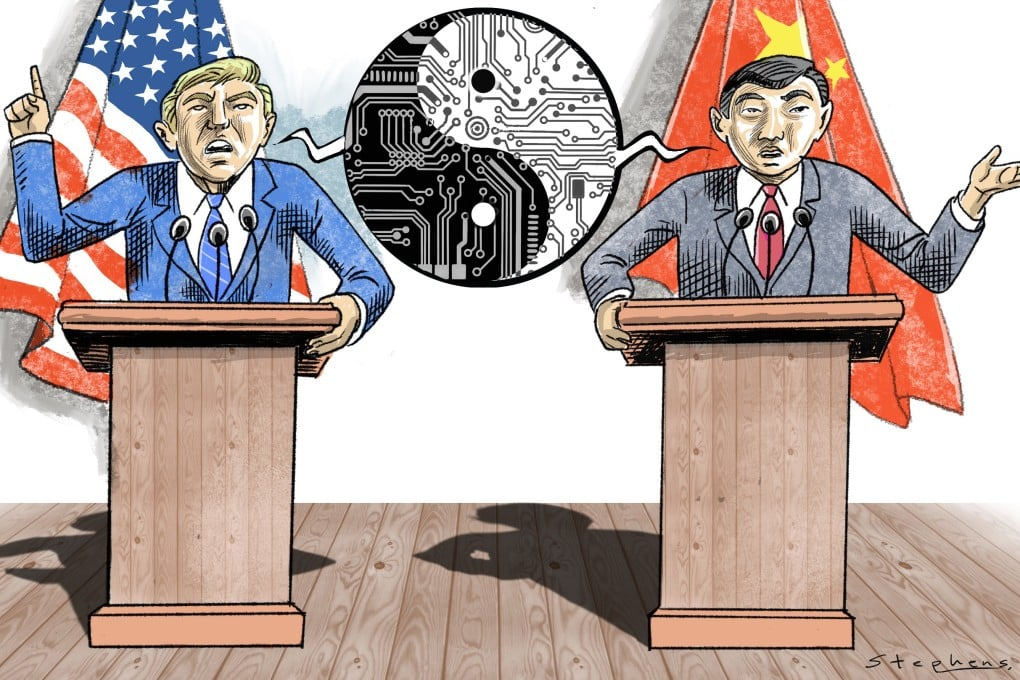
For years, analysts debated whether we were entering Cold War 2.0. The events of early 2026 have answered that question. When China deployed a 290-mile-long “floating barrier” of 2,000 fishing militia vessels near Taiwan, and the US overhauled its artificial intelligence export controls, the global security architecture fundamentally fractured. The battle lines are drawn. But the primary casualties won’t necessarily be American or Chinese. They will be the global supply chains that power everything from your smartphone to next-generation defense systems.
The 2026 AI Export Reversal
To understand who will dominate global power, look at the compute capacity.
In January 2026, Washington shocked the global tech sector. Reversing the “small yard, high fence” doctrine of the previous administration, the US Commerce Department shifted the export license policy for advanced chips like the Nvidia H200 and AMD MI325X from a “presumption of denial” to a “case-by-case review.” The caveat? A steep 25% tariff paid to the US government.
This is a profound strategic pivot. The US has effectively decided that preserving a strict technological lead is impossible, opting instead to monetize China’s insatiable demand for AI hardware. Chinese tech giants like ByteDance and Alibaba are reportedly preparing up to $14 billion in orders to bridge their compute gap.
However, this transactional approach creates massive geopolitical vulnerabilities. If China can rapidly build AI data centers with American hardware, it accelerates the People’s Liberation Army’s (PLA) integration of AI decision-support systems. We are already seeing this capability manifest in the physical world. In the South China Sea, recent satellite imagery confirms new land reclamation at Antelope Reef in the Paracels, transforming a mere sandbar into a potential radar and helicopter base. The tech war and the military rivalry are no longer separate theaters; they are the exact same front.
Effects on India
How does a superpower clash of this magnitude affect India? It creates a volatile mix of historic opportunity and severe economic risk.
First, the “China Plus One” strategy is accelerating. As Washington pressures allies to downgrade manufacturing ties with Beijing, New Delhi is stepping into the void. India’s aggressive Production-Linked Incentive (PLI) schemes are pulling in supply chains. We are seeing a boom in electronics exports and a deepening semiconductor partnership with South Korea, a nation also looking to hedge its bets against a dominant China.
But the risks are equally severe.
1. The Dumping Threat
With the US slapping massive tariffs on Chinese tech imports, Beijing has excess industrial capacity. The immediate consequence is “dumping.” China is flooding developing markets like India with cheap legacy chips, electric vehicles, and solar panels. This threatens to hollow out India’s domestic micro, small, and medium enterprises (MSMEs) before they can scale.
2. The Sovereign Tech Imperative
Washington’s willingness to abruptly change export rules (like the recent H200 reversal) proves that India cannot rely entirely on US policy for its tech security. This is driving India’s $250 billion pivot toward “Sovereign AI.” If the US is willing to sell the best chips to China for the right price, India must own its compute power to remain a relevant geopolitical player.
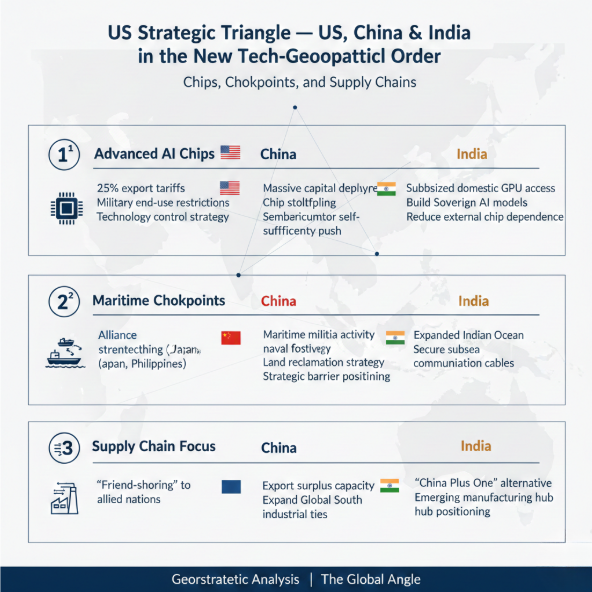
The 2026 Tech War Posture Matrix
| Strategic Domain | United States Strategy | China Strategy | India’s Counter-Strategy |
| Advanced AI Chips | Monetize exports via 25% tariffs; restrict military end-use | Massive capital deployment to hoard US chips; push for self-sufficiency | Subsidize domestic GPU access; build Sovereign AI models |
| Maritime Chokepoints | Strengthen alliances (Japan, Philippines); Freedom of Navigation | “Floating barriers” via maritime militia; aggressive land reclamation | Expand naval footprint in the Indian Ocean; secure subsea cables |
| Supply Chain Focus | “Friend-shoring” to allied nations | Exporting excess capacity to the Global South | “China Plus One” alternative manufacturing hub |
What’s Next
The tech war is entering a highly unpredictable phase. Do not expect a grand peace treaty. Watch for these specific friction points.
- May 2026: The “AI Overwatch” Impact. The newly proposed US “AI Overwatch Act” threatens to introduce permanent uncertainty. If Congress grants itself the power to revoke export licenses to China at any moment, expect global tech companies to panic-buy hardware, causing massive supply chain bottlenecks for secondary markets like India.
- August 2026: The South China Sea Blockade Test. China’s successful test of coordinating 2,000 fishing vessels into a physical barrier is a blueprint. We will likely see this tactic deployed aggressively near the Scarborough Shoal to test the US-Philippines mutual defense treaty.
- October 2026: India’s Tariff Wall. As the trade deficit widens due to Chinese dumping, anticipate the Indian government introducing stringent non-tariff barriers and anti-dumping duties specifically targeting Chinese legacy chips and IoT components.
Cold War 2.0 is not waiting in the wings. It is dictating global trade right now. The nations that build resilient, sovereign digital infrastructure today will dictate the terms of peace tomorrow.
Frequently Asked Questions
What is a “floating barrier” in the context of the South China Sea?
It refers to a new tactic where China coordinates thousands of commercial fishing vessels—acting under the People’s Armed Forces Maritime Militia (PAFMM)—to form dense, physical blockades. This denies access to contested waters without deploying actual naval warships, complicating the rules of engagement for US and allied forces.
Why did the US reverse its ban on selling advanced AI chips to China?
The 2026 policy shift stems from a calculation that strict bans were failing to stop China’s AI progress and were instead accelerating their domestic chip independence. By allowing the sale of Nvidia H200 chips with a 25% tariff, the US aims to monetize Chinese demand while attempting to keep Chinese tech firms reliant on American hardware.
ALSO READ:US-IRAN Tension Makes A Big Impact On Global Energy Sector : The $70 Oil Barrel Hike
ALSO READ:Trump 15% global tariff: Why the Supreme Court Couldn’t Stop the Global Tariff War
The Complete History of Iran Israel Relations: From Secret Allies to Arch-Rivals
Executive Briefing The Dramatic Shift: Today, Iran and Israel are engaged in a sprawling, multi-front…

Russian vs Gulf Crude Oil: Price, Refining, and Efficiency Compared
Executive Briefing Two of the most heavily traded categories in the world are Russian vs…
Who is Winning the US Iran War 2026? Casualties, Costs, and the 2026 Timeline
Executive Briefing (Update: March 12, 2026) As the 2026 Middle East conflict reshapes the global…

Global Oil Price Hike 2026: Petrol Prices & Strategic Reserves by Country
Executive Briefing Global Oil Price Hike 2026 (Update: March 12, 2026) The Price Shock: Following…
Can Trump Be Impeached In Midterm Elections 2026? Odds, Stats, and the Process Explained
Executive Briefing (Update: March 2026) As the United States gears up for the pivotal 2026…

Who Was Arrested From the Epstein Files in 2026? Photos & Facts
Executive Briefing (Update: March 2026) If you are wondering exactly who was arrested from the…