Key Takeaways
- The New Standard: 5th-Generation fighters like the F-35 and J-20 are no longer “future tech”—they are the operational backbone of major powers in 2026.
- The Next Leap: 6th-Generation programs (NGAD, GCAP, FCAS) are introducing AI co-pilots and “Loyal Wingman” drones to redefine aerial warfare.
- The Dominance Gap: The U.S. and China have effectively created a two-tier global air order, leaving Russia and Europe racing to catch up in stealth production.
In modern geopolitical poker, a nation’s fighter fleet is its strongest card. As of 2026, the era of the “dogfight” has been replaced by the era of “data warfare.” The fighter jet is no longer just a plane; it is a flying data center, a sniper, and a quarterback all at once.
While 4.5-generation workhorses like the Rafale and F-15EX still carry heavy payloads, the definition of military dominance has shifted entirely to 5th-generation stealth and the burgeoning 6th-generation concepts.
The Current Kings: 5th Generation Dominance
A “5th-generation” fighter is defined by Stealth (low radar visibility), Sensor Fusion (combining data from all sensors into one picture), and Supercruise (supersonic flight without afterburners).
The Global Inventory 2026
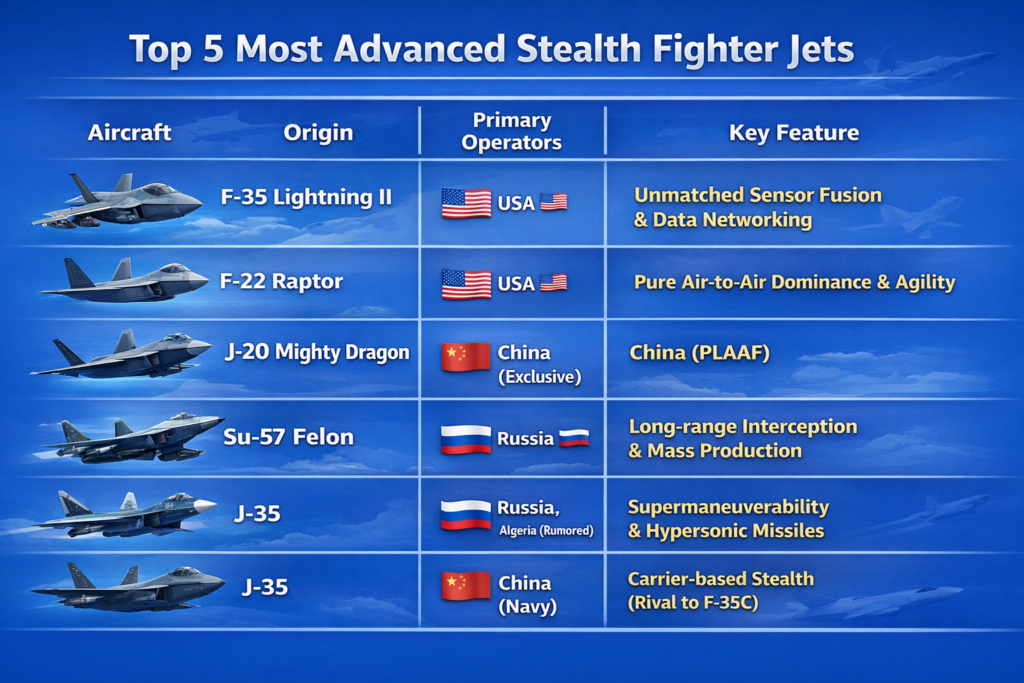
Who Has the Most?
- United States: Remains the undisputed leader with over 600+ 5th-gen fighters operational. The F-35 is now the “iPhone of fighters”—ubiquitous among Western allies.
- China: Has rapidly closed the gap. By 2026, the PLAAF operates an estimated 300+ J-20s, creating a dense “anti-access” bubble in the South China Sea.
- Russia: Struggles with mass production. The Su-57 fleet remains small (estimated <40 operational), relying heavily on older Su-35s for volume.
The Future is Now: 6th Generation & New Features
While 5th-gen jets rule the present, the race for the 6th Generation is the central obsession of defense budgets in 2026. These jets are not just “stealthier”—they are fundamentally different machines.
Key Features of 6th Gen
- AI & Optional Manning: The jet can fly itself. The human pilot (if present) acts as a “Mission Commander” rather than a stick-and-rudder operator.
- Loyal Wingmen (CCAs): These jets will fly alongside swarms of autonomous drones (Collaborative Combat Aircraft). The manned jet stays back while the drones jam radar, take photos, or absorb enemy missiles.
- Directed Energy Weapons: High-powered lasers for shooting down incoming missiles or blinding enemy sensors.
- Variable Cycle Engines: Engines that can switch modes mid-flight to offer the fuel efficiency of a passenger jet and the thrust of a rocket.
Major 6th Gen Programs
- NGAD (USA): The Next Generation Air Dominance program is well into prototype testing. It focuses on range and thermal management for the Pacific theater.
- GCAP (UK, Japan, Italy): The Global Combat Air Programme aims to replace the Typhoon and Mitsubishi F-2 by 2035. It highlights the fusion of Japanese sensors and British engine tech.
- FCAS (France, Germany, Spain): A European effort to build a “System of Systems,” connecting jets to satellites and ships in real-time.
How Jets Contribute to Military Dominance
In 2026, air dominance is not about who can fly higher or faster—it is about OODA Loop speed (Observe, Orient, Decide, Act).
- The “First Look, First Shot” Advantage: A 5th-gen jet like the F-35 can detect a 4th-gen enemy (like a MiG-29) from 150km away, while the enemy cannot see the F-35 until it is 20km away. The fight is over before the enemy knows it started.
- Network Nodes: Modern jets share target data with ground troops and navy ships. An F-35 can spot a target and guide a missile launched from a destroyer 100 miles away.
- Deterrence: The mere presence of F-22s or J-20s in a region forces adversaries to ground their air forces, as survival rates against them are calculated to be near zero.
The Global Perspective & Future Outlook
The “fighter gap” is widening. Nations that cannot afford or access 5th-gen technology (most of the Global South) are becoming vulnerable to those that can. We are seeing a bifurcated market:
- The “Elite” Club: US allies buying F-35s and Asian powers building indigenous stealth (South Korea’s KF-21, Turkey’s KAAN).
- The “Budget” Market: Nations relying on upgraded 4th-gen jets (like the Rafale or Gripen) or cheap drones to create asymmetric threats.
As we look toward 2030, the question is not just “who has the best jet,” but “whose AI pilot learns faster?”
Frequently Asked Questions
Which country has the strongest air force in 2026?
The United States retains the strongest air force due to the sheer volume of stealth aircraft (F-22/F-35) and logistical reach. However, China has achieved local air superiority potential in the Western Pacific.
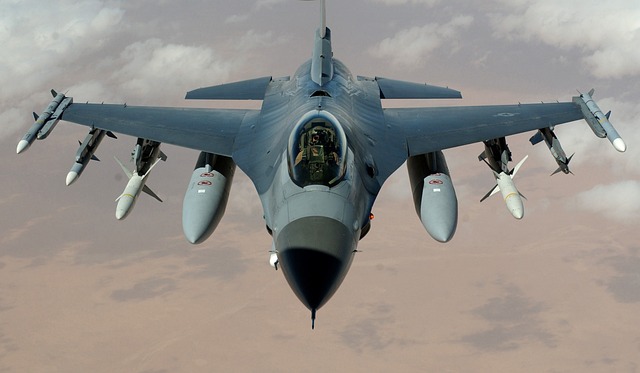
Is the F-16 still relevant?
Yes, but not for “Day One” of a war. The F-16 remains a capable truck for hauling bombs after 5th-gen jets have destroyed enemy air defenses, but it cannot survive in high-threat environments alone.
What is a ‘Loyal Wingman’?
It is an autonomous drone that flies alongside a manned fighter jet. It takes orders from the pilot to perform dangerous tasks, effectively expanding the pilot’s reach and firepower without risking a human life.