Executive Briefing Global Oil Price Hike 2026 (Update: March 12, 2026)
- The Price Shock: Following the U.S. and Israeli strikes on Iran and subsequent disruptions in the Strait of Hormuz, Brent crude has officially surged past $97 a barrel.
- The Pump Impact: Global petrol prices are skyrocketing, with countries heavily reliant on Middle Eastern imports seeing pump prices jump by as much as 50% in a matter of weeks.
- The Safety Net: The focus has rapidly shifted to Strategic Petroleum Reserves (SPR). While nations like Japan and the U.S. hold months of emergency fuel, massive consumer markets like India are operating on a much thinner margin of error.
As the geopolitical crisis in the Middle East escalates, the fallout has officially reached global energy markets. With roughly 20% of the world’s seaborne crude oil choked off at the Strait of Hormuz, the cost of transportation, manufacturing, and daily commuting is surging worldwide.
For policymakers and everyday consumers alike, the survival math comes down to two numbers: how much petrol currently costs per liter, and how many days of emergency oil reserves a country has left.
Here is the data-driven breakdown of the 2026 global oil price hike.
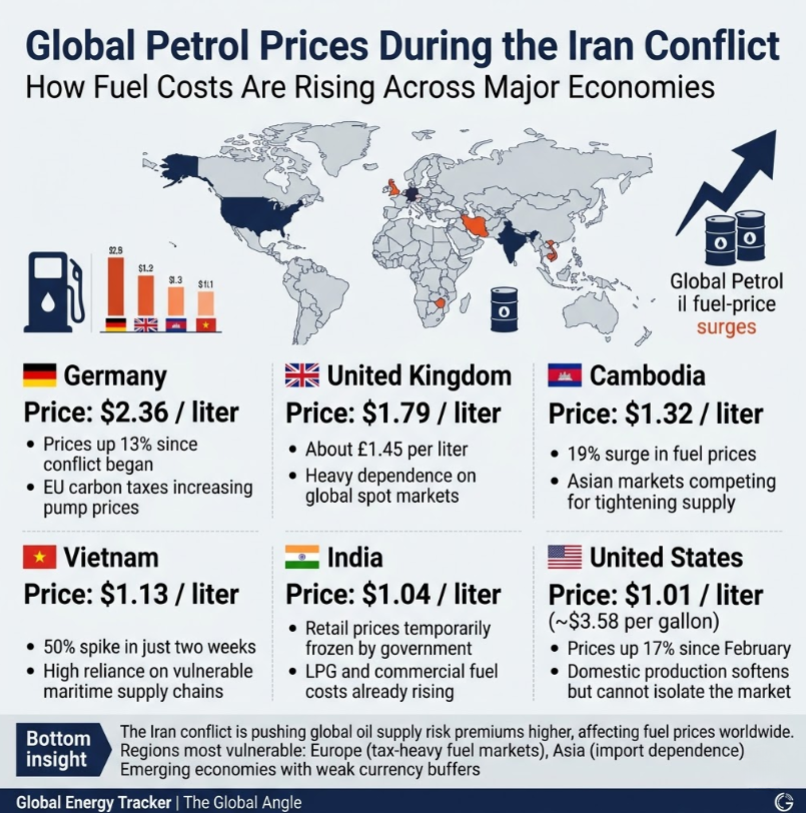
The Global Pump: Petrol Prices by Country (March 2026)
Fuel pricing is highly dependent on a country’s domestic tax structure, subsidies, and import reliance. While the underlying cost of crude oil is the same globally, the price you pay at the pump varies wildly.
Currently, nations that rely strictly on open-market imports (without heavy government subsidies) are taking the hardest hits.
| Country | Current Petrol Price (USD / Liter) | Local Currency Equivalent & Context |
| Germany | $2.36 | Surged over 13% since the conflict began; heavy EU carbon taxes compound the base price hike. |
| United Kingdom | $1.79 | Roughly £1.45/liter. The UK relies heavily on global spot markets, leading to immediate pump volatility. |
| Cambodia | $1.32 | Facing a massive 19% spike as Asian emerging markets compete for tightening supplies. |
| Vietnam | $1.13 | Experienced a staggering 50% price increase in just two weeks due to deep reliance on exposed maritime supply chains. |
| India | $1.04 | Currently frozen at ₹94.77/liter (Delhi). The government has absorbed the shock to shield consumers, though commercial LPG prices have already spiked. |
| United States | $1.01 | Roughly $3.58/gallon. Up 17% since February. Despite massive domestic production, global crude pricing still dictates the U.S. retail market. |
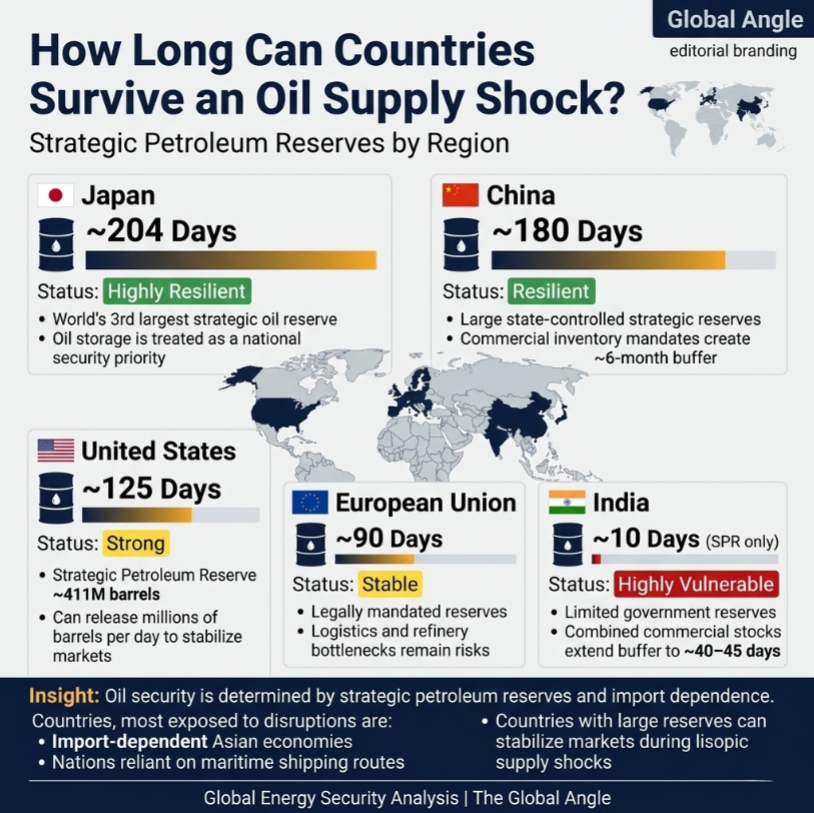
The Safety Net: Strategic Petroleum Reserves (SPR)
When global supply chains freeze, countries survive by tapping into their Strategic Petroleum Reserves—massive underground caverns and tanks filled with emergency crude oil.
Under standard International Energy Agency (IEA) rules, developed net-importer nations are supposed to hold 90 days’ worth of net oil imports. However, as the 2026 crisis proves, not all reserves are created equal.
Here is exactly how many days of import cover major economies have left if the Middle East supply remains entirely cut off:
| Country / Region | Estimated Days of Supply (DOS) | Reserve Status & Vulnerability |
| Japan | ~204 Days | Highly Resilient: Holds the world’s 3rd largest reserve (approx. 440M barrels). Japan treats oil storage as a critical national security imperative. |
| China | ~180 Days | Resilient: A massive mix of state-controlled strategic reserves and mandated commercial inventory provides a solid 6-month buffer. |
| United States | ~125 Days | Strong: Holds roughly 411M barrels in Gulf Coast salt caverns. Capable of unleashing 4.4 million barrels per day into the market to suppress global price shocks. |
| European Union | ~90 Days | Stable: Legally mandated to hold 90 days. France (SAGESS) and Germany actively manage extensive reserves, though they face secondary logistics bottlenecks. |
| India | ~10 Days (SPR only) | Highly Vulnerable: India’s dedicated government SPR caverns hold only 9–10 days of supply. However, combined with commercial refinery stocks and crude currently on ships, India has a total effective buffer of roughly 40–45 days. |
Future Aspects: What Happens Next?
If the conflict is localized and the Strait of Hormuz reopens within the month, the massive coordinated release of SPR oil by the IEA (currently underway) will successfully bridge the gap, bringing Brent crude back down to the $80 range.
However, if the military operations transform into a prolonged blockade, the future aspects of the global economy are grim:
- The $100+ Threshold: Analysts warn that if the Hormuz disruption lasts beyond 45 days, Brent crude will easily breach and sustain levels above $100 to $120 a barrel.
- Global Supply Chain Pivot: Nations like India and China will be forced into a highly expensive bidding war for West African, Latin American, and U.S. crude to replace Middle Eastern volumes. This will send global freight rates and maritime insurance premiums skyrocketing.
- Runaway Inflation: The most immediate future aspect is secondary inflation. A sustained spike in transport fuel directly increases the cost of food, manufacturing, and consumer goods, potentially forcing central banks to raise interest rates and triggering a global recession.
The next few weeks are critical. The world has enough oil sitting in underground caverns to survive a short-term shock, but no country—not even the U.S. or Japan—has enough strategic reserves to weather a permanent realignment of the Middle East.
Frequently Asked Questions (2026 Global Oil Price Hike)
Why are global oil prices rising so fast in 2026?
The massive spike in global oil prices is a direct result of the military conflict between the U.S., Israel, and Iran. With military operations disrupting the Strait of Hormuz—a critical maritime chokepoint that handles roughly 20% of the world’s seaborne crude oil—global supply chains have bottlenecked, driving Brent crude prices toward $100 a barrel.
Which country has the most strategic oil reserves?
The United States holds the largest authorized Strategic Petroleum Reserve (SPR) capacity in the world, stored in massive underground salt caverns along the Gulf Coast. However, in terms of sheer “Days of Supply” (DOS) relative to daily consumption, Japan is highly resilient, holding enough emergency reserves to cover over 200 days of net imports.
How many days of oil reserves does India have?
India’s dedicated government Strategic Petroleum Reserves (managed by ISPRL) currently hold roughly 9 to 10 days of emergency crude supply. However, when combined with the commercial stock held by domestic refineries and the crude oil currently in transit on ships, India’s total effective buffer is estimated to be between 40 and 45 days.
Will the oil price hike cause global inflation?
Yes. If crude oil prices remain elevated above $90 to $100 per barrel for a sustained period, it directly increases the cost of transportation, manufacturing, and logistics. This “cost-push” inflation forces companies to pass the expenses down to everyday consumers, raising the prices of groceries, consumer goods, and commercial LPG.
ALSO READ: Can Trump Be Impeached In Midterm Elections 2026? Odds, Stats, and the Process Explained
ALSO READ: Who Was Arrested From the Epstein Files in 2026? Photos & Facts
The Complete History of Iran Israel Relations: From Secret Allies to Arch-Rivals
Executive Briefing The Dramatic Shift: Today, Iran and Israel are engaged in a sprawling, multi-front…
Russian vs Gulf Crude Oil: Price, Refining, and Efficiency Compared
Executive Briefing Two of the most heavily traded categories in the world are Russian vs…
Who is Winning the US Iran War 2026? Casualties, Costs, and the 2026 Timeline
Executive Briefing (Update: March 12, 2026) As the 2026 Middle East conflict reshapes the global…
Global Oil Price Hike 2026: Petrol Prices & Strategic Reserves by Country
Executive Briefing Global Oil Price Hike 2026 (Update: March 12, 2026) The Price Shock: Following…
Can Trump Be Impeached In Midterm Elections 2026? Odds, Stats, and the Process Explained
Executive Briefing (Update: March 2026) As the United States gears up for the pivotal 2026…

Who Was Arrested From the Epstein Files in 2026? Photos & Facts
Executive Briefing (Update: March 2026) If you are wondering exactly who was arrested from the…

Ibrahim is the Founder and Lead Analyst at The Global Angle, an independent digital platform dedicated to factual geopolitical analysis and international affairs. Based in India, he combines an engineering background with a deep focus on global markets, diplomacy, and strategic security. Ibrahim leverages a data-driven, analytical approach to break down complex international conflicts and economic shifts, helping readers see beyond standard news narratives. When he isn’t researching global policy, he focuses on digital publishing, search engine optimization, and platform architecture.