Executive Briefing
- The Core Debate: As Iran’s nuclear program advances, the debate over a pre-emptive U.S. military strike and How Close is Iran to a Nuclear Bomb frequently resurfaces in Western policy circles.
- The Tactical Reality: While bunker-busting munitions could set Iran’s infrastructure back by 1 to 3 years, they cannot erase the scientific knowledge Tehran has acquired.
- The Strategic Blowback: A kinetic strike would likely trigger a massive regional war, choke global oil supplies, and paradoxically guarantee that Iran pursues a nuclear weapon for ultimate regime survival.

The idea of a “surgical strike” on Iran’s nuclear infrastructure is a persistent geopolitical myth. In reality, any kinetic military action against Tehran’s heavily fortified atomic program would not be an isolated event—it would be the opening salvo of a chaotic, multi-front regional war.
To understand the true cost of a U.S. strike on Iran’s nuclear facilities, we must separate the tactical military capabilities from the strategic, economic, and environmental blowback.
Understanding Iran’s Nuclear Geography
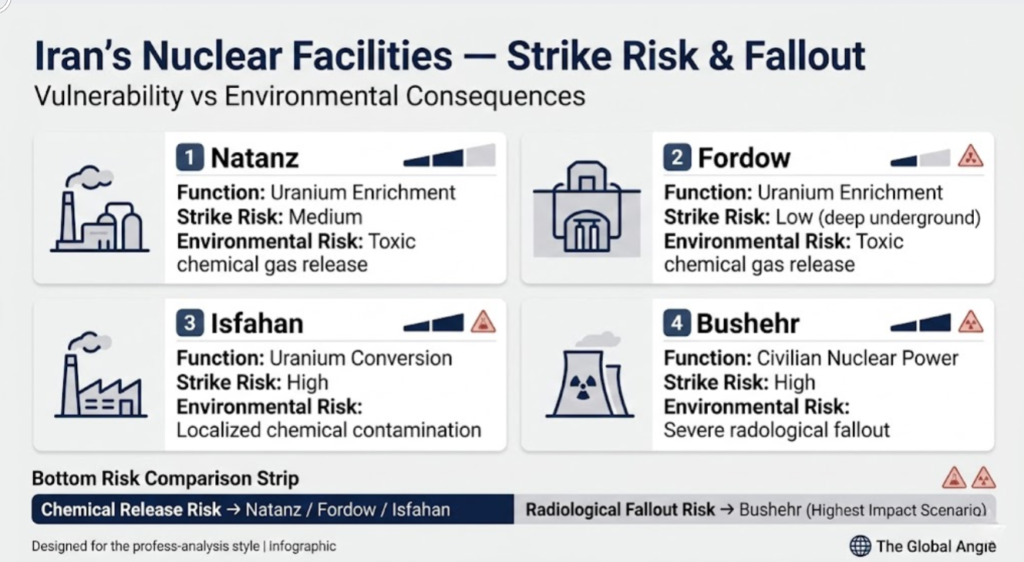
Iran’s nuclear program is not a single building; it is a vast, decentralized network spread across the country. Striking it requires neutralizing several highly distinct targets, each presenting unique military and environmental challenges.
- Natanz: The epicentre of Iran’s uranium enrichment. Much of this facility is buried underground, utilizing advanced centrifuges to spin uranium gas into highly enriched material.
- Fordow: A deeply buried enrichment facility built directly into a mountain near Qom. It is heavily fortified and designed specifically to withstand aerial bombardment.
- Isfahan: The hub for uranium conversion and storage. This is where yellowcake is converted into the gas used in centrifuges.
- Bushehr: A civilian, Russian-built nuclear power plant situated on the Persian Gulf coast, operating purely for energy generation.
| Facility Location | Primary Function | Strike Vulnerability | Environmental Risk if Bombed |
| Natanz | Uranium Enrichment | Medium (Underground, vulnerable to sustained strikes) | Chemical: Highly toxic hydrofluoric acid gas cloud. |
| Fordow | Uranium Enrichment | Low (Deep inside a mountain, requires massive ordnance) | Chemical: Highly toxic hydrofluoric acid gas cloud. |
| Isfahan | Uranium Conversion | High (Surface-level facilities) | Chemical: Localized toxic release; no major fallout. |
| Bushehr | Civilian Power | High (Surface-level, but strictly off-limits) | Radiological: Massive radioactive fallout (Cesium-137). |
The Tactical Setback vs. The Strategic Acceleration
Military planners agree that the U.S. Air Force possesses the conventional capability to severely degrade these facilities. However, the physical destruction of buildings rarely translates to the permanent destruction of a program.
The Tactical Setback
To reach deep facilities like Fordow, the U.S. would have to deploy the GBU-57 Massive Ordnance Penetrator (MOP)—a 30,000-pound precision-guided bunker buster. A coordinated, sustained bombing campaign utilizing MOPs could collapse tunnels, destroy delicate centrifuge cascades, and incinerate stockpiles.
Intelligence estimates suggest a successful campaign would set Iran’s nuclear program back by 1 to 3 years.
The Strategic Acceleration
However, this tactical delay would trigger a catastrophic strategic acceleration.
A military strike would instantly unify the Iranian populace and the fractured political establishment against a foreign aggressor. Tehran’s immediate response would be to expel all International Atomic Energy Agency (IAEA) inspectors, dismantle remaining camera networks, and formally withdraw from the Non-Proliferation Treaty (NPT).
Freed from international oversight and convinced that only a nuclear deterrent can prevent future invasions, Iran would almost certainly make a definitive, covert “dash for the bomb.” You can bomb centrifuges, but you cannot bomb away the scientific knowledge of the Iranian physicists who built them.
Myth vs. Reality: Chemical Clouds and Radioactive Fallout
A major source of public confusion regarding strikes on nuclear sites is the assumption of a “Chernobyl-style” radioactive disaster. The reality depends entirely on what is bombed.
The Chemical Threat (Natanz and Fordow)
Enrichment sites like Natanz do not house active nuclear reactors; they house Uranium Hexafluoride ($UF_6$) gas. If conventional bombs shatter these containment vessels, the $UF_6$ reacts violently with the moisture in the air.
This reaction produces a highly toxic, corrosive cloud of hydrofluoric acid. While this poses a lethal chemical hazard—causing severe burns and respiratory failure for anyone in the immediate localized vicinity—it does not create widespread radioactive fallout.
The Radiological Disaster (Bushehr)
Conversely, bombing an active nuclear reactor like Bushehr would be catastrophic. Destroying the reactor core or spent fuel pools would release massive amounts of highly radioactive fission products, such as Cesium-137, into the atmosphere.
This would contaminate the Persian Gulf, irradiate neighboring countries, and constitute a profound war crime. Because Bushehr is a civilian power plant and not part of the weapons-grade enrichment cycle, it is highly unlikely that U.S. military planners would ever target it.
Asymmetric Retaliation: Opening the Gates of Hell
Iran operates under a doctrine of asymmetric deterrence. Knowing it cannot win a conventional air war against the United States, Tehran has spent decades building a massive retaliatory apparatus.
- Direct Retaliation: Iran boasts the largest and most diverse ballistic missile and suicide drone arsenal in the Middle East. A U.S. strike would trigger immediate barrages against American military bases in Iraq, Syria, Bahrain, Qatar, and the UAE.
- Proxy Mobilization: Tehran would instantly activate its “Axis of Resistance.” We would see Hezbollah rain tens of thousands of rockets onto Israeli cities, while Iraqi and Syrian militias would relentlessly target U.S. personnel. The Houthis in Yemen would likely escalate their attacks on Red Sea shipping to unprecedented levels.
The Energy Factor and Great Power Dynamics
The most immediate global impact of this conflict would be felt at the gas pump.
In response to an attack, Iran would leverage its geographic advantage to choke the Strait of Hormuz—a narrow maritime chokepoint where roughly 20% of the world’s daily oil supply flows. Whether through naval mines, fast-attack swarms, or anti-ship missiles, effectively closing the Strait would send global oil prices skyrocketing well past $100 per barrel. This energy shock would disrupt global supply chains and likely plunge the global economy into a recession.
Furthermore, a U.S. strike would be a diplomatic gift to Beijing and Moscow. Russia and China would immediately condemn the “American adventurism” at the UN Security Council, using the chaos to deepen their economic and military ties with the Global South and present themselves as the true guarantors of international stability.
How Close is Iran to a Nuclear Bomb?
To understand the risks, we must look at the real-world trajectory of Iran’s program in early 2026.
Iran is currently enriching uranium to 60% purity—a short technical step away from the 90% required for weapons-grade material. Here is the Iran nuclear breakout time current estimate 2026
- Breakout Time: This is the time required to enrich enough fissile material for one nuclear device. Due to Iran’s massive stockpile and advanced centrifuges, breakout time is currently estimated to be near zero, measured in mere weeks, if not days.
- Weaponization Time: Having the material is not the same as having a bomb. The complex engineering process required to miniaturize a warhead, build a reliable detonation mechanism, and fit it onto a ballistic missile known as weaponization would still take Iran an estimated 1 to 2 years.
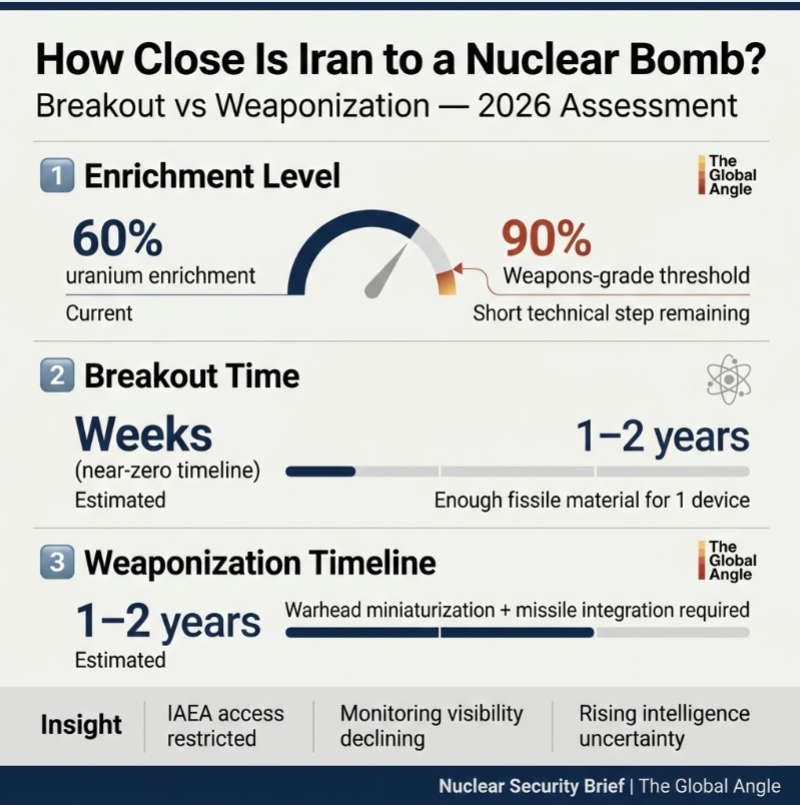
The greatest danger today is the loss of “continuity of knowledge.” Because Iran has severely restricted IAEA access, the international community’s visibility into the program is fading. If Iran is attacked and expels the IAEA completely, tracking their weaponization progress becomes a game of blind intelligence gathering.
Conclusion
A kinetic strike on Iran’s nuclear facilities is not a clean, surgical solution to a geopolitical problem; it is a catalyst for a much darker, more unpredictable era.
While a bombing campaign would temporarily delay Iran’s enrichment capabilities, the long-term costs are devastating. A regional war, a global economic shock driven by severed energy arteries, and the absolute guarantee that an enraged, unified Iranian regime would stop at nothing to build a nuclear arsenal far outweigh the short-term tactical gains. In the calculus of modern geopolitics, bombing the centrifuges may very well be the fastest way to ensure Iran builds the bomb.
Sources:
The IAEA Board of Governors Quarterly Reports on Iran
The Office of the Director of National Intelligence (ODNI) – Annual Threat Assessment
The U.S. Nuclear Regulatory Commission (NRC) or the Centers for Disease Control and Prevention (CDC)
Frequently Asked Questions
Would bombing Iran’s nuclear sites cause a radioactive fallout disaster?
It depends heavily on the target. Striking uranium enrichment sites like Natanz or Fordow would release highly toxic, corrosive hydrofluoric acid gas, but not widespread radioactive fallout. A true radiological disaster would only occur if an active nuclear power plant, like the civilian facility at Bushehr, was destroyed—a scenario military planners actively avoid.
How would Iran retaliate against a military strike?
Iran operates under a doctrine of asymmetric warfare. In response to a strike, Tehran would launch its massive ballistic missile and drone arsenal at U.S. and allied bases across the Middle East. Additionally, they would activate their “Axis of Resistance”—including Hezbollah in Lebanon and the Houthis in Yemen—to open multiple conflict fronts.
What is the difference between nuclear “breakout time” and “weaponization time”?
“Breakout time” refers to the technical timeframe required to enrich enough uranium to 90% purity for a single nuclear device. Iran’s current breakout time is estimated to be near zero. “Weaponization time” is the complex engineering process needed to build a deliverable nuclear warhead that fits on a missile, which experts estimate would still take Iran 1 to 2 years.
Could a U.S. strike on Iran impact global gas prices?
Yes, drastically. In the event of a kinetic strike, Iran would likely retaliate by disrupting shipping in the Strait of Hormuz, a critical maritime chokepoint where roughly 20% of the world’s daily oil supply flows. This disruption could easily send global oil prices skyrocketing past $100 per barrel, threatening a global economic recession.
ALSO READ: US-IRAN Tension Makes A Big Impact On Global Energy Sector : The $70 Oil Barrel Hike

The Complete History of Iran Israel Relations: From Secret Allies to Arch-Rivals
Executive Briefing The Dramatic Shift: Today, Iran and Israel are engaged in a sprawling, multi-front…

Russian vs Gulf Crude Oil: Price, Refining, and Efficiency Compared
Executive Briefing Two of the most heavily traded categories in the world are Russian vs…
Who is Winning the US Iran War 2026? Casualties, Costs, and the 2026 Timeline
Executive Briefing (Update: March 12, 2026) As the 2026 Middle East conflict reshapes the global…

Global Oil Price Hike 2026: Petrol Prices & Strategic Reserves by Country
Executive Briefing Global Oil Price Hike 2026 (Update: March 12, 2026) The Price Shock: Following…

Can Trump Be Impeached In Midterm Elections 2026? Odds, Stats, and the Process Explained
Executive Briefing (Update: March 2026) As the United States gears up for the pivotal 2026…

Who Was Arrested From the Epstein Files in 2026? Photos & Facts
Executive Briefing (Update: March 2026) If you are wondering exactly who was arrested from the…

Ibrahim is the Founder and Lead Analyst at The Global Angle, an independent digital platform dedicated to factual geopolitical analysis and international affairs. Based in India, he combines an engineering background with a deep focus on global markets, diplomacy, and strategic security. Ibrahim leverages a data-driven, analytical approach to break down complex international conflicts and economic shifts, helping readers see beyond standard news narratives. When he isn’t researching global policy, he focuses on digital publishing, search engine optimization, and platform architecture.