India EU Trade Deal 2026: Car Tariffs Slashed to 40%
The geopolitical and economic landscape of the automotive world is set for a seismic shift this week. Sources indicate that India and the European Union are on the verge of announcing a historic Free Trade Agreement (FTA), possibly as early as Tuesday. Dubbed the “mother of all deals,” the pact features a groundbreaking concession from New Delhi: a drastic reduction in import tariffs on European automobiles.
For decades, India has protected its domestic car market with some of the world’s highest tariffs, ranging from 70% to 110%. Under the proposed India EU Trade Deal 2026, these duties will be slashed to 40% for specific categories of vehicles. This move represents the most significant opening of the world’s third-largest car market and signals a strategic pivot by the Modi government to diversify trade partners amidst rising protectionism in the United States.

Breakdown of the Tariff Cuts
The central pillar of this agreement is the immediate reduction of import duties on European internal combustion engine (ICE) cars. The current prohibitive tax structure has long been a point of contention for global automakers, with industry titans like Elon Musk frequently criticizing the high barriers to entry.
Under the new terms, India will lower the tax to 40% for European cars with an import price exceeding €15,000 (approx. $17,739). This benefit will apply to a limited quota, estimated at 200,000 vehicles annually. Furthermore, the deal outlines a glide path where these tariffs will be progressively reduced to just 10% over the coming years. This structural change provides a direct corridor for luxury and mid-range European models to enter the Indian mass market at competitive price points.
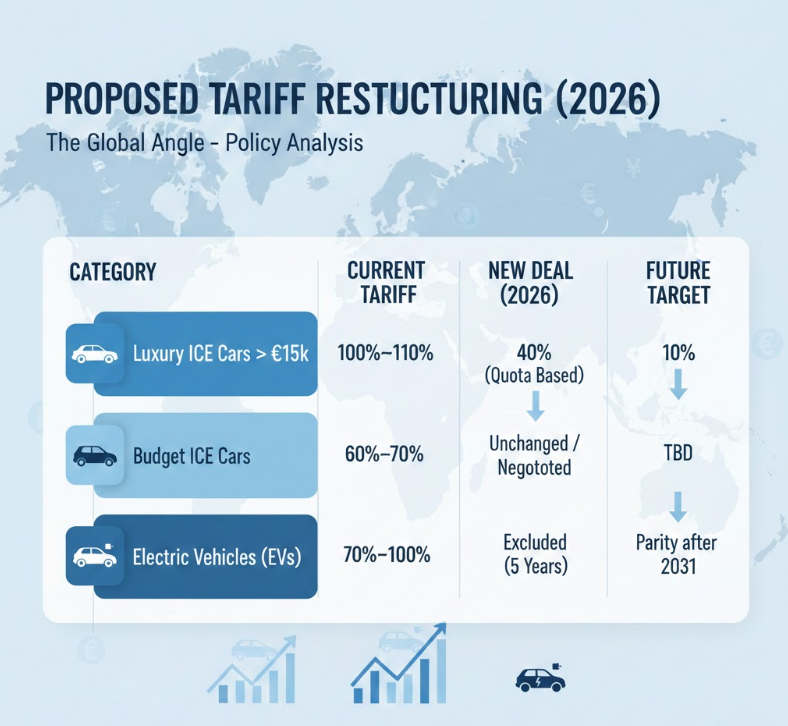
Proposed Tariff Restructuring (2026)
| Vehicle Category | Current Tariff | New Deal Tariff (Immediate) | Future Target |
| Luxury ICE Cars (>€15k) | 100% – 110% | 40% (Quota based) | 10% |
| Budget ICE Cars | 60% – 70% | Unchanged/Negotiated | TBD |
| Electric Vehicles (EVs) | 70% – 100% | Excluded (5 Years) | Parity after 2031 |
The EV Exception: Protecting Local Giants
While the India EU Trade Deal 2026 opens the door for traditional engines, it deliberately keeps the gate closed for electric vehicles. Sources confirm that Battery Electric Vehicles (BEVs) will be excluded from these duty reductions for the first five years.
This “protectionist pause” is designed to safeguard the massive investments made by homegrown heavyweights like Tata Motors and Mahindra & Mahindra. Both companies are currently in the critical phase of scaling their EV production capabilities. By delaying the entry of subsidized European EVs, the government aims to allow domestic players to mature their technology and supply chains without facing immediate predatory pricing from established global competitors.
Market Impact: Winners and Losers
The immediate beneficiaries of this policy shift will be European legacy automakers such as Volkswagen, Renault, and Stellantis, alongside luxury giants like Mercedes-Benz and BMW. Currently, these manufacturers hold a collective market share of less than 4% in India. The tariff cut allows them to test the Indian market with a broader portfolio of global models without the heavy capital expenditure of setting up immediate local manufacturing.
Conversely, the deal introduces new pressure on market leaders Maruti Suzuki and Hyundai. While they dominate the sub-€15,000 segment, the entry of competitively priced European SUVs and sedans in the mid-premium bracket could erode their margins. The quota of 200,000 units is substantial enough to disrupt the upper-middle-class segment, offering consumers high-quality alternatives to locally manufactured options.
Future Outlook: A Strategic Pivot
The timing of the India EU Trade Deal 2026 is not coincidental. With Indian exports of textiles and jewellery facing aggressive 50% tariffs from the United States since late August, New Delhi is urgently seeking alternative high-value markets.
By opening its automotive sector—a previously non-negotiable red line—India is securing duty-free access for its own labor-intensive exports to the EU’s 27-nation bloc. This trade-off reflects a pragmatic economic policy: sacrificing protectionism in the auto sector to save jobs in the textile and gem industries. If ratified on Tuesday, this deal could serve as a template for India’s future trade negotiations, signaling that the country is ready to integrate more deeply into the global value chain.
FAQ
When will the India EU Trade Deal 2026 be announced?
The agreement is expected to be announced as early as Tuesday, January 27, 2026, following the conclusion of final negotiations.
What is the new import duty on European cars?
Under the deal, import duties on specific European cars priced above €15,000 will be reduced from 110% to 40% immediately, eventually dropping to 10%.
Are electric vehicles (EVs) included in the tariff cuts?
No, electric vehicles are excluded from the import duty reductions for the first five years to protect domestic manufacturers like Tata and Mahindra.
Which car brands benefit most from this deal?
European automakers like Volkswagen, Skoda, Mercedes-Benz, BMW, and Audi stand to gain the most, as they can now import global models at significantly lower costs.
ALSO READ: Inside the high-stakes Trilateral Peace Talks in Abu Dhabi as Ukraine faces a winter crisis