Executive Briefing (Update: March 2026)
- The Immediate Fallout: The recent Iran Conflict Global Stock Market Crash 2026 has erased trillions in global market capitalization in just days, triggering a massive “flight to safety” among institutional investors.
- The Oil Trigger: With shipping through the Strait of Hormuz effectively halted, Brent crude is surging. A sustained closure threatens to push prices past $100 to $150, reigniting global inflation.
- Expert Consensus: Major investment banks advise against panic selling. While short-term volatility is guaranteed, experts suggest rebalancing portfolios toward defensive sectors rather than liquidating assets.

The unprecedented escalation of the conflict in the Middle East has sent immediate shockwaves through global financial markets. Investors are rapidly retreating from riskier equities, flocking to traditional safe havens like the US Dollar, Treasury bonds, and gold.
The primary question dominating trading floors worldwide is no longer if the market will react, but how much more will it crash, and what is the catalyst for a recovery? To cut through the panic, here is a data-driven breakdown of the market impact, expert price forecasts, and exactly how capital is rotating across global sectors.
1. The Immediate Impact: Global Index Sell-Off
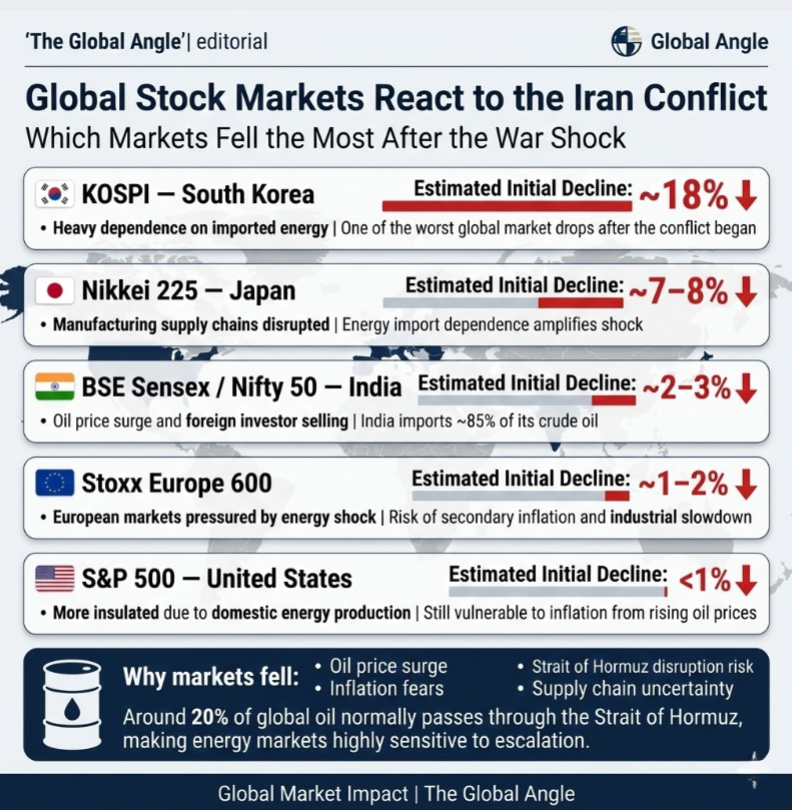
The initial market reaction has followed a classic “risk-off” pattern. However, the severity of the sell-off varies wildly depending on a country’s reliance on imported Middle Eastern energy. Emerging markets, particularly in Asia, have been battered the hardest.
| Global Index | Region | Estimated Initial Decline | Market Context & Vulnerability |
| KOSPI | South Korea | ~18.4% | Highly vulnerable due to massive energy imports; experienced the steepest initial crash but saw sharp intraday volatility. |
| Nikkei 225 | Japan | ~7.8% | Pulled down by heavy reliance on imported fuel and immediate disruptions in global manufacturing supply chains. |
| BSE Sensex / Nifty 50 | India | ~2.7% | Wiped out over ₹16.32 lakh crore in early sessions. Vulnerable due to importing roughly 85% of crude requirements. |
| S&P 500 | United States | < 1.0% | Relatively insulated initially due to domestic energy production, but faces technical resistance if inflation spikes. |
| Stoxx Europe 600 | Europe | ~1.5% | Pressured by proximity to the conflict and fears of a secondary energy crisis affecting industrial output. |
2. The Chokepoint: Expert Oil Price Scenarios
The stock market is not reacting to the military conflict itself; it is reacting to the transmission channel of energy prices.
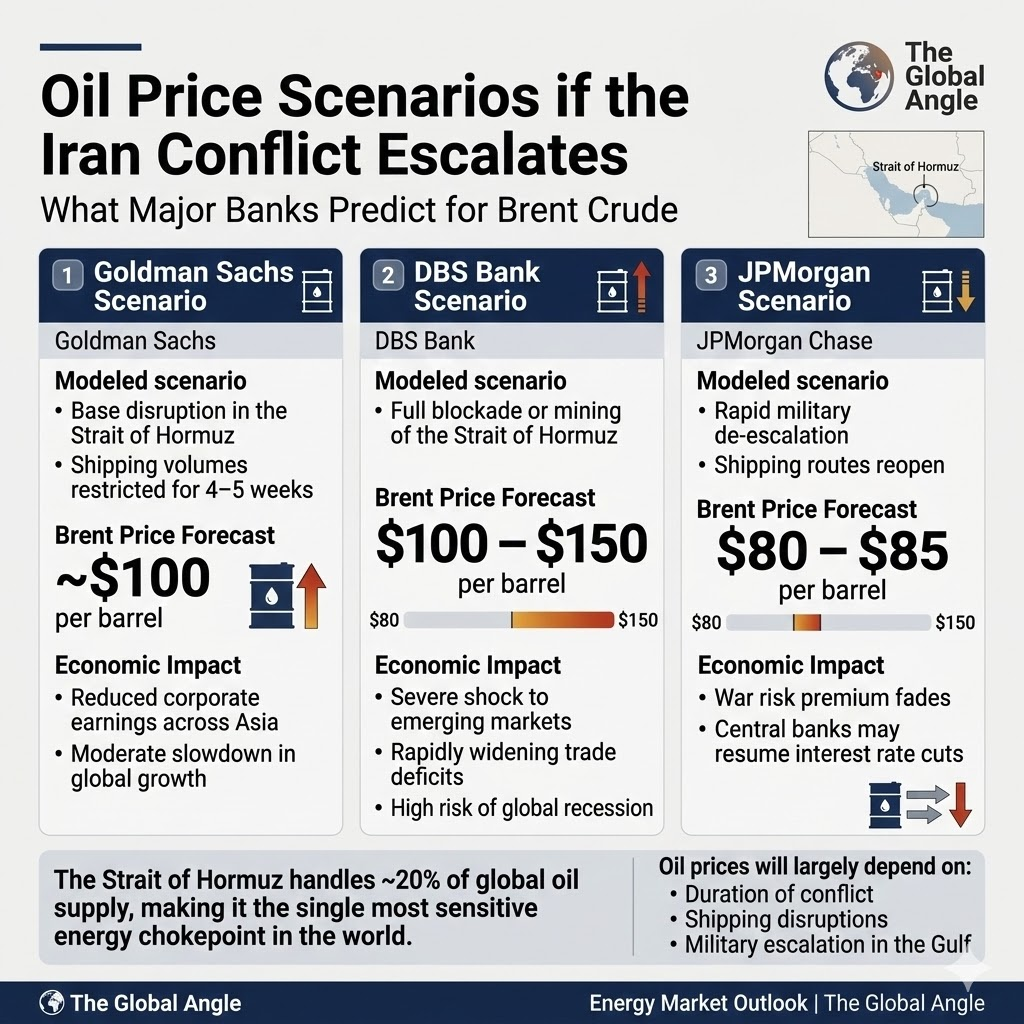
The Strait of Hormuz is the world’s most critical energy chokepoint, handling roughly 20% of global seaborne crude oil. With maritime traffic grinding to a halt, major financial institutions have modeled exactly how high oil could go based on the duration of the conflict.
| Financial Institution | Modeled Scenario | Brent Crude Price Forecast | Global Economic Impact |
| Goldman Sachs | Base Disruption: Hormuz volumes remain flat or restricted for 4 to 5 weeks. | $100 / barrel | Larger demand destruction required; reduces regional corporate earnings in Asia by roughly 2%. |
| DBS Bank | Extreme Disruption: Full, prolonged blockade or mining of the Strait of Hormuz. | $100 – $150 / barrel | Devastates emerging economies, widens current account deficits rapidly, and triggers a severe global recession. |
| JPMorgan Chase | De-escalation: Primary military operations conclude quickly; maritime traffic resumes. | $80 – $85 / barrel (Stabilization) | The “war premium” evaporates, allowing central banks to resume planned interest rate cuts. |
3. Sector Rotation: Where is the Capital Moving?
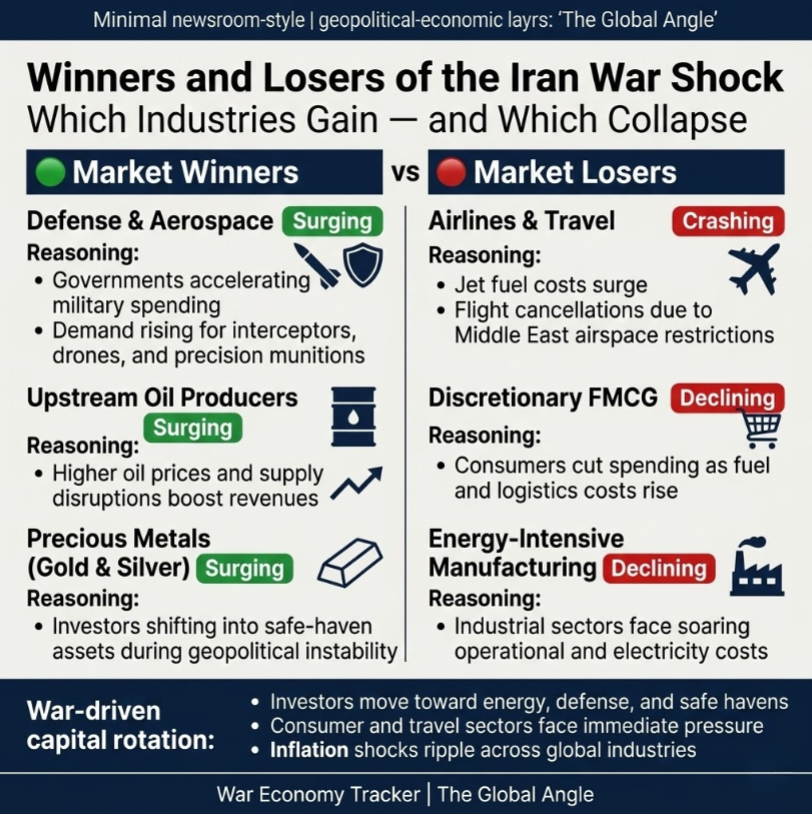
A geopolitical crisis of this magnitude forces an immediate reallocation of capital. Institutional money is flowing rapidly out of consumer-dependent sectors and into structural defense and energy plays.
| Economic Sector | Market Status | Reason for Capital Movement |
| Defense & Aerospace | Surging (Winner) | Governments worldwide will accelerate military spending to replenish interceptors, drones, and smart munitions. |
| Upstream Oil Producers | Surging (Winner) | Companies extracting and refining crude benefit directly from higher market realizations and supply constraints. |
| Precious Metals (Gold/Silver) | Surging (Winner) | Surging demand for inflation hedges and non-fiat safe-haven assets amid geopolitical uncertainty. |
| Airlines & Travel | Crashing (Loser) | Highly sensitive to sudden jet fuel price spikes and mass cancellations due to restricted Middle East airspace. |
| Discretionary FMCG | Declining (Loser) | Consumer goods suffer when rising fuel and logistics costs eat into household disposable income and corporate margins. |
| Energy-Intensive Manufacturing | Declining (Loser) | Heavy industries face squeezed profit margins as operational costs skyrocket overnight. |
4. The Bottom Line: Advice for Retail Investors
Higher inflation driven by an oil shock means central banks (like the US Federal Reserve) cannot cut interest rates as planned. “Higher-for-longer” interest rates choke off corporate borrowing and consumer spending, which ultimately drags down broad equity valuations.
However, wealth management experts strongly caution against emotional trading during kinetic military events.
| Investment Strategy | Expert Recommendation | Rationale |
| Panic Selling / Liquidating | Strongly Advise Against | Locking in steep losses during peak fear often means missing out on the inevitable, aggressive “relief rally” when tensions cool. |
| Systematic Investment Plans (SIPs) | Maintain / Continue | Continuing SIPs allows investors to average down their cost basis during market dips. |
| Portfolio Rebalancing | Recommended | Shift marginal capital toward high-quality, large-cap defensive stocks, energy, and dividend-yielding assets to weather the volatility. |
If the conflict transforms into a prolonged war of attrition featuring daily strikes on Gulf energy infrastructure, global markets will face a structural, medium-term correction. Until then, resilience is more valuable than opportunism.
Frequently Asked Questions
Will the global stock market crash further due to the Iran conflict?
The trajectory of the stock market depends heavily on the duration of the conflict and the Strait of Hormuz. Experts from major financial institutions predict that if the military operations conclude within a few weeks without a permanent oil blockade, the markets will likely stage a rapid relief rally. However, a prolonged war of attrition could trigger a deeper 5% to 10% correction across major global indices like the S&P 500 and Nifty 50.
How high could oil prices go if the Strait of Hormuz is closed?
Because roughly 20% of the world’s seaborne crude oil passes through the Strait of Hormuz, a full blockade would be devastating. In extreme scenarios modeled by banks like DBS and Goldman Sachs, a sustained closure could push Brent crude prices between $100 and $150 per barrel, triggering a massive spike in global inflation.
Which stock market sectors are safe during a war?
During severe geopolitical crises, capital rapidly rotates into “defensive” and safe-haven sectors. The primary winners during the 2026 Middle East conflict are the Defense & Aerospace industry, upstream Oil & Gas producers, and Precious Metals (gold and silver miners). Conversely, airlines, travel, and energy-intensive manufacturing are considered highly vulnerable.
Should I sell my stocks during the Middle East war?
Financial advisors and wealth managers strongly advise against panic selling during kinetic military events. Liquidating your portfolio during peak market fear often results in locking in steep losses and missing out on the subsequent market rebound. The general consensus is to maintain your Systematic Investment Plans (SIPs) and use dips to rebalance into high-quality, large-cap defensive stocks.
ALSO READ: Countries Currently at War 2026: The Complete Global Conflict Tracker
ALSO READ: How Long Will the US-Israel Iran War Last? The Sustainability and the Cost of War
The Complete History of Iran Israel Relations: From Secret Allies to Arch-Rivals
Executive Briefing The Dramatic Shift: Today, Iran and Israel are engaged in a sprawling, multi-front…
Russian vs Gulf Crude Oil: Price, Refining, and Efficiency Compared
Executive Briefing Two of the most heavily traded categories in the world are Russian vs…
Who is Winning the US Iran War 2026? Casualties, Costs, and the 2026 Timeline
Executive Briefing (Update: March 12, 2026) As the 2026 Middle East conflict reshapes the global…

Global Oil Price Hike 2026: Petrol Prices & Strategic Reserves by Country
Executive Briefing Global Oil Price Hike 2026 (Update: March 12, 2026) The Price Shock: Following…
Can Trump Be Impeached In Midterm Elections 2026? Odds, Stats, and the Process Explained
Executive Briefing (Update: March 2026) As the United States gears up for the pivotal 2026…

Who Was Arrested From the Epstein Files in 2026? Photos & Facts
Executive Briefing (Update: March 2026) If you are wondering exactly who was arrested from the…

Ibrahim is the Founder and Lead Analyst at The Global Angle, an independent digital platform dedicated to factual geopolitical analysis and international affairs. Based in India, he combines an engineering background with a deep focus on global markets, diplomacy, and strategic security. Ibrahim leverages a data-driven, analytical approach to break down complex international conflicts and economic shifts, helping readers see beyond standard news narratives. When he isn’t researching global policy, he focuses on digital publishing, search engine optimization, and platform architecture.