Executive Briefing
When analysing the Iran vs Israel military power comparison 2026, looking at a single metric like troop count is misleading. To understand the trajectory of the current Middle East war, we must compare the specific domains of warfare: Land, Air, Sea, and Technology.
- The Global Ranking: According to the newly released 2026 Global Firepower Index, these two nations are in a virtual dead heat. Israel ranks 15th globally, while Iran sits just behind at 16th.
- The Core Doctrine Difference: Iran relies on mass scale, asymmetric proxies, and a massive ballistic missile inventory. Israel relies on hyper-advanced technology, precision air superiority, and multi-layered defense shields.
- The Current Reality: As “Operation Epic Fury” and Iran’s retaliatory strikes continue, the theoretical numbers are now being tested in real-time combat.

Here is the complete, by-the-numbers breakdown of their respective military capabilities.
1. Overall Manpower & Defence Budgets
The most glaring difference between the two nations is population size and financial backing. Iran’s population of roughly 88 million gives it a massive manpower pool, allowing it to absorb heavy casualties in a prolonged, attrition-based conflict.
Israel, with a population of 9.4 million, cannot afford a war of attrition. To counter this, Israel maintains a significantly higher defense budget (bolstered by U.S. aid) and relies on a rapid-mobilization reserve system.
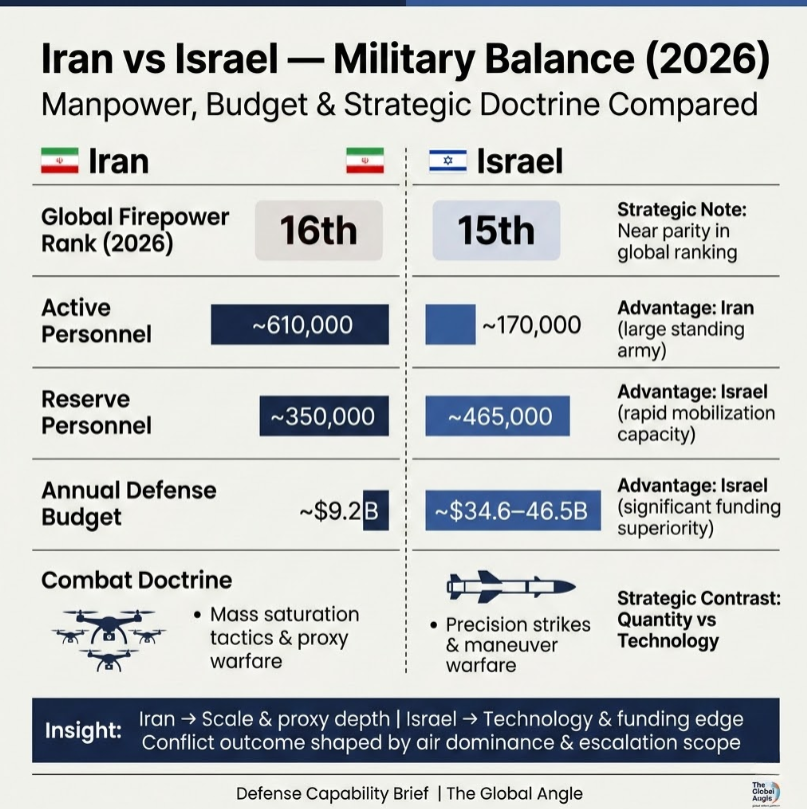
| Metric | Iran | Israel | Strategic Advantage |
| Global Firepower Rank (2026) | 16th | 15th | Tie |
| Active Personnel | ~610,000 | ~170,000 | Iran (Massive standing army) |
| Reserve Personnel | ~350,000 | ~465,000 | Israel (Highly trained, rapid deployment) |
| Annual Defense Budget | USD 9.2 Billion | USD 34.6 – 46.5 Billion | Israel (Vastly superior funding) |
| Combat Doctrine | Mass saturation & Proxies | Precision strikes & Maneuverability | N/A |
2. Air Power: Technology vs. Drone Swarms
Air capability is the critical dividing line in this conflict. Decades of heavy international sanctions have severely limited Iran’s ability to purchase or manufacture modern fighter jets. Consequently, their conventional air force is effectively obsolete.
Israel, conversely, operates one of the most technologically advanced and lethal air forces on the planet, heavily featuring 5th-generation stealth technology. To compensate for its lack of fighter jets, Iran has aggressively developed its “kamikaze” drone fleet (Shahed series) to act as a poor man’s air force.
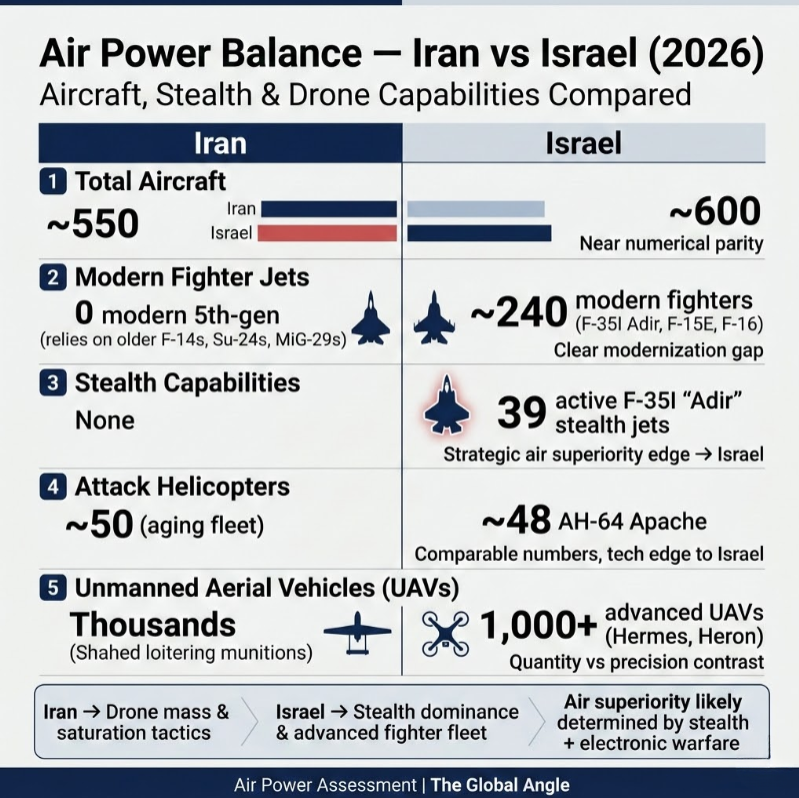
| Aviation Asset | Iran | Israel |
| Total Aircraft | ~550 | ~600 |
| Modern Fighter Jets | 0 (Relies on older F-14s, Su-24s, MiG-29s) | ~240 (F-35I Adir, F-15E, F-16) |
| Stealth Capabilities | None | 39 Active F-35I “Adir” Stealth Jets |
| Attack Helicopters | ~50 (Aging models) | ~48 (AH-64 Apache) |
| Unmanned Aerial Vehicles (UAVs) | Thousands (Shahed series loitering munitions) | 1,000+ (Hermes, Heron reconnaissance/strike) |
3. Land Forces & Armored Capability
If a ground invasion were to occur, the terrain and distance (over 1,000 kilometers separating their borders) make direct tank-on-tank battles highly unlikely. However, their ground inventories reflect their different military philosophies. Iran builds for large-scale, static defense and saturation fire. Israel builds for speed, agility, and crew survivability.
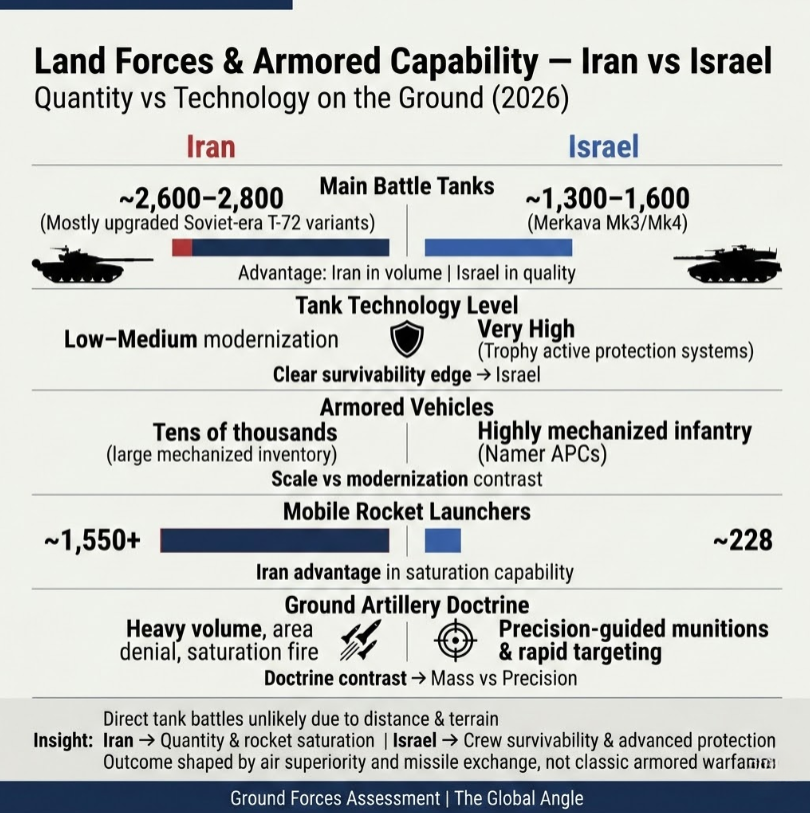
| Land Military Asset | Iran | Israel |
| Main Battle Tanks | ~2,600 – 2,800 (Mostly Soviet-era T-72s/upgrades) | ~1,300 – 1,600 (Merkava Mk 3/Mk 4) |
| Tank Technology Level | Low to Medium | Very High (Equipped with ‘Trophy’ active defense) |
| Armored Vehicles | Tens of thousands | Highly mechanized infantry (Namer APCs) |
| Mobile Rocket Launchers | ~1,550+ | ~228 |
| Ground Artillery Doctrine | Heavy volume, area denial | Precision-guided munitions, rapid targeting |
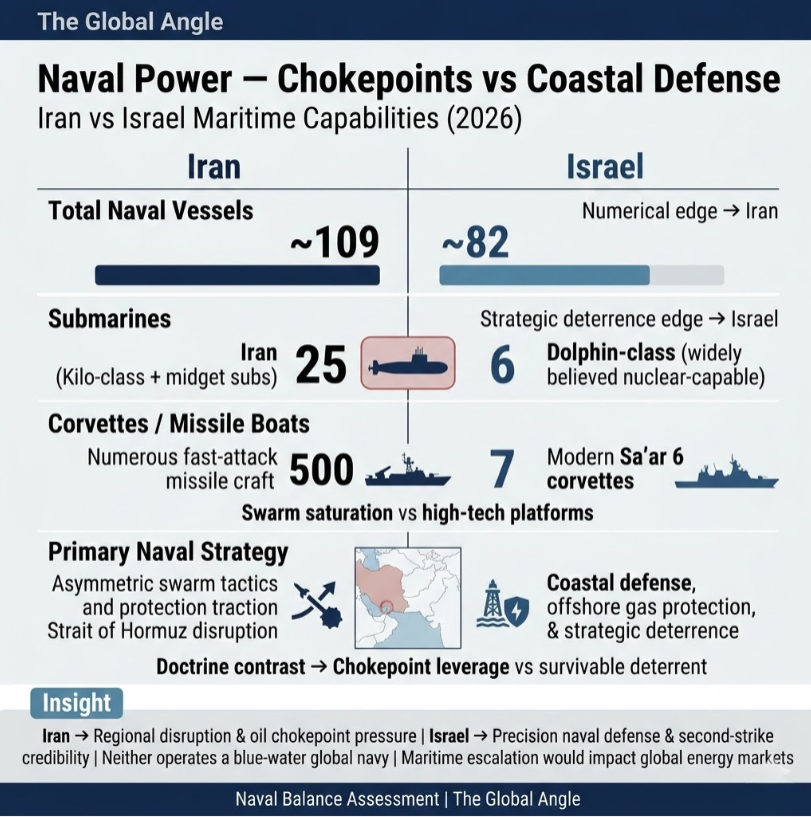
4. Naval Power: Regional Chokepoints vs. Coastal Defense
Neither country possesses a “blue-water” navy capable of dominating global oceans. Their naval forces are strictly tailored to their immediate geography.
Iran focuses heavily on the Persian Gulf and the Strait of Hormuz. They utilize “swarm tactics” with heavily armed fast-attack craft designed to overwhelm larger warships and disrupt global oil shipping. Israel’s navy is highly specialized, focused on defending offshore natural gas rigs in the Mediterranean and maintaining a stealthy, strategic nuclear deterrent.
| Naval Asset | Iran | Israel |
| Total Naval Vessels | ~109 | ~82 |
| Submarines | 25 (Mix of Kilo-class and midget subs) | 6 (Dolphin-class, widely believed to be nuclear-armed) |
| Corvettes / Missile Boats | Numerous fast-attack missile craft | 7 Modern Corvettes (Sa’ar 6-class) |
| Primary Naval Strategy | Asymmetric swarm tactics, strait blockades | Coastal asset protection, strategic deterrence |
5. Missiles, Tech, and Weapons of Mass Destruction
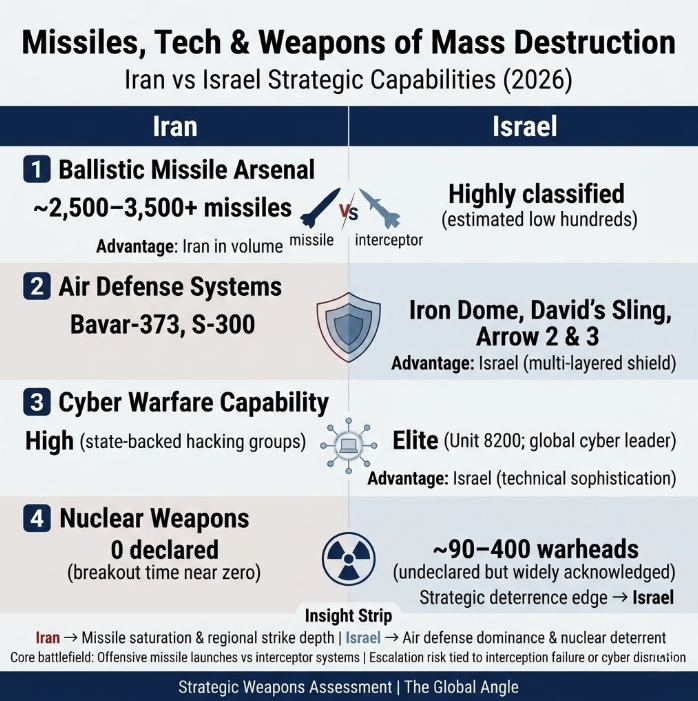
The defining characteristic of the 2026 war is the race between Iranian missile launchers and American/Israeli interceptors. Iran operates the largest ballistic missile network in the Middle East. Israel operates the most comprehensive, multi-layered air defense shield in the world.
| Strategic Weapons & Tech | Iran | Israel |
| Ballistic Missile Arsenal | ~2,500 – 3,500+ | Highly Classified (Estimated in the low hundreds) |
| Air Defense Systems | Bavar-373, S-300 | Iron Dome, David’s Sling, Arrow 2 & 3 |
| Cyber Warfare Capability | High (Aggressive state-sponsored hacking groups) | Elite (Unit 8200, global leader in cyber espionage) |
| Nuclear Weapons | 0 (Though “breakout time” is near zero) | ~90 – 400 Warheads (Undeclared but universally acknowledged) |
The Final Verdict
When comparing Iran vs Israel military power, the edge heavily depends on the type of war being fought.
In a direct conventional conflict defined by air superiority and technological precision, Israel holds a devastating advantage. However, Iran’s military is not designed to fight conventionally. By utilizing an overwhelming numerical advantage in ballistic missiles, weaponizing proxy militias across multiple borders, and leveraging geographic depth, Tehran has built a formidable machine of asymmetric warfare designed to bleed out technologically superior foes.
ALSO READ: 2026 Middle East War Affected Countries: Every Country Involved & Why the Conflict is Spreading
ALSO READ: How Close is Iran to Having a Nuclear Weapon? U.S Strike and Radiation Leak Myths
The Complete History of Iran Israel Relations: From Secret Allies to Arch-Rivals
Executive Briefing The Dramatic Shift: Today, Iran and Israel are engaged in a sprawling, multi-front…
Russian vs Gulf Crude Oil: Price, Refining, and Efficiency Compared
Executive Briefing Two of the most heavily traded categories in the world are Russian vs…
Who is Winning the US Iran War 2026? Casualties, Costs, and the 2026 Timeline
Executive Briefing (Update: March 12, 2026) As the 2026 Middle East conflict reshapes the global…

Global Oil Price Hike 2026: Petrol Prices & Strategic Reserves by Country
Executive Briefing Global Oil Price Hike 2026 (Update: March 12, 2026) The Price Shock: Following…

Can Trump Be Impeached In Midterm Elections 2026? Odds, Stats, and the Process Explained
Executive Briefing (Update: March 2026) As the United States gears up for the pivotal 2026…

Who Was Arrested From the Epstein Files in 2026? Photos & Facts
Executive Briefing (Update: March 2026) If you are wondering exactly who was arrested from the…

Ibrahim is the Founder and Lead Analyst at The Global Angle, an independent digital platform dedicated to factual geopolitical analysis and international affairs. Based in India, he combines an engineering background with a deep focus on global markets, diplomacy, and strategic security. Ibrahim leverages a data-driven, analytical approach to break down complex international conflicts and economic shifts, helping readers see beyond standard news narratives. When he isn’t researching global policy, he focuses on digital publishing, search engine optimization, and platform architecture.