Introduction
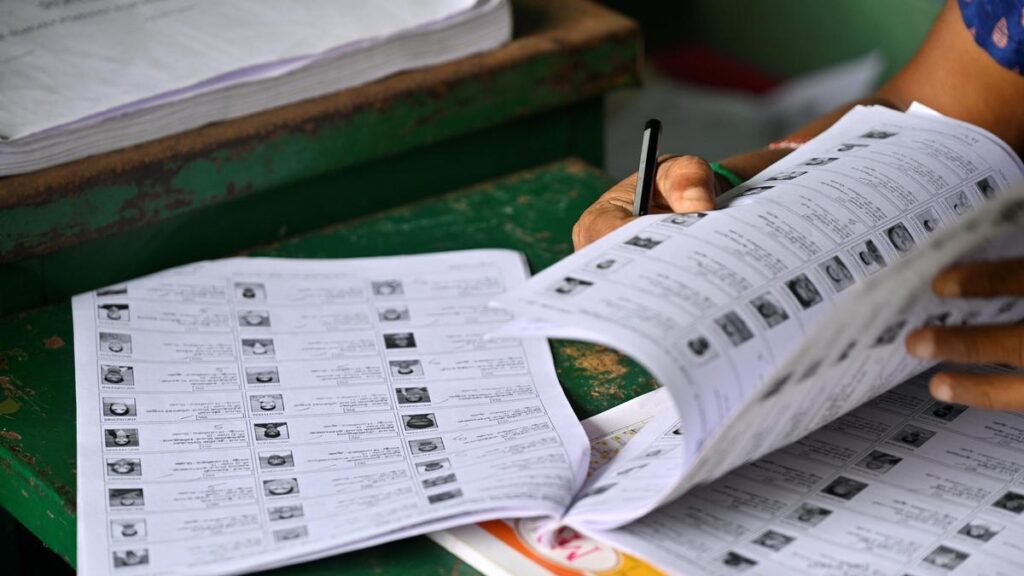
MGNREGA replaced by VB–G RAM G marks one of the most significant shifts in India’s rural employment policy since 2005. The Centre has moved to introduce a new law in Parliament — the Viksit Bharat Guarantee for Rozgar and Ajeevika Mission (Gramin) Bill, 2025 — proposing to repeal the Mahatma Gandhi National Rural Employment Guarantee Act.
The new framework seeks to align rural employment with the national vision of Viksit Bharat 2047, promising higher guaranteed workdays, stronger infrastructure outcomes, and tighter accountability.
What Is VB–G RAM G?
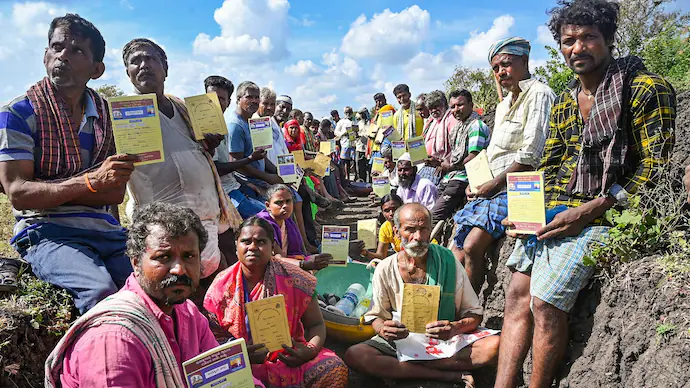
VB–G RAM G stands for Viksit Bharat Guarantee for Rozgar and Ajeevika Mission (Gramin). The proposed Act establishes a new statutory framework guaranteeing 125 days of wage employment per rural household whose adult members volunteer for unskilled manual work.
This represents a shift from an employment-only focus to a combined employment-plus-infrastructure mission. The aim is not just to provide wages, but to build durable rural assets that support long-term livelihoods.
Four Priority Verticals Under the New Act
The new law narrows the scope of works into four clearly defined verticals:
1. Water Security
Focus on water-related works, including harvesting, conservation, and groundwater recharge.
2. Core Rural Infrastructure
Creation of roads, connectivity, and foundational infrastructure that improves access to markets and services.
3. Livelihood-Related Infrastructure
Assets such as storage facilities, local markets, and production-related infrastructure to support income diversification.
4. Climate Adaptation Works
Special works to mitigate extreme weather events, including flood drainage, soil conservation, and drought resilience.
All assets created will be mapped into a Viksit Bharat National Rural Infrastructure Stack, aimed at creating a unified national view of rural infrastructure.
How Is VB–G RAM G Different From MGNREGA?
Higher Employment Guarantee
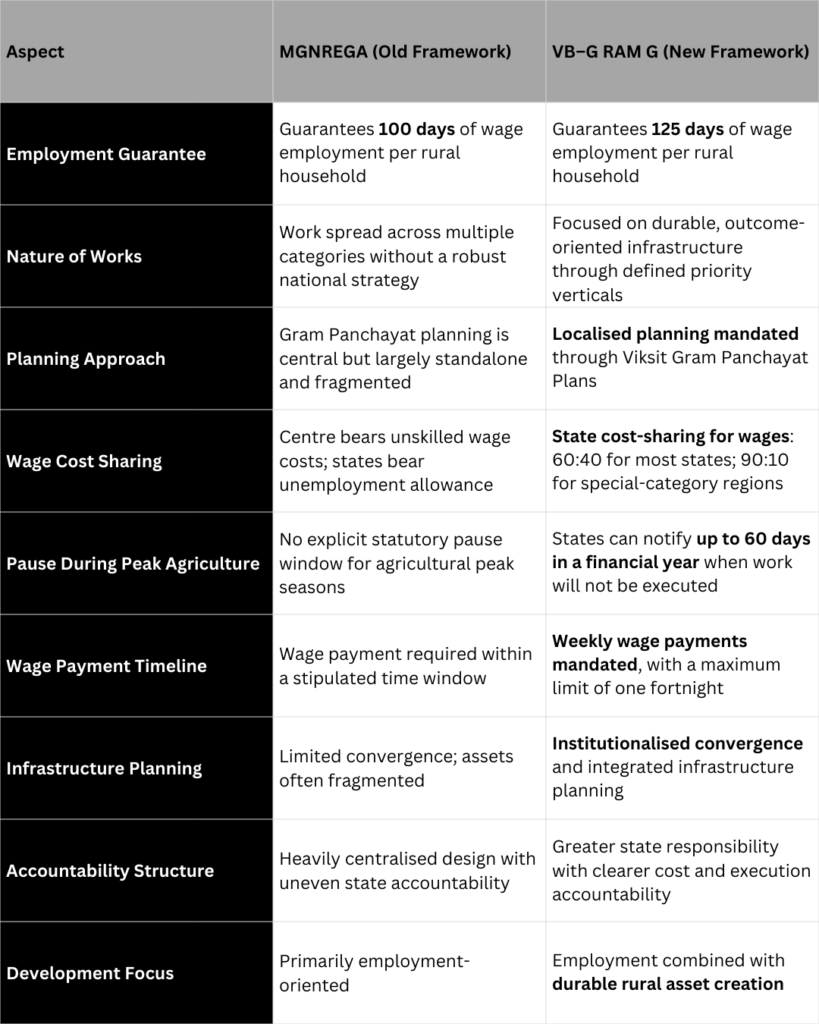
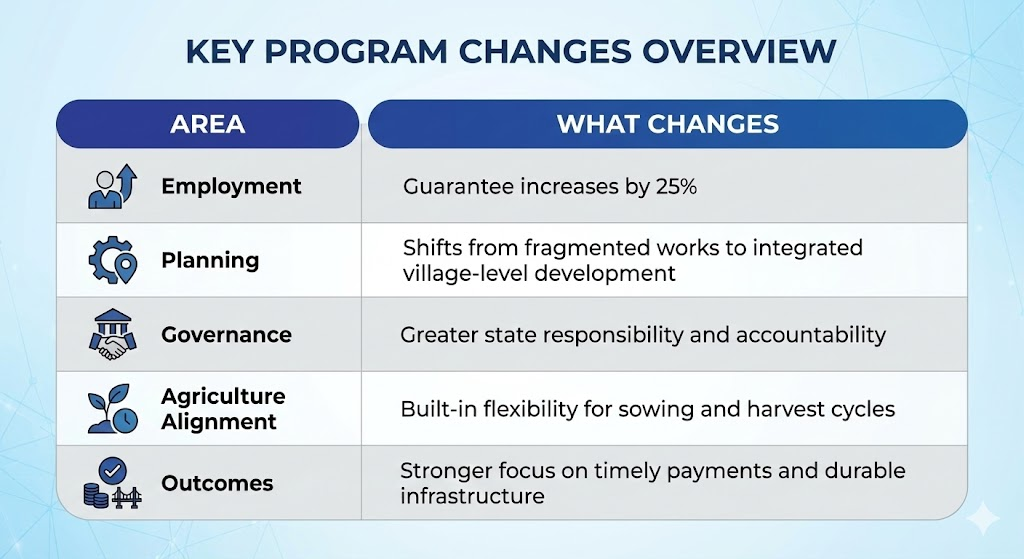
MGNREGA guaranteed 100 days of work per household. The new law raises this to 125 days, increasing potential household income by 25 percent.
Strategic Asset Creation
Under MGNREGA, works were spread across numerous categories without a cohesive national strategy. VB–G RAM G restricts works to four priority areas, ensuring durability and economic relevance.
Integrated Planning
The new Act mandates Viksit Gram Panchayat Plans, prepared by panchayats themselves and integrated with national spatial platforms. This replaces fragmented planning with coordinated, location-specific execution.
How Will VB–G RAM G Benefit the Rural Economy?
Productive Assets Over Short-Term Relief
By focusing on water, infrastructure, livelihoods, and climate resilience, the scheme links wage employment with long-term productivity.
Water-related works improve agricultural output and groundwater availability. Roads and connectivity reduce transaction costs. Livelihood assets support diversification beyond farming.
Higher Incomes and Local Demand
With 125 guaranteed workdays, rural households receive higher and more predictable income. This boosts local consumption and strengthens village-level economic activity.
Reduced Distress Migration
Better local opportunities and infrastructure reduce the pressure to migrate for survival, especially during lean seasons.
What Does the New Law Mean for Farmers?
Guaranteed Labour Availability
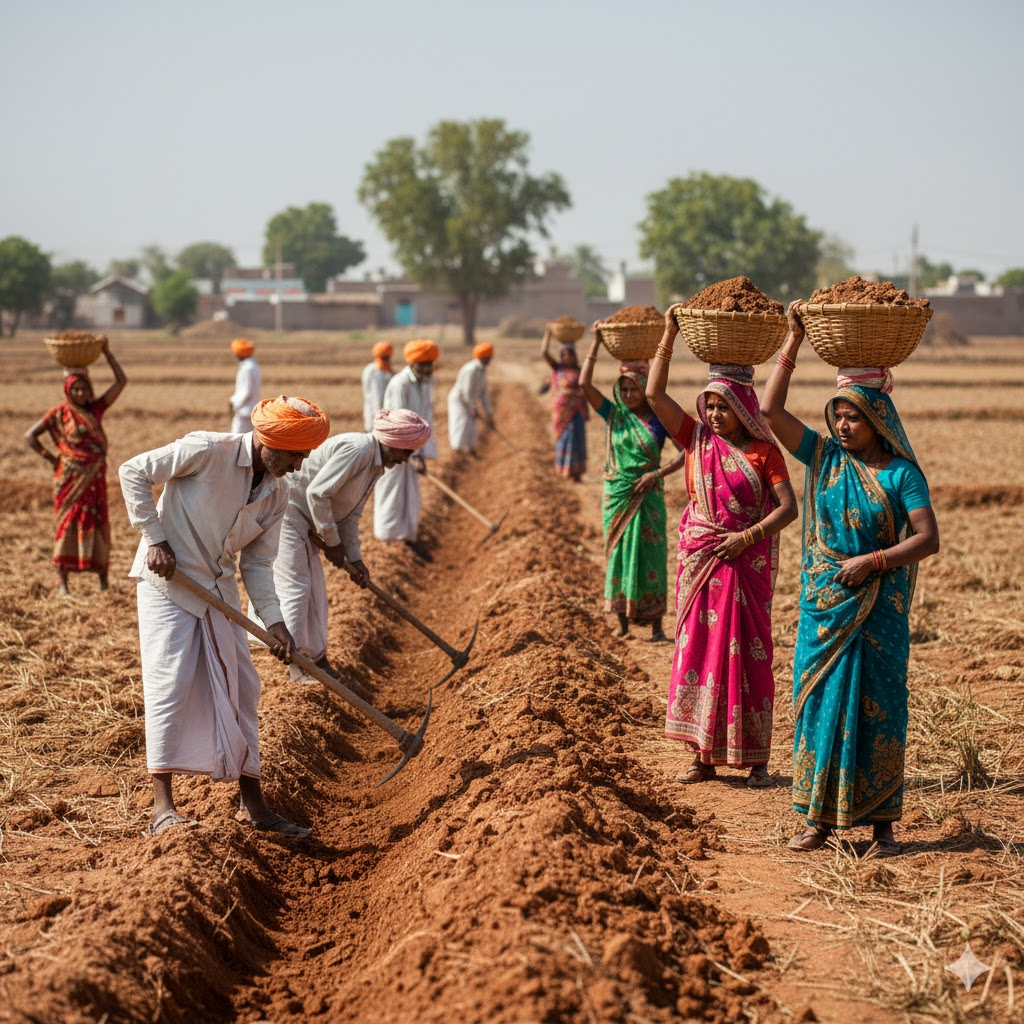
States can notify up to 60 days during peak sowing and harvesting periods when public works stop. This ensures labour is available for agriculture when it is most needed.
Preventing Wage Distortions
By pausing public works during peak seasons, the system avoids artificial wage inflation that raises food production costs.
Improved Agricultural Infrastructure
Prioritised water works, irrigation support, storage, and connectivity directly benefit farm productivity and resilience.
What Does It Mean for Rural Labourers?
Higher and More Predictable Earnings
An increase from 100 to 125 guaranteed days raises income security. Work availability is planned in advance through Gram Panchayat Plans.
Strong Wage Protection
The scheme continues digital payments with biometric and Aadhaar-based verification, reducing wage theft and delays.
Unemployment Allowance
If work is not provided when demanded, states are legally required to pay an unemployment allowance.
Why Change MGNREGA Now?
MGNREGA was designed in 2005 for a very different rural economy. Since then, rural India has seen:
- Significant reduction in poverty
- Greater financial inclusion
- Better digital connectivity
- More diversified livelihoods
The open-ended, demand-driven design of MGNREGA no longer aligned well with this transformed landscape. According to the government’s assessment, the framework had become inefficient and poorly matched to current needs.
VB–G RAM G is presented as a modernisation, not a withdrawal, of the employment guarantee.
Why Shift From Demand-Based to Normative Funding?
Predictable Budgeting
Demand-based funding led to unpredictable allocations and frequent mismatches between demand and budgets. Normative funding uses objective parameters to plan allocations more rationally.
Guarantee Remains Intact
The shift does not remove the right to employment. If work is not provided, unemployment allowance remains mandatory.
Special relaxations are also permitted during disasters or exceptional circumstances.
Were Improvements Not Made to MGNREGA Earlier?
Several reforms were introduced over the years, including:
- Higher women’s participation
- Aadhaar-linked worker databases
- Near-universal digital wage payments
- Geo-tagging of assets
Despite these improvements, systemic problems persisted, including misappropriation, bypassing of digital attendance, and weak asset quality.
The government argues that incremental fixes were insufficient to resolve structural flaws.
What Problems With MGNREGA Led to Its Replacement?
According to official assessments:
- Investigations found non-existent works and rule violations in multiple districts
- Monitoring revealed works not matching reported expenditure
- Machine use replaced manual labour in some cases
- Attendance systems were frequently bypassed
- Misappropriation of funds continued across states
Only a small share of households consistently completed the full 100 days of work, indicating limited effectiveness.
What Transparency Measures Are Built Into VB–G RAM G?
The new Act introduces multiple safeguards:
- AI-based fraud detection
- Central and state-level steering committees
- GPS and mobile-based monitoring
- Real-time MIS dashboards
- Weekly public disclosures
- Mandatory social audits twice a year for every Gram Panchayat
The goal is to shift from reactive oversight to continuous, technology-driven monitoring.
Why Convert It Into a Centrally Sponsored Scheme?
Rural employment is inherently local. Under the new structure:
- States share responsibility and costs
- Planning reflects regional conditions
- Panchayats have stronger oversight roles
- The Centre sets standards and ensures funding discipline
This partnership model is intended to improve accountability and reduce misuse.
Will This Burden States Financially?
The cost-sharing structure is designed to be balanced:
| Category | Centre | State |
|---|---|---|
| Standard States | 60% | 40% |
| North-East & Himalayan States | 90% | 10% |
| UTs without Legislature | 100% | 0% |
States already bore significant material and administrative costs earlier. Predictable allocations and reduced leakage are expected to offset fiscal pressures.
Why Is There a 60-Day No-Work Period?
The no-work period ensures:
- Labour availability for agriculture
- Prevention of wage inflation
- Lower food production costs
The 60 days are aggregated, not continuous. Workers still receive the full 125-day guarantee across the year.
Conclusion
MGNREGA replaced by VB–G RAM G represents a structural rethinking of rural employment policy. The new law seeks to combine income security with durable asset creation, tighter accountability, and alignment with today’s rural economy.
The central question now is not whether change was needed, but whether VB–G RAM G can deliver on its promise of higher employment, better infrastructure, and cleaner governance without excluding the most vulnerable.
Will this transition strengthen rural resilience, or will implementation challenges determine its fate?
Frequently Asked Questions
1. Is MGNREGA being completely scrapped?
Yes, the proposed law repeals MGNREGA and replaces it with VB–G RAM G.
2. How many workdays are guaranteed under the new scheme?
Each rural household is guaranteed 125 days of wage employment.
3. Does normative funding reduce employment rights?
No. If work is not provided, unemployment allowance is mandatory.
4. What is the biggest change from MGNREGA?
The biggest change is the shift from scattered works to focused, durable infrastructure aligned with long-term rural development.
ALSO READ: Which Maharashtra Municipal Corporation topped the 2025-26 budget rankings?
ALSO READ: India Union Budget 2026: A Blueprint for Infrastructure and Fiscal Stability

The Complete History of Iran Israel Relations: From Secret Allies to Arch-Rivals
Executive Briefing The Dramatic Shift: Today, Iran and Israel are engaged in a sprawling, multi-front…

Russian vs Gulf Crude Oil: Price, Refining, and Efficiency Compared
Executive Briefing Two of the most heavily traded categories in the world are Russian vs…

Who is Winning the US Iran War 2026? Casualties, Costs, and the 2026 Timeline
Executive Briefing (Update: March 12, 2026) As the 2026 Middle East conflict reshapes the global…

Global Oil Price Hike 2026: Petrol Prices & Strategic Reserves by Country
Executive Briefing Global Oil Price Hike 2026 (Update: March 12, 2026) The Price Shock: Following…
Can Trump Be Impeached In Midterm Elections 2026? Odds, Stats, and the Process Explained
Executive Briefing (Update: March 2026) As the United States gears up for the pivotal 2026…

Who Was Arrested From the Epstein Files in 2026? Photos & Facts
Executive Briefing (Update: March 2026) If you are wondering exactly who was arrested from the…

Ibrahim is the Founder and Lead Analyst at The Global Angle, an independent digital platform dedicated to factual geopolitical analysis and international affairs. Based in India, he combines an engineering background with a deep focus on global markets, diplomacy, and strategic security. Ibrahim leverages a data-driven, analytical approach to break down complex international conflicts and economic shifts, helping readers see beyond standard news narratives. When he isn’t researching global policy, he focuses on digital publishing, search engine optimization, and platform architecture.