Executive Briefing
- The Core Event: Following cross-border skirmishes, Pakistani Defence Minister Khawaja Muhammad Asif formally openly declared a Pakistan Afghanistan war as fighter jets struck Taliban headquarters in Kabul, Kandahar, and Paktia.
- The Primary Data Point: The Afghan Ministry of National Defense launched a massive retaliatory ground offensive, claiming to have killed 55 Pakistani soldiers and captured 19 border posts—figures Islamabad vehemently denies.
- The Hidden Impact: The collapse of the Qatar-brokered ceasefire immediately threatens regional trade routes and has prompted Russia to step in with an offer to mediate, challenging traditional Western diplomatic influence in Central Asia.

Just days ago, we published an intelligence briefing asking a highly specific question: Can Afghanistan retaliate to the Pakistan attack? The geopolitical analysis indicated that Kabul’s domestic political survival depended on a kinetic response.
That prediction materialized overnight in the form of a devastating Pakistan Afghanistan open war.
Following a barrage of Pakistani airstrikes targeting major Afghan urban centers, Taliban ground forces mobilized along the 2,600-km Durand Line. The diplomatic channels have completely collapsed. Both nations are now engaged in a fierce information war regarding the tactical realities on the ground.
The Information War: Decoding Ministry Statements
Relying on independent verification in this theater is currently impossible. Analysts must evaluate the vastly conflicting reports issued directly by state defense ministries.
Pakistani Defence Minister Khawaja Asif utilized social media platform X to announce that Islamabad’s “patience has overflowed,” officially categorizing the conflict as a war. The Pakistani military claims its airstrikes were precision operations targeting Tehreek-e-Taliban (TTP) infrastructure.
Conversely, the Afghan Ministry of National Defense issued a detailed press release detailing their counter-offensive.
Taliban spokesperson Zabihullah Mujahid confirmed the strikes hit Kabul and Kandahar—the spiritual heartland of the Taliban leadership. He categorized the Pakistani aerial bombardment as a cowardly violation of sovereignty that resulted in civilian casualties, triggering their retaliatory ground sweep.
| Combatant | Official Claimed Target | Official Claimed Enemy Casualties | Captured Infrastructure |
| Pakistan MoD | TTP / ISKP militant hideouts | 133 Taliban fighters killed | 27 posts destroyed, 9 captured |
| Afghan MoD | Pakistani military installations | 55 Pakistani soldiers killed | 2 military bases, 19 posts captured |
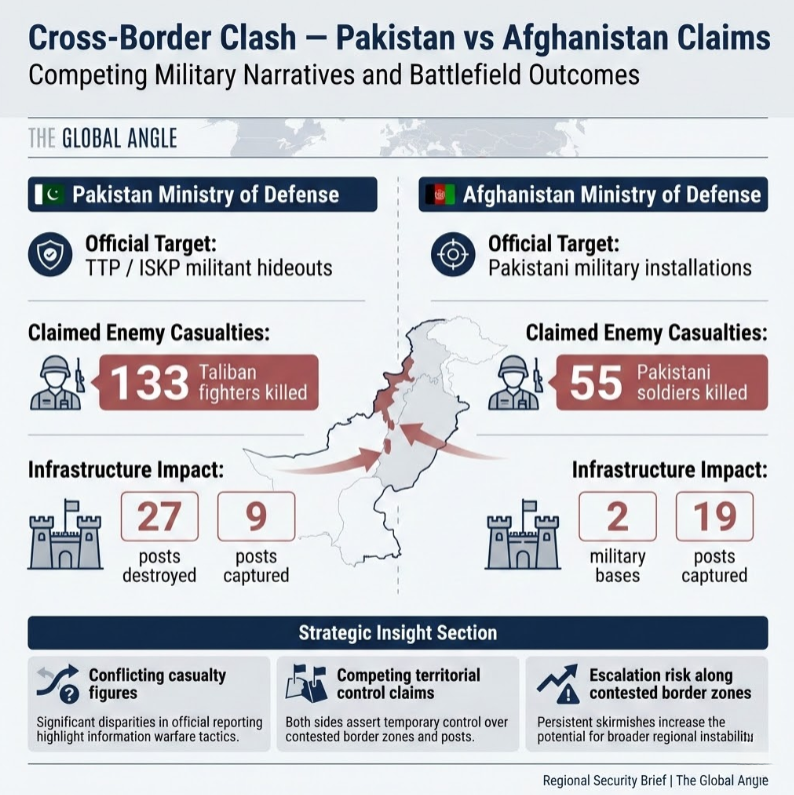
These contradictory datasets reveal a heavy reliance on psychological operations. Neither side wants to project weakness to their respective domestic populations.
Tactical Disparities and Guerrilla Asymmetry in Pakistan Afghanistan war
The conventional military disparity between the two nations is massive. Pakistan possesses a highly advanced air force and a nuclear deterrent. Afghanistan lacks functional air superiority entirely.
However, the Taliban holds a distinct asymmetric advantage.
They are heavily hardened by two decades of grueling guerrilla warfare against U.S.-led coalition forces. The Afghan strategy relies on overwhelming isolated border outposts through coordinated light-infantry assaults. A state-run Afghan media outlet in Nangarhar even broadcasted images of suicide battalions equipped with explosive vests, signaling a willingness to deploy extreme asymmetric tactics.
Pakistan’s internal security apparatus is reacting defensively. The Punjab provincial government initiated a high-security alert, rounding up 90 Afghan nationals for rapid deportation amid fears of urban terror reprisal strikes.
The Russian Advantage: Strengthening Russia Taliban relations
The immediate second-order effect of this border war is a total disruption of regional diplomacy.
Previous skirmishes in October were mediated by a coalition of Turkey, Qatar, and Saudi Arabia. This time, a different global power is attempting to exploit the security vacuum. Moscow’s foreign ministry immediately offered to mediate the crisis.
Russia remains the only major global power to formally recognize the Taliban administration.
| Geopolitical Actor | Stated Position / Action | Strategic Objective |
| Russia | Offered formal diplomatic mediation. | Solidify influence in Central Asia over Western rivals. |
| Saudi Arabia | Initiated high-level foreign ministry calls. | Prevent regional destabilization and refugee spillover. |
| United Nations | Condemned the civilian death toll. | Maintain access for critical humanitarian aid corridors. |
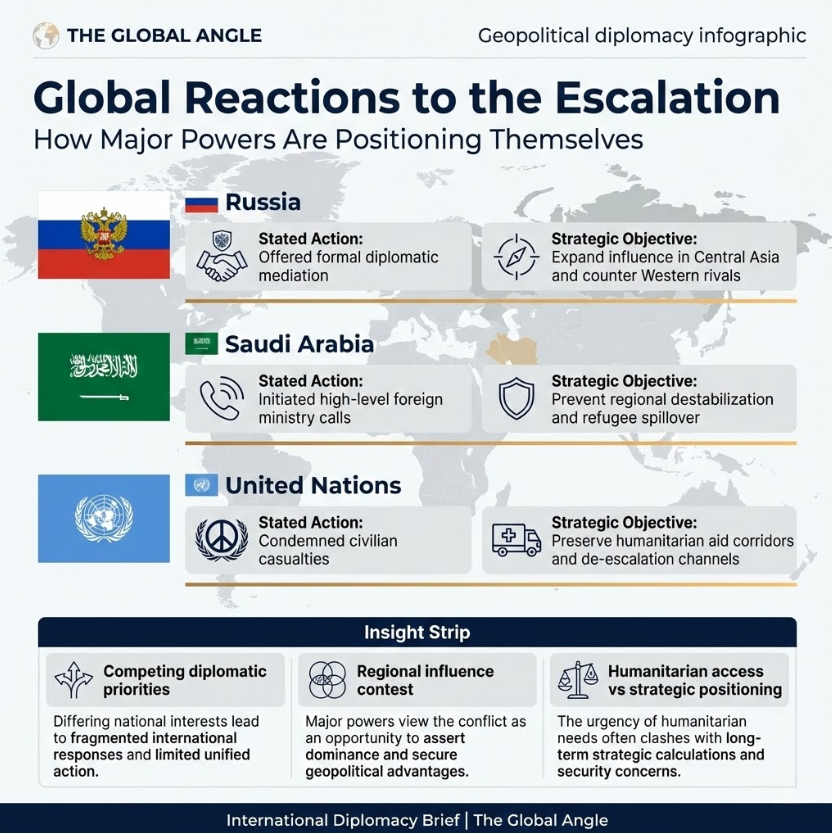
By stepping in as the primary peacemaker, Moscow aims to solidify its strategic foothold in Central Asia. If Russia successfully brokers a new ceasefire, it severely undercuts the diplomatic leverage of both Islamabad and Western nations operating in the region.
The economic fallout will be severe. The closure of the Torkham border crossing chokes off vital trade arteries. Until the artillery fire ceases, global supply chains reliant on South Asian land routes remain entirely paralyzed.
Frequently Asked Questions
Why did Pakistan declare ‘open war’ on Afghanistan?
Pakistani Defence Minister Khawaja Asif declared an open conflict after Islamabad accused the Taliban government of harboring TTP militants. Pakistan claims these militants are responsible for a surge in deadly terror attacks inside Pakistani urban centers.
Did the Taliban capture Pakistani military bases?
The Afghan Ministry of National Defense officially claims their forces captured two Pakistani military bases and 19 border posts during a retaliatory night operation. The Pakistani government strongly denies these claims, stating they successfully repelled the unprovoked attacks.
ALSO READ: Pakistan attack on Afghanistan: Can Afghanistan Retaliate to the Pakistan Attack?
ALSO READ: Is China Faking Flights for a Taiwan Invasion Rehearsal?
The Complete History of Iran Israel Relations: From Secret Allies to Arch-Rivals
Executive Briefing The Dramatic Shift: Today, Iran and Israel are engaged in a sprawling, multi-front…
Russian vs Gulf Crude Oil: Price, Refining, and Efficiency Compared
Executive Briefing Two of the most heavily traded categories in the world are Russian vs…
Who is Winning the US Iran War 2026? Casualties, Costs, and the 2026 Timeline
Executive Briefing (Update: March 12, 2026) As the 2026 Middle East conflict reshapes the global…

Global Oil Price Hike 2026: Petrol Prices & Strategic Reserves by Country
Executive Briefing Global Oil Price Hike 2026 (Update: March 12, 2026) The Price Shock: Following…
Can Trump Be Impeached In Midterm Elections 2026? Odds, Stats, and the Process Explained
Executive Briefing (Update: March 2026) As the United States gears up for the pivotal 2026…
Who Was Arrested From the Epstein Files in 2026? Photos & Facts
Executive Briefing (Update: March 2026) If you are wondering exactly who was arrested from the…

Ibrahim is the Founder and Lead Analyst at The Global Angle, an independent digital platform dedicated to factual geopolitical analysis and international affairs. Based in India, he combines an engineering background with a deep focus on global markets, diplomacy, and strategic security. Ibrahim leverages a data-driven, analytical approach to break down complex international conflicts and economic shifts, helping readers see beyond standard news narratives. When he isn’t researching global policy, he focuses on digital publishing, search engine optimization, and platform architecture.