Executive Briefing
Two of the most heavily traded categories in the world are Russian vs Gulf Crude Oil. Understanding the differences between them is essential for decoding global energy economics, pump prices, and supply chain vulnerabilities.
- The Contenders: The global energy market is dominated by two massive supply pools: Russian crude (primarily the Urals blend) and Gulf crude (Middle Eastern blend like Arab Light and Dubai).
- The Refining Difference: While both are generally classified as “medium sour,” they have distinct chemical profiles that dictate how easily they can be refined into high-value products like gasoline and diesel.
- The Logistics Shift: Geopolitical sanctions have fundamentally altered how oil travels, creating massive discrepancies in freight costs, insurance, and delivery times between Russian and Gulf shipments.
When global refineries purchase millions of barrels of crude oil, they aren’t just buying generic black liquid. Oil is a highly complex chemical mixture, and its origin dictates its price, how it travels, and what products it can efficiently yield.
Here is the definitive, head-to-head comparison of Russian vs. Gulf crude oil across all major parameters.
1. Process Capabilities & Efficiency (The Chemistry)
Refineries judge crude oil primarily on two metrics: API Gravity (how light or heavy the liquid is) and Sulfur Content (sweet vs. sour).
- Lighter/Sweeter crude is easier and cheaper to refine into premium gasoline.
- Heavier/Sourer crude requires complex, expensive processing units (like “crackers” and “desulfurizers”) to remove sulfur and yield useful fuels, but it is excellent for producing diesel.
The Chemical Profile
| Parameter | Russian Crude (Urals Benchmark) | Gulf Crude (Arab Light Benchmark) |
| API Gravity | 31° to 32° (Medium) | 33° to 34° (Medium-Light) |
| Sulfur Content | ~1.4% to 1.8% (Sour) | ~1.7% to 1.8% (Sour) |
| Primary Yield Efficiency | Highly efficient for producing Middle Distillates (Diesel, Jet Fuel, Heating Oil). | Highly versatile; excellent for both Gasoline and Diesel. |
| Refining Complexity Required | High: Requires advanced, complex refineries to process the heavier sulfur content cleanly. | Medium-High: Requires desulfurization, but the slightly lighter gravity makes it easier to process than Urals. |
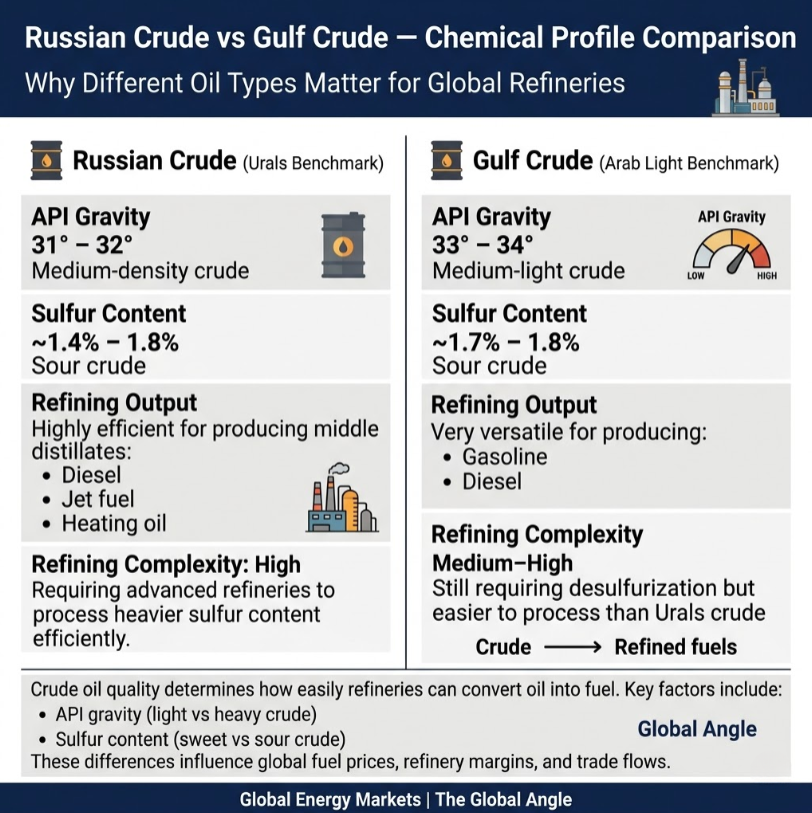
The Efficiency Verdict: Gulf crude (specifically Arab Light) is generally more versatile and slightly easier to process for gasoline-heavy markets. However, for complex refineries built specifically to handle sour crude, Russian Urals is a highly efficient feedstock for maximizing diesel production.
2. Price Dynamics & Economics
Historically, Russian Urals traded at a slight discount to the global Brent benchmark to account for its heavier chemical profile and higher shipping costs to certain regions. However, modern geopolitics have completely decoupled Russian oil from standard market economics.
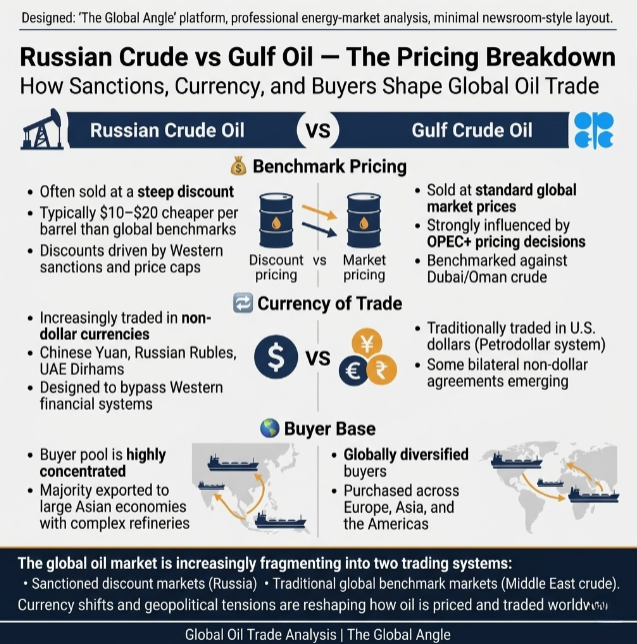
Russian vs Gulf Crude Oil The Pricing Breakdown
| Economic Factor | Russian Crude Oil | Gulf Crude Oil |
| Benchmark Pricing | Often trades at a steep discount (sometimes $10 to $20 less per barrel) compared to global benchmarks due to Western sanctions and price caps. | Traded at standard global market rates, heavily influenced by the OPEC+ pricing structures and the Dubai/Oman benchmarks. |
| Currency of Trade | Increasingly traded in non-dollar currencies (Yuan, Rubles, Dirhams) to bypass Western financial systems. | Traditionally traded in US Dollars (Petrodollar), though some bilateral, non-dollar agreements are slowly emerging. |
| Buyer Base | Heavily concentrated. The vast majority is purchased by massive Asian economies with the complex refineries needed to process it. | Universally purchased by global markets, including Europe, Asia, and the Americas. |
3. Travel, Logistics, and Shipping
The way these two types of crude oil travel to their final destinations could not be more different. Logistics determine the “landed cost”—the final price a refinery pays once the oil is actually delivered.
Gulf oil relies on established, transparent maritime routes, while Russian oil increasingly relies on complex, opaque logistics networks.
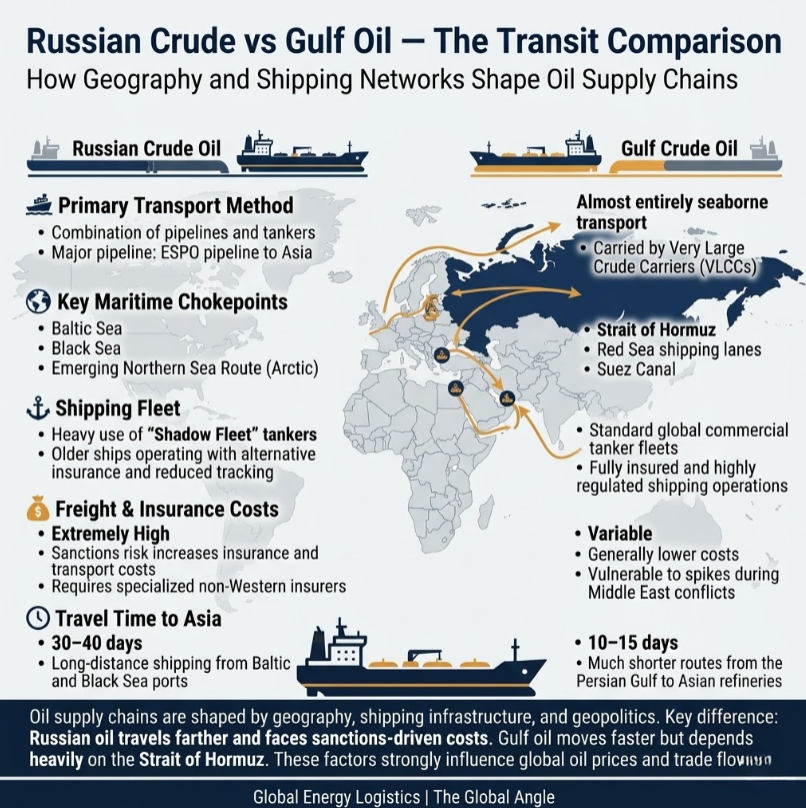
The Transit Comparison
| Logistics Parameter | Russian Crude Oil | Gulf Crude Oil |
| Primary Transport Method | A mix of pipeline networks (like the ESPO pipeline to Asia) and seaborne tankers. | Overwhelmingly seaborne via massive Very Large Crude Carriers (VLCCs). |
| Key Maritime Chokepoints | The Baltic Sea, the Black Sea, and the increasingly utilized Northern Sea Route (Arctic). | The Strait of Hormuz, the Red Sea, and the Suez Canal. |
| Shipping Fleet | Relies heavily on the “Shadow Fleet”—older vessels operating with alternative insurance and often turning off tracking transponders to bypass sanctions. | Utilizes the standard, fully insured, and highly regulated global commercial tanker fleet. |
| Freight & Insurance Costs | Extremely High. Sanctions risk and the need for specialized non-Western insurance drive up the cost of transport significantly. | Variable. Generally lower and more stable, but highly susceptible to sudden spikes during Middle Eastern geopolitical flare-ups. |
| Travel Time (to Asia) | Roughly 30 to 40 days via sea from Western Russian ports (Baltic/Black Sea) to major Asian refining hubs. | Roughly 10 to 15 days from the Persian Gulf to major Asian refining hubs, making supply chains much faster. |
Conclusion: Which is “Better”?
In the oil industry, “better” is strictly a matter of refinery hardware and landed cost.
If a nation possesses highly complex, deep-conversion refineries, the massive geopolitical discount on Russian crude makes it an incredibly lucrative, high-margin feedstock—despite the longer travel times and logistical headaches.
Conversely, Gulf crude remains the bedrock of the global energy system. Its reliable quality, faster shipping times to the East, and transparent pricing make it the indispensable baseline for the majority of the world’s refineries.
Frequently Asked Questions
Is Russian oil heavier than Gulf oil?
Generally, yes. The primary Russian export blend, Urals, is slightly heavier and often has a marginally higher sulfur content than the benchmark Arab Light blend from the Gulf. However, Russia also produces lighter, sweeter blends like ESPO (Eastern Siberia-Pacific Ocean) crude, which rivals premium global oils.
Why is Russian crude oil cheaper?
Russian crude currently trades at a significant discount primarily due to international sanctions, import bans by Western nations, and price cap mechanisms. This forces Russia to offer steep discounts to attract buyers in alternative markets willing to take on the financial and logistical risks of transporting it.
Which oil is better for producing diesel?
Both medium sour crudes are excellent for diesel, but Russian Urals is specifically prized by complex refineries for its high middle-distillate yield, making it highly efficient for producing diesel, jet fuel, and heating oil.
ALSO READ: Who is Winning the US Iran War 2026? Casualties, Costs, and the 2026 Timeline
ALSO READ: Global Oil Price Hike 2026: Petrol Prices & Strategic Reserves by Country

The Complete History of Iran Israel Relations: From Secret Allies to Arch-Rivals
Executive Briefing The Dramatic Shift: Today, Iran and Israel are engaged in a sprawling, multi-front…
Russian vs Gulf Crude Oil: Price, Refining, and Efficiency Compared
Executive Briefing Two of the most heavily traded categories in the world are Russian vs…

Who is Winning the US Iran War 2026? Casualties, Costs, and the 2026 Timeline
Executive Briefing (Update: March 12, 2026) As the 2026 Middle East conflict reshapes the global…

Global Oil Price Hike 2026: Petrol Prices & Strategic Reserves by Country
Executive Briefing Global Oil Price Hike 2026 (Update: March 12, 2026) The Price Shock: Following…

Can Trump Be Impeached In Midterm Elections 2026? Odds, Stats, and the Process Explained
Executive Briefing (Update: March 2026) As the United States gears up for the pivotal 2026…

Who Was Arrested From the Epstein Files in 2026? Photos & Facts
Executive Briefing (Update: March 2026) If you are wondering exactly who was arrested from the…

Ibrahim is the Founder and Lead Analyst at The Global Angle, an independent digital platform dedicated to factual geopolitical analysis and international affairs. Based in India, he combines an engineering background with a deep focus on global markets, diplomacy, and strategic security. Ibrahim leverages a data-driven, analytical approach to break down complex international conflicts and economic shifts, helping readers see beyond standard news narratives. When he isn’t researching global policy, he focuses on digital publishing, search engine optimization, and platform architecture.