Executive Briefing
- The core event: The executive branch delivered a record-breaking 107-minute address immediately following the Supreme Court’s striking down of its signature global tariff policy.
- The primary data point: The administration claimed record-low inflation, despite federal data showing a 2.4% rate in January 2026—a drop from 3.0% inherited, but far from historic lows.
- The hidden geopolitical impact: Refusing to seek congressional approval for international trade tariffs guarantees profound regulatory uncertainty, forcing multinational supply chains to price in massive legal risk ahead of the midterms.

The executive branch faces an unprecedented legislative and judicial bottleneck. Delivering the longest address in congressional history, the President confronted a visibly hostile chamber.
Any serious assessment of the 2026 State of the Union Analysis requires looking past the localized partisan friction to evaluate the underlying global economic indicators. The true narrative centers on international trade volatility and rapid Middle Eastern military posturing.
The administration is attempting to project absolute authority over an increasingly fractured institutional foundation.
The Tariff Nullification and Trade Ambiguity
The Supreme Court fundamentally altered the administration’s economic strategy last Friday. By striking down the executive branch’s global tariffs, the judiciary eliminated Washington’s primary international trade lever.
The President explicitly rejected the need for congressional intervention.
He stated that legislative action to codify the tariffs remains unnecessary. This signals a prolonged period of legal ambiguity for international importers. Relying on executive authority alone, rather than statutory law, forces multinational corporations into a defensive posture.
Corporate boards cannot formulate long-term capital expenditures based on contested executive orders.
| Economic Claim | Executive Assertion | Verified Federal/Market Data |
| Inflation Rate | Inherited “record levels” | 2.4% (Jan 2026), down from 3.0% (Jan 2025). |
| Job Market | “Roaring economy” | Anemic 2025 growth; rising national unemployment rate. |
| Energy Costs | Sub-$2.30/gallon gas | AAA confirms zero state averages currently below $2.30. |
| Foreign Direct Investment | $18 Trillion committed | Figure lacks institutional or financial verification. |
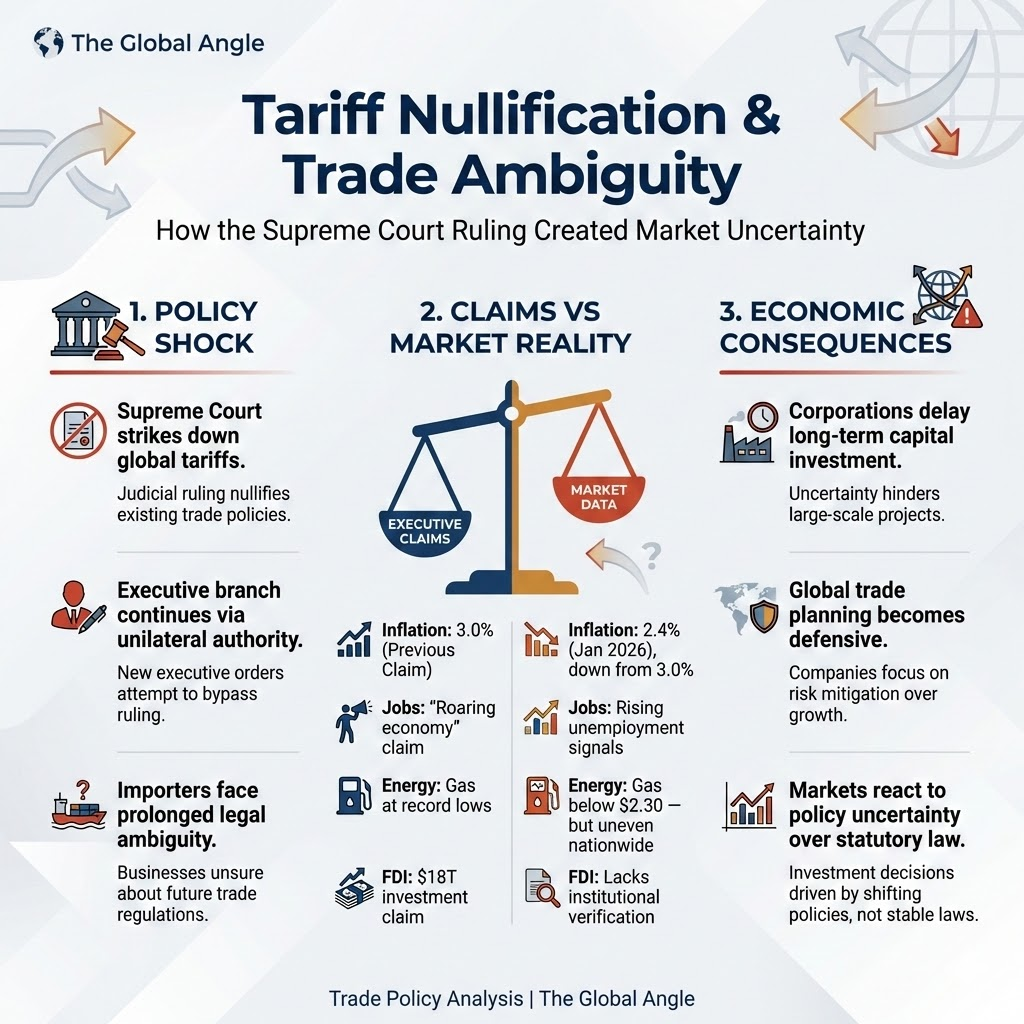
The divergence between executive claims and actual federal data highlights a highly defensive domestic economic strategy. The President boldly predicted that foreign tariffs will eventually replace the modern income tax system entirely.
Global markets will likely ignore this projection, recognizing the constitutional inability of the executive to unilaterally alter the federal tax code without the House of Representatives.
Persian Gulf Posturing and the Nuclear Paradox
The address marked a sharp escalation in rhetoric regarding the Persian Gulf.
Eight months ago, the administration executed targeted strikes intended to dismantle Iranian nuclear infrastructure. Now, the executive branch is openly forecasting secondary kinetic operations.
The President cited the deaths of thousands of American service members and 32,000 Iranian protesters as justification for maintaining a maximum-pressure military posture.
He stated unequivocally that Tehran will not acquire a nuclear weapon.
This dual-track messaging creates profound uncertainty in global energy markets. Claiming the absolute obliteration of a nuclear program while simultaneously threatening preemptive strikes against its resurrection signals a massive intelligence gap.
| Strategic Threat Vector | Administrative Stance | Regional Geopolitical Implication |
| Iran Nuclear Capability | Zero-tolerance for weapons development. | Elevated risk of preemptive U.S. airstrikes in 2026. |
| Regional Proxies | Highlighting attacks on U.S. forces. | Potential for asymmetric warfare targeting shipping lanes. |
| Diplomatic Leverage | Preferring to “cut a deal.” | Contradictory messaging weakens allied coalition building. |
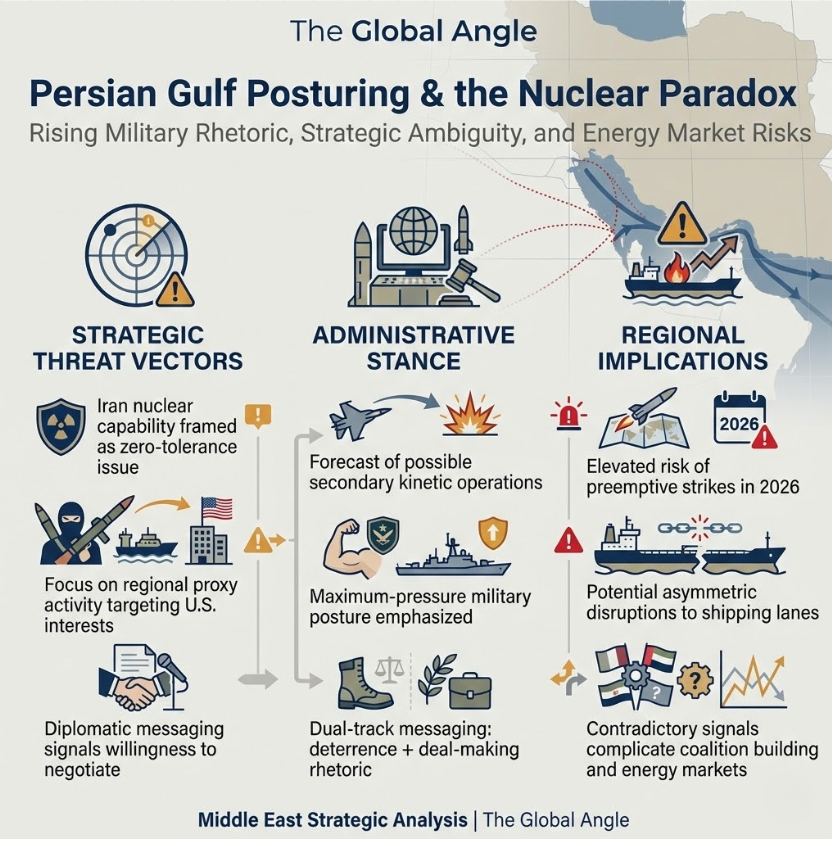
Brent crude prices will absorb a heavy risk premium as the threat of regional escalation normalizes. Foreign ministries in Europe and Asia are already re-evaluating their reliance on maritime logistics routed through the Strait of Hormuz.
Domestic Fractures and Legislative Paralysis
Domestic political stability directly dictates international market confidence. The physical environment inside the House chamber reflected severe institutional degradation.
Democratic representatives actively protested the speech.
Multiple lawmakers openly yelled at the executive. Capitol security escorted Representative Al Green from the chamber following a visual protest referencing a deleted social media post. When the President claimed to have ended eight wars, a dissenting lawmaker loudly accused him of lying.
| Incident | Lawmaker/Faction | Institutional Context |
| Visual Protest & Removal | Rep. Al Green (TX) | Escorted out; follows a previous censure for a similar protest. |
| Vocal Interruptions | Rep. Tlaib (MI), Rep. Omar (MN) | Ignored party leadership warnings against floor outbursts. |
| The “Liar” Accusation | Unidentified Democrat | Echoed the infamous 2009 Joe Wilson interruption. |
| The “Angel Moms” Stand | Republican Caucus | Highlighted the severe partisan split on border enforcement. |
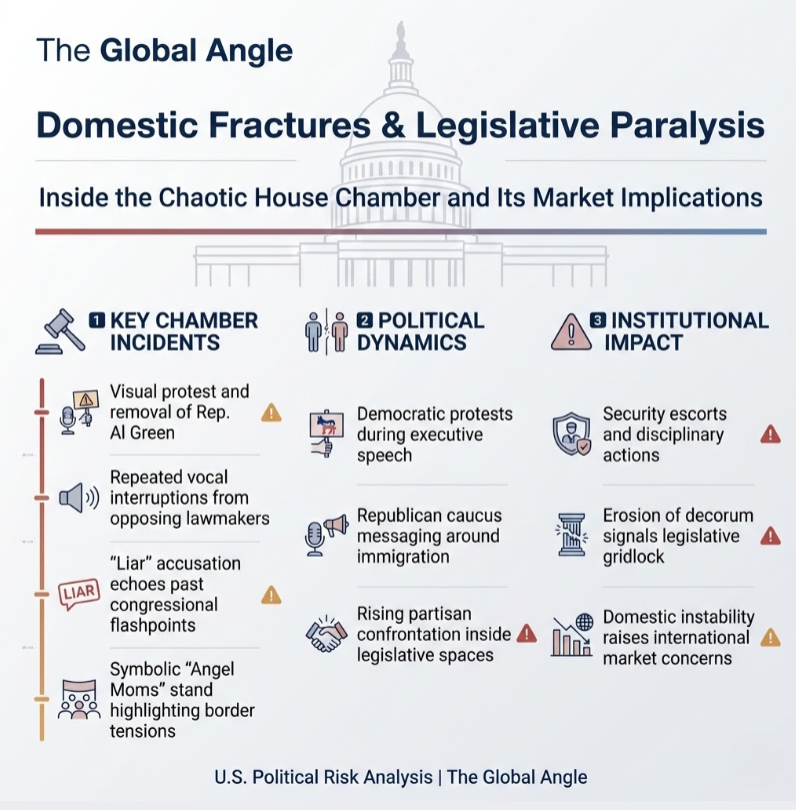
This level of visible hostility guarantees total legislative gridlock for the remainder of the calendar year.
The Securitization of the Electoral Process
The administration is heavily leaning into immigration enforcement and election security to galvanize its base ahead of the midterms.
The President actively goaded opposition lawmakers on border policy. He categorized undocumented migration strictly as a “border invasion.”
Furthermore, pushing the “Save America Act” and highlighting Department of Justice seizures of 2020 ballots in Fulton County, Georgia, indicates a highly defensive electoral strategy. He explicitly accused the opposition party of requiring fraud to win elections.
This was not a celebratory address aimed at national unity.
It was a tactical maneuver designed to project executive strength amidst mounting judicial defeats and anemic economic growth. Foreign allies and adversaries alike will interpret this absolute gridlock as an opportunity to aggressively renegotiate their own bilateral leverage with Washington.
Frequently Asked Questions
How does the 2026 State of the Union impact global trade policy?
The administration’s refusal to seek congressional codification for its global tariffs—following their nullification by the Supreme Court—creates severe legal ambiguity. International importers and supply chains must now operate under the constant threat of regulatory shifts dictated purely by executive order.
What is the current administration’s stance on military action in Iran?
The address confirmed a willingness to authorize secondary kinetic strikes against Iranian infrastructure. Despite claiming to have dismantled their nuclear program eight months prior, the executive branch warned that Tehran is attempting to rebuild it, signaling a high probability of future military engagement in the Persian Gulf.
ALSO READ: Pakistan attack on Afghanistan: Can Afghanistan Retaliate to the Pakistan Attack?
ALSO READ: Analyzing the Escalating Mexico Cartel War and The Fall of El Mencho

The Complete History of Iran Israel Relations: From Secret Allies to Arch-Rivals
Executive Briefing The Dramatic Shift: Today, Iran and Israel are engaged in a sprawling, multi-front…
Russian vs Gulf Crude Oil: Price, Refining, and Efficiency Compared
Executive Briefing Two of the most heavily traded categories in the world are Russian vs…
Who is Winning the US Iran War 2026? Casualties, Costs, and the 2026 Timeline
Executive Briefing (Update: March 12, 2026) As the 2026 Middle East conflict reshapes the global…

Global Oil Price Hike 2026: Petrol Prices & Strategic Reserves by Country
Executive Briefing Global Oil Price Hike 2026 (Update: March 12, 2026) The Price Shock: Following…
Can Trump Be Impeached In Midterm Elections 2026? Odds, Stats, and the Process Explained
Executive Briefing (Update: March 2026) As the United States gears up for the pivotal 2026…
Who Was Arrested From the Epstein Files in 2026? Photos & Facts
Executive Briefing (Update: March 2026) If you are wondering exactly who was arrested from the…

Ibrahim is the Founder and Lead Analyst at The Global Angle, an independent digital platform dedicated to factual geopolitical analysis and international affairs. Based in India, he combines an engineering background with a deep focus on global markets, diplomacy, and strategic security. Ibrahim leverages a data-driven, analytical approach to break down complex international conflicts and economic shifts, helping readers see beyond standard news narratives. When he isn’t researching global policy, he focuses on digital publishing, search engine optimization, and platform architecture.