Executive Briefing (BRICS Currency Explained)
- The Big Misconception: BRICS is not printing a single, physical paper currency like the Euro. Instead, they are launching BRICS Pay—a massive digital financial architecture designed to bypass the U.S. dollar entirely.
- The 2026 Push: Under India’s current BRICS presidency, the bloc is aggressively pushing to interconnect their national digital currencies (CBDCs) and domestic payment systems (like UPI and Pix) before the end of the year.
- The U.S. Retaliation: The threat is so severe that U.S. President Donald Trump has explicitly threatened to impose 100% tariffs on any nation that adopts a BRICS currency system to replace the dollar.
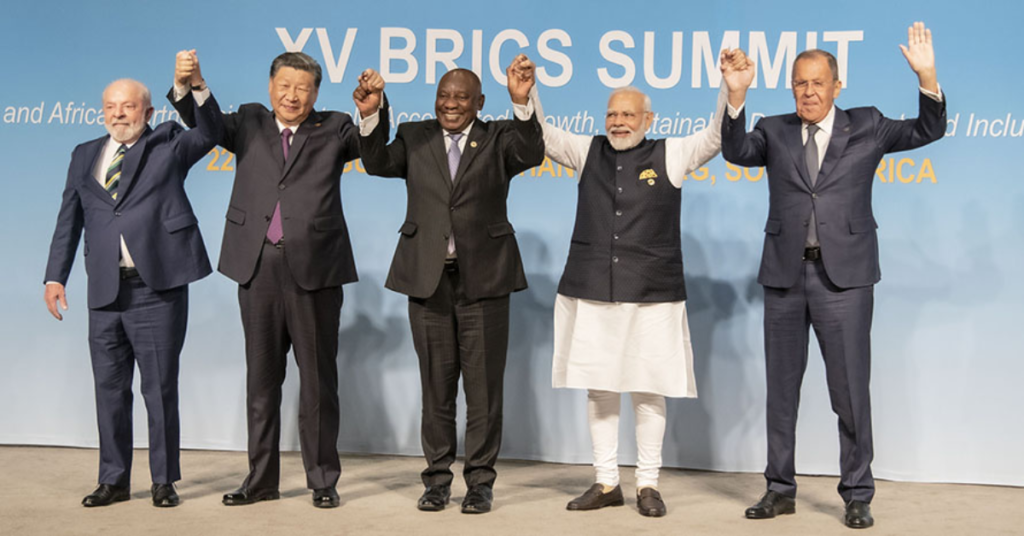
For the last three years, rumors of a gold-backed “BRICS currency” have dominated the geopolitical news cycle. With massive economies like Saudi Arabia, the UAE, and Iran now in the fold, the bloc controls a staggering portion of the world’s oil and population.
But to understand how BRICS is actually reshaping the global economy in 2026, we have to separate internet rumors from financial reality. Here is the definitive, data-driven breakdown of what the BRICS currency actually is, when it will be implemented, and why Washington is panicking.
What is the “BRICS Currency” Actually? (BRICS Pay)
Let’s clear up the biggest misconception right now: There is no physical BRICS banknote. You cannot go to a bank and exchange dollars for a “BRICS Coin.”
Uniting the economies of China, India, Russia, and Brazil under a single central bank and a single interest rate is economically impossible right now—their economies are simply too different.
Instead of a shared currency, BRICS has built a shared system. It is called BRICS Pay, powered by a Decentralized Cross-border Messaging System (DCMS).
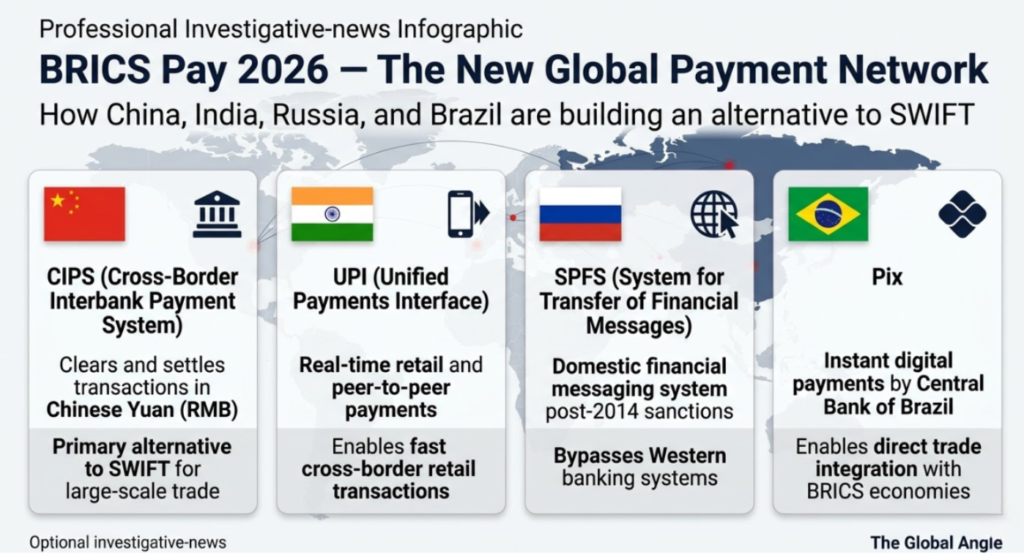
Think of it as an alternative to SWIFT. Rather than forcing a country like India to convert Rupees into U.S. Dollars to buy oil from Russia (which requires going through Western clearinghouses), BRICS Pay digitally links India’s UPI, Russia’s SPFS, China’s CIPS, and Brazil’s Pix. It allows member nations to trade directly in their own local, national currencies using blockchain and Central Bank Digital Currencies (CBDCs).
BRICS Currency Explained
| Country | Domestic Digital System | Core Function | Role in the 2026 BRICS Pay Network |
| China | CIPS (Cross-Border Interbank Payment System) | Clearing and settlement services in Chinese Yuan (RMB). | Acts as the primary heavy-weight alternative to SWIFT for massive energy and manufacturing trades. |
| India | UPI (Unified Payments Interface) | Instant real-time domestic retail and peer-to-peer payments. | Provides the high-speed, consumer-level transaction technology being adapted for cross-border retail trade. |
| Russia | SPFS (System for Transfer of Financial Messages) | Domestic financial messaging network developed after 2014 sanctions. | Serves as the blueprint for bypassing Western banking clearinghouses entirely. |
| Brazil | Pix | Instant electronic payment system managed by the Central Bank of Brazil. | Integrates South America’s largest economy into the network, allowing direct Real-to-Yuan commodity settlements. |
How is it Advantageous? (The System Comparison)
Why would nations spend billions developing an entirely new financial plumbing system? Because relying on the U.S. dollar comes with massive geopolitical strings attached.
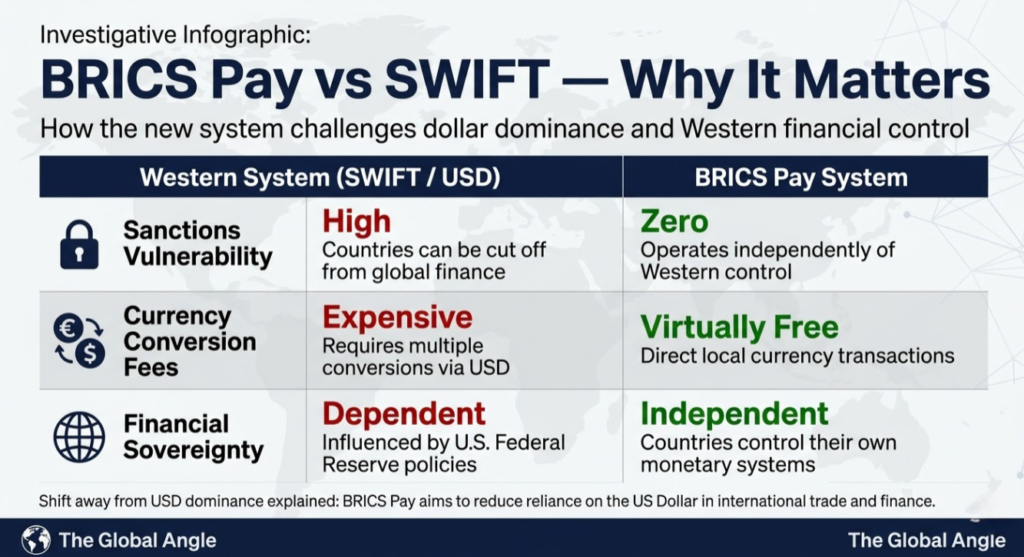
| Economic Parameter | The Western System (SWIFT / USD) | The BRICS Pay System |
| Sanctions Vulnerability | High. The U.S. can instantly freeze a country out of the global economy (as seen with Russia and Iran) by blocking their access to SWIFT and dollar reserves. | Zero. The system operates independently of Western clearinghouses, making it entirely sanction-proof. |
| Currency Conversion Fees | Expensive. Bilateral trade usually requires a double-conversion (e.g., Brazilian Real $\rightarrow$ USD $\rightarrow$ Chinese Yuan), resulting in high banking fees. | Virtually Free. Direct local currency swapping (Real $\rightarrow$ Yuan) using decentralized blockchain architecture removes the middleman. |
| Financial Sovereignty | Dependent. Nations are at the mercy of U.S. Federal Reserve interest rate hikes, which can crash emerging market currencies overnight. | Independent. Allows nations to trade commodities (like oil and minerals) based on their own sovereign monetary policies. |
How is it a Threat to the U.S. Dollar?
The U.S. dollar is the world’s reserve currency. This status grants the United States “exorbitant privilege”—the ability to run massive national deficits, borrow money cheaply, and project immense geopolitical power through financial sanctions.
If BRICS Pay succeeds, it triggers De-dollarization.
If China, India, Russia, Saudi Arabia, and the UAE start trading oil, tech, and agriculture entirely in local digital currencies, the global demand for the U.S. dollar will plummet. If fewer countries need dollars to buy oil, the value of the dollar drops, U.S. inflation could skyrocket, and the American government’s ability to fund its massive $34+ trillion national debt becomes severely compromised.
This is exactly why Washington views BRICS Pay not just as a financial tool, but as a direct national security threat.
BRICS+ vs. The G7
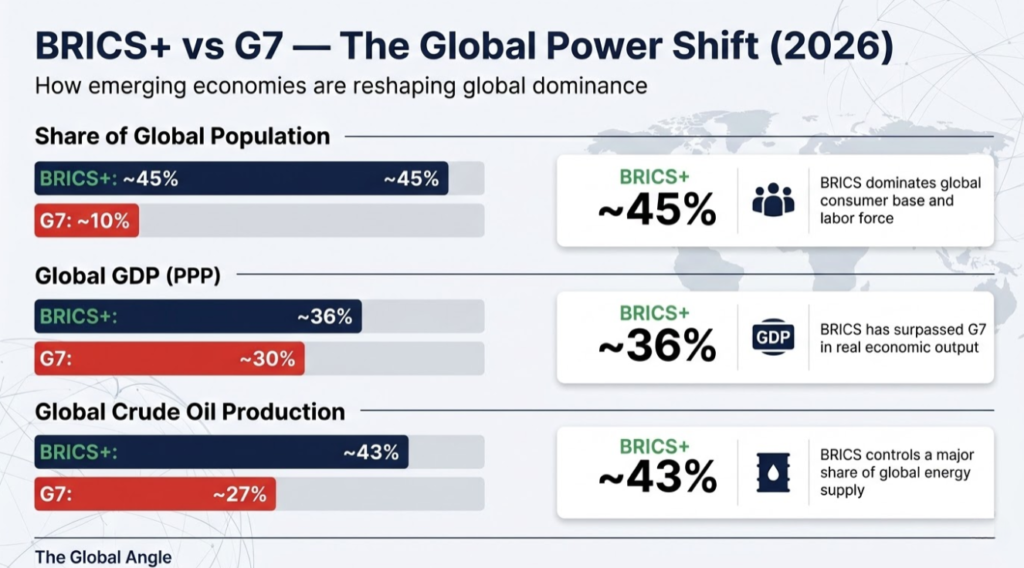
| Global Metric (2026 Est.) | BRICS+ (Expanded Bloc) | The G7 (Western Bloc) | Why This Threatens the U.S. Dollar |
| Share of Global Population | ~45% | ~10% | BRICS controls the vast majority of the world’s consumer base and future labor force. |
| Global GDP (Purchasing Power Parity) | ~36% | ~30% | The BRICS bloc has officially surpassed the G7 in actual economic output (adjusted for local costs). |
| Global Crude Oil Production | ~43% | ~27% | With Saudi Arabia, the UAE, and Iran joining Russia, BRICS now dictates the global energy market. If they stop pricing oil in dollars, the Petrodollar system collapses. |
When Will It Be Implemented? (The 2026 Timeline)
The timeline for implementation is happening right now.
- 2024 (The Pilot): A prototype demonstration of BRICS Pay was successfully showcased at the Kazan Summit in Russia.
- 2025 (The Infrastructure): Russia, China, and the UAE began actively testing CBDC bridges for energy transactions to bypass Western financial restrictions.
- 2026 (The Rollout): With India holding the 2026 BRICS presidency, the official agenda includes a massive push for cross-border digital payment architecture. The goal is to successfully link the CBDCs of the core BRICS nations by late 2026, creating a functioning, high-volume alternative to SWIFT for major state-to-state transactions.
What is the Value of the BRICS Currency?
Because it is a decentralized payment protocol rather than a printed fiat currency, the BRICS currency does not have an exchange rate or a standalone “value.”
Warning: If you see online charts tracking the “price” of a BRICS coin, or someone trying to sell you a BRICS cryptocurrency token, it is a scam.
The “value” of the BRICS financial system is measured by the volume of trade passing through it. Currently, Russia reports that roughly 90% of its trade within the BRICS bloc is already being conducted in national currencies. The true value of this initiative is the hundreds of billions of dollars in bilateral trade that is successfully bypassing the American financial system.
Frequently Asked Questions (BRICS Currency & BRICS Pay)
Is there a physical BRICS currency?
No, there is no physical paper money or single fiat “BRICS currency” like the Euro. Uniting the vastly different economies of China, India, Russia, and Brazil under one central bank is currently impossible. Instead, the bloc is developing a decentralized digital financial architecture (BRICS Pay) to allow member nations to trade directly using their own local currencies.
What is BRICS Pay?
BRICS Pay is a decentralized cross-border payment messaging system designed by the BRICS member states. It functions as an alternative to the Western-dominated SWIFT system. By utilizing blockchain technology and Central Bank Digital Currencies (CBDCs), BRICS Pay allows countries to settle international trade (like buying oil or tech) without needing to convert their money into U.S. dollars first.
How much is 1 BRICS currency in USD?
Because the BRICS currency is not a printed fiat currency or a centralized crypto token, it does not have an exchange rate or a standalone value in U.S. dollars. Any online platform, chart, or exchange claiming to sell “BRICS coins” or showing a fluctuating BRICS currency price is a scam. The system’s true “value” is measured by the billions of dollars in bilateral trade it facilitates outside the U.S. banking system.
Will the BRICS currency replace the U.S. dollar?
The BRICS financial system will not immediately replace the U.S. dollar as the world’s primary reserve currency. However, it is actively driving a trend called “de-dollarization.” By allowing massive energy exporters (like Saudi Arabia, the UAE, and Russia) and massive consumers (like China and India) to trade in local currencies, it significantly reduces global reliance on the dollar, which threatens U.S. financial hegemony over time.
ALSO READ: India BRICS Presidency 2026: Leadership in an Era of Global Uncertainty
ALSO READ: Indian Oil Imports Diversification: India’s Strategy Against the 2026 Energy Crisis
Russia Ukraine War 2026: Analysis of Drone and Missile Strikes
Executive Summary of Russia Ukraine War 2026 (25 March 2026) The News: A coordinated Russian…
Is the U.S. Losing the Iran War? What are Iran’s Demands For Peace Talks
Executive Briefing (Update: March 2026) The Asymmetric Advantage: Despite weeks of heavy U.S. and Israeli…
EU Australia Free Trade Agreement: Tariffs, Critical Minerals, and Global Impact
Executive Briefing (Update: March 2026) The A$10 Billion Milestone: Following eight years of complex negotiations,…

Iran War Impact On Russia Ukraine War: Battlefield Updates, Middle East Impact, and Peace Talks
Executive Briefing (Update: March 2026) For observers tracking global geopolitics, the Russia-Ukraine war can no…

Can China Takeover Taiwan in 2026? Why Does China Wants Taiwan
Executive Briefing (Update: March 2026) The Vulnerability: With the United States heavily entrenched in a…

The Pakistan Afghanistan War 2026 Explained: Why Former Allies Are Now Fighting
Executive Briefing (Update: March 2026) The Current Situation: Pakistan Afghanistan War 2026is currently engaged in…

Ibrahim is the Founder and Lead Analyst at The Global Angle, an independent digital platform dedicated to factual geopolitical analysis and international affairs. Based in India, he combines an engineering background with a deep focus on global markets, diplomacy, and strategic security. Ibrahim leverages a data-driven, analytical approach to break down complex international conflicts and economic shifts, helping readers see beyond standard news narratives. When he isn’t researching global policy, he focuses on digital publishing, search engine optimization, and platform architecture.