Executive Briefing
- The Dramatic Shift: Today, Iran and Israel are engaged in a sprawling, multi-front conflict. Yet, for nearly three decades, they were close strategic allies sharing intelligence, military technology, and massive oil pipelines.
- The Turning Point: The 1979 Islamic Revolution severed all diplomatic and economic ties overnight, transforming Israel into the ideological enemy of the new Iranian state.
- The Current Reality: The conflict has evolved from a “shadow war” of cyberattacks and proxy militias into direct, overt military confrontations, fundamentally destabilizing the modern Middle East.
To understand the current geopolitical crises dominating the headlines, it is essential to look backward. The animosity between Jerusalem and Tehran is not ancient; it is a modern geopolitical rivalry shaped by shifting alliances, regime changes, and the fight for regional hegemony.
Here is the complete, chronological history of Iran-Israel relations, broken down by the defining eras that shaped the modern Middle East.
Phase 1: Ambivalence and Early Encounters (1947–1953)
Before the 1979 revolution, Iran was a monarchy ruled by the Pahlavi dynasty. During the establishment of the State of Israel, Iran’s position was cautious and ambivalent.
In 1947, Iran was one of the 13 nations that voted against the UN Partition Plan for Palestine, arguing it would lead to decades of regional violence. However, pragmatism quickly took over. By 1950, Iran became the second Muslim-majority nation (after Turkey) to grant de facto (practical) recognition to Israel.
This brief relationship was paused in 1951 when Iranian Prime Minister Mohammad Mossadegh, during his campaign to nationalize Iranian oil, severed ties to appease Arab nations. However, a Western-backed coup ousted Mossadegh in 1953, restoring the Shah to absolute power and paving the way for a golden era of cooperation.
Phase 2: The Alliance and the “Periphery Doctrine” (1953–1979)
Following the 1953 coup, Israel and Iran entered a period of deep, albeit highly secretive, strategic cooperation. Israel was entirely surrounded by hostile Arab states. To survive, Israeli Prime Minister David Ben-Gurion developed the “Periphery Doctrine”—a strategy of forging alliances with non-Arab nations on the edges of the Middle East, primarily Iran, Turkey, and Ethiopia.
For the Shah of Iran, an alliance with Israel provided access to advanced Western technology and a counterbalance to the rising threat of Soviet-backed Arab nationalism (led by Egypt’s Gamal Abdel Nasser).
Pillars of the Secret Alliance
- Intelligence Sharing: Israel’s Mossad helped establish and train SAVAK, the Shah’s infamous domestic intelligence agency.
- Economic Lifelines: Following the 1956 Suez Crisis, Iran became Israel’s primary oil supplier. The two nations jointly built the Eilat-Ashkelon Pipeline (EAPC), an incredibly lucrative venture allowing Iranian oil to bypass the Suez Canal and be shipped directly to Europe via Israel.
- Military Tech (Project Flower): In the late 1970s, the two countries engaged in “Project Flower,” a joint military endeavor where Iran provided funding and Israel provided the technology to develop advanced ballistic missiles.
Phase 3: The Islamic Revolution & Realpolitik (1979–1990)
The 1979 Islamic Revolution completely upended the geopolitical chessboard. The Shah was overthrown, and Ayatollah Ruhollah Khomeini established an Islamic Republic.
Khomeini immediately severed all formal ties with Israel, viewing it as an illegitimate outpost of Western imperialism. The Israeli embassy in Tehran was seized and handed over to Yasser Arafat and the Palestine Liberation Organization (PLO). Israel was officially branded the “Little Satan” (second only to the United States, the “Great Satan”).
The Realpolitik Paradox: Despite the intense ideological hatred, a shocking level of covert cooperation occurred during the 1980–1988 Iran-Iraq War. Viewing Saddam Hussein’s Iraq as the greater immediate threat, Israel covertly sold hundreds of millions of dollars in weapons and spare parts to Iran. Israel’s strategy was simple: keep both of its enemies occupied and prevent an Iraqi victory.
Phase 4: The Rise of the Shadow War (1990s–2010s)
By the early 1990s, the Gulf War had decimated Iraq’s military power. With Saddam Hussein contained, Iran and Israel were left as the two uncontested regional powers, turning their attention entirely toward one another.
The Axis of Resistance vs. Covert Operations
- Proxy Warfare: Iran heavily funded, armed, and trained its “Axis of Resistance”—a network of proxy militias designed to surround Israel. This included Hezbollah in Lebanon, Hamas and Palestinian Islamic Jihad (PIJ) in Gaza, and eventually the Houthis in Yemen.
- The Nuclear Threat: By the 2000s, Israel identified Iran’s rapidly advancing nuclear program as an existential threat.
- The Shadow War: Israel launched a massive, unacknowledged covert campaign to sabotage Iranian capabilities. This era saw the deployment of the Stuxnet computer virus (which destroyed Iranian nuclear centrifuges) and a string of targeted assassinations of high-ranking Iranian nuclear scientists inside Tehran.
Phase 5: From Proxies to Direct Conflict (2020s–Present)
The unwritten rules of the “Shadow War” collapsed over the last few years. The Syrian Civil War brought Iranian military forces directly to Israel’s northern border, leading to hundreds of Israeli airstrikes on Iranian weapons shipments in Syria.
Simultaneously, the conflict spilled into international waters, with both nations allegedly sabotaging each other’s commercial shipping vessels in the Persian Gulf and the Red Sea.
The Paradigm Shift (April 2024): The definitive break from the shadow war occurred in April 2024. Following an Israeli airstrike on the Iranian consulate in Damascus, Syria (which killed top Islamic Revolutionary Guard Corps commanders), Iran retaliated directly. For the first time in history, Iran launched a massive barrage of hundreds of drones and ballistic missiles directly from Iranian soil onto Israeli territory, forever altering the deterrence equations of the Middle East.
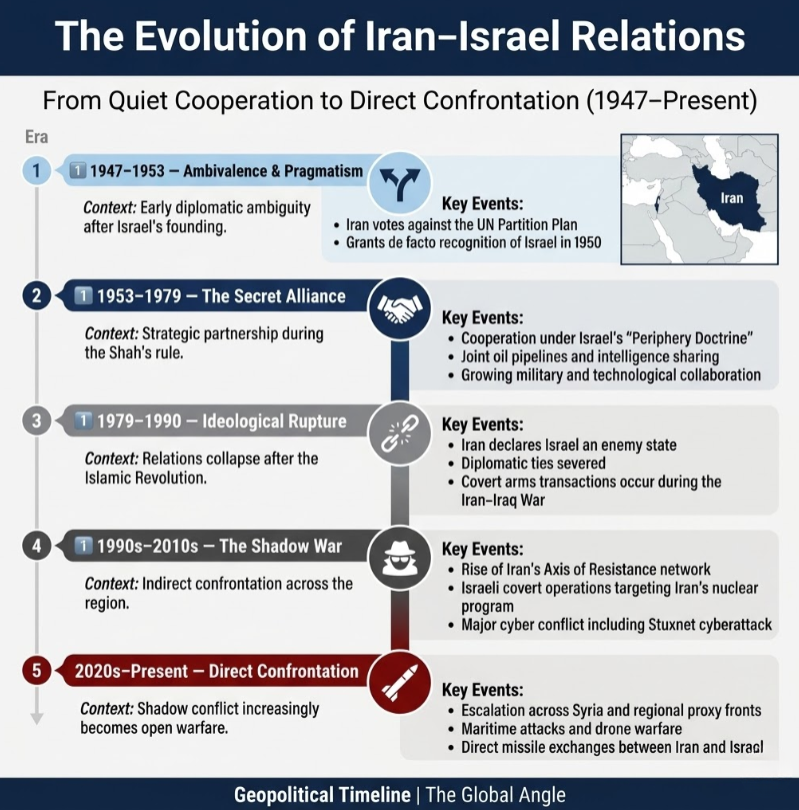
History of Iran Israel Relations
| Era | Defining Characteristics | Key Events |
| 1947–1953 | Ambivalence & Pragmatism | Iran votes against UN Partition; grants de facto recognition in 1950. |
| 1953–1979 | The Secret Alliance | The “Periphery Doctrine,” joint oil pipelines, and military tech development. |
| 1979–1990 | Ideological Rupture | The Islamic Revolution; ties severed, yet covert arms sales continue during the Iran-Iraq war. |
| 1990s–2010s | The Shadow War | Rise of the “Axis of Resistance,” Stuxnet cyberattacks, and nuclear sabotage. |
| 2020s–Present | Direct Confrontation | Spillover in Syria, maritime warfare, and direct, overt missile exchanges.# |
Frequently Asked Questions (Iran-Israel History)
Why did Iran and Israel become enemies?
Iran and Israel officially became enemies following the 1979 Islamic Revolution in Iran. The new clerical regime, led by Ayatollah Ruhollah Khomeini, fundamentally rejected the State of Israel, viewing it as an illegitimate outpost of Western imperialism. Overnight, Iran severed all diplomatic and economic ties, transforming from a strategic ally into Israel’s ideological arch-rival.
Were Iran and Israel ever allies?
Yes. From 1953 to 1979, under the rule of the Shah, Iran and Israel maintained a close, highly secretive strategic alliance. Driven by Israel’s “Periphery Doctrine,” the two nations shared intelligence, collaborated on advanced military technology (like Project Flower), and jointly operated the Eilat-Ashkelon pipeline, making Iran Israel’s primary oil supplier during that era.
Does Iran recognize Israel as a country?
No, the current government of the Islamic Republic of Iran does not recognize the State of Israel. However, historically, Iran was the second Muslim-majority nation to grant de facto (practical) recognition to Israel in 1950, before completely withdrawing that recognition after the 1979 revolution.
What is the “Shadow War” between Iran and Israel?
The “Shadow War” refers to the decades-long, unacknowledged conflict between the two nations following the Gulf War. Instead of direct military confrontation, Israel and Iran fought via proxy militias (like Hezbollah and Hamas), cyber warfare (such as the Stuxnet virus targeting Iranian nuclear facilities), covert assassinations of scientists, and sabotage of maritime shipping vessels.
ALSO READ: Who is Winning the US Iran War 2026? Casualties, Costs, and the 2026 Timeline
ALSO READ: Iran Conflict Global Stock Market Crash 2026: What Experts Predict Next
The Complete History of Iran Israel Relations: From Secret Allies to Arch-Rivals
Executive Briefing The Dramatic Shift: Today, Iran and Israel are engaged in a sprawling, multi-front…
Russian vs Gulf Crude Oil: Price, Refining, and Efficiency Compared
Executive Briefing Two of the most heavily traded categories in the world are Russian vs…
Who is Winning the US Iran War 2026? Casualties, Costs, and the 2026 Timeline
Executive Briefing (Update: March 12, 2026) As the 2026 Middle East conflict reshapes the global…
Global Oil Price Hike 2026: Petrol Prices & Strategic Reserves by Country
Executive Briefing Global Oil Price Hike 2026 (Update: March 12, 2026) The Price Shock: Following…
Can Trump Be Impeached In Midterm Elections 2026? Odds, Stats, and the Process Explained
Executive Briefing (Update: March 2026) As the United States gears up for the pivotal 2026…

Who Was Arrested From the Epstein Files in 2026? Photos & Facts
Executive Briefing (Update: March 2026) If you are wondering exactly who was arrested from the…

Ibrahim is the Founder and Lead Analyst at The Global Angle, an independent digital platform dedicated to factual geopolitical analysis and international affairs. Based in India, he combines an engineering background with a deep focus on global markets, diplomacy, and strategic security. Ibrahim leverages a data-driven, analytical approach to break down complex international conflicts and economic shifts, helping readers see beyond standard news narratives. When he isn’t researching global policy, he focuses on digital publishing, search engine optimization, and platform architecture.