Executive Summary
- The News: Just 24 hours after the US Supreme Court struck down his sweeping global import taxes, President Donald Trump announced a new, even higher Trump 15% global tariff on all imported goods.
- The Hidden Link: Trump did not defy the Supreme Court; he simply changed the legal playbook. By pivoting from the invalidated emergency powers act (IEEPA) to a dormant 1974 law regarding “balance-of-payments,” he found a temporary loophole to keep his trade agenda alive.
- The Outlook: Global supply chains face unprecedented volatility. European leaders are warning of economic “poison,” and US businesses are bracing for a chaotic 150-day window. However, the court’s ruling may accidentally trigger a massive economic stimulus right before the 2026 midterm elections.

When the highest court in the United States ruled 6-3 on Friday that President Donald Trump overstepped his constitutional authority by levying sweeping global tariffs, the business community breathed a sigh of relief.
That relief lasted exactly one day.
By Saturday morning, Trump took to Truth Social to announce not only a replacement global tariff, but an increase. The rate is now set at a staggering 15%, the absolute maximum allowed under his newly discovered legal mechanism.
How can a president legally bypass a landmark Supreme Court ruling overnight? The answer lies deep within the archives of US trade law—and the fallout is about to restructure global economics.
The Core Analysis: The Section 122 Loophole
To understand how Trump executed this maneuver, you have to look at the exact statutes involved.
The Supreme Court struck down Trump’s use of the International Emergency Economic Powers Act (IEEPA) of 1977. The court determined that “national emergencies” do not give the executive branch a blank check to write tax law, which is a power strictly reserved for Congress.
Trump immediately abandoned IEEPA and invoked Section 122 of the Trade Act of 1974.
This is a virtually never-used law originally designed for the 1970s fixed-exchange-rate era. It allows a president to unilaterally impose an import surcharge of up to 15% if the United States is facing a “fundamental international payments problem.” Because the US trade deficit just hit a record $1.24 trillion for 2025, the administration argues they have the legal justification to pull this trigger.
But Section 122 has a massive catch: It is explicitly temporary. The tariffs can only remain in place for a maximum of 150 days. After that, they expire unless Congress votes to extend them.
The Unique Angle: The “Accidental Stimulus” Paradox
While the media focuses on the legal drama, there is a massive political irony unfolding beneath the surface: the Supreme Court’s ruling against Trump might actually guarantee a booming economy for his party ahead of the November 2026 midterms.
The US Treasury has illegally collected an estimated $130 billion to $160 billion under the now-voided IEEPA tariffs. Retail groups and the US Chamber of Commerce are aggressively demanding that this money be refunded to businesses.
If the government is forced to cut $160 billion worth of refund checks to American companies over the next few months, it will act as a massive, unintended corporate stimulus. As Senator John Kennedy (R-LA) pointed out, injecting that much cash back into the business community could make the US economy “roar” just in time for the midterm elections—effectively turning a massive legal defeat into a spectacular political victory.
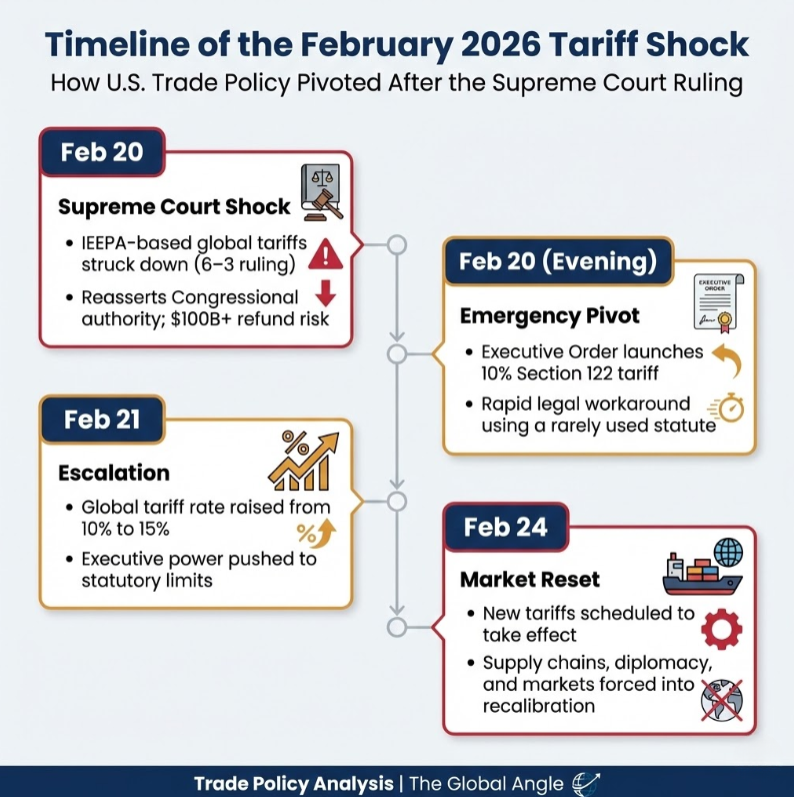
Timeline of the February 2026 Tariff Shock
| Date | Event | Geopolitical & Market Significance |
| Friday, Feb 20 | Supreme Court (6-3) strikes down IEEPA-based global tariffs. | Reasserts Congressional authority over taxation; potential for over $100 billion in refunds to importers. |
| Friday, Feb 20 (Evening) | Executive Order signed for a 10% tariff under Section 122. | A rapid executive pivot utilizing a rarely tested, 50-year-old trade statute. |
| Saturday, Feb 21 | Global tariff rate raised from 10% to 15%. | Pushes executive authority to the absolute statutory maximum limit permitted under Section 122. |
| Tuesday, Feb 24 | Scheduled effective date for the new tariffs. | Global markets, diplomatic channels, and supply chains forced into immediate recalibration. |
What Do Other Countries Say?
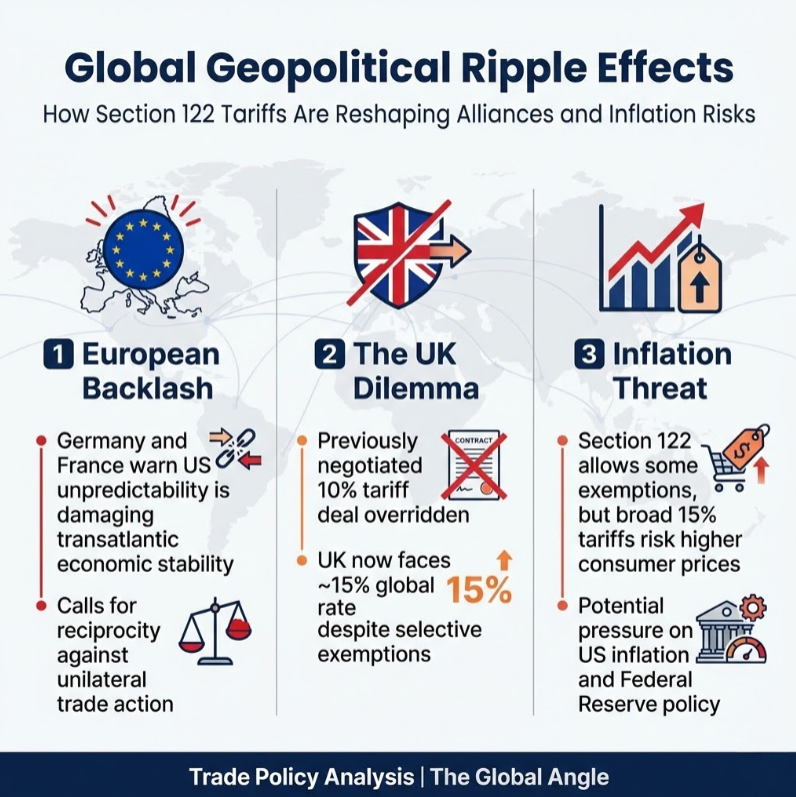
The pivot to Section 122 has thrown international allies into chaos, as this law is a blunt instrument that does not easily recognize existing trade agreements.
- The European Backlash: German Chancellor Friedrich Merz, who will be traveling to Washington soon with a coordinated European position, openly warned that this constant unpredictability is the “biggest poison” for the US-European economy. French President Emmanuel Macron echoed this, demanding reciprocity over unilateral aggression.
- The UK Dilemma: The UK recently negotiated a favorable 10% tariff deal with the US. The White House has now indicated that under Section 122, those deals are overridden, and the UK will face the full 15% global rate (though specific sector exemptions like aerospace remain untouched).
- The Inflation Threat: While Section 122 allows exemptions for critical minerals and pharmaceuticals, a 15% tax on everything else will undoubtedly be passed down to the American consumer, threatening to reignite inflation just as the Federal Reserve attempts to stabilize the economy.
The Tariff Playbook: IEEPA vs. Section 122
| Legal Framework | Original IEEPA Tariffs (Struck Down) | New Section 122 Tariffs (Active) |
| The Justification | National Security / “Unusual Threat” | Balance-of-Payments Deficit |
| The Tariff Rate | Variable (often 10% to 35%+) | Flat 15% (Maximum allowed) |
| The Time Limit | Indefinite | Strict 150-Day Limit |
| Congressional Approval | Bypassed | Required after 150 days |
Trump 15% global tariff: The 150-Day Countdown
The clock is now ticking. During this 150-day window, expect the Trump administration to frantically launch targeted investigations under other, more permanent trade laws (like Section 301 for unfair trade practices) to secure legally binding tariffs before Section 122 expires.
Simultaneously, watch the US Court of International Trade. If they mandate swift refunds for the $160 billion collected under IEEPA, we will witness one of the largest sudden capital injections in US corporate history.
Would you like me to outline a strategic guide for small business importers on how to navigate this 150-day 15% tariff window and track potential IEEPA refunds?
Frequently Asked Questions
Why did the global tariff suddenly jump from 10% to 15% in under 24 hours?
Following the 6-3 Supreme Court ruling on February 20, 2026, which invalidated the use of the International Emergency Economic Powers Act (IEEPA) for sweeping tariffs, the administration immediately pivoted to Section 122 of the Trade Act of 1974. Initially announcing a 10% rate on Friday evening, the president maximized the statutory limit the very next day, pushing the rate to the legal ceiling of 15% in response to the Court’s decision.
Can these new tariffs be extended indefinitely?
No. While Section 122 grants the executive branch the authority to impose temporary tariffs to address “balance-of-payments deficits,” the statute strictly limits this action to 150 days. Extending the 15% tariff beyond mid-July 2026 will require explicit legislative approval from Congress.
How does this impact existing bilateral trade agreements and international allies?
The 15% tariff is applied globally as a baseline, complicating recent diplomatic and trade negotiations. Countries that had previously negotiated lower specific rates—such as the UK and South Korea—now face this universal floor. European officials have warned that the constant uncertainty and unilateral actions threaten the transatlantic economy. USMCA partners (Canada and Mexico) remain the notable exceptions, shielded by compliance exemptions
Will this face further legal challenges?
It is highly likely. Legal scholars and trade organizations are already evaluating the administration’s justification. Section 122 requires a “large and serious United States balance-of-payments deficit.” Challengers may argue in federal court that trade deficits are conceptually distinct from balance-of-payments deficits, questioning whether the statutory requirements to invoke the 15% levy have actually been met.
ALSO READ: Has the Tariff War Ended? The Truth Behind the Supreme Court Ruling

The Complete History of Iran Israel Relations: From Secret Allies to Arch-Rivals
Executive Briefing The Dramatic Shift: Today, Iran and Israel are engaged in a sprawling, multi-front…

Russian vs Gulf Crude Oil: Price, Refining, and Efficiency Compared
Executive Briefing Two of the most heavily traded categories in the world are Russian vs…

Who is Winning the US Iran War 2026? Casualties, Costs, and the 2026 Timeline
Executive Briefing (Update: March 12, 2026) As the 2026 Middle East conflict reshapes the global…

Global Oil Price Hike 2026: Petrol Prices & Strategic Reserves by Country
Executive Briefing Global Oil Price Hike 2026 (Update: March 12, 2026) The Price Shock: Following…
Can Trump Be Impeached In Midterm Elections 2026? Odds, Stats, and the Process Explained
Executive Briefing (Update: March 2026) As the United States gears up for the pivotal 2026…
Who Was Arrested From the Epstein Files in 2026? Photos & Facts
Executive Briefing (Update: March 2026) If you are wondering exactly who was arrested from the…

Ibrahim is the Founder and Lead Analyst at The Global Angle, an independent digital platform dedicated to factual geopolitical analysis and international affairs. Based in India, he combines an engineering background with a deep focus on global markets, diplomacy, and strategic security. Ibrahim leverages a data-driven, analytical approach to break down complex international conflicts and economic shifts, helping readers see beyond standard news narratives. When he isn’t researching global policy, he focuses on digital publishing, search engine optimization, and platform architecture.