Executive Summary
- Trump’s Board of Peace The News: U.S. President Donald Trump has officially convened the inaugural Washington meeting of the “Board of Peace,” a newly minted international organization tasked with global conflict resolution and the immediate reconstruction of Gaza.
- The Hidden Link: This is not a standard diplomatic initiative; it is a corporate takeover of global governance. By implementing a $1 billion entrance fee for permanent membership and bypassing universal consensus, it effectively replaces traditional diplomacy with a pay-to-play shareholder model.
- The Outlook: Backed by $17 billion in initial pledges and a planned 20,000-strong International Stabilization Force (ISF) for Gaza, the Board will move significantly faster than the UN. However, its glaring exclusion of traditional European powers will inevitably fracture the Western alliance.
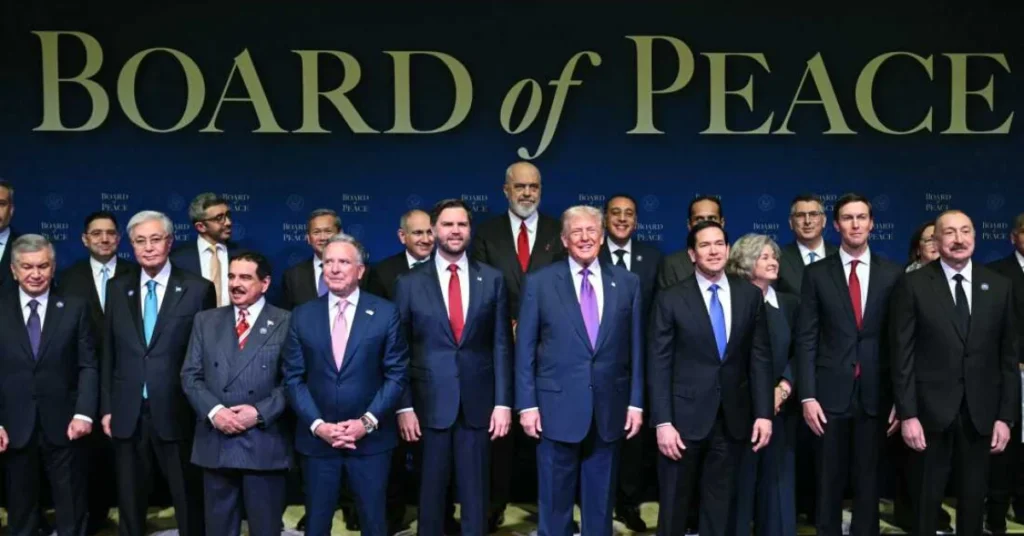
On February 19, 2026, the diplomatic gravity of the world briefly shifted from the glass corridors of the United Nations in New York to a private, invite-only room in Washington, D.C.
Donald Trump officially gaveled in the first working session of the Board of Peace (BoP). Ostensibly born from UN Security Council Resolution 2803 to manage the post-war reconstruction of the Gaza Strip, the Board has rapidly morphed into something entirely different. It is a permanent, standing organization designed to sideline the bureaucratic gridlock of the United Nations.
But how does a private, U.S.-led geopolitical club actually work? And more importantly, why are major emerging powers like India refusing to buy a seat at the table?
The Core Analysis: A “Corporate” Peace Architecture
The Board of Peace is structured less like a diplomatic forum and more like the executive board of a Fortune 500 company.
Its stated aim and objective is to act as a rapid-response mechanism for global conflict resolution, beginning with the complete demilitarization and economic redevelopment of Gaza (which attendees aggressively pitched as a future “Mediterranean Riviera”).
However, the mechanics of the Board are deeply controversial:
- The Ultimate Veto: The charter explicitly names Donald Trump as “Chairman for Life.” He possesses sweeping, unilateral authority to invite members, expel them, and veto any board resolution.
- The $1 Billion Paywall: This is the most shocking criterion. To gain permanent membership status, a nation must deposit $1 billion into a central fund. Countries that do not pay the fee are limited to three-year, renewable terms—subject entirely to the Chairman’s discretion.
- The Executive Tier: Instead of seasoned multilateral diplomats, the founding Executive Board features private capital heavyweights, including Steve Witkoff, Marc Rowan, and Jared Kushner, alongside political allies like Marco Rubio and Tony Blair.
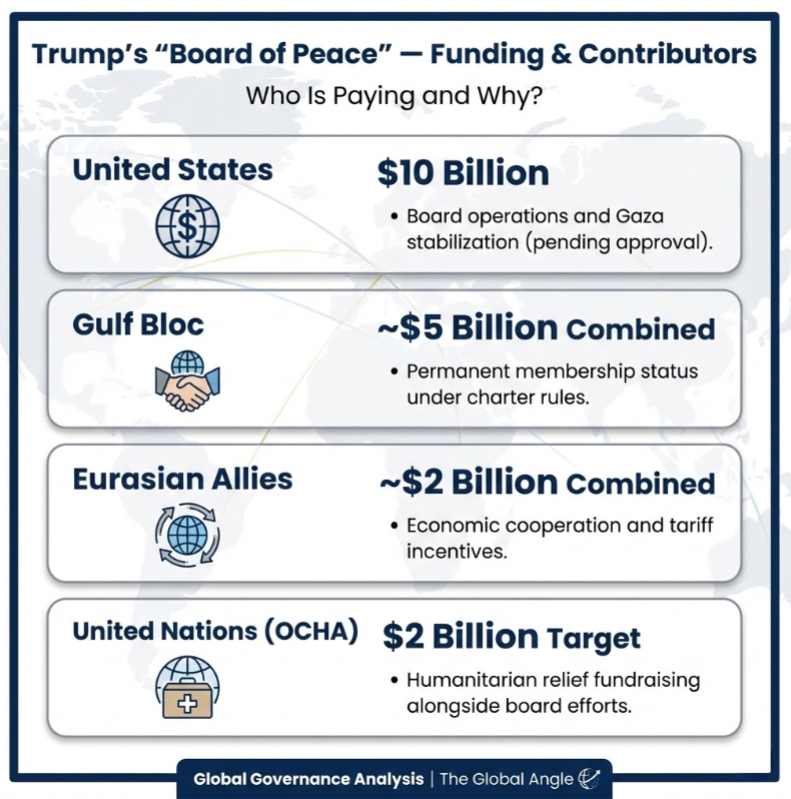
| Contributing Nation / Bloc | Pledged Amount | Strategic Purpose / Caveat |
| United States | $10 Billion | General board efforts and Gaza stabilization; however, this sum still requires formal US Congressional approval. |
| The “Gulf Bloc” (UAE, Saudi Arabia, Qatar, Kuwait, Bahrain) | ~$5 Billion (Combined) | Each major Gulf state pledged at least $1 billion, automatically securing their “Permanent Member” status under the charter’s pay-to-play rules. |
| The “Eurasian Allies” (Kazakhstan, Azerbaijan, Uzbekistan, Morocco) | ~$2 Billion (Combined) | Contributions aimed at securing U.S. economic favor and tariff reprieves under the Trump administration. |
| United Nations (OCHA) | $2 Billion (Target) | A parallel fundraising goal coordinated by the UN to support humanitarian relief alongside the Board’s efforts. |
The Historical Parallel
You have to look back to the Concert of Europe in 1815 to find a similar architectural shift. Following the Napoleonic Wars, a handful of great powers agreed to manage global stability through exclusive, closed-door agreements rather than universal treaties. The Board of Peace is the 21st-century, monetized version of this. It operates on the premise that global equality is a myth, and peace can only be enforced by a “coalition of the willing” backed by massive financial leverage.
Trump’s Board of Peace vs. The United Nations
Why is this causing panic in diplomatic circles? Because the Board strips away the foundational elements of international law.
When the UN Security Council makes a ruling under Chapter VII, it becomes binding international law across 193 nations. The Board of Peace has no such universal authority. It relies entirely on transactional pressure and voluntary military commitments from its specific members.
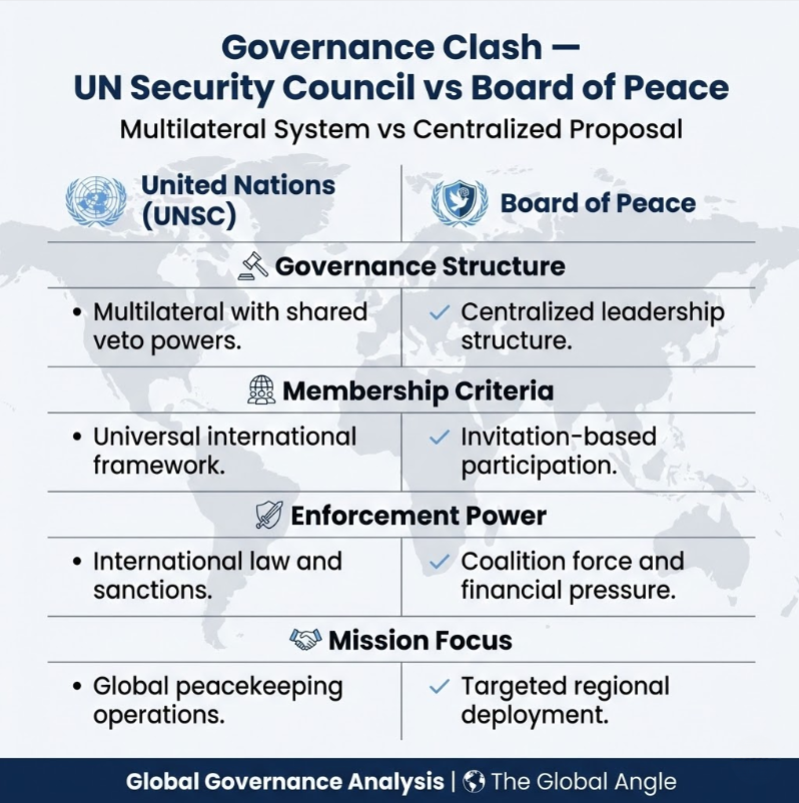
The Governance Clash: UN Security Council vs. Board of Peace
| Metric | United Nations (UNSC) | Trump Board of Peace |
| Governance Structure | Multilateral (15 members, 5 vetos) | Unilateral (Trump holds sole veto and lifetime chairmanship) |
| Membership Criteria | Universal (193 recognized nations) | Invitation-only. Permanent seat requires a $1 Billion fee. |
| Enforcement Power | International Law & Global Sanctions | Coalition military force & localized financial pressure |
| Current Mission Focus | Global peacekeeping ops globally | Deployment of 20,000 ISF troops & 12,000 police to Gaza |
The Global Roster: Who is In, and Who is Out?
Trump invited roughly 60 nations to join. As of late February 2026, about 28 countries have signed the charter.
- The Enthusiasts: Middle Eastern and Asian nations looking to secure U.S. favor or investment have flocked to the Board. The UAE, Saudi Arabia, Qatar, Egypt, Turkey, Indonesia, and Kazakhstan are officially in. Right-wing-led nations like Argentina, El Salvador, and Hungary also signed eagerly.
- The Rejects: Sub-Saharan Africa was almost entirely ignored during the invitation process, sparking outrage over regional marginalization.
- The Boycott: Traditional U.S. allies—including France, the UK, Germany, and Canada—have refused to join, viewing the Board as a direct threat to the UN’s legitimacy. Even Pope Leo XIV explicitly declined the Vatican’s invitation.
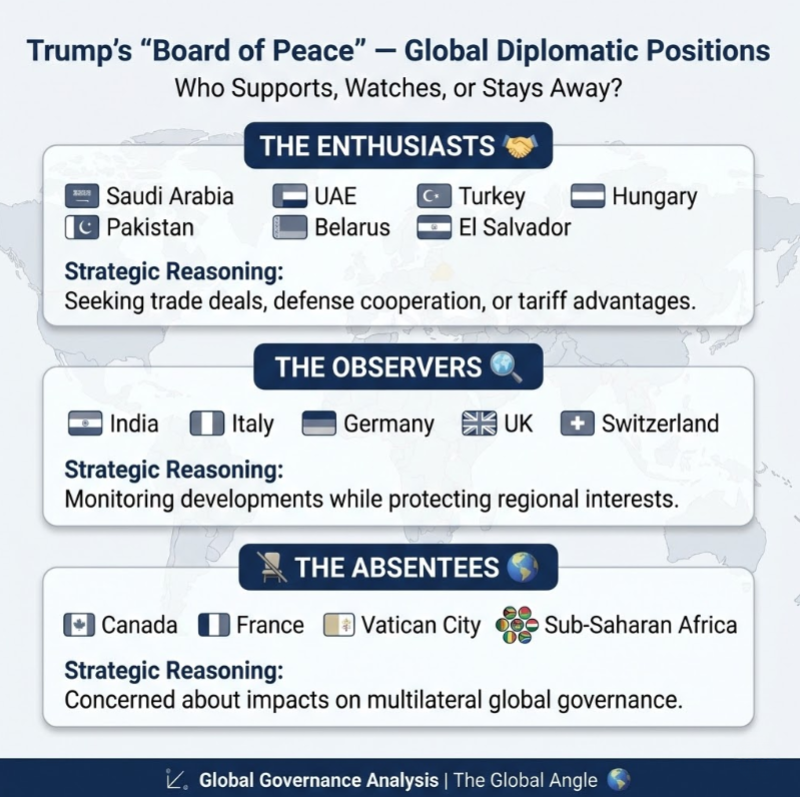
| Diplomatic Stance | Key Countries | The Strategic Reasoning |
| The Enthusiasts (Permanent/Signed Members) | Saudi Arabia, UAE, Turkey, Hungary, Pakistan, Belarus, El Salvador | Capitalizing on the transactional nature of the Board to secure US trade deals, weapons sales, or tariff reductions (e.g., El Salvador securing 0% tariffs). |
| The Observers (On the Fence) | India, Italy, Germany, UK, Switzerland | Refusing to pay the $1 billion fee or legitimize Trump’s lifetime veto power, but attending to monitor developments and protect regional interests. |
| The Absentees (Declined / Uninvited) | Canada, France, Vatican City, Sub-Saharan Africa | Viewing the Board as a direct threat to the multilateral rules-based order and the UN Security Council. |
The Indian Angle: Why New Delhi is Playing Hard to Get
Where does India stand in this geopolitical earthquake? Firmly on the fence.
Prime Minister Narendra Modi was personally invited by Trump. Yet, during the massive February 19 summit in Washington, India only attended as an “Observer,” represented by a deputy diplomat (Namgya C. Khampa) rather than a head of state.
India’s hesitation is highly calculated.
First, New Delhi is fiercely protective of its “strategic autonomy.” Paying $1 billion to join a club where an American president holds absolute veto power fundamentally contradicts India’s push for an equitable, multipolar world.
Second, India is a champion of the Global South and the United Nations. Endorsing a private board that bypasses the UN Security Council undermines India’s own decades-long campaign to secure a permanent seat on that very Council. Finally, with regional rival Pakistan already signing the charter, India sees little value in participating in a highly volatile, U.S.-centric Middle East experiment that could alienate its other critical partners, like Iran or Russia.
Future Outlook: The Next 6 Months
Watch the military logistics carefully.
The Board has already secured pledges for 20,000 soldiers (from Indonesia, Kazakhstan, Morocco, Albania, and Kosovo) to enter Gaza as a stabilization force. Over the next six months, the friction will move from the boardroom to the ground. If this private coalition successfully demilitarizes Hamas and begins the $17 billion reconstruction effort without UN oversight, it will validate Trump’s transactional worldview. If it bogs down in urban combat, the $1 billion entrance fee will look like the worst investment in modern diplomatic history.
Frequently Asked Questions
What are the criteria to join the Trump Board of Peace?
Membership is strictly by invitation from Donald Trump. To secure a permanent seat on the board, a country must voluntarily contribute $1 billion to the organization’s fund within its first year. Otherwise, members serve a three-year term that the Chairman can renew or terminate.
How does the Board of Peace differ from the UN?
Unlike the UN, which is a universal body governed by multilateral consensus and international law, the Board of Peace is a selective, centralized coalition. It operates outside the UN system, relies on voluntary financial and military contributions, and grants ultimate decision-making and veto power to a single individual: its Chairman.
Did India join the Board of Peace?
No. While India was invited and attended the inaugural Washington meeting as an “Observer,” New Delhi has refused to formally sign the charter or pay the membership fee, citing its long-standing commitment to the United Nations and strategic autonomy.
ALSO READ: Munich Security Conference 2026 takeaways: A World “Under Destruction” or Reconstruction?
ALSO READ: Yoon Suk Yeol life sentence: The Dec 2024 Insurrection & The “Pardon Cycle”
The 2026 India-EU Free Trade Agreement :”Mother of all deals or A Loophole to enter India
Executive Summary (The “Global Angle”) The News: On January 27, 2026, after two decades of…
Trump JPMorgan lawsuit 2026: Why JPMorgan is Moving Trump’s Lawsuit to Federal Court
Executive Summary Trump JPMorgan lawsuit 2026 The News: JPMorgan Chase has aggressively pushed back against…
Trump’s Board of Peace: The $1 Billion Geopolitical Club Explained
Executive Summary Trump’s Board of Peace The News: U.S. President Donald Trump has officially convened…
India AI Impact Summit Day 3 Summary: Google’s Subsea Cable, $50B Pledges & The Viral Exit Chaos
Executive Summary India AI Impact Summit Day 3 summary The News: Day 3 of the…
The End of “Free Leverage”: How RBI’s 2026 Guidelines Are Reshaping the Broking Industry
Executive Summary (The “Global Angle”) The News: The Reserve Bank of India (RBI) has issued…
The Thermal Masterstroke: Why the 2026 F1 Championship Could Be Decided in Court
F1 vs Mercedes key takeaways – The News: The FIA has launched an emergency e-vote…