Executive Briefing (Update: March 8, 2026)
As the conflict triggered by the February 28 decapitation strikes enters its second week, the global intelligence community is aggressively analyzing the battlefield data. People around the world are watching the escalating chaos and asking the most critical questions: What has actually happened, how many people have been killed, and who is winning the US-Iran war day 10?
- The Current Status: We are exactly nine days into the massive joint U.S.-Israeli military offensive against Iran (Operation Epic Fury / Operation Roaring Lion).
- The Death Toll: The human cost is escalating rapidly. While U.S. and Israeli military casualties remain remarkably low, Iranian military and civilian deaths have crossed the 1,500 mark following heavy bombardment of Tehran and coastal naval bases.
- The Global Spillover: What began as a targeted strike has morphed into a multi-nation conflict, dragging at least 15 countries into the crossfire of drone swarms and airspace closures.

Here is the definitive Day 9 geopolitical and military summary.
How Many Have Been Killed? (The Casualty Breakdown)
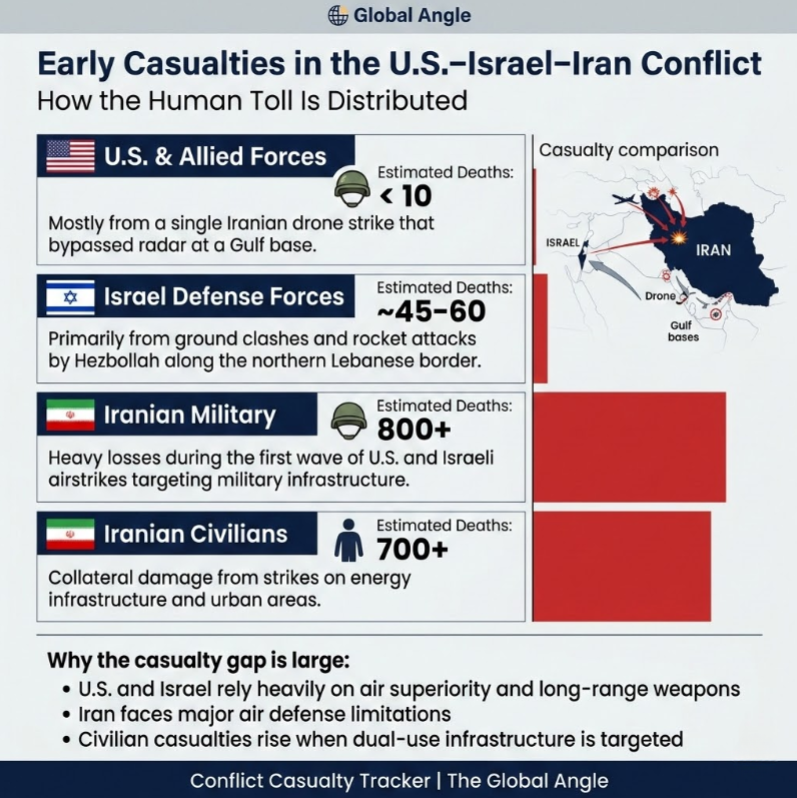
The sheer volume of ordnance dropped by U.S. B-1 and B-2 stealth bombers has resulted in massive infrastructural damage across Iran. Because the U.S. and Israel are relying almost entirely on air superiority and standoff munitions (firing from long distances), their own casualty rates are incredibly low.
Conversely, Iran’s inability to defend its airspace has led to a skyrocketing death toll on the ground, including tragic collateral damage in civilian zones.
| Faction / Nation | Estimated Killed | Context & Notes |
| U.S. & Allied Forces | < 10 | Mostly resulting from an isolated Iranian kamikaze drone strike that bypassed early warning radar at a Gulf forward operating base. |
| Israel Defense Forces (IDF) | ~45 – 60 | Casualties primarily sustained during the intense, ongoing ground and rocket skirmishes with Hezbollah along the northern Lebanese border. |
| Iranian Military (IRGC / Army) | 800+ | Devastating losses during the opening 48 hours, including the assassination of Supreme Leader Ali Khamenei and the sinking of multiple naval vessels. |
| Iranian Civilians | 700+ | High collateral damage due to strikes on dual-use infrastructure (oil refineries, power grids) and the tragic Day 1 strike near a school in Minab. |
US-Iran War Day 10 Summary: What Has Happened?
The speed of the military escalation has been unprecedented. Here is a rapid timeline of how the war evolved over the last nine days:
- The Opening Salvo (Days 1–2): The U.S. initiated the war with a massive cyberattack, blinding Iranian early-warning radar. Over 1,000 targets were struck in 24 hours. The primary objective was achieved immediately: eliminating the Supreme Leader and crippling the senior command of the Islamic Revolutionary Guard Corps (IRGC).
- The Naval Annihilation (Days 3–5): U.S. Central Command (CENTCOM) systematically dismantled the Iranian Navy to secure the Strait of Hormuz. Heavy bombers operating out of the U.K. and Cyprus dropped bunker-busting munitions on underground missile silos (known as “missile cities”).
- The Asymmetric Retaliation (Days 6–9): Realizing they cannot win a conventional air war, surviving Iranian factions transitioned to economic and asymmetric warfare. Iran unleashed massive drone swarms targeting U.S. allies across the Gulf, striking oil storage facilities, desalination plants, and temporarily halting operations at major civilian airports like Dubai.
Who is Actually Winning the War?
To determine who is winning, you have to separate the tactical destruction of military hardware from the ultimate strategic goals.
1. Tactical Dominance: The U.S. and Israel are Winning
From a purely military standpoint, Washington and Tel Aviv hold absolute dominance. They have established total air supremacy. The Pentagon reports that Iranian ballistic missile launch capabilities have been degraded by over 85%. The U.S. is destroying targets at will while taking almost zero casualties, proving the overwhelming superiority of 5th-generation stealth fighters and precision munitions.
2. Strategic Endurance: It is a Dangerous Stalemate
However, wars are fought for political outcomes, not just to blow up buildings. The U.S. goal is regime collapse. Yet, despite the decapitation of its leadership, the Iranian regime has not surrendered. The Assembly of Experts has already formed an interim council.
Furthermore, Iran is succeeding in its primary defensive strategy: economic disruption. By firing cheap drones that force the U.S. to use multi-million dollar interceptors, and by threatening the global oil supply chain in the Gulf, Iran is making the war incredibly expensive for the West. Until a political surrender is negotiated, the U.S. is winning the battles, but the overarching war remains a volatile stalemate.
How Many Countries Are Involved?
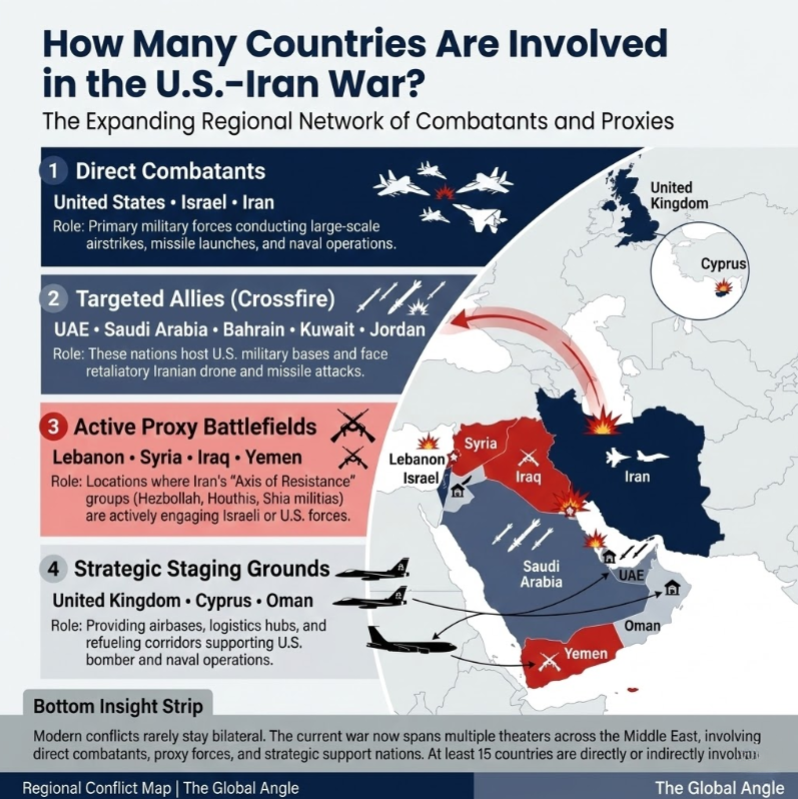
Because modern warfare relies heavily on proxy networks and regional military bases, the U.S.-Iran war is not isolated to two countries. At least 15 nations are currently involved, either as direct combatants, proxy battlegrounds, or targets of retaliation.
| Level of Involvement | Nations Involved | Geopolitical Role in the War |
| Direct Combatants | United States, Israel, Iran | The primary military forces executing large-scale kinetic strikes. |
| Targeted Allies (Crossfire) | UAE, Saudi Arabia, Bahrain, Kuwait, Jordan | These nations host U.S. military bases and are facing retaliatory drone and missile strikes from Iran. |
| Active Proxy Battlegrounds | Lebanon, Syria, Iraq, Yemen | Nations where Iran’s “Axis of Resistance” (Hezbollah, Houthis, Shia militias) are actively fighting Israeli or U.S. forces. |
| Strategic Staging Grounds | United Kingdom, Cyprus, Oman | Providing critical airbases, logistical support, and refueling corridors for U.S. bombers and naval fleets. |
The next 72 hours are critical. If the U.S. continues its strikes on Tehran’s oil infrastructure, global energy markets could face an unprecedented shock, fundamentally altering the trajectory of the global economy.
Frequently Asked Questions
What is Operation Epic Fury and Operation Roaring Lion?
“Operation Epic Fury” is the official U.S. military codename for the massive aerial and naval campaign launched against Iran on February 28, 2026. “Operation Roaring Lion” is the corresponding codename used by the Israel Defense Forces (IDF) for their joint participation in the offensive. The combined mission aims to permanently dismantle Iran’s nuclear program, destroy its ballistic missile capabilities, and neutralize its naval forces.
How many people have died in the 2026 US-Iran war?
As of Day 9 (March 8, 2026), casualty estimates vary by source, but the death toll is rising rapidly. U.S. and Israeli military casualties remain remarkably low (estimated under 70 combined) due to their reliance on high-altitude stealth bombers and standoff munitions. However, Iranian casualties have surpassed 1,500, including over 800 military/IRGC personnel and 700 civilians caught in the crossfire of infrastructure strikes.
Which countries are involved in the 2026 Middle East conflict?
While the United States, Israel, and Iran are the primary combatants, the conflict has dragged at least 15 nations into the crossfire. Due to retaliatory Iranian drone and missile strikes targeting U.S. military assets, Gulf nations including the UAE, Saudi Arabia, Bahrain, Kuwait, and Qatar have been directly impacted. Additionally, the U.K. and Cyprus are providing critical staging grounds for U.S. bombers.
Who is currently winning the US-Iran war?
Militarily, the United States and Israel maintain absolute tactical dominance. U.S. Central Command (CENTCOM) reports that they have established total air superiority, sunk the majority of Iran’s navy, and decreased Iranian ballistic missile launches by 86%. Strategically, however, the war is a volatile stalemate. Iran’s surviving leadership has not surrendered and is successfully using cheap drone swarms to disrupt global oil supplies and inflict massive economic costs on the West.
ALSO READ: Why Does Trump Want Cuba? The Cuban Crisis 2026 Analysis & US Oil Blockade Explained
ALSO READ: Countries Currently at War 2026: The Complete Global Conflict Tracker
The Complete History of Iran Israel Relations: From Secret Allies to Arch-Rivals
Executive Briefing The Dramatic Shift: Today, Iran and Israel are engaged in a sprawling, multi-front…
Russian vs Gulf Crude Oil: Price, Refining, and Efficiency Compared
Executive Briefing Two of the most heavily traded categories in the world are Russian vs…
Who is Winning the US Iran War 2026? Casualties, Costs, and the 2026 Timeline
Executive Briefing (Update: March 12, 2026) As the 2026 Middle East conflict reshapes the global…

Global Oil Price Hike 2026: Petrol Prices & Strategic Reserves by Country
Executive Briefing Global Oil Price Hike 2026 (Update: March 12, 2026) The Price Shock: Following…
Can Trump Be Impeached In Midterm Elections 2026? Odds, Stats, and the Process Explained
Executive Briefing (Update: March 2026) As the United States gears up for the pivotal 2026…

Who Was Arrested From the Epstein Files in 2026? Photos & Facts
Executive Briefing (Update: March 2026) If you are wondering exactly who was arrested from the…

Ibrahim is the Founder and Lead Analyst at The Global Angle, an independent digital platform dedicated to factual geopolitical analysis and international affairs. Based in India, he combines an engineering background with a deep focus on global markets, diplomacy, and strategic security. Ibrahim leverages a data-driven, analytical approach to break down complex international conflicts and economic shifts, helping readers see beyond standard news narratives. When he isn’t researching global policy, he focuses on digital publishing, search engine optimization, and platform architecture.