Executive Briefing (US Attack On Kharg Island)
- The Location: Kharg Island is a tiny coral island in the Persian Gulf that serves as the beating heart of Iran’s energy sector, processing roughly 90% of the nation’s crude oil exports.
- The Escalation: On March 14, 2026, U.S. forces carried out direct airstrikes on military installations on the island, deliberately sparing the oil infrastructure for now.
- The Global Stakes: If the oil terminals are destroyed, analysts warn that global crude prices could instantly surge toward $150 a barrel, triggering a massive worldwide economic shock.
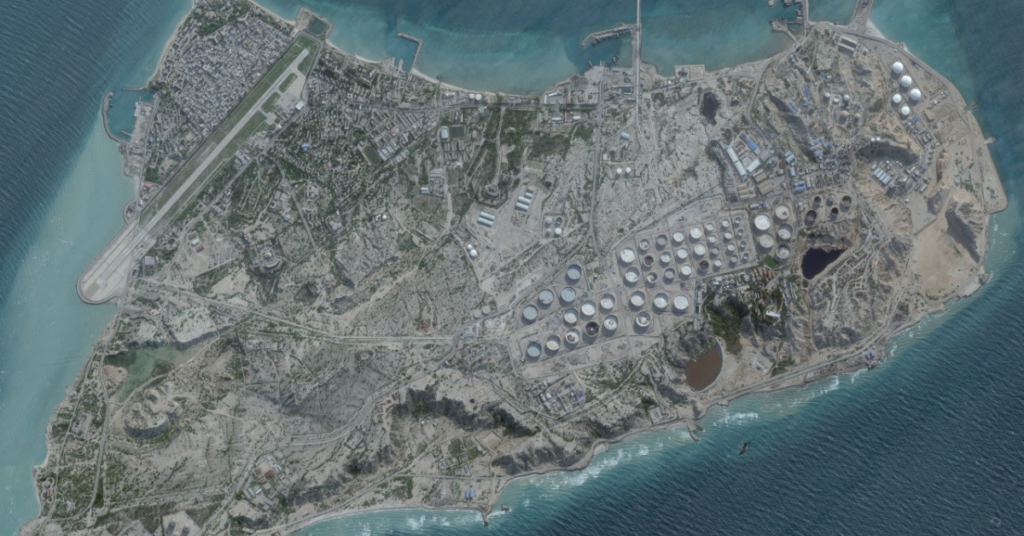
As the 2026 Middle East conflict intensifies, a five-mile-long strip of coral in the Persian Gulf has suddenly become the most consequential piece of real estate on the planet.
While the world watches the skies over Tehran and Tel Aviv, military strategists and energy markets are hyper-focused on Kharg Island. Understanding this island’s geography, its economic weight, and the immediate geopolitical fallout of the recent U.S. airstrikes is essential to predicting where this war goes next.
What is Kharg Island?
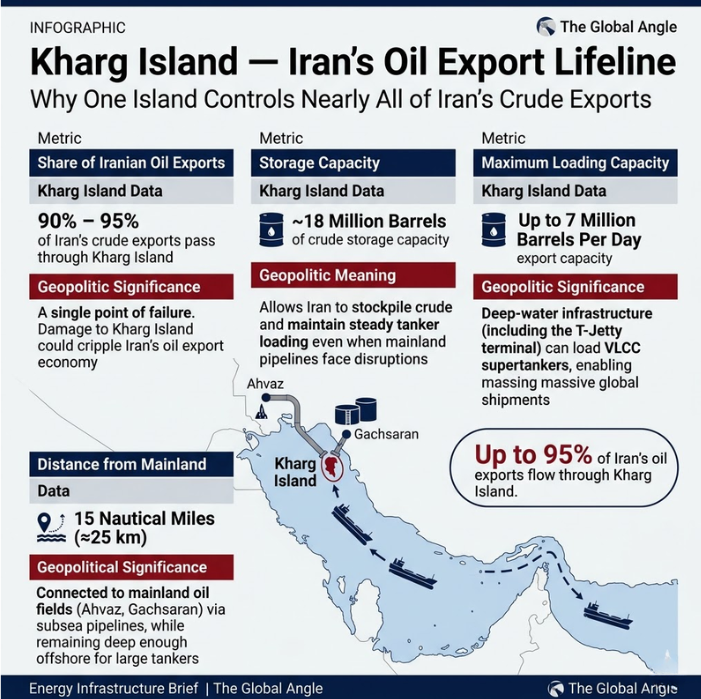
Located roughly 15 nautical miles off Iran’s southwestern coast, Kharg Island (often called the “orphan pearl” of the Gulf) is the undisputed nerve center of the Iranian economy.
While much of Iran’s mainland coastline is silty and too shallow for commercial shipping, Kharg is surrounded by deep waters. This natural geographic advantage allows colossal supertankers to dock safely. Iran has spent decades building a massive network of subsea pipelines connecting its major inland oil fields (like Ahvaz and Gachsaran) directly to the island’s colossal storage tanks and loading jetties.
The Staggering Numbers:
- Handles 90% to 95% of all Iranian seaborne crude exports.
- Can theoretically load up to 7 million barrels of oil per day at peak capacity.
- Currently stores an estimated 18 million barrels of emergency backup crude.
Kharg Island at a Glance
| Metric | Kharg Island Data | Geopolitical Significance |
| Share of Iranian Exports | 90% to 95% | A single point of failure. Destroying the island essentially bankrupts the state’s export economy. |
| Storage Capacity | ~18 Million Barrels | Allows Iran to stockpile crude to maintain continuous loading even if mainland pipelines are temporarily disrupted. |
| Max Loading Capacity | 7 Million Barrels / Day | Features massive deep-water berths (like the “T-Jetty”) capable of docking the world’s largest supertankers (VLCCs). |
| Distance to Mainland | 15 Nautical Miles (25 km) | Close enough to run massive subsea pipelines from mainland oil fields (Ahvaz, Gachsaran), but deep enough for ocean freighters. |
How Does the U.S. Attacking It Affect Iran?
On Saturday, March 14, 2026, President Donald Trump announced that the U.S. military had successfully struck and “obliterated” military targets on Kharg Island. These targets primarily included Islamic Revolutionary Guard Corps (IRGC) naval bases, helicopter hangars, and storage facilities for naval mines used to threaten the Strait of Hormuz.
Crucially, the U.S. deliberately avoided hitting the oil infrastructure itself—a calculated move designed to send a devastating warning.
If the U.S. decides to target the oil terminals, the effect on Iran would be apocalyptic. Because Iran concentrates almost all its export capacity in this single location, destroying Kharg Island would instantly choke off the country’s primary source of foreign currency. Without the billions of dollars generated by these exports, the Iranian government would be unable to fund its state operations, subsidize domestic goods, or finance its regional proxy networks, likely leading to a rapid economic collapse.
How Can Iran Retaliate?
Tehran views Kharg Island as an absolute red line. If the U.S. or Israel crosses that line and destroys the export terminals, Iran’s retaliation would likely plunge the entire region into chaos. Their retaliatory playbook includes:
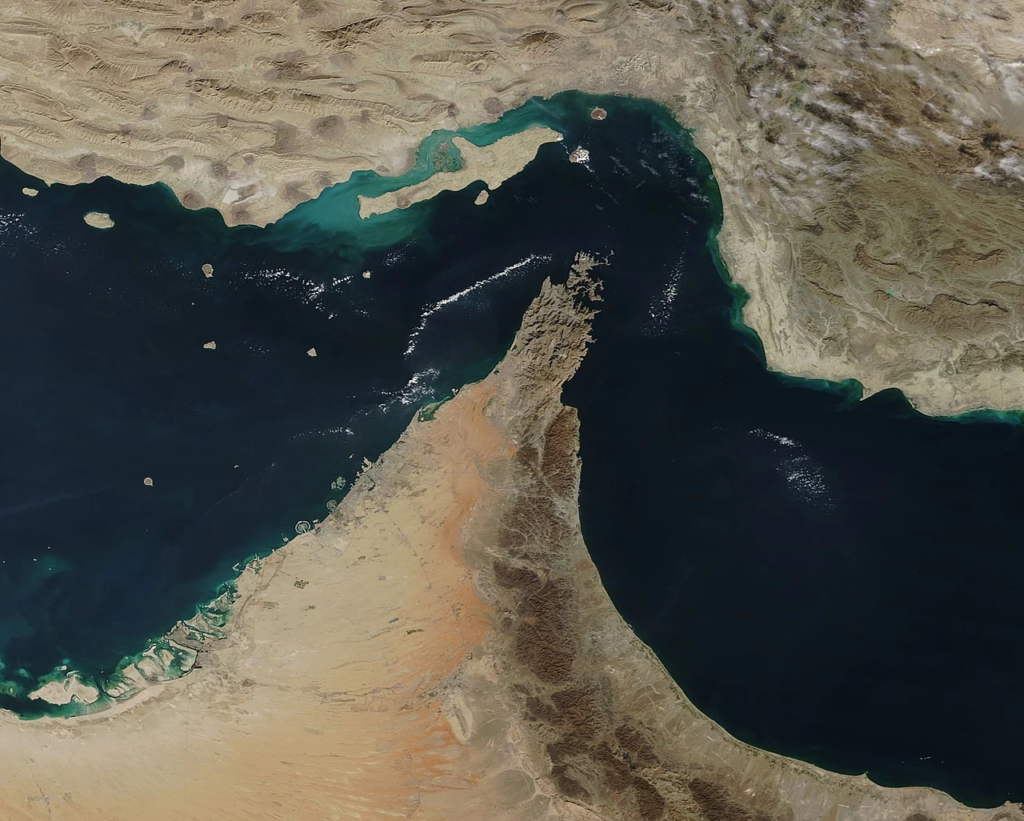
- Closing the Strait of Hormuz: Iran has repeatedly threatened to mine or militarily blockade this narrow maritime chokepoint, through which 20% of the world’s liquid energy flows.
- Striking Regional Oil Hubs: If Iran cannot export its oil, it will ensure its neighbors cannot either. Iran could launch massive drone and ballistic missile swarms at the energy infrastructure of U.S. allies, specifically targeting Saudi Arabia’s Aramco facilities and the UAE’s desalination and oil plants.
- Targeting U.S. Bases: A dramatic escalation in attacks on U.S. military personnel stationed across Iraq, Syria, Kuwait, and Bahrain.
The Impact on the Rest of the World
The survival of Kharg Island is not just an Iranian issue; it is a global economic pillar.
If the island’s oil infrastructure burns, roughly 1.5 million barrels of daily oil supply vanishes from the market overnight. Because the global oil supply chain is deeply interconnected, this localized destruction would have an immediate, devastating ripple effect worldwide:
- Price Shock: Energy analysts predict Brent crude could instantly shoot past $120 and quickly approach **$150 a barrel**.
- Asian Market Crisis: China and India are the primary buyers of Iranian crude. A sudden halt in supply would force these massive economies into a bidding war for alternative oil sources, driving up global freight and insurance costs.
- Runaway Inflation: A sustained spike in transport fuel directly increases the cost of shipping, manufacturing, and food. This would force global central banks to keep interest rates high, significantly raising the risk of a worldwide recession in late 2026.
For now, the oil continues to flow, and supertankers are still quietly slipping away from the island’s deep-water docks. But as long as U.S. bombers remain in the skies above the Persian Gulf, the global economy is just one airstrike away from a historic crisis.
Frequently Asked Questions (Kharg Island & 2026 US Iran Conflict)
What is Kharg Island and why is it important?
Kharg Island is a small Iranian island located in the Persian Gulf. It is the most critical asset in Iran’s energy sector because it operates as the country’s primary oil export terminal. Deep-water docks and massive storage facilities allow the island to handle roughly 90% to 95% of all Iranian seaborne crude oil exports.
Where is Kharg Island located?
Kharg Island is situated in the Persian Gulf, approximately 15 nautical miles (25 kilometers) off the southwestern coast of mainland Iran. Its deep-water surroundings make it an ideal natural harbor for docking massive Very Large Crude Carriers (VLCCs) and supertankers.
How much oil does Iran export from Kharg Island?
At peak capacity, the facilities on Kharg Island can load up to 7 million barrels of crude oil per day. Even under heavy international sanctions, the island continuously processes well over 1 million barrels per day, serving as the financial lifeline for the Iranian government.
What happens if the US or Israel destroys Kharg Island?
If the oil export terminals on Kharg Island are destroyed, roughly 90% of Iran’s oil export revenue would vanish overnight. In retaliation, Iran would likely attempt to blockade the Strait of Hormuz and strike neighboring energy hubs. Globally, the sudden loss of Iranian crude would send Brent crude prices skyrocketing toward $120–$150 a barrel, triggering severe inflation worldwide.
ALSO READ: The Complete History of Iran Israel Relations: From Secret Allies to Arch-Rivals
ALSO READ: Who is Winning the US Iran War 2026? Casualties, Costs, and the 2026 Timeline
Russia Ukraine War 2026: Analysis of Drone and Missile Strikes
Executive Summary of Russia Ukraine War 2026 (25 March 2026) The News: A coordinated Russian…
Is the U.S. Losing the Iran War? What are Iran’s Demands For Peace Talks
Executive Briefing (Update: March 2026) The Asymmetric Advantage: Despite weeks of heavy U.S. and Israeli…

EU Australia Free Trade Agreement: Tariffs, Critical Minerals, and Global Impact
Executive Briefing (Update: March 2026) The A$10 Billion Milestone: Following eight years of complex negotiations,…
Iran War Impact On Russia Ukraine War: Battlefield Updates, Middle East Impact, and Peace Talks
Executive Briefing (Update: March 2026) For observers tracking global geopolitics, the Russia-Ukraine war can no…
Can China Takeover Taiwan in 2026? Why Does China Wants Taiwan
Executive Briefing (Update: March 2026) The Vulnerability: With the United States heavily entrenched in a…
The Pakistan Afghanistan War 2026 Explained: Why Former Allies Are Now Fighting
Executive Briefing (Update: March 2026) The Current Situation: Pakistan Afghanistan War 2026is currently engaged in…

Ibrahim is the Founder and Lead Analyst at The Global Angle, an independent digital platform dedicated to factual geopolitical analysis and international affairs. Based in India, he combines an engineering background with a deep focus on global markets, diplomacy, and strategic security. Ibrahim leverages a data-driven, analytical approach to break down complex international conflicts and economic shifts, helping readers see beyond standard news narratives. When he isn’t researching global policy, he focuses on digital publishing, search engine optimization, and platform architecture.