Executive Briefing (Update: March 2026)
Search engines are flooded with a singular question: Why does Trump want Cuba, and what exactly is happening on the island? To understand the rapidly escalating situation, we must break down the mechanics of the Cuban crisis 2026, America’s strategic motivations, and the immediate ripple effects impacting the rest of the world.
- The Current Reality: Following the successful U.S. military operation to capture Venezuelan President Nicolás Maduro in January 2026, the Trump administration has aggressively pivoted its focus to Havana.
- The Squeeze: Without Venezuelan oil, Cuba is experiencing a total economic and infrastructural collapse, marked by 20-hour daily blackouts and fuel shortages.
- The Endgame: President Donald Trump has publicly suggested a “friendly takeover” of the island, utilizing an unprecedented naval and economic blockade to force regime change.

In the fast-moving geopolitical landscape of early 2026, Washington’s foreign policy has intensely focused on a target just 90 miles off the coast of Florida. While global attention is frequently pulled toward the Middle East, the U.S. is currently executing a “maximum pressure” campaign against Cuba that experts call the most severe action taken against the island since the 1962 missile crisis.
The Cuban Crisis 2026 Explained
The current catastrophe in Cuba is not an isolated event; it is the direct collateral damage of U.S. operations in South America.
For years, the communist government in Havana relied heavily on cheap, subsidized oil imports from Venezuela to keep its electrical grid and transportation networks running. However, when U.S. forces ousted and captured Venezuelan leader Nicolás Maduro in early January 2026, that vital oil pipeline was instantly severed.
Recognizing the vulnerability of the Cuban regime, the U.S. administration seized the opportunity to force a collapse. On January 29, 2026, President Trump signed Executive Order 14380, initiating a de facto energy blockade.
The Real-Time Impact on the Island
The blockade threatens severe tariffs on any country or foreign corporation (such as Mexico’s state-owned Pemex) that attempts to deliver oil to Cuba. The results on the ground have been devastating:
- Grid Collapse: The island is enduring nationwide power outages that exceed 20 hours a day.
- Transport & Tourism Paralysis: With jet fuel reserves depleted, major international airlines from Canada and Russia have suspended flights. Domestic public transportation has largely halted.
- Basic Services Failure: According to the UN, 84% of Cuba’s water pumping systems rely on electricity. The blackouts have severely compromised clean water access, hospital emergency rooms, and food refrigeration.
Why Are America’s Eyes on Cuba?
President Trump recently told reporters that Cuba will “fall pretty soon,” indicating that after the administration’s operations regarding Iran, Cuba is next on the agenda. He has even floated the unprecedented concept of a “friendly takeover.”
But why is the U.S. expending so much geopolitical capital on a small Caribbean island with a collapsing economy? The motivations are a blend of national security, regional dominance, and domestic politics.
1. Removing a Strategic Outpost for Adversaries
Despite its economic weakness, Cuba remains a critical intelligence and military outpost for U.S. adversaries. The White House has explicitly cited the fact that Cuba hosts Russia’s largest overseas signals intelligence facility, designed to intercept U.S. communications. Furthermore, Havana maintains deep diplomatic ties with China and Iran. By forcing regime change, the U.S. aims to permanently evict Russian and Chinese intelligence assets from the Western Hemisphere.
2. The Domestic Political Mandate
U.S. Secretary of State Marco Rubio, the son of Cuban immigrants, is acting as the administration’s point man on this crisis. For decades, the politically powerful Cuban-American voter base in Florida has lobbied for the eradication of the Castro-era communist regime. Delivering a transition to a democratic, pro-Western government in Havana would be a historic ideological victory for the administration’s conservative base.
3. Securing the Caribbean Basin
A collapsing, desperate Cuba poses a massive, unpredictable security threat to the U.S. border. The administration calculates that a managed, forced capitulation—a “deal” negotiated under extreme economic duress—is preferable to a chaotic civil war that could trigger millions of refugees fleeing across the Florida Straits.
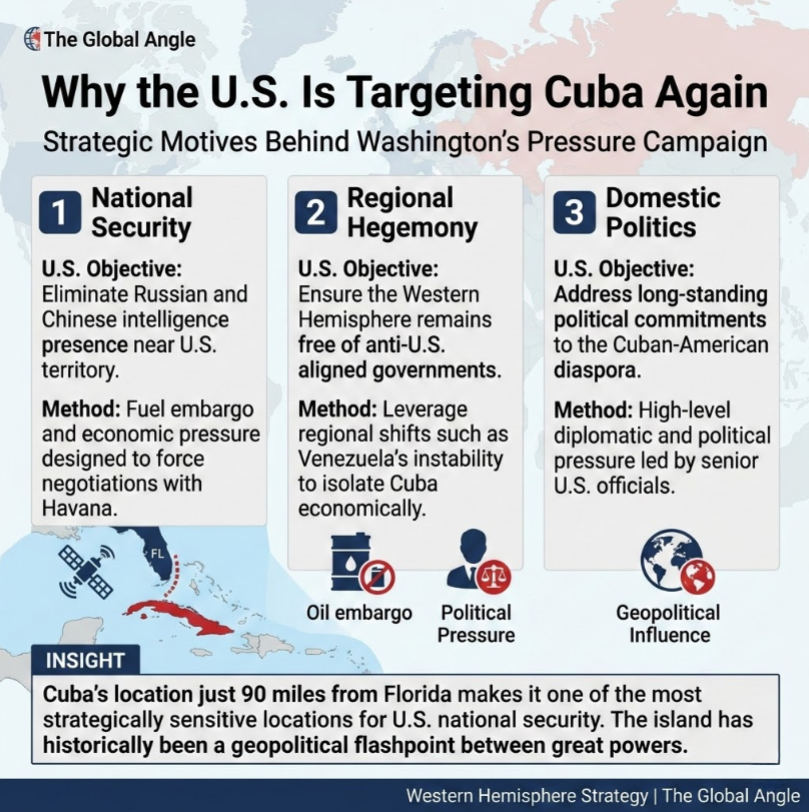
The Geopolitical Matrix: U.S. Motivations
| Strategic Pillar | The U.S. Objective in Cuba | The Method of Execution |
| National Security | Eliminate Russian/Chinese spy bases and geopolitical influence. | Complete fuel embargo; forcing the government to negotiate survival. |
| Regional Hegemony | Ensure the Western Hemisphere is free of allied anti-U.S. regimes. | Capitalizing on the ouster of Venezuela’s Maduro to starve Havana of resources. |
| Domestic Politics | Fulfill decades-old promises to the Cuban-American diaspora. | Secretary of State Marco Rubio leading high-level pressure campaigns. |
The Impact on the Rest of the World
While Washington views this as a necessary security measure, the aggressive tactics are creating severe diplomatic friction globally.
1. The Threat to Mexico and Allies
The Executive Order authorizing the blockade uses the threat of secondary sanctions and tariffs against U.S. allies. Mexico, which briefly attempted to supply Cuba with oil to prevent a humanitarian disaster, was forced to halt shipments following direct tariff threats from Washington. This heavy-handed economic coercion is straining U.S. relations with Latin American partners.
2. The Caribbean Backlash
The Caribbean Community (CARICOM) is deeply alarmed. Regional leaders fear that the aggressive U.S. posture could destabilize the entire Caribbean basin. In late February 2026, CARICOM nations pledged to send humanitarian support to Cuba, despite the ongoing U.S. pressure, highlighting a rare diplomatic fracture between Washington and its Caribbean neighbors.
3. A Looming Humanitarian Emergency
The United Nations High Commissioner for Human Rights has declared that they are “extremely worried” about the deepening crisis. The U.N. warns that the blockade is indiscriminate, severely impacting innocent civilians by destroying access to medicine, clean water, and food distribution.
Ultimately, the U.S. administration is betting that the Cuban government will capitulate before the island descends into total anarchy. However, as the blackouts stretch on and the fuel tanks run dry, the window for a peaceful, “friendly takeover” is rapidly closing.
Frequently Asked Questions (Cuban Crisis 2026)
Why does Trump want Cuba
The Trump administration views the communist Cuban government as a hostile regime that harbors Russian intelligence assets and destabilizes the region. The goal of the proposed “friendly takeover” or negotiated regime change is to secure the Western Hemisphere, eliminate foreign adversary outposts, and deliver a historic political victory for the Cuban-American diaspora.
What caused the 2026 Cuba fuel crisis?
The crisis was triggered by the U.S. capture of Venezuelan President Nicolás Maduro in early 2026, which instantly cut off Cuba’s primary source of imported oil. The U.S. subsequently implemented Executive Order 14380, placing a strict naval and economic blockade on the island and threatening tariffs on any nation that supplies Cuba with fuel.
How is the rest of the world reacting to the U.S. blockade on Cuba?
The reaction is largely critical. The United Nations has raised alarms over the severe humanitarian toll on Cuban civilians. Neighboring nations, including Mexico and CARICOM member states, have expressed deep concern over the aggressive use of U.S. tariffs to enforce the blockade, warning that a total collapse of Cuba could trigger a massive regional refugee crisis.
ALSO READ: Iran Conflict Global Stock Market Crash 2026: What Experts Predict Next
ALSO READ: Countries Currently at War 2026: The Complete Global Conflict Tracker
The Complete History of Iran Israel Relations: From Secret Allies to Arch-Rivals
Executive Briefing The Dramatic Shift: Today, Iran and Israel are engaged in a sprawling, multi-front…
Russian vs Gulf Crude Oil: Price, Refining, and Efficiency Compared
Executive Briefing Two of the most heavily traded categories in the world are Russian vs…
Who is Winning the US Iran War 2026? Casualties, Costs, and the 2026 Timeline
Executive Briefing (Update: March 12, 2026) As the 2026 Middle East conflict reshapes the global…
Global Oil Price Hike 2026: Petrol Prices & Strategic Reserves by Country
Executive Briefing Global Oil Price Hike 2026 (Update: March 12, 2026) The Price Shock: Following…
Can Trump Be Impeached In Midterm Elections 2026? Odds, Stats, and the Process Explained
Executive Briefing (Update: March 2026) As the United States gears up for the pivotal 2026…
Who Was Arrested From the Epstein Files in 2026? Photos & Facts
Executive Briefing (Update: March 2026) If you are wondering exactly who was arrested from the…

Ibrahim is the Founder and Lead Analyst at The Global Angle, an independent digital platform dedicated to factual geopolitical analysis and international affairs. Based in India, he combines an engineering background with a deep focus on global markets, diplomacy, and strategic security. Ibrahim leverages a data-driven, analytical approach to break down complex international conflicts and economic shifts, helping readers see beyond standard news narratives. When he isn’t researching global policy, he focuses on digital publishing, search engine optimization, and platform architecture.