Key Takeaways
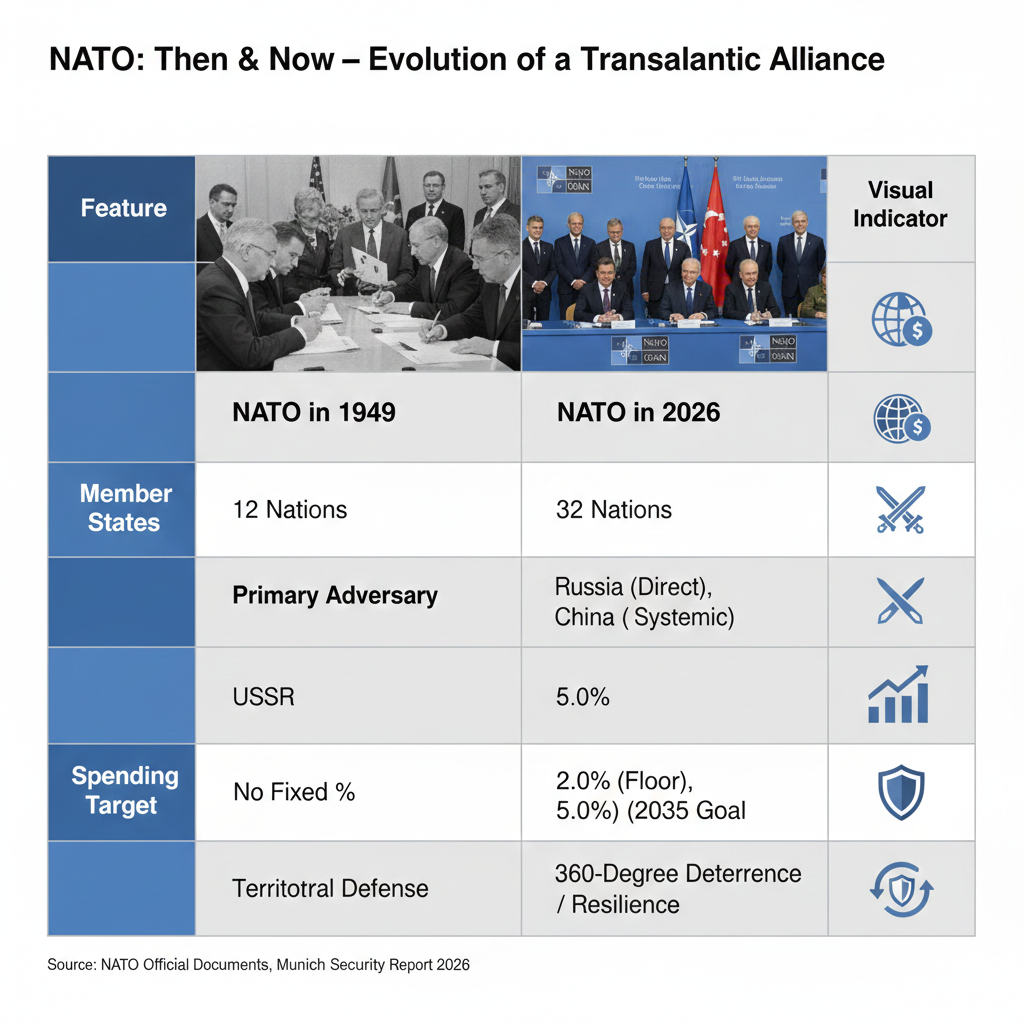
- NATO has expanded to 32 members as of 2026, with Finland and Sweden fully integrated into the alliance’s defensive plans.
- A historic shift in 2026 sees European Allies taking over all three Joint Force Commands, reducing reliance on U.S. operational leadership.
- The “Hague Commitment” of 2025 has set a new benchmark for defense spending, with members aiming for 5% of GDP by 2035.
The North Atlantic Treaty Organization (NATO) stands in 2026 as the world’s most powerful military alliance, yet it faces its most profound internal and external pressures since the height of the Cold War. Originally a 12-member pact designed to contain Soviet expansion, it has evolved into a 32-nation security architecture spanning two continents. Today, the alliance is navigating a “Strategic Reset,” balancing the immediate threat of Russian hybrid aggression with a volatile transatlantic political landscape and the rise of technological warfare.
The Genesis: History of the 1949 Washington Treaty
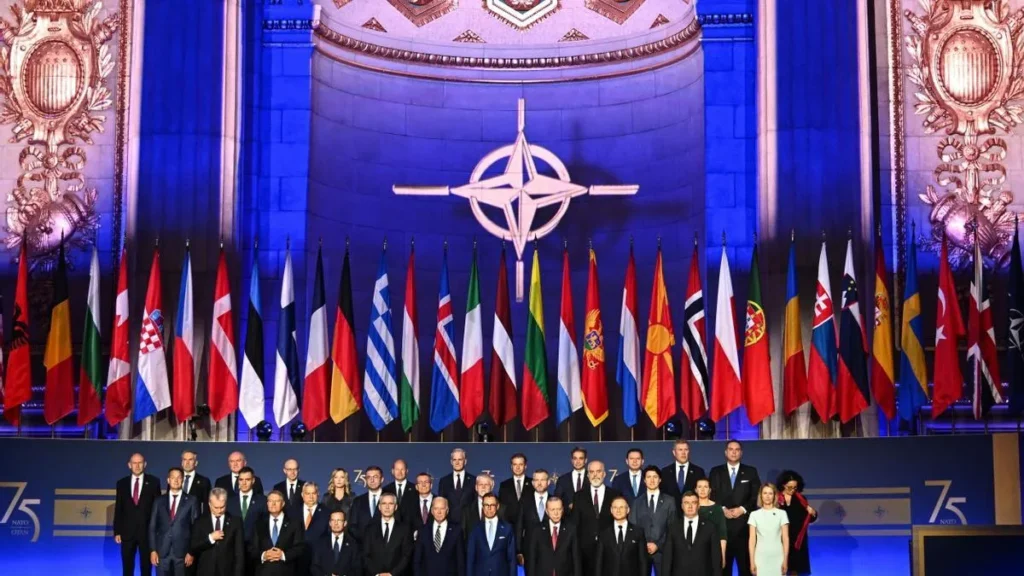
The foundations of NATO were laid on April 4, 1949, with the signing of the North Atlantic Treaty (the Washington Treaty). In the aftermath of World War II, Western European nations feared both a resurgent Germany and the growing shadow of the Soviet Union. The United States, moving away from its traditional isolationism, viewed an integrated European defense as vital to preventing communist expansion.
The treaty’s “beating heart” is Article 5, which famously states that an attack against one member is an attack against all. Interestingly, the treaty was originally only valid for 10 years, but its success in maintaining the “Long Peace” in Europe ensured its survival well beyond the collapse of the USSR in 1991.
Present Condition (2026): The European Pivot
In February 2026, NATO underwent a landmark structural change. For decades, the alliance was criticized for being “over-reliant” on U.S. leadership. As of this year, European Allies have taken on senior officer responsibilities across the NATO Command Structure.
Current Leadership and Force Model
- Joint Force Commands (JFC): All three operational-level commands—Norfolk (UK-led), Naples (Italy-led), and Brunssum (Germany/Poland-led)—are now under European leadership.
- The New Force Model: NATO has transitioned to a pool of over 300,000 high-readiness troops, capable of deploying within 30 days to the Eastern Flank.
- Hybrid Defense: The primary “front line” in 2026 is no longer just physical borders but critical subsea infrastructure and digital networks, which are under constant threat from “gray zone” operations.
Future Goals and the 2030 Strategic Concept
The “NATO 2030” initiative and the subsequent 2022 Strategic Concept guide the alliance’s path over the next decade. The focus has shifted from “out-of-area” missions (like Afghanistan) back to Collective Defense and Resilience.
- Industrial Scaling: Following the 2024 Washington Summit, members are aggressively expanding defense industrial capacity to ensure long-term munitions sustainability.
- Technological Superiority: Through the DIANA (Defence Innovation Accelerator) program, NATO’s 2026 cohort of 150 innovators is focusing on AI-driven electronic warfare and autonomous undersea vehicles.
- The 5% Pledge: At the 2025 Hague Summit, Allies committed to a tiered spending goal: 3.5% for core military requirements and 1.5% for security-related measures (cyber, space, and energy security).
Evaluation: A House Divided or a Unified Front?
Evaluations of NATO in 2026 remain polarized. On one hand, the alliance is more unified than ever in its perception of Russia as the “most significant and direct threat.” The inclusion of Finland and Sweden has turned the Baltic Sea into a “NATO Lake,” significantly complicating Russian naval strategy.
On the other hand, “internal strains” persist. Public trust in the U.S. as a “reliable ally of last resort” has eroded in some European capitals, prompting the push for European Strategic Autonomy. While the alliance has successfully deterred a direct conventional strike, its ability to respond to “below Article 5” hybrid attacks—such as the sabotage of the Baltic-connector pipelines—remains a critical vulnerability.
As NATO approaches its 80th anniversary, the central question is whether the “Europeanization” of the alliance will strengthen the transatlantic bond or lead to a gradual decoupling of North American and European security interests.
Will the shift to European leadership be enough to sustain the alliance if U.S. priorities continue to pivot toward the Indo-Pacific?
Frequently Asked Questions
Is Ukraine a member of NATO in 2026?
No. While Ukraine remains NATO’s most significant partner and receives massive lethal aid through the “Coalition of the Willing,” formal membership remains excluded pending a definitive end to hostilities and territorial concessions.
What is ‘DIANA’ in the NATO context?
DIANA (Defence Innovation Accelerator for the North Atlantic) is NATO’s primary tech-hub system. It connects military end-users with private-sector innovators to rapidly adopt “dual-use” technologies like quantum computing and advanced sensors.
FOR MORE UPDATEShttps://theglobalangle.com/understanding-u-s-midterm-elections-guide/