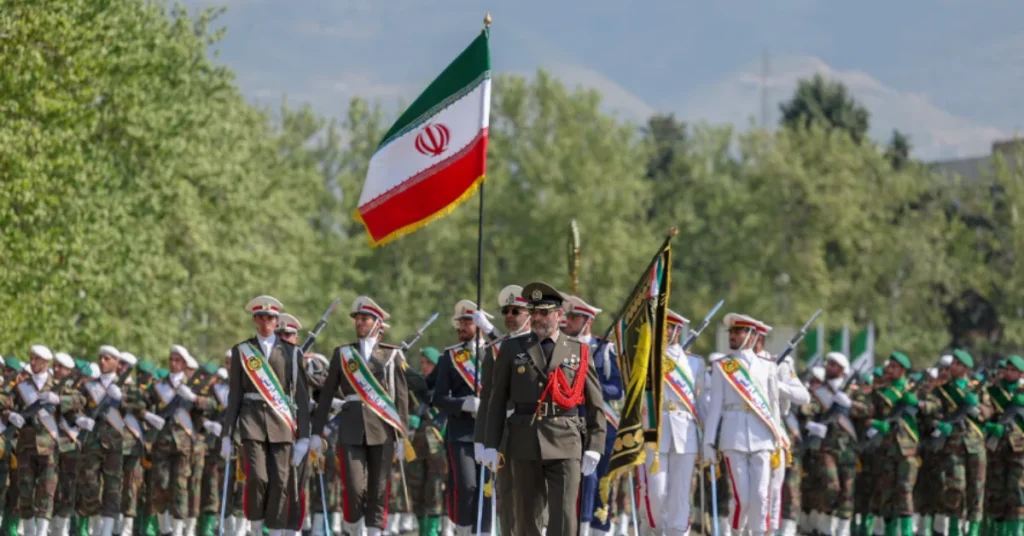
Executive Briefing (Update: March 5, 2026)
- The Polling Reality: Initial polling shows significant domestic skepticism regarding the US-Iran war. Only 1 in 4 Americans currently approve of the preemptive military strikes. So analysing the US public opinion Iran war 2026
- The Approval Hit: President Donald Trump’s approval rating has dropped to a second-term low of 38% amid fears of escalating troop casualties and rising gas prices.
- The Blowback Risk: While the US military holds absolute operational superiority, the administration faces severe domestic vulnerabilities, including potential cyberattacks on critical infrastructure and inflation-triggering oil shocks.
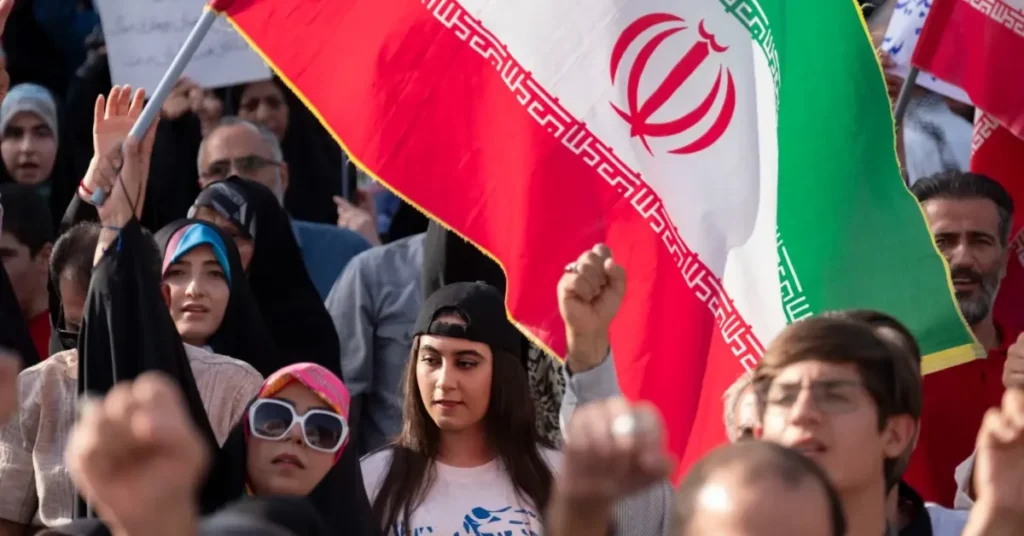
As the Pentagon continues to assess the battle damage of “Operation Epic Fury,” a secondary, highly volatile front has opened for the Trump administration: domestic public opinion.
In modern geopolitics, a military can fight indefinitely, but a presidency cannot sustain a war without the backing of its citizens. For investors, policymakers, and global observers, understanding the political sustainability of this conflict is just as critical as tracking the military logistics.
To provide a clear, objective assessment, we must bypass the partisan rhetoric and analyze the raw polling data, the constitutional realities of the War Powers debate, and the verified homeland security alerts issued by federal agencies.
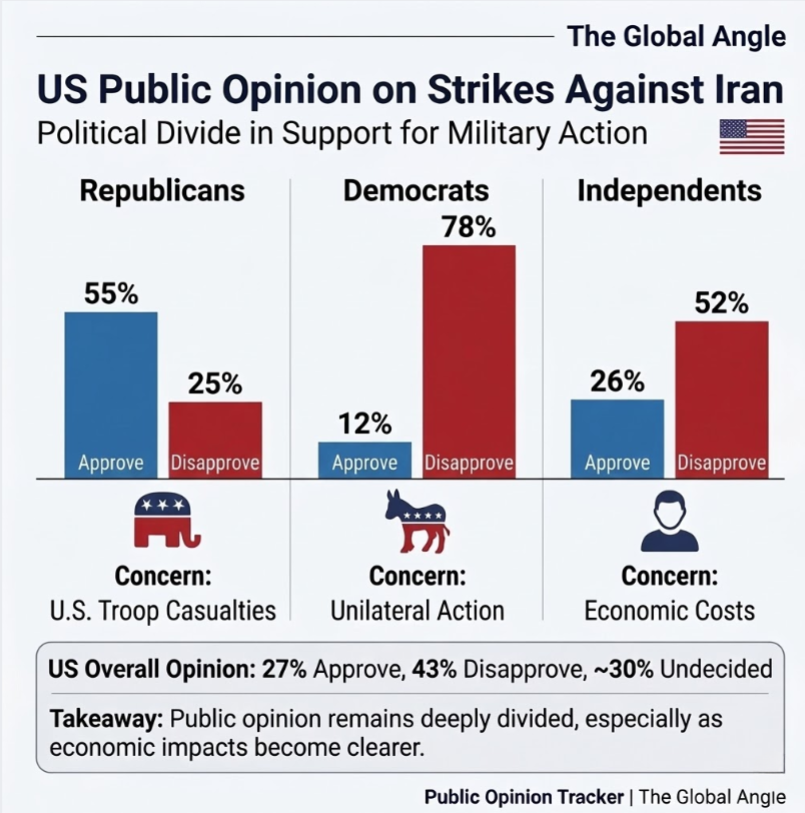
US public opinion Iran war 2026: US Public Opinion by Political Affiliation
| Voter Demographic | Approve of Strikes | Disapprove of Strikes | Primary Concern / Sticking Point |
| Republicans | 55% | 25% | Troop casualties; prolonged ground war |
| Democrats | 12% | 78% | Unilateral escalation; lack of Congressional approval |
| Independents | 26% | 52% | Economic impact; rising domestic gas prices |
| Overall National | 27% | 43% | 30% remain undecided pending economic fallout |
The Data: Do Americans Support the War?
To accurately gauge national sentiment, it is vital to aggregate data from non-partisan polling institutions conducted after the initial strikes on February 28, 2026. The consensus indicates a deeply polarized electorate with high levels of economic anxiety.
According to flash polling data aggregated from major research firms (including Reuters/Ipsos and Gallup methodologies), the national mood is highly skeptical.
The Partisan and Independent Divide
Breaking down the cross-tabs reveals exactly where the administration’s political vulnerabilities lie:
- The Base Support: A majority of Republican voters (55%) currently support the Commander-in-Chief’s military directive. However, nearly half of those supporters indicated their backing is conditional and would drop if U.S. troop casualties escalate.
- The Opposition: Democratic voters overwhelmingly oppose the unilateral military action, citing concerns over regional destabilization.
- The Swing Voters: Independent voters—the critical demographic for political survival—are rapidly distancing themselves. Approval among independents for the administration’s current foreign policy has dropped to 26%.
The Political Clock: Sustainability and the Economy
The U.S. Department of Defense has the financial and logistical capacity to maintain the operational tempo of “Epic Fury” indefinitely. However, the administration’s political window is strictly bound by two domestic thresholds:
- The Casualty Tolerance: The American public has an incredibly low threshold for troop fatalities in preemptive conflicts. Following the confirmation from U.S. Central Command (CENTCOM) regarding service member casualties from Iranian drone strikes, domestic pressure for a clear “exit strategy” is mounting in Congress.
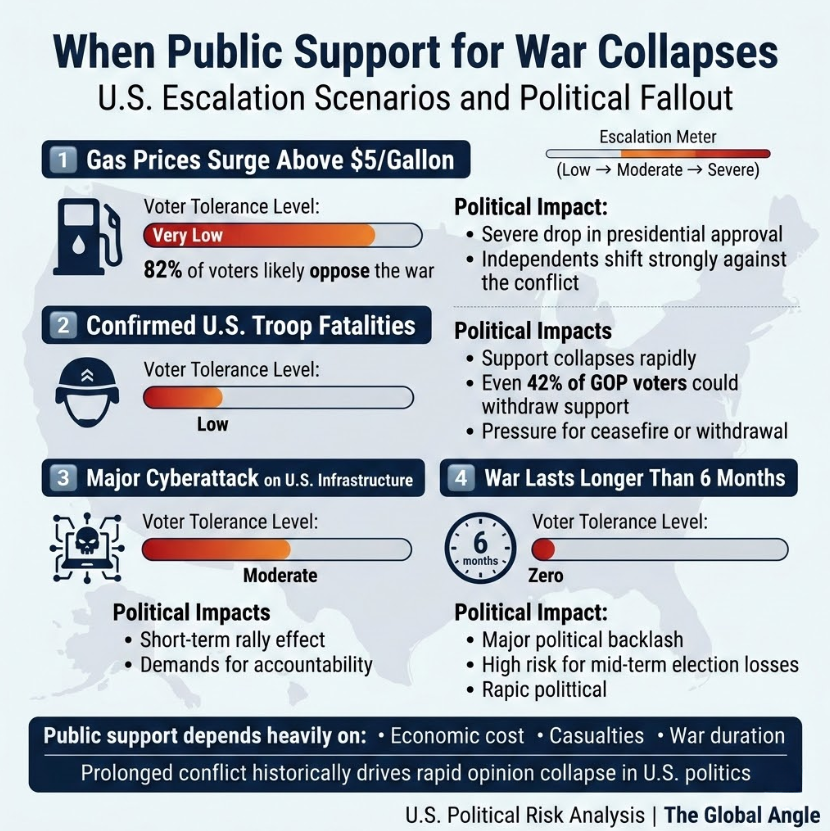
- The Economic Red Line: Global Brent crude oil prices have surged, and the impact is already hitting domestic gas pumps. With 82% of voters opposing the war if it severely impacts their daily cost of living, a prolonged energy shock will aggressively drain the administration’s political capital.
The Impeachment Question & The War Powers Act
| Escalation Scenario | Voter Tolerance Level | Impact on Presidential Approval |
| Gas prices surge past $5.00/gallon | Very Low (82% would oppose war) | Severe drop across all demographics (especially Independents) |
| Confirmed U.S. Troop Fatalities | Low (42% of GOP would pull support) | High domestic pressure for immediate withdrawal/ceasefire |
| Major Cyberattack on U.S. Infrastructure | Moderate (Creates panic, but unifies base) | Temporary rally effect, followed by demands for accountability |
| War lasts longer than 6 Months | Zero | Total loss of political capital; high risk for mid-term elections |
Critics and progressive lawmakers have accused the administration of violating the War Powers Resolution of 1973 or The War Powers Act by launching a massive preemptive offensive without formal, prior Congressional authorization (notifying only the “Gang of Eight” intelligence committee leaders). This has triggered intense media debate regarding potential impeachment.
From a strict constitutional and mathematical perspective, what is the reality?
A successful impeachment and removal is highly improbable. While the House of Representatives holds the sole power of impeachment (Article I, Section 2) and could theoretically draft articles citing a violation of war-making clauses, removing a president requires a two-thirds supermajority in the Senate. Because the Republican party largely supports the strategic objective of neutralizing Iran’s nuclear infrastructure, a Senate conviction is practically impossible.
Instead, expect Congress to attempt to pass binding resolutions requiring explicit authorization for future funding—a legislative maneuver that often faces presidential vetoes.
Homeland Blowback: Verified Domestic Threats
While U.S. forces dismantle targets abroad, the asymmetric blowback facing the American homeland is severe. The true immediate risk to the U.S. is not a conventional military strike, but cyber and proxy warfare.
- Critical Infrastructure Cyber Threats: The Cybersecurity and Infrastructure Security Agency (CISA) has issued “Shields Up” urgent warnings. Iran operates highly sophisticated, state-sponsored cyber warfare units (such as APT33). The U.S. intelligence community is actively bracing for aggressive ransomware and DDoS attacks targeting municipal water treatment plants, regional healthcare systems, and financial networks.
- The Power Vacuum: The decapitation strike in Tehran has created a severe power vacuum. Intelligence analysts warn that a total collapse of the Iranian state would leave a heavily armed, fragmented Islamic Revolutionary Guard Corps (IRGC) operating without centralized restraint, guaranteeing long-term regional chaos.
- Domestic Proxy Activation: The FBI and the Department of Homeland Security (DHS) have elevated national threat levels. Iran’s global network of proxy organizations could attempt to activate sleeper cells to target American embassies abroad or domestic targets within the U.S., shifting the battlefield into unpredictable, asymmetric terror operations.
Trump approval rating Iran war
| Threat Vector | Primary Target in the U.S. | Federal Advisory Status | Potential Domestic Impact |
| State-Sponsored Cyberattacks (APT) | Financial sector, Water treatment, Hospital grids | “Shields Up” (Critical) | Ransomware lockouts, service outages, severe economic disruption. |
| Proxy “Sleeper Cell” Activation | Embassies abroad, domestic government buildings | Elevated (FBI/DHS monitoring) | Localized terror incidents; shift from conventional to asymmetric warfare. |
| Disinformation Campaigns | Social media networks, U.S. election cycles | Active | Deepfakes and AI-generated panic designed to fracture public unity. |
ALSO READ: How Long Will the US-Israel Iran War Last? The Sustainability and the Cost of War
ALSO READ: Iran vs Israel military power comparison 2026 Full Breakdown (Land, Air, Sea & Tech)
Russia China trade relations 2026: Sanctions Evasion, Dual-Use Tech, and the Putin-Xi Summit
Russia China trade relations 2026: Sanctions Evasion, Dual-Use Tech, and the Putin-Xi Summit Executive Briefing…
What is Hantavirus Outbreak 2026: Symptoms, Vaccine Status, and the Climate Vector
What is Hantavirus Outbreak 2026: Symptoms, Vaccine Status, and the Climate Vector The Immediate Trigger:…
Starlink & SpaceX IPO 2026: Everything You Need to Know
Starlink & SpaceX IPO 2026: Everything You Need to Know The Valuation: According to Institutional…
What is OPEC? How the Oil Cartel Functions and Why It’s Fracturing in 2026
What is OPEC? How the Oil Cartel Functions and Why It’s Fracturing in 2026 The…

Why the UAE Quit OPEC and the Birth of the Petro-Rupee
Why the UAE Quit OPEC and the Birth of the Petro-Rupee The Rupture: The United…

Microsoft OpenAI Partnership Ends: Why Microsoft is Dropping OpenAI’s Exclusive License
Microsoft OpenAI Partnership Ends: Why Microsoft is Dropping OpenAI’s Exclusive License The Announcement: On April…

Ibrahim is the Founder and Lead Analyst at The Global Angle, an independent digital platform dedicated to factual geopolitical analysis and international affairs. Based in India, he combines an engineering background with a deep focus on global markets, diplomacy, and strategic security. Ibrahim leverages a data-driven, analytical approach to break down complex international conflicts and economic shifts, helping readers see beyond standard news narratives. When he isn’t researching global policy, he focuses on digital publishing, search engine optimization, and platform architecture.