Why the UAE Quit OPEC and the Birth of the Petro-Rupee
- The Rupture: The United Arab Emirates has officially withdrawn from the Organization of the Petroleum Exporting Countries (OPEC). This ends a decades-long alliance and shatters Saudi Arabia’s ability to artificially control global oil prices.
- The Motive: Abu Dhabi is executing a “Sprint to the Finish.” Sitting on massive, unused production capacity, the UAE is abandoning quotas to monetize its reserves immediately, using the cash to fund its transition into a post-oil, AI-driven tech economy.
- The Indian Windfall: While Western analysts focus on falling crude prices, the real winner is New Delhi. The UAE’s exit supercharges the India-UAE Local Currency Settlement (LCS) system, allowing India to absorb the UAE’s excess oil using the Indian Rupee (INR), dealing a severe blow to the Petrodollar.
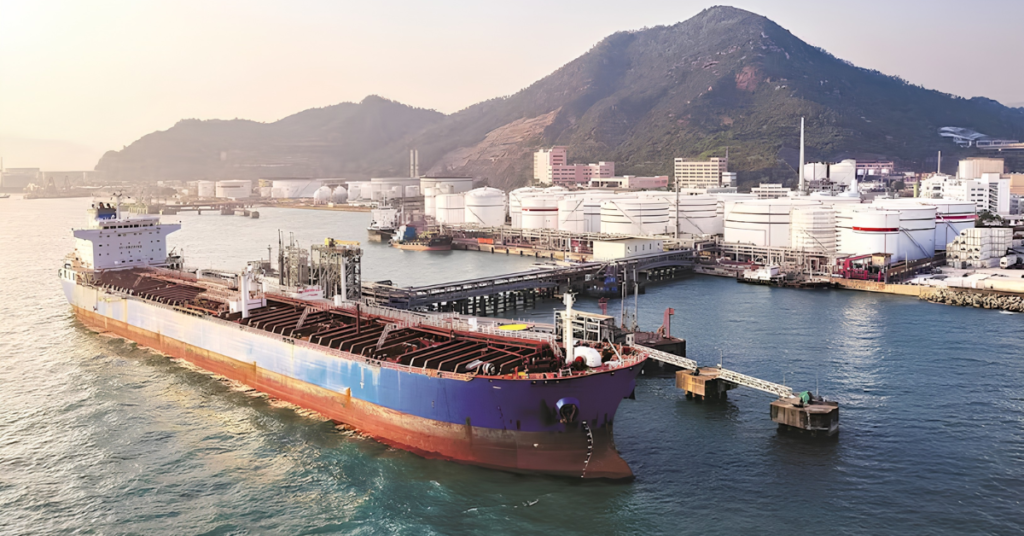
On April 28, 2026, the geopolitical architecture of the Middle East fundamentally fractured. The United Arab Emirates announced its immediate withdrawal from OPEC.
Mainstream financial media is framing this strictly as a dispute over production quotas. That analysis is shallow. The UAE’s exit is not a temper tantrum over output targets; it is a highly calculated, macroeconomic divorce from Saudi Arabia.
Here is the unvarnished analysis of why Abu Dhabi broke the cartel, how it triggers a devastating price war for Riyadh, and the heavily overlooked Indian currency strategy that will redefine Asian energy markets.
The Capacity Paradox: The Race Against Peak Oil
The immediate catalyst for the exit is “stranded capital.” For the past decade, the UAE’s national oil company, ADNOC, invested billions of dollars to expand its oil production capacity to 5 million barrels per day (bpd).
Under OPEC+ rules dictated by Riyadh, the UAE was restricted to pumping roughly 3 million bpd to keep global prices artificially high.
Abu Dhabi realized the math no longer works. The global transition to renewable energy and electric vehicles is accelerating. If the UAE waits for OPEC permission to pump its oil, those reserves will become worthless stranded assets by the 2030s. The UAE quit OPEC to open the taps. They intend to flood the market, sell their oil at a discount, and hoard the cash to fund their sovereign wealth funds (like Mubadala) to dominate the global AI and semiconductor sectors.
The Saudi-Emirati Divorce: A War of Break-Even Prices
The UAE’s exit effectively declares an oil price war against Saudi Arabia. Without the UAE’s compliance, OPEC loses its market discipline.
This creates an immediate, existential crisis for Saudi Crown Prince Mohammed bin Salman (MBS). Saudi Arabia’s massive domestic economic transformation—including the trillion-dollar Neom megacity—requires crude oil to stay above $80 per barrel.
The UAE operates on a completely different fiscal reality.
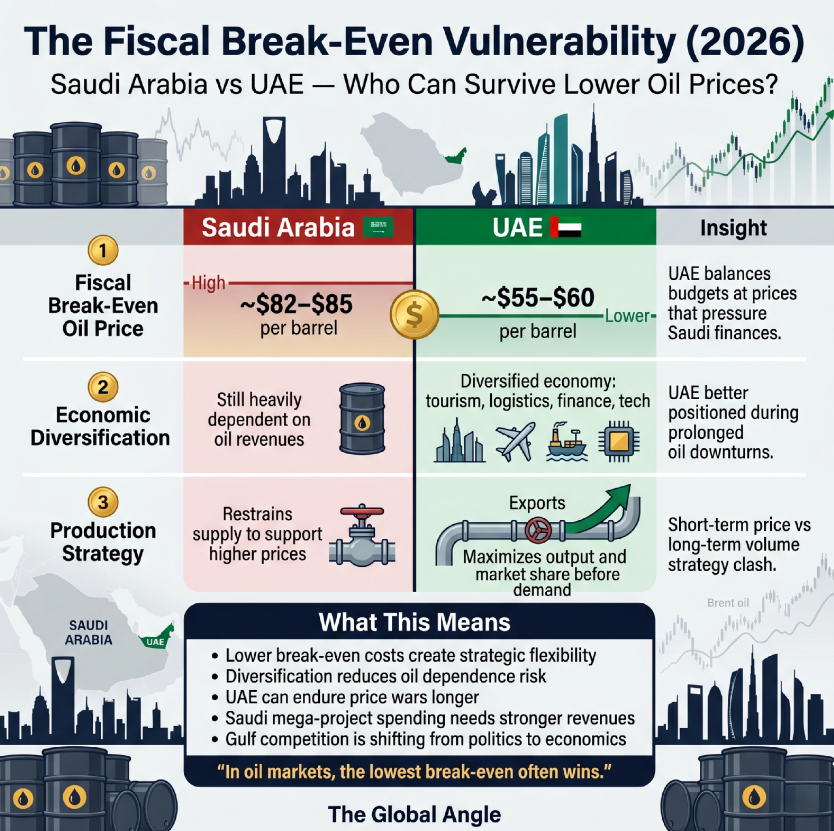
The Fiscal Break-Even Vulnerability (2026)
| Economic Metric | Saudi Arabia | United Arab Emirates | The Strategic Reality |
| Fiscal Break-Even Price | ~$82 – $85 per barrel | ~$55 – $60 per barrel | The UAE can comfortably balance its national budget at prices that would completely bankrupt Saudi mega-projects. |
| Economic Diversification | Highly dependent on oil revenues. | Highly diversified (Dubai tourism, global logistics, tech investments). | The UAE can survive a prolonged price war; Riyadh cannot. |
| Production Strategy | Withhold supply to maintain high prices. | Maximize volume immediately before peak demand hits. | The UAE is sacrificing short-term price premiums for long-term market share. |
India’s “Petro-Rupee” Masterstroke
While European and American markets brace for energy volatility, New Delhi is positioned to execute a geopolitical masterstroke. India is the world’s third-largest oil importer, purchasing over 85% of its crude.
Standard analysis notes that India benefits from the resulting drop in global oil prices, which drastically lowers its import bill and domestic inflation. However, the true “Information Gain” lies in the currency mechanics.
In 2023, India and the UAE signed the Local Currency Settlement (LCS) system, allowing bilateral trade in Indian Rupees (INR) and UAE Dirhams (AED), bypassing the U.S. Dollar. Until now, OPEC commitments restricted how much oil the UAE could sell to India under this framework.
With the UAE free from OPEC quotas, Abu Dhabi needs guaranteed buyers to absorb its massive new output. India provides that infinite demand.
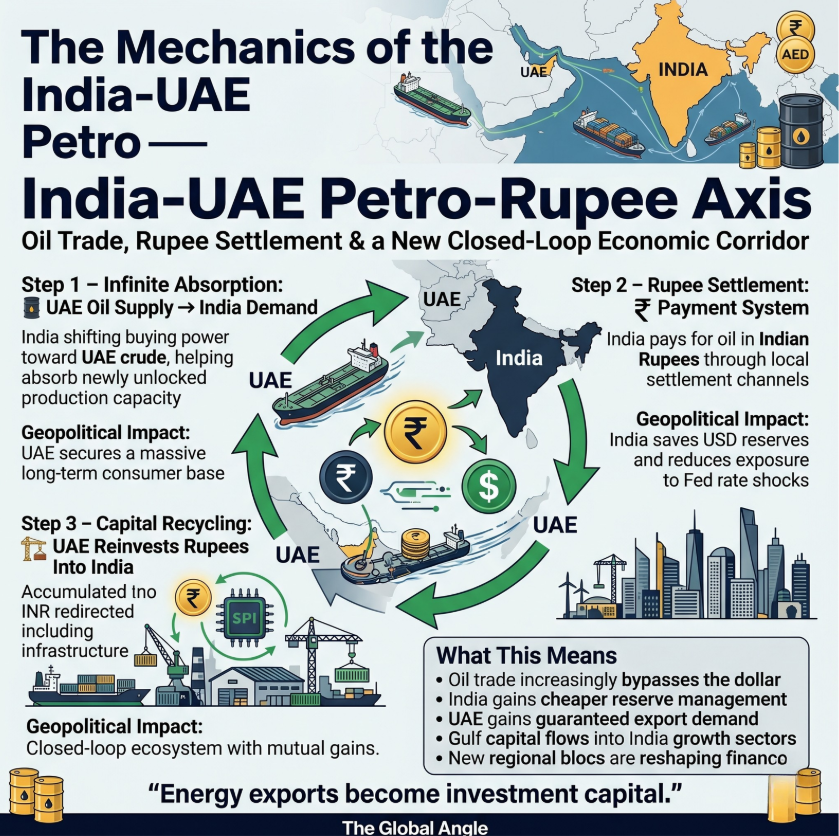
The Mechanics of the India-UAE Petro-Rupee Axis
| The Mechanism | How It Works Post-OPEC | The Geopolitical Impact |
| Infinite Absorption | India shifts its purchasing power away from strict OPEC members (like Saudi Arabia) to absorb the UAE’s newly unlocked 2 million bpd capacity. | The UAE secures a permanent, massive consumer base for its oil sprint. |
| Rupee Settlement | India pays for this excess UAE crude entirely in Indian Rupees via the LCS system. | India saves billions in U.S. Dollar reserves, structurally insulating its economy from Federal Reserve interest rate shocks. |
| Capital Recycling | The UAE holds massive reserves of INR. To utilize it, the UAE reinvests those Rupees directly into Indian infrastructure and tech startups. | Creates a closed-loop economic ecosystem. The UAE gets a return on investment; India gets foreign direct investment without dollar dependency. |
The Death of the Petrodollar Monopoly
If India successfully transitions the bulk of its Middle Eastern energy imports to a Rupee-Dirham framework, it marks the first major structural crack in the Petrodollar system. The UAE’s exit from OPEC is the catalyst that allows India to weaponize its massive consumer market, dictating not just where it buys its oil, but how it pays for it.
The Strategic Endgame
OPEC is functionally dead. It will continue to exist on paper, but without the UAE to shoulder production cuts alongside Saudi Arabia, the cartel cannot dictate global pricing.
We are entering an era of “Volume over Value.” Producers will race to pump as much crude as possible before the green transition renders the commodity obsolete. The United Arab Emirates recognized the shift first, abandoned a sinking ship, and partnered with India to execute the exit.
Sources:
International Energy Agency (IEA) – World Energy Outlook (Primary data for peak oil demand projections and the “stranded assets” risk mentioned in the Capacity Paradox)
Reserve Bank of India (RBI) – Framework for Local Currency Settlement (LCS) (Official documentation on the INR-AED settlement system and the mechanics of bypassing the U.S. Dollar)
International Monetary Fund (IMF) – Middle East and Central Asia Economic Outlook (Comparative data on Fiscal Break-Even oil prices for Saudi Arabia vs. the UAE)
OPEC – Monthly Oil Market Reports (MOMR) (Historical data on production quotas and the “Capacity Paradox” regarding unused bpd capacity)
Frequently Asked Questions
Why did the UAE leave OPEC?
The UAE left OPEC because the cartel’s production quotas were preventing Abu Dhabi from pumping millions of barrels of its own oil. The UAE wants to monetize its oil reserves immediately before global demand peaks, using the revenue to fund its domestic transition into a technology and AI-driven economy.
How does the UAE leaving OPEC affect global oil prices?
It will likely trigger a massive drop in global oil prices. Unbound by OPEC restrictions, the UAE will flood the market with cheap crude. To maintain market share, other nations (like Saudi Arabia and Russia) will be forced to match those low prices, creating a global price war.
What is the “Petro-Rupee” and how does it involve India?
The Petro-Rupee refers to India purchasing oil using its local currency (INR) instead of the U.S. Dollar. With the UAE needing to sell massive amounts of non-OPEC oil, India can absorb that supply using the pre-existing India-UAE Local Currency Settlement system. This saves India foreign exchange reserves and heavily boosts the international value of the Rupee.
Will Saudi Arabia retaliate against the UAE?
Direct military retaliation is non-existent, but fierce economic competition will follow. Riyadh will likely slash its own oil prices to punish the UAE and fiercely compete for buyers in Asian markets, completely ending the diplomatic “brotherhood” between the two Gulf monarchies.
ALSO READ: Iranian Stock Market 2026 War Impact: History of Tehran Stock Exchange Since Iran War
ALSO READ: US-Spain Relations NATO 2026: The NATO Expulsion Threat and Iran War Disagreements
Russia China trade relations 2026: Sanctions Evasion, Dual-Use Tech, and the Putin-Xi Summit
Russia China trade relations 2026: Sanctions Evasion, Dual-Use Tech, and the Putin-Xi Summit Executive Briefing…

What is Hantavirus Outbreak 2026: Symptoms, Vaccine Status, and the Climate Vector
What is Hantavirus Outbreak 2026: Symptoms, Vaccine Status, and the Climate Vector The Immediate Trigger:…
Starlink & SpaceX IPO 2026: Everything You Need to Know
Starlink & SpaceX IPO 2026: Everything You Need to Know The Valuation: According to Institutional…
What is OPEC? How the Oil Cartel Functions and Why It’s Fracturing in 2026
What is OPEC? How the Oil Cartel Functions and Why It’s Fracturing in 2026 The…
Why the UAE Quit OPEC and the Birth of the Petro-Rupee
Why the UAE Quit OPEC and the Birth of the Petro-Rupee The Rupture: The United…

Microsoft OpenAI Partnership Ends: Why Microsoft is Dropping OpenAI’s Exclusive License
Microsoft OpenAI Partnership Ends: Why Microsoft is Dropping OpenAI’s Exclusive License The Announcement: On April…

Ibrahim is the Founder and Lead Analyst at The Global Angle, an independent digital platform dedicated to factual geopolitical analysis and international affairs. Based in India, he combines an engineering background with a deep focus on global markets, diplomacy, and strategic security. Ibrahim leverages a data-driven, analytical approach to break down complex international conflicts and economic shifts, helping readers see beyond standard news narratives. When he isn’t researching global policy, he focuses on digital publishing, search engine optimization, and platform architecture.