US-Spain Relations NATO 2026: The NATO Expulsion Threat and Iran War Disagreements
- The Immediate Trigger: Following Spain’s absolute refusal to allow the U.S. military to use Naval Station Rota and Morón Air Base for offensive operations in the Iran War, diplomatic relations have completely collapsed.
- The NATO Threat: In an unprecedented escalation, the U.S. administration has floated the idea of actively pushing to suspend or remove Spain from the NATO alliance, citing “logistical sabotage” and insufficient defense spending.
- The European Fallout: Brussels views the U.S. threats against Madrid as a direct assault on European sovereignty. The crisis is rapidly accelerating the EU’s push for total military independence from Washington.

The diplomatic bridge between Washington and Madrid is broken. For the first time since the Spanish-American War of 1898, the United States and Spain are engaged in a high-stakes, adversarial standoff.
The crisis erupted in early 2026 when the U.S. demanded full operational access to its shared military bases in southern Spain to sustain its air campaigns in the Middle East. Spain firmly rejected the request. In retaliation, the U.S. administration leaked intentions to strip Spain of its NATO membership.
To understand how a foundational European ally became a primary target of Washington’s ire, you must analyze the structural history of their military alliance and the localized panic over the current Iran War.
The 2026 Rift: The Iran War and the Base Denials
The United States relies heavily on Spanish geography. Naval Station Rota and Morón Air Base are the logistical linchpins connecting the U.S. mainland to the Mediterranean and the Middle East.
When the U.S.-Iran conflict escalated, the Pentagon required these bases to stage bombers, refuel cargo planes, and deploy Aegis destroyers to the Red Sea. Spain’s coalition government, facing massive domestic anti-war protests and terrified of the economic fallout from the Strait of Hormuz blockade, invoked its sovereign right to deny the use of its soil for the conflict.
Spain categorized the U.S. strikes in Iran as a “unilateral escalation outside of NATO’s defensive mandate.”
By denying base access, Spain effectively severed Washington’s fastest logistical pipeline to the Persian Gulf, forcing U.S. military flights to execute highly inefficient, expensive reroutes.
The NATO Expulsion Threat: Rhetoric vs. Reality
Furious over the logistical bottleneck, U.S. President Donald Trump publicly accused Spain of “protecting terrorists” and acting as a “freeloader” on American defense dollars. White House officials subsequently confirmed to the press that they are exploring legal mechanisms to suspend Spain’s NATO status.
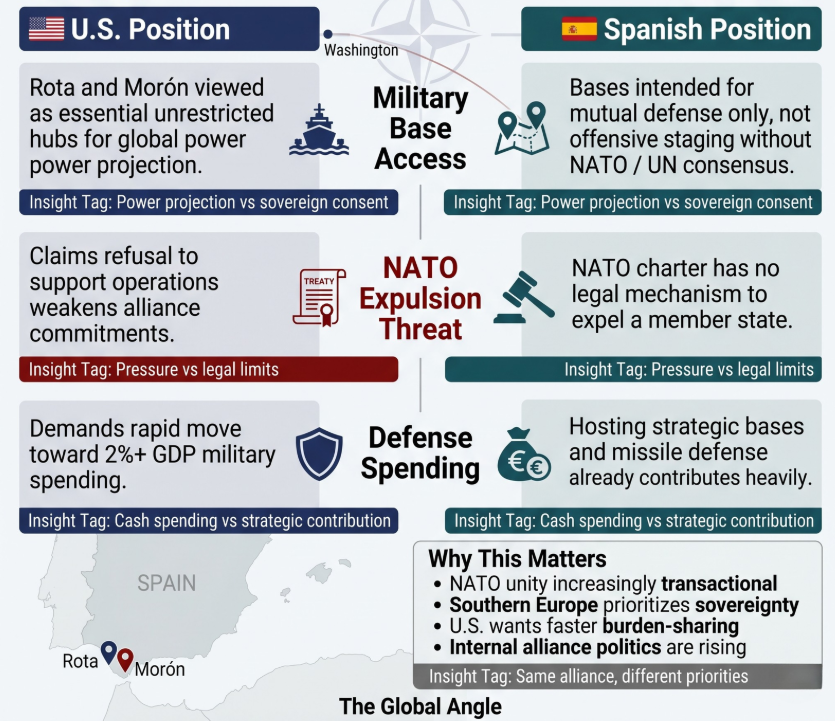
The NATO Standoff (U.S. Demands vs. Spanish Reality)
| Geopolitical Metric | The U.S. Position | The Spanish Position |
| Military Base Access | Views Rota and Morón as essential, unrestricted staging grounds for global U.S. power projection. | Views the bases as strictly for mutual defense; explicitly prohibits offensive staging without UN or NATO consensus. |
| NATO Expulsion Threat | Argues Spain’s refusal to assist in the Middle East voids its commitment to the alliance. | Dismisses the threat as political theater, noting the NATO charter contains no legal mechanism to expel a member state. |
| Defense Spending | Demands Spain immediately double its defense budget to meet the 2% GDP NATO threshold. | Argues that hosting strategic U.S. bases and European missile defense shields counts heavily toward its burden-sharing. |
The Information Gain: The Ghost of Zapatero
To geopolitical analysts, the 2026 base denial is not a surprise. It is a direct continuation of a historical pattern.
In 2003, Spanish Prime Minister José María Aznar supported the U.S. invasion of Iraq. The Spanish public violently opposed it. Following the devastating 2004 Madrid train bombings, a new Prime Minister, José Luis Rodríguez Zapatero, immediately withdrew all Spanish troops from Iraq. That sudden withdrawal enraged the Bush administration and froze bilateral relations for years.
Washington failed to learn the lesson of 2004. Spanish voters will brutally punish any government that drags the country into American wars in the Middle East. The 2026 denial of base access is Madrid prioritizing its own domestic political survival over Washington’s strategic goals.
The Historical Context: From 1898 to the Pact of Madrid
The U.S.-Spain relationship has always been highly transactional, born out of conflict and sustained by geographic necessity.
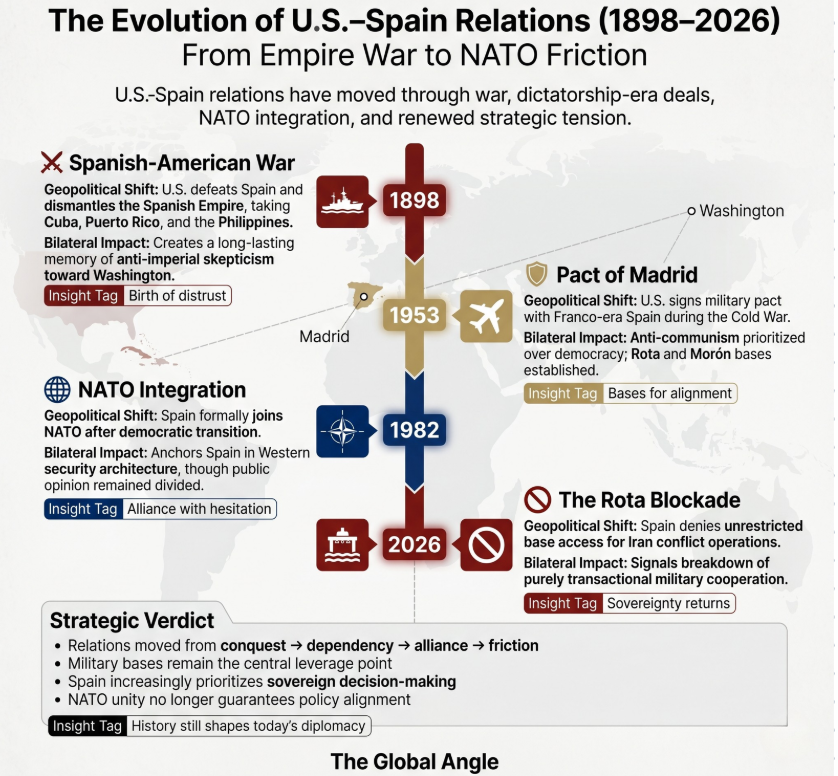
The Evolution of US-Spain Relations NATO 2026
| Era | Geopolitical Shift | Impact on Bilateral Relations |
| 1898: Spanish-American War | The U.S. dismantles the Spanish Empire, seizing Cuba, Puerto Rico, and the Philippines. | Leaves a deep, generational legacy of anti-imperialist skepticism toward Washington within Spanish political culture. |
| 1953: The Pact of Madrid | The U.S. signs a military pact with the fascist Franco dictatorship during the Cold War. | Washington prioritizes anti-communism over democracy, establishing the Rota and Morón bases. |
| 1982: NATO Integration | Spain formally joins NATO following its transition to democracy. | Anchors Spain to Western security architectures, though public referendums showed deep hesitation. |
| 2026: The Rota Blockade | Spain denies base access for the Iran War; U.S. threatens NATO expulsion. | The complete collapse of the transactional base-sharing agreement. |
Europe’s Reaction: The Catalyst for Autonomy
The U.S. threat to expel Spain from NATO has sent shockwaves through European capitals. Brussels does not view this as an isolated dispute between Washington and Madrid. It is universally perceived as a threat to the entire continent.
If the United States can threaten to dismantle NATO security guarantees simply because a European nation refuses to participate in an off-book war in the Middle East, the alliance is effectively a protection racket.
France and Germany have aggressively rallied behind Spain. French President Emmanuel Macron cited the U.S. threats as the absolute validation of “Strategic Autonomy.” The crisis has accelerated the European Union’s timeline to establish an independent rapid deployment force and heavily decouple its defense procurement from American contractors.
Spain is currently accelerating military partnerships within the EU framework, preparing for a reality where the American security umbrella is permanently withdrawn.
Sources:
Center for Strategic and International Studies (CSIS) – Europe, Russia, and Eurasia Program (High-level think tank analysis on NATO burden-sharing, U.S. force posture in the Mediterranean, and the friction between Washington and Brussels)
Spanish Ministry of Defense (Ministerio de Defensa) – International Missions & NATO Integration (Official Spanish government documentation outlining Madrid’s legal parameters for foreign military deployments and its sovereign defense strategy)
U.S. European Command (USEUCOM) – Force Posture and Logistics (The official U.S. military command responsible for coordinating all American operations, base logistics, and strategic deterrence across Europe and the Mediterranean)
Carnegie Endowment for International Peace – Europe Program (Deep-dive geopolitical research on the European Union’s push for “Strategic Autonomy” and the diplomatic fallout of U.S. foreign policy shifts)
Congressional Research Service (CRS) – U.S. Military Bases Overseas & Bilateral Agreements (Neutral, data-rich reports provided to the U.S. Congress detailing the exact legal and financial mechanics of operating bases like Rota and Morón in foreign, sovereign nations)
Frequently Asked Questions
Can the U.S. legally remove Spain from NATO?
No. The North Atlantic Treaty (signed in 1949) contains Article 13, which allows a member state to voluntarily leave the alliance. However, the treaty contains zero legal mechanisms for expelling, suspending, or removing a member state against its will. The U.S. threats are entirely political leverage, not legal realities.
Why are the Spanish military bases so important to the U.S.?
Naval Station Rota and Morón Air Base are geographically vital. They provide the U.S. military with the closest, most secure staging areas to project naval and air power into the Mediterranean Sea, North Africa, and the Middle East without requiring highly complex mid-air refueling logistics from the American mainland.
Why did Spain refuse to help the U.S. in the Iran War?
The Spanish government views the U.S. military campaign in Iran as a dangerous, unilateral escalation that threatens European energy security. Furthermore, domestic anti-war sentiment in Spain is overwhelmingly high. The government refused to allow its sovereign territory to be used to facilitate an offensive war that lacks a United Nations mandate.
ALSO READ: US-Europe Diplomatic Divide 2026: How U.S. & Europe are Falling Apart
ALSO READ: Strait of Hormuz Current Status: Comparing U.S vs Iranian Narrative What Each Side Has to Say?
Russia China trade relations 2026: Sanctions Evasion, Dual-Use Tech, and the Putin-Xi Summit
Russia China trade relations 2026: Sanctions Evasion, Dual-Use Tech, and the Putin-Xi Summit Executive Briefing…

What is Hantavirus Outbreak 2026: Symptoms, Vaccine Status, and the Climate Vector
What is Hantavirus Outbreak 2026: Symptoms, Vaccine Status, and the Climate Vector The Immediate Trigger:…
Starlink & SpaceX IPO 2026: Everything You Need to Know
Starlink & SpaceX IPO 2026: Everything You Need to Know The Valuation: According to Institutional…
What is OPEC? How the Oil Cartel Functions and Why It’s Fracturing in 2026
What is OPEC? How the Oil Cartel Functions and Why It’s Fracturing in 2026 The…

Why the UAE Quit OPEC and the Birth of the Petro-Rupee
Why the UAE Quit OPEC and the Birth of the Petro-Rupee The Rupture: The United…

Microsoft OpenAI Partnership Ends: Why Microsoft is Dropping OpenAI’s Exclusive License
Microsoft OpenAI Partnership Ends: Why Microsoft is Dropping OpenAI’s Exclusive License The Announcement: On April…

Ibrahim is the Founder and Lead Analyst at The Global Angle, an independent digital platform dedicated to factual geopolitical analysis and international affairs. Based in India, he combines an engineering background with a deep focus on global markets, diplomacy, and strategic security. Ibrahim leverages a data-driven, analytical approach to break down complex international conflicts and economic shifts, helping readers see beyond standard news narratives. When he isn’t researching global policy, he focuses on digital publishing, search engine optimization, and platform architecture.