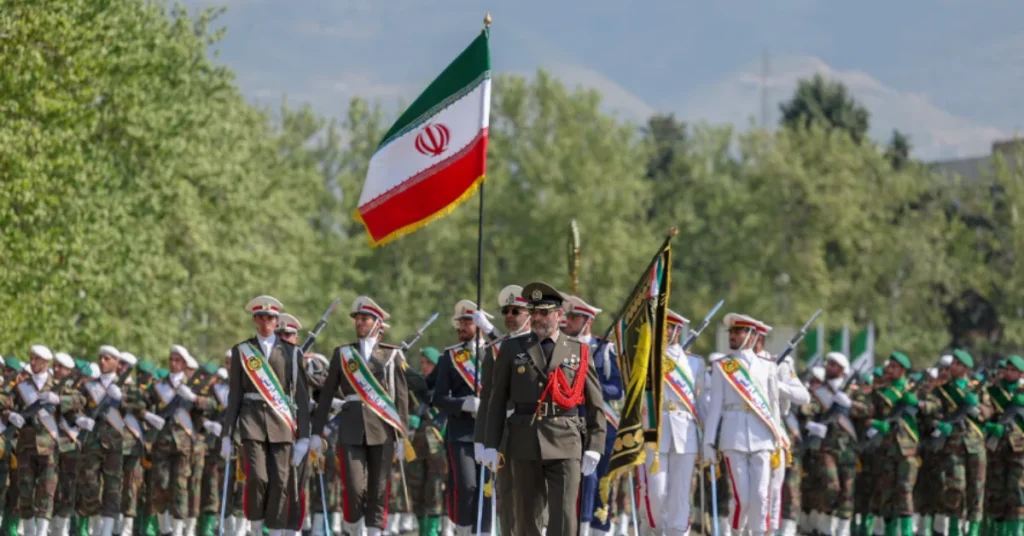
Strait of Hormuz Current Status: Comparing U.S vs Iranian Narrative What Each Side Has to Say?
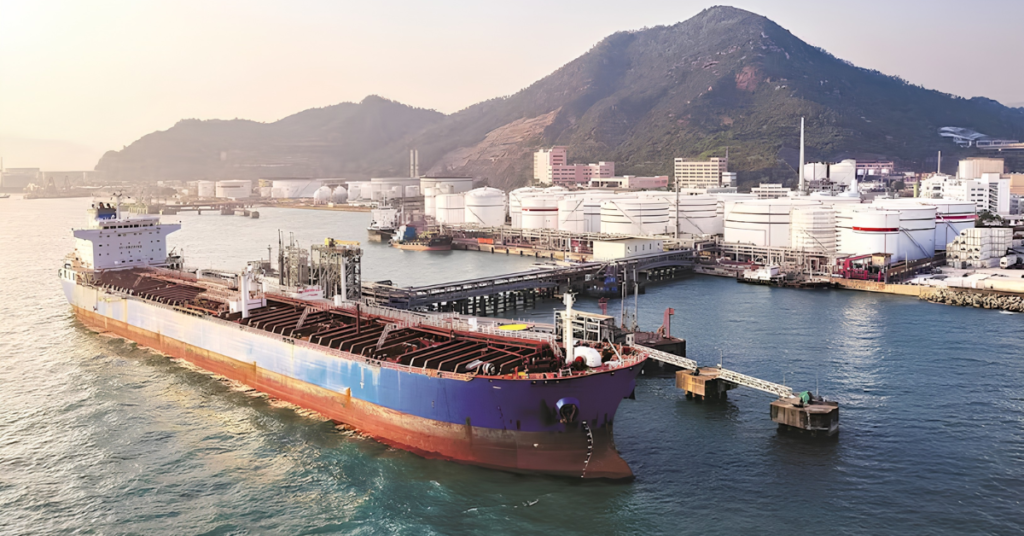
Commercial transit through the Strait of Hormuz has plummeted by 95% as of April 2026. The 21-mile-wide chokepoint connecting the Persian Gulf to the open ocean is effectively closed to Western shipping.
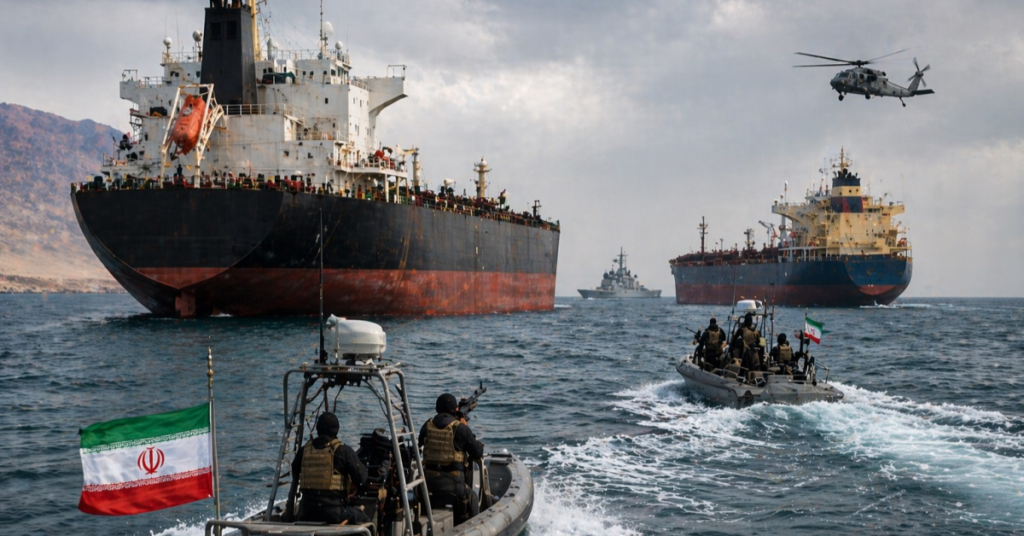
Analysts warn that disruptions in the Strait of Hormuz could be used as leverage over global energy markets. By establishing a de facto blockade using GPS spoofing, drone swarms, and localized naval dominance, Tehran is forcing severe cost-push inflation onto the Western world.
Here is the exact tactical reality on the water, a direct comparison of the competing geopolitical narratives, and the strategic endgames of Washington and Tehran.
The Tactical Reality on the Water
The Strait of Hormuz is not completely impassable. It is highly filtered.
Iran is executing a strategy of “selective maritime denial.” The Islamic Revolutionary Guard Corps Navy (IRGCN) is not sinking every vessel. Instead, they are conducting ideological and economic audits of cargo.
Only a tightly controlled trickle of vessels is allowed passage. These consist almost entirely of Chinese-bound supertankers and vessels operating within the “shadow fleet”—older ships lacking Western insurance that transport sanctioned crude oil. Western-flagged vessels, or those insured by European syndicates, face immediate boarding threats, localized GPS jamming, and drone harassment.
This filtering turns an international global commons into a sovereign Iranian checkpoint. It completely fractures the baseline assumption of international maritime law: freedom of movement.
The Narrative War: What Each Side Has to Say
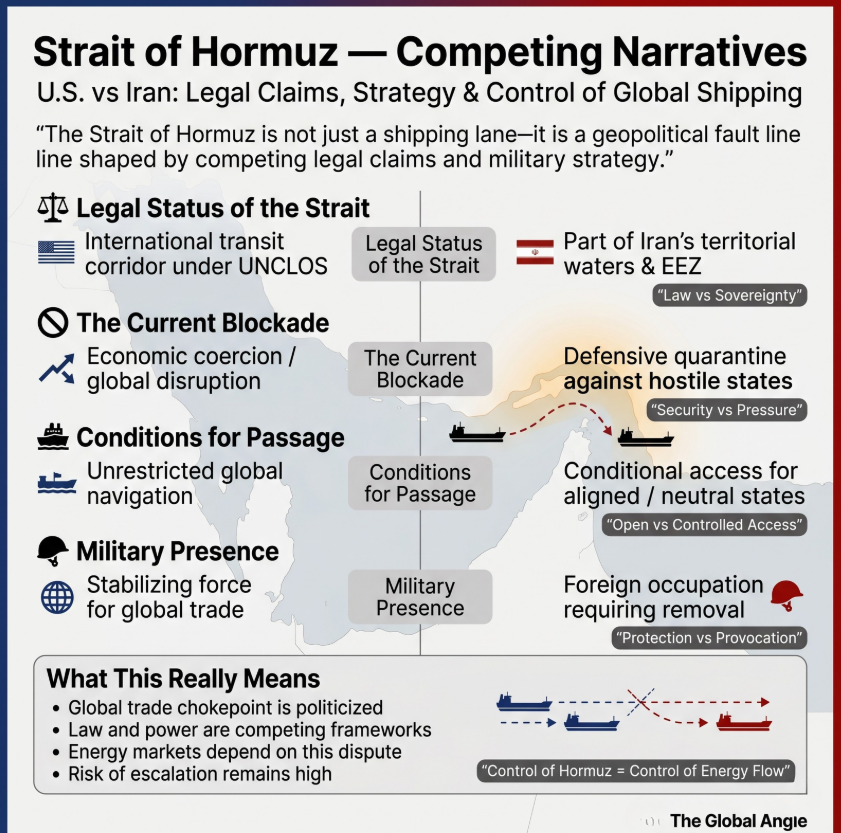
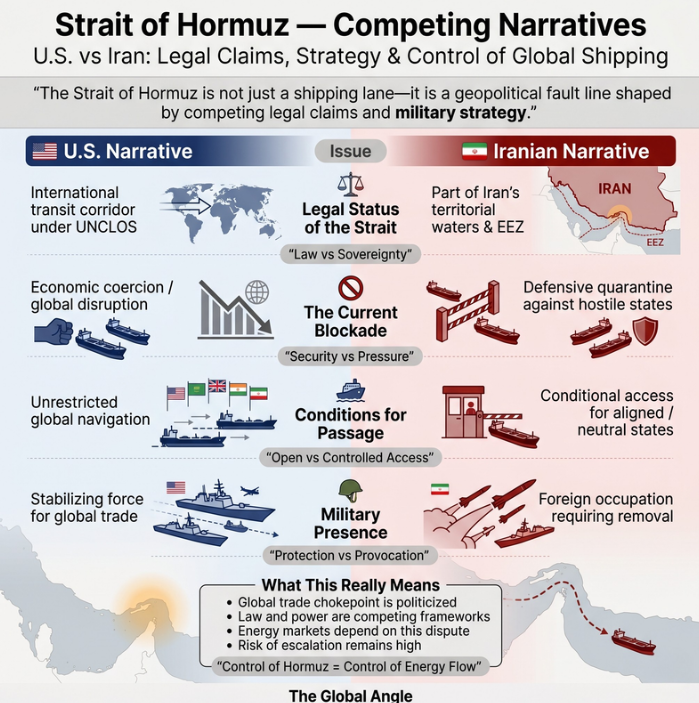
The diplomatic standoff is rooted in entirely incompatible views of maritime sovereignty. Washington views the Strait as a protected international corridor. Tehran views the Strait as its own territorial waters, subject to its national security directives.
Competing Claims and Justifications
| The Issue | The U.S. Narrative | The Iranian Narrative |
| Legal Status of the Strait | It is an international transit corridor protected by the UN Convention on the Law of the Sea (UNCLOS). | It falls within Iran’s territorial waters and Exclusive Economic Zone (EEZ); Iran holds jurisdiction. |
| The Current Blockade | A blatant act of international terrorism and economic piracy designed to hold the global economy hostage. | A legitimate, defensive military quarantine to prevent hostile nations from supplying Israel and the U.S. |
| Condition for Passage | Absolute, unconditional freedom of navigation for all commercial vessels regardless of flag. | Safe transit is guaranteed only to “non-belligerent” nations that coordinate directly with Tehran. |
| U.S. Military Presence | Essential for maintaining global security, deterring aggression, and keeping energy markets stable. | An illegal, destabilizing occupation force that must be entirely expelled from the Persian Gulf. |
What Both Sides Actually Want
Beyond the public rhetoric, the strategic objectives of the United States and Iran are fundamentally opposed.
The American Objective: Macroeconomic Stability
Washington wants immediate, unhindered access to the Gulf to stabilize Brent crude prices. The U.S. defense industrial base is highly strained, and the administration is facing severe domestic backlash over spiking gas prices ahead of the 2026 midterm elections.
The U.S. requires a return to the pre-2026 status quo. Washington wants to contain Iran without committing ground troops, relying entirely on precision airstrikes to degrade the IRGC’s coastal missile batteries.
The Iranian Objective: Asymmetric Deterrence
Tehran wants to inflict maximum economic pain without triggering a direct U.S. ground invasion.
Iran knows it cannot defeat the U.S. Navy in a conventional, symmetrical naval battle. Instead, its leaders are utilizing the Strait of Hormuz as their primary mechanism for deterrence. Iran’s absolute demand is the cessation of all U.S. and Israeli airstrikes. By strangling the world’s oil supply, Tehran is attempting to force Western voters to demand an early exit from the war.
The Diplomatic Deadlock: Negotiations and Demands
Backchannel negotiations remain entirely frozen. Both Washington and Tehran have established red lines that make a short-term diplomatic resolution highly improbable.
Conditions for De-escalation
| Resolution Metric | The American Demand | The Iranian Demand |
| Freedom of Navigation | Immediate, unconditional reopening of the Strait to all commercial and military traffic. | Transit granted only to nations that do not support U.S. or Israeli military operations. |
| Military Posture | Iran must permanently dismantle coastal anti-ship batteries and cease drone harassment. | The United States must permanently withdraw the 5th Fleet from its naval headquarters in Bahrain. |
| Sanctions & Economics | The U.S. retains the right to seize vessels carrying sanctioned Iranian crude oil. | The West must release frozen Iranian assets and allow uninterrupted oil exports to Asia. |
The Future of the Strait of Hormuz
Conditions in the Strait can change rapidly, and reports often differ by source. The current standoff guarantees a permanent structural shift in global energy markets.
Even if a ceasefire is brokered, the physical security of the Strait is permanently compromised. Global insurance syndicates in London will mandate massive risk premiums for any vessel entering the Persian Gulf for the foreseeable future.
Future Outcome: The Tollbooth Economy
The most significant future outcome is the normalization of the “tollbooth economy.” Iran has proven that a regional power can successfully override international maritime law using cheap, asymmetrical technology.
Moving forward, the Strait of Hormuz will likely operate under a dual system. Allied nations of Iran, such as Russia and China, will enjoy safe, expedited passage. Western nations will be forced to rely on expensive overland pipelines, rerouted supply chains, or heavily armed naval convoys. The era of free, unquestioned global transit through the Persian Gulf has ended.
Sources:
U.S. Central Command (CENTCOM) – Official Press Releases
(Official U.S. Department of Defense updates regarding naval deployments, 5th Fleet operations, and maritime blockades in the Persian Gulf)
United Nations Convention on the Law of the Sea (UNCLOS) – Part III: Straits Used for International Navigation
(The foundational international legal framework defining the right of transit passage versus territorial water claims)
U.S. Naval Institute (USNI) News – Fleet and Marine Tracker
(Independent, authoritative tracking of U.S. carrier strike groups, naval posture, and tactical maritime movements in the Middle East)
Lloyd’s List / MarineTraffic – Global Maritime Intelligence
(Live AIS tracking data, commercial shipping disruptions, “shadow fleet” movements, and adjustments to London insurance risk premiums)
Institute for the Study of War (ISW) – Iran Update
(Daily geopolitical and tactical assessments of IRGC operations, asymmetric warfare strategies, and Iranian proxy networks)
Frequently Asked Questions
Why is the Strait of Hormuz so important?
The Strait is the world’s most vital energy chokepoint. Approximately 20% of global liquefied natural gas (LNG) and 25% of the total global oil consumption passes through this narrow waterway to reach international markets.
What is the U.S. doing to open the Strait?
The U.S. and its allies are conducting continuous airstrikes against Iranian coastal radar installations, drone launch sites, and anti-ship missile batteries. However, the U.S. is heavily avoiding the deployment of ground troops to physically occupy the Iranian coastline.
Who is allowed to pass through the Strait right now?
Iran has established a selective blockade. Currently, only vessels that Tehran deems “non-belligerent”—primarily Chinese tankers and non-Western shadow fleet vessels—are granted safe passage.
ALSO READ: Global Debt Report 2026 Analysis and the $348 Trillion World Debt Crisis
Russia China trade relations 2026: Sanctions Evasion, Dual-Use Tech, and the Putin-Xi Summit
Russia China trade relations 2026: Sanctions Evasion, Dual-Use Tech, and the Putin-Xi Summit Executive Briefing…

What is Hantavirus Outbreak 2026: Symptoms, Vaccine Status, and the Climate Vector
What is Hantavirus Outbreak 2026: Symptoms, Vaccine Status, and the Climate Vector The Immediate Trigger:…
Starlink & SpaceX IPO 2026: Everything You Need to Know
Starlink & SpaceX IPO 2026: Everything You Need to Know The Valuation: According to Institutional…
What is OPEC? How the Oil Cartel Functions and Why It’s Fracturing in 2026
What is OPEC? How the Oil Cartel Functions and Why It’s Fracturing in 2026 The…
Why the UAE Quit OPEC and the Birth of the Petro-Rupee
Why the UAE Quit OPEC and the Birth of the Petro-Rupee The Rupture: The United…

Microsoft OpenAI Partnership Ends: Why Microsoft is Dropping OpenAI’s Exclusive License
Microsoft OpenAI Partnership Ends: Why Microsoft is Dropping OpenAI’s Exclusive License The Announcement: On April…

Ibrahim is the Founder and Lead Analyst at The Global Angle, an independent digital platform dedicated to factual geopolitical analysis and international affairs. Based in India, he combines an engineering background with a deep focus on global markets, diplomacy, and strategic security. Ibrahim leverages a data-driven, analytical approach to break down complex international conflicts and economic shifts, helping readers see beyond standard news narratives. When he isn’t researching global policy, he focuses on digital publishing, search engine optimization, and platform architecture.