Where is Mojtaba Khamenei: Who is Controlling Iran?
Right now, the skies over Iran are contested. But the real black box isn’t the airspace. It is the political architecture underneath it.
Everyone tracking the 2026 conflict is asking the exact same question. Who is actually giving the orders? And more specifically: where is Mojtaba Khamenei?
If you watch Western cable news, you would assume the Iranian leadership is running around a subterranean bunker in a blind, chaotic panic, cut off from the outside world. If you read Iranian state-run media, you would think the Supreme Leader and his inner circle are sitting calmly in Tehran, entirely unbothered by Western bunker-busters.
Neither is true.
The reality of who is controlling Iran right now is much darker, highly bureaucratic, and deeply decentralized. Here is the unvarnished breakdown of the Iranian shadow state, the media spin, and why decapitating the regime is mathematically impossible right now.
The Ghost in the Machine: Where is Mojtaba Khamenei?
Let’s address the ghost in the room. Mojtaba Khamenei.
He holds no official constitutional title. He isn’t the President. He isn’t the chief commander of the Islamic Revolutionary Guard Corps (IRGC). He is a cleric, and he is the second son of the 87-year-old Supreme Leader, Ayatollah Ali Khamenei.
Yet, Mojtaba controls the Beit-e Rahbari the Office of the Supreme Leader. He is the ultimate gatekeeper. In a wartime economy, he controls the shadow financial empires (the Bonyads) that fund the regime. He is widely considered the unannounced heir to the Supreme Leadership.
So where is he?
Western intelligence heavily suspects Mojtaba was moved out of Tehran weeks before the heaviest U.S. and Israeli airstrikes began. He did not flee the country. Fleeing projects terminal weakness, and the regime’s survival depends entirely on the projection of strength.
Instead, he is likely operating out of the deeply fortified subterranean command centers in Isfahan, or the heavily shielded, mountainous nuclear complexes near Kermanshah or Fordow. His physical survival is the regime’s ultimate continuity plan. If the Supreme Leader dies whether from old age, illness, or a kinetic strike Mojtaba is the only figure with enough institutional leverage to prevent a civil war between the clerics and the military.
The Media War: Washington vs. Tehran
The information war is just as aggressive as the physical one. Both sides are peddling highly curated fictions about Iran’s governance.
What Western Media Claims: The prevailing narrative in Washington and London is that the Iranian regime is essentially decapitated. Western analysts suggest that the strikes have severed communications between Tehran and its proxy networks. They paint a picture of severe infighting claiming that Mojtaba Khamenei is currently locked in a brutal power struggle with IRGC hardliners over who actually controls the shrinking wartime budget. The West projects a regime on the brink of total institutional collapse.
What Iranian State Media Claims: Outlets like Kayhan and Tasnim News project an alternate reality of absolute, unshakeable continuity. They broadcast pre-recorded, tightly edited footage of the Supreme Leader delivering calm sermons. They refuse to acknowledge the destruction of their ballistic missile silos. The state media narrative is “Strategic Patience” the idea that the governance structure is functioning perfectly, the economy is resilient, and the leadership is united in its holy defense.
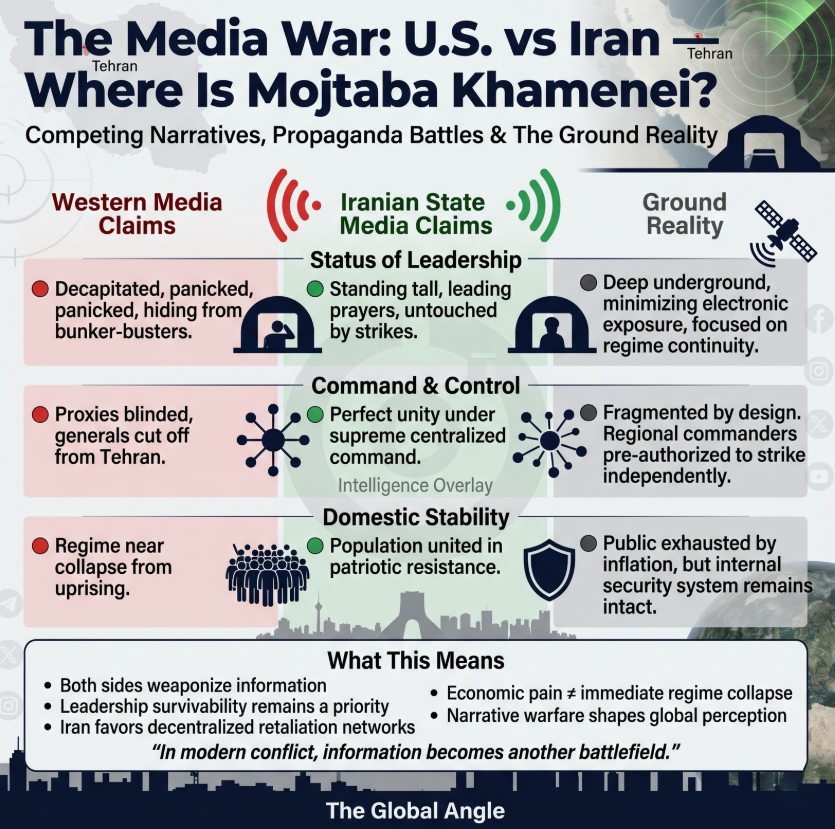
The Media War U.S Vs Iran: Where is Mojtaba Khamenei?
| The Narrative Battlefield | What Western Media Claims | What Iranian State Media Broadcasts | The Unvarnished Reality |
| Status of Leadership | Decapitated, panicked, and hiding in terror from bunker-busters. | Standing tall, leading prayers, completely unbothered by U.S. strikes. | Deep underground. Operating through couriers to avoid electronic assassination, highly focused on long-term regime continuity. |
| Command & Control | Severed. Proxies are blind, and generals are completely cut off from the capital. | Perfectly unified under the Supreme Leader’s divine, day-to-day guidance. | Fractured by design. Local commanders have pre-delegated authority to strike without waiting for Tehran’s permission. |
| Domestic Stability | The regime is on the brink of a massive, war-ending civilian uprising. | The populace is united in holy defense against Western imperialism. | The public is exhausted and hyper-inflation is rampant, but the IRGC’s internal security apparatus remains brutal and entirely intact. |
The “Mosaic Doctrine”: Who is Controlling Iran?
Here is what page one of Google will not tell you about who is running Iran.
Iran is not currently being run by one man sitting at the head of a mahogany table. It is not a top-down pyramid right now. It is a mesh network.
Years ago, anticipating a massive U.S. or Israeli strike that would destroy communication lines in Tehran, the IRGC implemented a military strategy called the “Mosaic Doctrine.”
They knew centralized Command and Control (C2) was a fatal vulnerability. So, they intentionally fractured their own military. The IRGC is broken into 31 autonomous provincial commands.
Who is controlling Iran right now? The local IRGC Brigadiers.
These provincial commanders do not need Mojtaba Khamenei or the President to call them on a secure satellite phone to give the order to fire a drone swarm or suppress a local riot. The authority is pre-delegated. If communication with the capital is severed, these brigadiers become their own localized Supreme Leaders. They fire at will. They govern their own provinces.
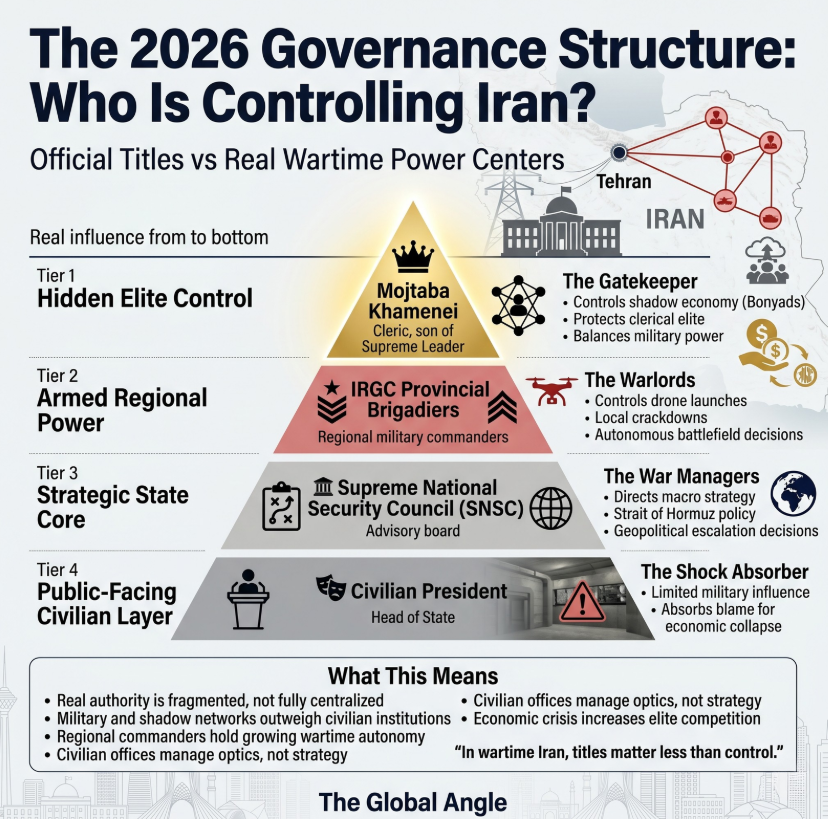
The 2026 Governance Structure: Who is Controlling Iran?
| The Power Broker | On-Paper Role | The Actual Wartime Function |
| Mojtaba Khamenei | Cleric; second son of the Supreme Leader. | The Gatekeeper. He controls the shadow economy (the Bonyads) and manages the political survival of the clerical class against the military. |
| IRGC Provincial Brigadiers | Regional military commanders. | The Warlords. Operating under the “Mosaic Doctrine,” they independently control drone launches and local crackdowns without needing capital approval. |
| Supreme National Security Council (SNSC) | Advisory board. | The War Managers. Coordinating the macro-strategy, managing the Strait of Hormuz blockade, and dictating geopolitical leverage. |
| The Civilian President | Head of State. | The Shock Absorber. Completely sidelined from military decisions. Their only job is taking the public blame for the collapsing economy. |
The Real Power Split
The governance of Iran has split into two parallel tracks.
Track 1: The War Managers The daily logistics of the war the Strait of Hormuz blockade, the GPS spoofing, the missile launches are being handled by the Supreme National Security Council (SNSC) and the localized IRGC commanders. They are executing a pre-written playbook. They don’t need daily micromanagement from the clerics.
Track 2: The Survival Managers This is Mojtaba Khamenei’s domain. Mojtaba is not picking targets for drone strikes. He is managing the politics of the aftermath. His singular focus is ensuring that the clerical establishment does not get swallowed whole by a military dictatorship. War gives the IRGC massive power and unlimited budgets. Mojtaba is operating in the shadows to keep the generals on a leash, ensuring that when the dust settles, the Ayatollahs and specifically, himself are still the ones signing the checks.
The West is looking for a singular leader to pressure, sanction, or eliminate. But in 2026, targeting the “head” of Iran doesn’t kill the state. The regime was built to survive its own decapitation.
Sources:
Foundation for Defense of Democracies (FDD) – Iran Internal Politics & Succession (Authoritative tracking of the post-Khamenei power vacuum, the 5-man interim leadership council, and the operational status of the new Supreme Leader, Mojtaba Khamenei)
The Washington Institute for Near East Policy – The IRGC and Supreme Succession (Deep-dive analysis on how the Islamic Revolutionary Guard Corps controls the Beit-e Rahbari and leverages the Assembly of Experts during leadership transitions)
Middle East Institute (MEI) – Iran Program (Expert analysis of the IRGC’s structural control over the Iranian state, domestic politics, and the marginalization of the civilian government)
United States Institute of Peace (USIP) – The “Mosaic Doctrine” and IRGC Strategy (Comprehensive military analysis detailing the 2005 restructuring of the IRGC into 31 decentralized provincial commands designed to survive command-and-control decapitation)
Where is Mojtaba Khamenei right now?
He has not fled the country. Fleeing projects terminal weakness. Western intelligence assessments strongly suggest he was relocated from Tehran to deeply fortified, subterranean command centers—likely near Isfahan or the shielded complexes near Fordow—weeks before the heaviest strikes. His physical survival is the regime’s fail-safe to prevent a succession crisis.
Why hasn’t the Iranian government collapsed under the airstrikes?
Because the West is treating Iran like a traditional top-down dictatorship. It isn’t. The regime was specifically built to survive its own decapitation. Through pre-delegated military authority and a massive shadow economy that operates entirely outside traditional banking structures, the state can continue functioning even when its central infrastructure is destroyed.
Is Ayatollah Ali Khamenei still in power?
Yes. He remains the Supreme Leader. But the day-to-day tactical management of the 2026 war has been handed off to the Supreme National Security Council (SNSC) and military generals. The Ayatollah acts as the untouchable ideological figurehead, while his son, Mojtaba, quietly manages the survival of the shadow state.
Who is actually controlling Iran’s military right now?
It is not a single person sitting in a war room. The Islamic Revolutionary Guard Corps (IRGC) is operating under the “Mosaic Doctrine.” The military is intentionally decentralized into 31 autonomous provincial commands. Local brigadiers have the pre-delegated authority to launch drone swarms and execute defense protocols even if all communications with Tehran are permanently severed.
ALSO READ: Iranian Stock Market 2026 War Impact: History of Tehran Stock Exchange Since Iran War
ALSO READ: US-Spain Relations NATO 2026: The NATO Expulsion Threat and Iran War Disagreements
Russia China trade relations 2026: Sanctions Evasion, Dual-Use Tech, and the Putin-Xi Summit
Russia China trade relations 2026: Sanctions Evasion, Dual-Use Tech, and the Putin-Xi Summit Executive Briefing…
What is Hantavirus Outbreak 2026: Symptoms, Vaccine Status, and the Climate Vector
What is Hantavirus Outbreak 2026: Symptoms, Vaccine Status, and the Climate Vector The Immediate Trigger:…
Starlink & SpaceX IPO 2026: Everything You Need to Know
Starlink & SpaceX IPO 2026: Everything You Need to Know The Valuation: According to Institutional…
What is OPEC? How the Oil Cartel Functions and Why It’s Fracturing in 2026
What is OPEC? How the Oil Cartel Functions and Why It’s Fracturing in 2026 The…
Why the UAE Quit OPEC and the Birth of the Petro-Rupee
Why the UAE Quit OPEC and the Birth of the Petro-Rupee The Rupture: The United…

Microsoft OpenAI Partnership Ends: Why Microsoft is Dropping OpenAI’s Exclusive License
Microsoft OpenAI Partnership Ends: Why Microsoft is Dropping OpenAI’s Exclusive License The Announcement: On April…

Ibrahim is the Founder and Lead Analyst at The Global Angle, an independent digital platform dedicated to factual geopolitical analysis and international affairs. Based in India, he combines an engineering background with a deep focus on global markets, diplomacy, and strategic security. Ibrahim leverages a data-driven, analytical approach to break down complex international conflicts and economic shifts, helping readers see beyond standard news narratives. When he isn’t researching global policy, he focuses on digital publishing, search engine optimization, and platform architecture.