Iranian Stock Market 2026 War Impact: History of Tehran Stock Exchange Since Iran War
- The Crash: Since the escalation of the US-Iran war and the implementation of international snapback sanctions, the Tehran Stock Exchange (TSE) has experienced record daily falls, shrinking its market capitalization to a fraction of its pre-war valuation.
- Domestic Unrest: Retail investors are protesting, referring to the exchange as a “rigged casino.” Evidence points to the state effectively trapping domestic savings to fund the government’s widening wartime budget deficits.
- The Strategic Imbalance: While Iran projects asymmetric power in the Red Sea and Strait of Hormuz, the TSE metrics reveal a domestic economy in freefall, burdened by 60% inflation and severe capital flight.

The geopolitical standoff in the Strait of Hormuz projects Iranian military resilience abroad, but the domestic capital markets tell a completely different story. Since the outbreak of hostilities, the Iranian financial system has absorbed catastrophic damage.
To understand the true state of the 2026 conflict, you must look past the military hardware and analyze the money. Here is the complete history of the Iranian stock market’s collapse since the war began, and what these numbers say about Tehran’s ability to survive a protracted standoff.
The Timeline of the Crash: From Sanctions to Airstrikes
The current trajectory of the Iranian capital market began unraveling before the first bombs dropped. When international snapback sanctions were reactivated in late 2025, the market anticipated severe revenue shortfalls from restricted oil exports.
As military tensions escalated into open conflict by early 2026 culminating in the arrival of U.S. carrier strike groups and subsequent airstrikes—the market panicked. In January 2026, the TSE suffered record daily losses.
Cut off from global trade, the government turned inward to finance the war. To cover massive budget deficits, the state aggressively offloaded shares of government-owned enterprises onto the domestic market. Institutional investors, many with ties to the state, quickly withdrew their capital after taking profits. This orchestrated exit left millions of everyday Iranian citizens holding rapidly depreciating assets.
Current Market Status: The “Broken Showcase”
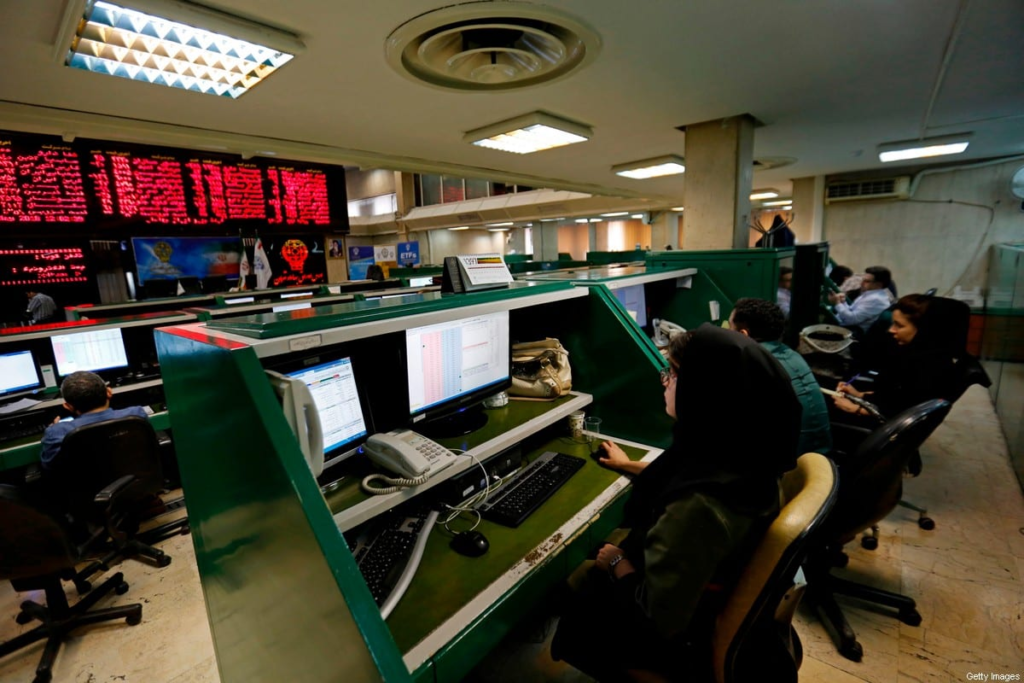
Today, the TSE is functionally paralyzed. Once heralded by state media as the “showcase of the Iranian economy,” it has become a symbol of institutional decay.
Recent economic reports from regional analysts describe the market as deeply anomic—plagued by opacity, manipulation, and insider control. The total market capitalization, which once measured comfortably in the hundreds of billions of dollars, is projected to crater toward the $65 billion mark.
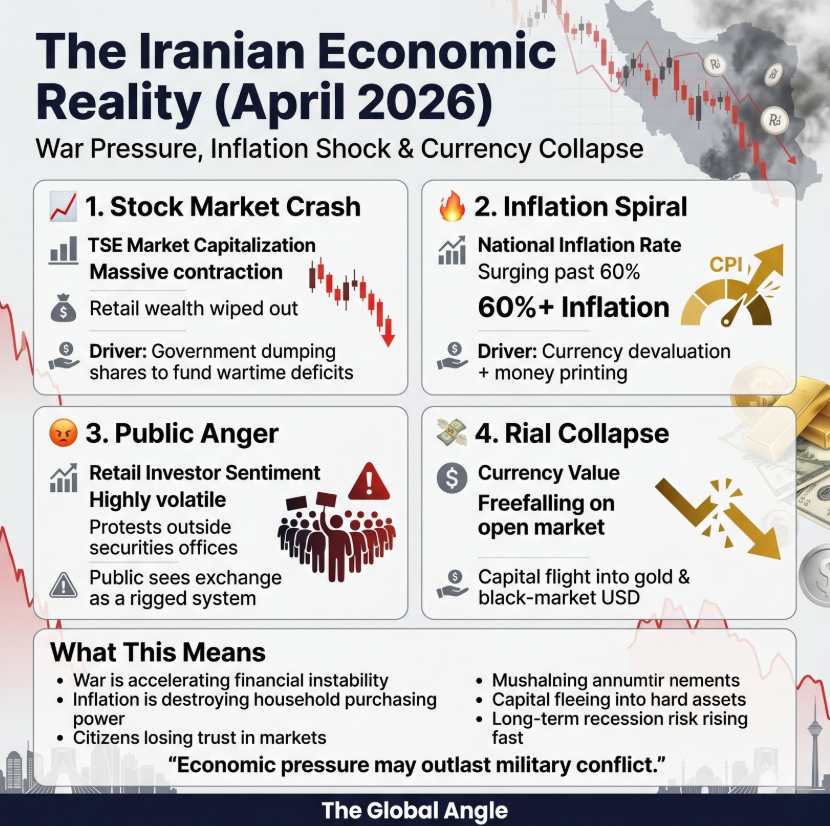
The Iranian Economic Reality (April 2026)
| Economic Indicator | Current Status | Primary Driver |
| TSE Market Capitalization | Massive contraction; retail wealth wiped out. | War panic; the state dumping shares to fund military deficits. |
| National Inflation Rate | Surging past 60%. | Currency devaluation; printing money to cover wartime shortfalls. |
| Retail Investor Sentiment | Highly volatile; public protests outside Securities offices. | Perception of the exchange as a “rigged game” designed to steal civilian wealth. |
| Currency (Rial) Value | Freefalling on the open market. | Massive capital flight into physical gold and black-market U.S. Dollars. |
What the Market Says About the War
Stock markets act as predictive engines. The collapse of the TSE strips away the regime’s geopolitical posturing and exposes a highly fragile domestic foundation.
The market loudly indicates that Iran cannot sustain a long-term, conventional war of attrition. While Tehran’s military strategy relying on cheap drone swarms and proxy militias is cost-effective compared to firing multi-million-dollar Western interceptors, the macroeconomic cost of the war is unsustainable.
By utilizing the stock market to plug budget holes, the state is cannibalizing its own middle class to fund the military apparatus.
Does Iran Have the Advantage or Disadvantage?
To answer this, you must separate the military theater from the financial theater. Iran is currently fighting two entirely different wars.
The Asymmetric Advantage (Geopolitical):
Iran holds a highly disruptive hand in the Persian Gulf. By weaponizing the Strait of Hormuz and choking off global oil supplies, Tehran is forcing severe cost-push inflation onto Western economies. This creates massive political pressure on Washington to seek an early, negotiated exit.
The Domestic Disadvantage (Financial):
Inside its own borders, Iran is heavily disadvantaged. The stock market data confirms that the state’s financial architecture is cracking. A nation cannot easily fund a protracted, multi-front conflict when the national currency is hyper-inflating and its citizens are rioting over erased life savings.
The Strategic Conclusion
The Tehran Stock Exchange serves as the ultimate reality check for the 2026 conflict. Iran’s ability to hold out depends entirely on a ticking clock. Their endgame relies on their maritime blockade forcing a U.S. withdrawal before their own domestic economy implodes. Right now, the race is between Western inflation fatigue and total Iranian financial collapse.
Sources:
Bourse & Bazaar Foundation (A premier economic think tank specializing in the Iranian economy, sanctions impact, and the domestic financial architecture of Tehran)
The World Bank – Iran Economic Monitor (Official macroeconomic tracking of Iran’s GDP contraction, hyperinflation rates, and the structural deficits facing the Iranian state)
International Monetary Fund (IMF) – Islamic Republic of Iran (Data regarding Iran’s currency devaluation, capital flight, and the broad economic impact of international snapback sanctions)
Foundation for Defense of Democracies (FDD) – Iran Economic Tracker (In-depth analysis of how the Islamic Revolutionary Guard Corps (IRGC) and state-owned enterprises dominate the Tehran Stock Exchange)
Frequently Asked Questions
Why did the Tehran Stock Exchange crash in 2026?
The crash was triggered by a combination of war panic following U.S. and Israeli airstrikes and the reactivation of international snapback sanctions. The collapse accelerated when government-affiliated institutions aggressively dumped shares to fund military budget deficits, wiping out retail investors.
Does a collapsing stock market mean Iran will lose the war?
Not immediately. Iran relies on cheap, asymmetric drone warfare, which costs a fraction of the U.S. defense budget. However, the stock market collapse indicates total domestic financial failure. Tehran is racing a ticking clock, betting the West will tire of the Strait of Hormuz blockade before the Iranian public completely revolts over hyperinflation.
Are Iranian citizens protesting the stock market crash?
Yes. Following the erasure of their life savings, retail investors have organized protests outside the Securities and Exchange Organization headquarters in Tehran. Demonstrators openly refer to the exchange as a “rigged casino” run by the state.
How is the Iranian government funding the war?
Cut off from global oil markets by the U.S. naval blockade, Tehran is monetizing its domestic deficits. This involves printing unbacked currency—driving inflation past 60%—and using the stock market to absorb civilian savings by offloading shares of failing state-owned enterprises.
ALSO READ: US-Spain Relations NATO 2026: The NATO Expulsion Threat and Iran War Disagreements
ALSO READ: Strait of Hormuz Current Status: Comparing U.S vs Iranian Narrative What Each Side Has to Say?
Russia China trade relations 2026: Sanctions Evasion, Dual-Use Tech, and the Putin-Xi Summit
Russia China trade relations 2026: Sanctions Evasion, Dual-Use Tech, and the Putin-Xi Summit Executive Briefing…

What is Hantavirus Outbreak 2026: Symptoms, Vaccine Status, and the Climate Vector
What is Hantavirus Outbreak 2026: Symptoms, Vaccine Status, and the Climate Vector The Immediate Trigger:…

Starlink & SpaceX IPO 2026: Everything You Need to Know
Starlink & SpaceX IPO 2026: Everything You Need to Know The Valuation: According to Institutional…
What is OPEC? How the Oil Cartel Functions and Why It’s Fracturing in 2026
What is OPEC? How the Oil Cartel Functions and Why It’s Fracturing in 2026 The…
Why the UAE Quit OPEC and the Birth of the Petro-Rupee
Why the UAE Quit OPEC and the Birth of the Petro-Rupee The Rupture: The United…

Microsoft OpenAI Partnership Ends: Why Microsoft is Dropping OpenAI’s Exclusive License
Microsoft OpenAI Partnership Ends: Why Microsoft is Dropping OpenAI’s Exclusive License The Announcement: On April…

Ibrahim is the Founder and Lead Analyst at The Global Angle, an independent digital platform dedicated to factual geopolitical analysis and international affairs. Based in India, he combines an engineering background with a deep focus on global markets, diplomacy, and strategic security. Ibrahim leverages a data-driven, analytical approach to break down complex international conflicts and economic shifts, helping readers see beyond standard news narratives. When he isn’t researching global policy, he focuses on digital publishing, search engine optimization, and platform architecture.