Russia China trade relations 2026: Sanctions Evasion, Dual-Use Tech, and the Putin-Xi Summit
Executive Briefing (Update: May 2026)
- The May 2026 Summit: Russian President Vladimir Putin arrived in Beijing on May 19, 2026, for a two-day state visit, occurring a highly calculated 48 hours after U.S. President Donald Trump departed the Chinese capital. Beijing has effectively positioned itself as the central pivot point of global diplomacy.
- The “Multipolar” Declaration: Putin and Chinese President Xi Jinping signed a joint declaration to build a “multipolar world” and extended their Treaty of Good-Neighborliness. The optics were designed to signal an unyielding front against Western sanctions and diplomatic isolation.
- The Pipeline Stalemate: Despite heavy lobbying from Moscow to secure an overland energy alternative to the conflict-ridden Middle East, the summit concluded without a finalized agreement or clear timeline for the massive “Power of Siberia 2” natural gas pipeline.
- The Asymmetric Reality: While state media hailed their unbreakable ties, the underlying data reveals a deeply unequal partnership. Russia is now structurally dependent on China to sustain its war economy, while Beijing carefully calibrates its support to avoid crippling U.S. and EU secondary sanctions.
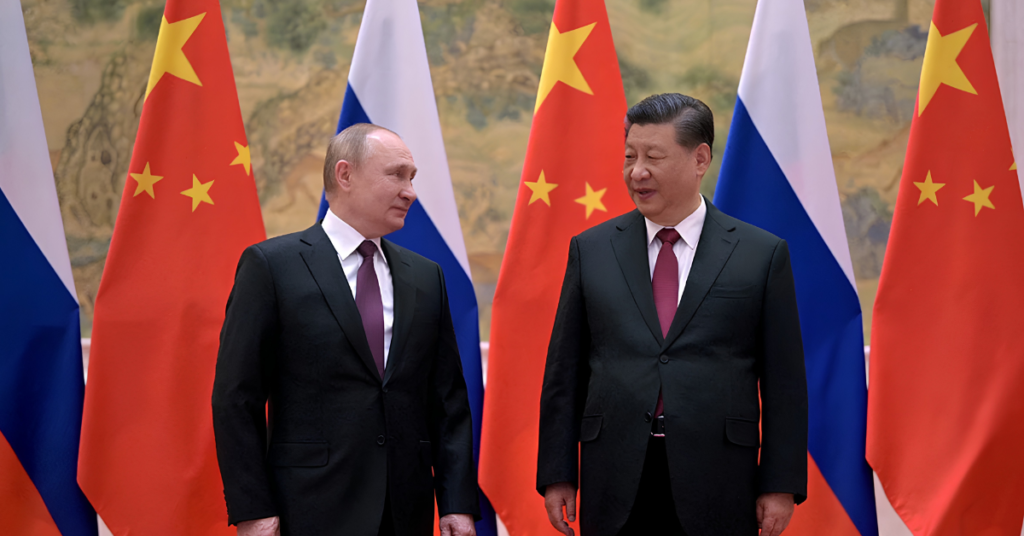
In May 2026, the geopolitical center of gravity briefly shifted to Beijing. Russian President Vladimir Putin arrived in China for a highly scrutinized state visit—just days after U.S. President Donald Trump walked the exact same halls.
The optics were deliberate. As Washington attempts to navigate an increasingly fractured global order, Beijing and Moscow are aggressively signaling an “unyielding” alliance. But beyond the ceremonial handshakes and the launch of the “China-Russia Years of Education,” the true foundation of this partnership is raw, unadulterated economics.
The Russia-China trade relationship has fundamentally altered the global financial system. It has provided Moscow with an economic lifeline to sustain its war economy, while granting Beijing access to deeply discounted, land-based energy.
Here is the data-driven breakdown of the 2026 Russia-China economic axis, how they are bypassing Western sanctions, and what it means for the United States.
The May 2026 Summit: Putin In China
Putin’s May 19-20 visit to Beijing was anchored in securing long-term economic survival. Quoting a Chinese proverb to President Xi Jinping—”A day apart feels like three autumns”—Putin emphasized that their relations have reached an unprecedentedly high level despite severe Western pressure.
The Underlying Agenda:
- The Middle East Hedge: With the ongoing U.S.-Israel war on Iran severely disrupting crude and gas flows from the Middle East, Putin seized the opportunity to position Russia as China’s most reliable, overland energy alternative.
- Power of Siberia 2: Putin aggressively pushed for final progress on this massive natural gas pipeline through Mongolia, which would permanently pivot Russian gas exports away from Europe and directly into the Chinese industrial heartland.
- Countering Trump: Coming right on the heels of President Trump’s visit to Beijing, Putin needed to solidify guarantees that China’s trade policies would not be leveraged as a bargaining chip in U.S.-China negotiations.
The Data: A Historic Trade Explosion (and Correction)
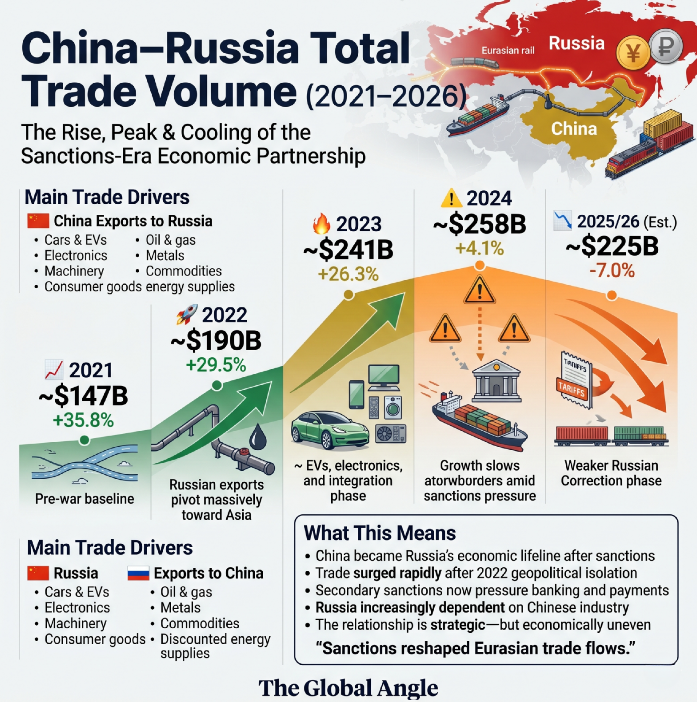
Following the 2022 invasion of Ukraine, bilateral trade between the two nations surged at a historic pace. However, by early 2026, the boom has begun to cool as Chinese firms face mounting secondary sanction threats from the West, and Russia implements heavy tariffs to protect its domestic industries.
China-Russia Total Trade Volume (2021–2026)
| Year | Total Trade Volume (USD) | Year-on-Year Growth | Context |
| 2021 | ~$147.0 Billion | +35.8% | Pre-war baseline. |
| 2022 | ~$190.2 Billion | +29.5% | Massive pivot of Russian exports to Asia. |
| 2023 | ~$240.7 Billion | +26.3% | Peak integration; Chinese cars flood Russia. |
| 2024 | ~$257.8 Billion | +4.1% | Growth slows amid secondary sanction fears. |
| 2025/2026 (Est) | ~$225.0 Billion | -7.0% | Correction phase; Russian interest rates and tariffs cool consumer imports. |
The Commodity Exchange: Tech for Oil
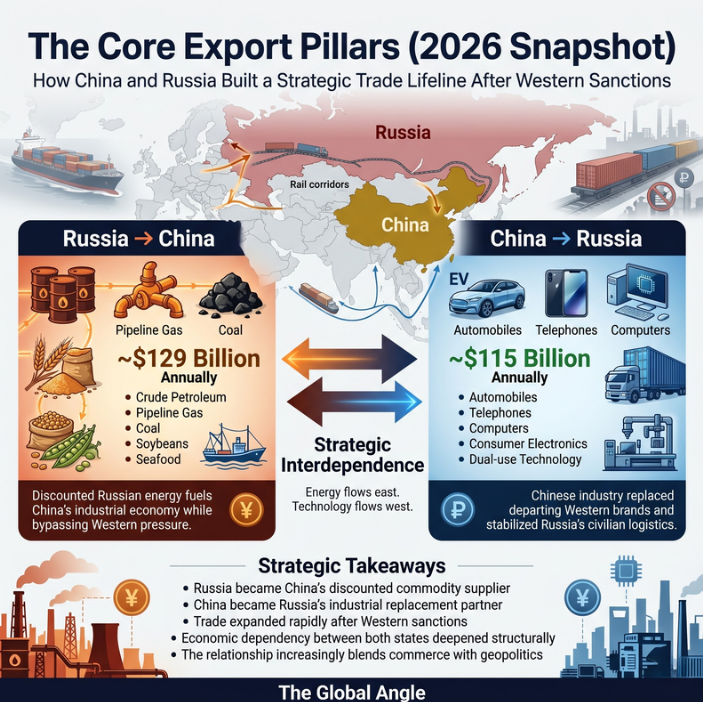
The trade relationship is heavily segmented. Russia acts as a resource appendage for China, while China acts as the sole supplier of high-tech and manufactured goods for Russia.
The Core Export Pillars (2026 Snapshot)
| Direction | Primary Export Categories | Economic Value | Strategic Impact |
| Russia to China | Crude Petroleum, Pipeline Gas, Coal, Soybeans, Seafood. | ~$129 Billion annually. | Fuels China’s economy with discounted energy, insulated from U.S. naval blockades. |
| China to Russia | Automobiles, Telephones, Computers, Dual-Use Tech. | ~$115 Billion annually. | Replaced Western brands entirely; keeps Russian civilian and military logistics functioning. |
Bypassing the Blockade: How the Sanctions Wall Broke
The United States designed its sanction regime to completely isolate Russia from the global financial system. China provided the escape hatch.
1. Total De-Dollarization
The most structural shift in the global economy is the rapid de-dollarization of Sino-Russian trade. Prior to 2022, nearly all bilateral trade was settled in U.S. Dollars or Euros.
The Currency Settlement Shift
| Year | U.S. Dollar / Euro Settlement | Yuan / Ruble Settlement |
| 2021 | ~98% | < 2% |
| 2026 | < 1% | 99.1% |
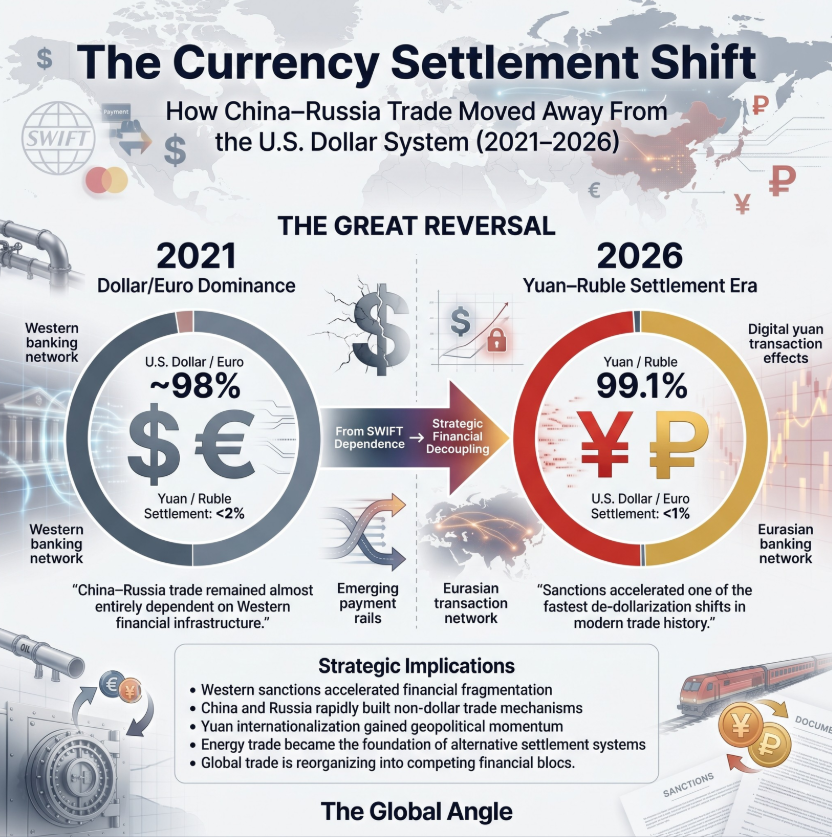
By settling 99.1% of their trade in local currencies, Moscow and Beijing have entirely bypassed the SWIFT banking system and the jurisdiction of the U.S. Treasury Department.
2. The Dual-Use Smokescreen
While China officially claims neutrality in the Ukraine conflict and denies sending lethal weapons to Russia, custom data reveals a massive surge in “dual-use” exports—civilian goods that are critical for military applications.
- Optics and Sensors: Chinese exports of drone optics and surveillance cameras to Russia have quadrupled since 2023.
- Ballistic Fibers: Shipments of Kevlar-like materials used in body armor have increased by over 60%.
- Heavy Machinery: Exports of “civilian” dump trucks, tractors, and diesel engines have surged, replacing the logistical fleet of the Russian military.
Information Gain: The Asymmetric Interdependence
Standard analysis often treats the Russia-China alliance as a partnership of equals. It is not. The “Information Gain” here is the absolute asymmetry of their relationship.
The Power Imbalance
| Metric | The Russian Reality | The Chinese Reality |
| Market Dependency | China is Russia’s undisputed #1 trade partner, buying over 50% of all Russian exports. | Russia barely cracks China’s top 10 export destinations (behind the U.S., EU, ASEAN, etc.). |
| Technological Reliance | Russia is entirely dependent on China for microchips, smartphones, and 5G infrastructure. | China holds a monopoly; it can dictate prices and technological standards to Moscow. |
| Geopolitical Leverage | Russia has burned its bridges with the West; it has nowhere else to go. | China is constantly calibrating its support for Russia to avoid devastating U.S. and EU secondary sanctions. |
Russia has survived the Western blockade, but the cost was its economic sovereignty. Moscow has effectively become a junior partner, highly dependent on Beijing’s goodwill.
The Global Impact: How the U.S. and World Are Affected
The solidification of the Sino-Russian economic bloc is forcing a massive realignment of global supply chains and strategic doctrines.
- The Ineffectiveness of Unilateral Sanctions: The U.S. has learned a harsh lesson. Financial sanctions are only lethal if the entire world complies. Because China (the world’s largest manufacturing hub) refused to participate, the U.S. blockade leaked. This sets a dangerous precedent for future conflicts; rogue states now know they can survive Western isolation if they anchor themselves to the Chinese economy.
- Energy Security in an Age of War: The U.S.-Israel war on Iran threatens to cut off the Strait of Hormuz. For China, this makes Russian energy a matter of national survival. By securing millions of barrels of oil and gas via secure, overland pipelines from Russia, China is actively immunizing its economy against the threat of a U.S. Navy blockade in the Pacific or the Middle East.
The 2026 summit in Beijing proved that the global economy has officially split into two distinct, competing operating systems. And right now, the system built on the Yuan and the Ruble is proving far more resilient than Washington anticipated.
Sources:
Carnegie Endowment for International Peace – Russia-Eurasia Program (Deep-dive analysis on the structural asymmetry of the Sino-Russian economic partnership and Moscow’s growing reliance on the Yuan)
Center for Strategic and International Studies (CSIS) – Sanctions Evasion & Dual-Use Tech (Authoritative tracking of Chinese customs data, highlighting the export of optics, microelectronics, and heavy machinery to the Russian military-industrial complex)
Atlantic Council – GeoEconomics Center (Macroeconomic data regarding the de-dollarization of the Russian economy, SWIFT bypass mechanisms, and the threat of U.S. secondary sanctions on Chinese banks)
Oxford Institute for Energy Studies – Eurasian Gas Markets (Industry-standard research on the stalled negotiations, pricing disputes, and infrastructure hurdles surrounding the Power of Siberia 2 pipeline)
Frequently Asked Questions
Why did Vladimir Putin visit China immediately after Donald Trump?
The timing of Putin’s May 19-20, 2026 visit was highly deliberate. Arriving just 48 hours after Trump’s departure allowed Moscow to immediately assess any U.S.-China diplomatic settlements—particularly regarding the Ukraine conflict and Middle Eastern security—ensuring that Russian strategic interests were not compromised during Washington and Beijing’s negotiations.
Did Russia and China sign a deal for the “Power of Siberia 2” pipeline?
No. Despite extensive discussions during the May 2026 summit, the two nations failed to reach a finalized agreement. While the Kremlin stated there is a “basic understanding” regarding the pipeline’s route through Mongolia, there is still no clear construction timeline, indicating Beijing’s reluctance to fully commit to the massive infrastructure project amidst global energy volatility.
How is the U.S.-Iran war impacting Russia-China trade?
The ongoing conflict in the Middle East, particularly the disruptions in the Strait of Hormuz, has severely threatened China’s seaborne energy imports. This provides Russia with immense leverage. Moscow is aggressively positioning itself as Beijing’s most reliable, overland energy supplier, pitching its oil and gas as completely insulated from U.S. naval blockades in the Persian Gulf.
How are Russia and China bypassing U.S. financial sanctions?
They have achieved this through the near-total de-dollarization of their bilateral trade. As of 2026, over 99% of trade between the two nations is settled in Chinese Yuan or Russian Rubles. By entirely abandoning the U.S. Dollar and Euro, they bypass the SWIFT banking system and effectively neutralize the jurisdiction of the U.S. Treasury Department.
Is China secretly supplying Russia with weapons?
China officially denies supplying lethal military equipment to Russia and maintains a public stance of neutrality. However, customs data reveals a massive surge in the export of “dual-use” technologies. China is the primary supplier of microchips, drone optics, telecommunications gear, and heavy machinery that, while categorized as civilian goods, are critical for sustaining the Russian military apparatus.
ALSO READ: Global Debt Report 2026 Analysis and the $348 Trillion World Debt Crisis
ALSO READ: The 39 Trillion Dollar U.S. National Debt Explained: Impact, Interest, and Solutions
Russia China trade relations 2026: Sanctions Evasion, Dual-Use Tech, and the Putin-Xi Summit
Russia China trade relations 2026: Sanctions Evasion, Dual-Use Tech, and the Putin-Xi Summit Executive Briefing…

What is Hantavirus Outbreak 2026: Symptoms, Vaccine Status, and the Climate Vector
What is Hantavirus Outbreak 2026: Symptoms, Vaccine Status, and the Climate Vector The Immediate Trigger:…
Starlink & SpaceX IPO 2026: Everything You Need to Know
Starlink & SpaceX IPO 2026: Everything You Need to Know The Valuation: According to Institutional…
What is OPEC? How the Oil Cartel Functions and Why It’s Fracturing in 2026
What is OPEC? How the Oil Cartel Functions and Why It’s Fracturing in 2026 The…
Why the UAE Quit OPEC and the Birth of the Petro-Rupee
Why the UAE Quit OPEC and the Birth of the Petro-Rupee The Rupture: The United…

Microsoft OpenAI Partnership Ends: Why Microsoft is Dropping OpenAI’s Exclusive License
Microsoft OpenAI Partnership Ends: Why Microsoft is Dropping OpenAI’s Exclusive License The Announcement: On April…

Ibrahim is the Founder and Lead Analyst at The Global Angle, an independent digital platform dedicated to factual geopolitical analysis and international affairs. Based in India, he combines an engineering background with a deep focus on global markets, diplomacy, and strategic security. Ibrahim leverages a data-driven, analytical approach to break down complex international conflicts and economic shifts, helping readers see beyond standard news narratives. When he isn’t researching global policy, he focuses on digital publishing, search engine optimization, and platform architecture.