
Starlink & SpaceX IPO 2026: Everything You Need to Know
- The Valuation: According to Institutional secondary markets current Spacex valuation is at approximately $250 billion. Analysts suggest an IPO of its satellite division, Starlink, could immediately command a $150 billion+ market cap.
- The “Elon Time” Variable: While Elon Musk has historically tied an IPO to “predictable cash flow,” Starlink’s 2025-2026 performance—achieving consistent profitability and expanding into the maritime and aviation sectors—has removed the last financial hurdle.
- The Strategic Shift: This isn’t about launching rockets anymore. Investors are eyeing SpaceX for its transition from a transportation provider to a global telecommunications and data infrastructure monopoly.
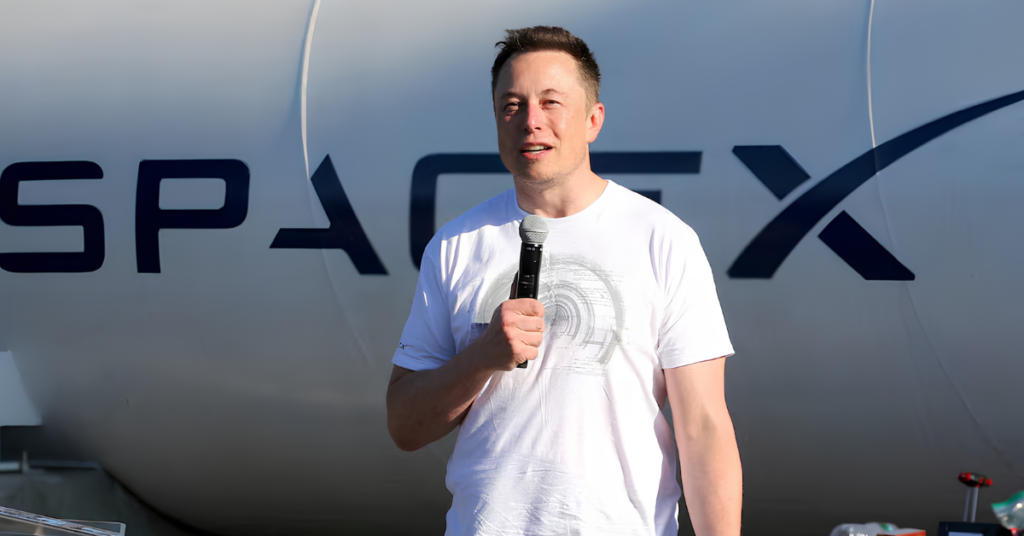
The “SpaceX IPO” is the Loch Ness Monster of the financial world: frequently sighted in rumors but never captured on a stock exchange. However, as of mid-2026, the variables have fundamentally shifted. Starship is now executing routine orbital flights, and Starlink has successfully moved from an “experimental” ISP to the backbone of global military and maritime communications.
Here is the deep-dive intelligence briefing on what you are actually buying when (and if) SpaceX goes public.
The Spin-off Strategy: Starlink vs. Starship
The most likely path to public markets is a spin-off of Starlink, not the parent company SpaceX. Why? Because the “Mars Mission” (Starship) is a capital-intensive, high-risk venture that the public markets—notoriously short-sighted—are ill-equipped to handle.
Starlink, conversely, is a cash-cow utility.
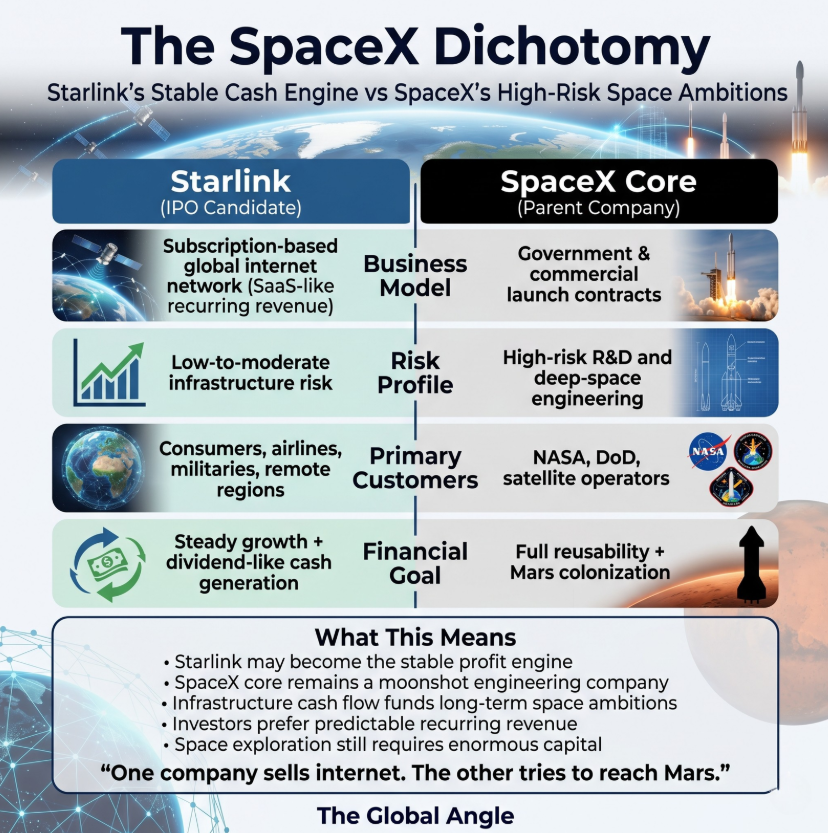
The SpaceX Dichotomy
| Feature | Starlink (The IPO Candidate) | SpaceX Core (The Parent) |
| Business Model | Subscription-based (SaaS-like) | Government/Commercial Contracts |
| Risk Profile | Low-to-Moderate (Infrastructure) | High (Research & Development) |
| Primary Customer | Global Consumers, Airlines, Militaries | NASA, DoD, Satellite Operators |
| Financial Goal | Steady dividends and growth | Full reusability and Mars colonization |
Starlink is a “Low Latency” Data Hedge
Most retail investors view Starlink as “internet for rural areas.” This is a shallow analysis. The real “Information Gain” here is Starlink’s role in high-frequency trading (HFT) and global backbone infrastructure.
Because light travels faster through the vacuum of space than through fiber-optic cables (which must zig-zag across the ocean floor), Starlink can offer lower latency between London and Tokyo than any subsea cable.
Insight: Starlink isn’t competing with Comcast; it’s competing with the submarine cable industry. By 2027, Starlink could theoretically act as the primary “tollbooth” for global financial data, charging a premium for milliseconds of speed.
The Starship Economic Formula
The success of a SpaceX IPO (or Starlink spin-off) is tethered to the decreasing cost per kilogram of payload. With Starship now operational in 2026, the orbital economy has reached a tipping point.
The traditional cost of putting mass into orbit can be simplified by this basic relationship:
Cost per kg = [ L + H ] / M
- L: Operational Launch Costs (fuel, logistics)
- H: Hardware Costs (the rocket itself)
- M: Total Payload Mass
By increasing M to over 100 tons and making the vehicle entirely reusable, SpaceX is effectively dropping the price of space access from $2,500/kg (Falcon 9) to an estimated $100/kg (Starship).
Competitive Landscape: The 2026 Peers
SpaceX no longer competes with “Old Space” (Boeing/Lockheed). In 2026, its true competitors are state-backed constellations and trillion-dollar tech giants.
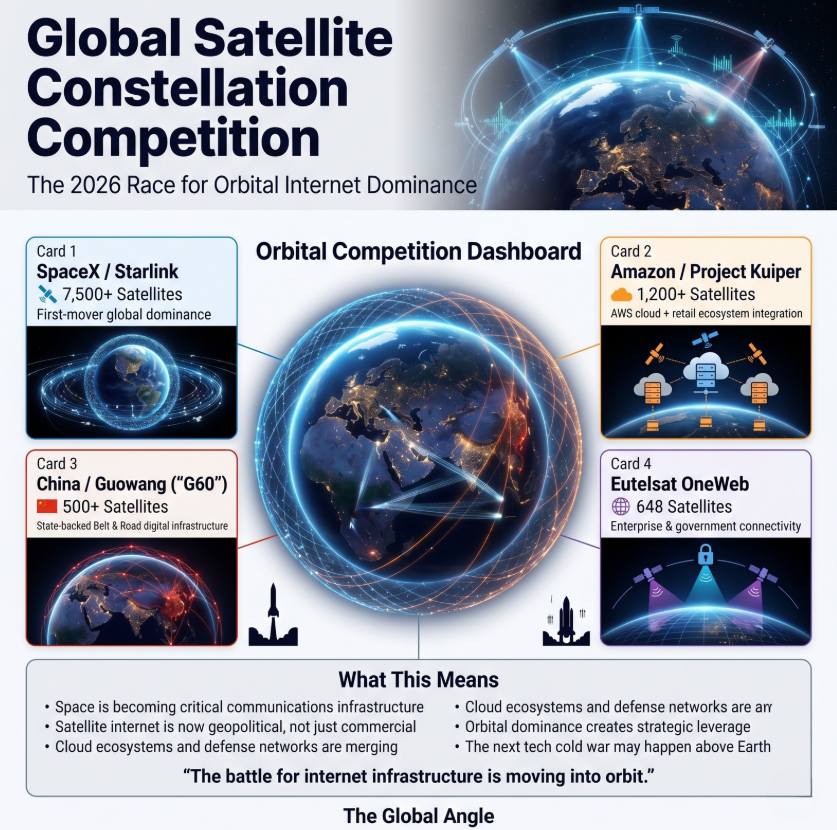
Global Satellite Constellation Competition
| Entity | Constellation | Status (2026) | Market Positioning |
| SpaceX | Starlink | 7,500+ Satellites | First-mover; Global Dominance |
| Amazon | Project Kuiper | 1,200+ Satellites | Retail/AWS Cloud Integration |
| China | “G60” / Guowang | 500+ Satellites | State-mandated; Belt & Road Focus |
| Eutelsat OneWeb | OneWeb | 648 Satellites | Enterprise/Government Fixed Links |
Risks: The “Elon Key-Man” Vulnerability
The biggest risk to a SpaceX IPO isn’t technological; it’s personnel.
- Regulatory Friction: As SpaceX becomes a global utility, it faces increasing pushback from the ITU (International Telecommunication Union) and astronomers over orbital debris and light pollution.
- The Musk Premium: Much like Tesla, SpaceX’s valuation includes a “Musk Premium.” Any distraction (X, Tesla, or political involvement) directly impacts investor confidence.
- Orbital Crowding: One major collision in Low Earth Orbit (LEO) could trigger a Kessler Syndrome event, rendering the orbital plane unusable and Starlink’s assets worthless.
The 2026 Investor Verdict
If Starlink IPOs in late 2026, it will likely be the largest listing in history. Investors are not just buying a satellite company; they are buying the Infrastructure of the Second Space Age.
Why you should watch the 2026 Q3 Earnings: Look for the “Starlink Gen3” deployment schedule. If Starship begins launching 50-100 Gen3 satellites per flight, Starlink’s bandwidth capacity will outpace all terrestrial fiber growth.
Final Insight: The smart money is watching the SpaceX Starshield division. This is the classified, military-specific version of Starlink. If Starshield contracts are bundled into the IPO, the valuation could break the $300 billion mark by the time the bell rings.
Sources & Reference Data:
Center for Strategic and International Studies (CSIS) – Aerospace Security Project (Authoritative defense analysis on the militarization of Low Earth Orbit, satellite constellations, and the strategic importance of programs like Starshield)
International Telecommunication Union (ITU) – Space Services Department (The primary UN regulatory body governing orbital slots, radio frequency spectrum allocations, and LEO satellite collision avoidance protocols)
Federal Communications Commission (FCC) – Space Bureau (U.S. regulatory filings and approvals for Starlink Gen3 deployments, orbital debris mitigation rules, and domestic spectrum rights)
U.S. Space Development Agency (SDA) – Proliferated Warfighter Space Architecture (Official documentation on the Pentagon’s shift toward using commercial LEO constellations for global military communication and missile tracking)
Frequently Asked Questions
When is the SpaceX IPO date?
There is no official date. However, internal liquidity events and Starship’s maturity suggest a Starlink spin-off is most probable between Q4 2026 and Q2 2027.
Can I buy SpaceX stock now?
Only on secondary markets (like Hiive or EquityZen) if you are an accredited investor. For retail investors, the closest proxy is the Alphabet (Google) or Fidelity stake in SpaceX, though these are diluted by their other holdings.
Will Starlink be separate from SpaceX?
Most analysts expect SpaceX to remain a private “R&D” parent company while Starlink becomes a public “Utility” subsidiary. This allows Elon Musk to maintain control over the Mars mission while providing liquidity to early investors.
What will the SpaceX ticker symbol be?
Rumored symbols include $STAR, $SPX, or $LINK.
ALSO READ: Microsoft OpenAI Partnership Ends: Why Microsoft is Dropping OpenAI’s Exclusive License
ALSO READ: What is OPEC? How the Oil Cartel Functions and Why It’s Fracturing in 2026
Russia China trade relations 2026: Sanctions Evasion, Dual-Use Tech, and the Putin-Xi Summit
Russia China trade relations 2026: Sanctions Evasion, Dual-Use Tech, and the Putin-Xi Summit Executive Briefing…
What is Hantavirus Outbreak 2026: Symptoms, Vaccine Status, and the Climate Vector
What is Hantavirus Outbreak 2026: Symptoms, Vaccine Status, and the Climate Vector The Immediate Trigger:…
Starlink & SpaceX IPO 2026: Everything You Need to Know
Starlink & SpaceX IPO 2026: Everything You Need to Know The Valuation: According to Institutional…
What is OPEC? How the Oil Cartel Functions and Why It’s Fracturing in 2026
What is OPEC? How the Oil Cartel Functions and Why It’s Fracturing in 2026 The…

Why the UAE Quit OPEC and the Birth of the Petro-Rupee
Why the UAE Quit OPEC and the Birth of the Petro-Rupee The Rupture: The United…

Microsoft OpenAI Partnership Ends: Why Microsoft is Dropping OpenAI’s Exclusive License
Microsoft OpenAI Partnership Ends: Why Microsoft is Dropping OpenAI’s Exclusive License The Announcement: On April…

Ibrahim is the Founder and Lead Analyst at The Global Angle, an independent digital platform dedicated to factual geopolitical analysis and international affairs. Based in India, he combines an engineering background with a deep focus on global markets, diplomacy, and strategic security. Ibrahim leverages a data-driven, analytical approach to break down complex international conflicts and economic shifts, helping readers see beyond standard news narratives. When he isn’t researching global policy, he focuses on digital publishing, search engine optimization, and platform architecture.


Pingback: What is Hantavirus Outbreak 2026: Symptoms, Vaccine Status, and the Climate Vector
I would be reluctant to buy Star Link stocks for the long term.
Elon Musk only recently terminated Russian access to the Star Link systems. The Russians were using Star Link to communicate with its Armed Drones. These drones were directed to and struck targets in Ukraine. This technology enabled many thousands of combatants and civilians to be killed including innocent children. Many billions of dollars of infrastructure were targeted and destroyed. Russian war casualties alone number in excess of one million according to recently published information. After Elon Musk terminated the Russian access to Star Link, Russian drone attacks in Ukraine decreased by approximately 40%.
Given the near stalemate, peace may be a possibility! At what point will the Ukrainian victims go to the world court systems to bring suit against Elon Musk’s Star Link company? What are the possibilities of large judgements against Star Link. What damage to the company’s value could occur? Thoughts to consider!!