Executive Briefing (Update: March 18, 2026)
- The Core Question: Yes, Indian ships passing through Strait of Hormuz is true, despite the ongoing US Iran military conflict.
- The Method: The passages are not happening freely. They are being heavily guarded by Indian Navy warships under a massive escalation of Operation Sankalp, alongside intense diplomatic negotiations with Tehran.
- The Current Toll: While a handful of high-priority energy vessels have made it out, roughly 22 Indian-flagged merchant ships remain stranded west of the strait, waiting for military escorts or diplomatic clearance.
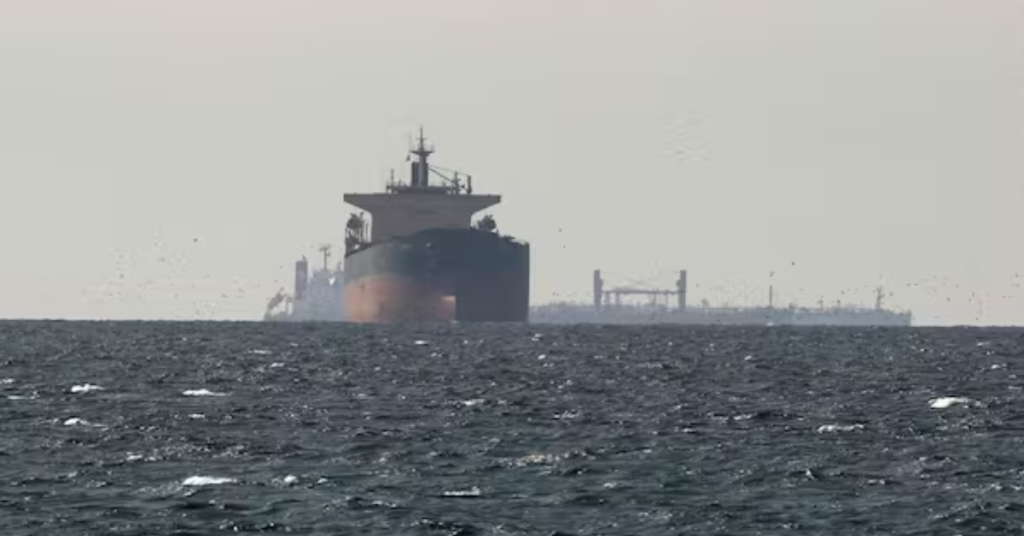
Since the military escalation began in late February 2026, the Strait of Hormuz—the maritime chokepoint responsible for 20% of the world’s oil—has been practically paralyzed. With international shipping lines halting operations and insurance premiums skyrocketing, media reports began circulating that Indian vessels were somehow slipping through the blockade.
To separate the rumors from the reality, we have compiled a definitive breakdown of exactly how many Indian ships have crossed, the military firepower getting them out, and the secret diplomatic deals making it possible.
The Data: Which Indian Ships Have Passed Through?
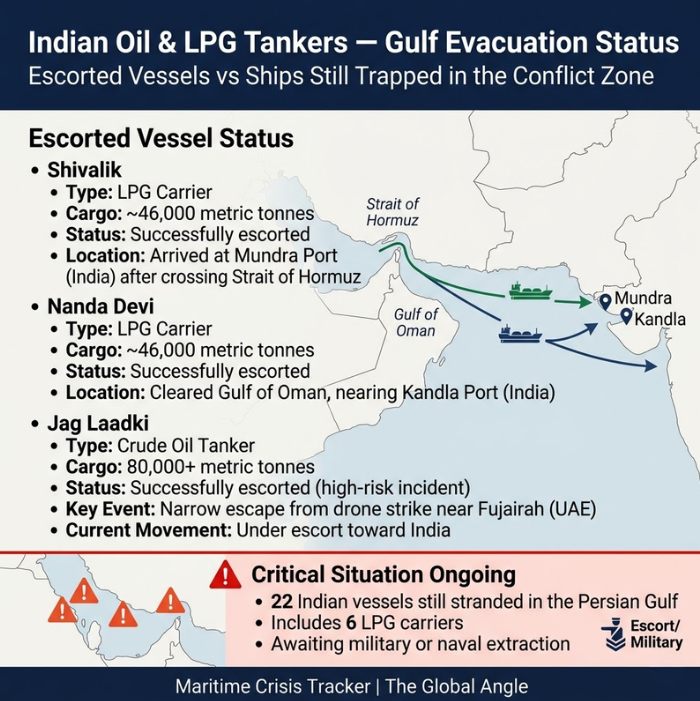
As of March 18, 2026, the Indian Navy has successfully secured the passage of three massive, high-priority energy vessels. These ships belong to the state-owned Shipping Corporation of India (SCI) and were prioritized to prevent a domestic fuel shortage.
Here is the exact status of the successful crossings:
| Vessel Name | Vessel Type | Cargo Volume | Current Status & Destination |
| Shivalik | LPG Carrier | ~46,000 Metric Tonnes | Successfully Escorted. Safely crossed the Strait and arrived at Mundra Port (Gujarat). |
| Nanda Devi | LPG Carrier | ~46,000 Metric Tonnes | Successfully Escorted. Cleared the Gulf of Oman and is arriving at Kandla Port. |
| Jag Laadki | Crude Oil Tanker | >80,000 Metric Tonnes | Successfully Escorted. Had a narrow escape during an Iranian drone strike while loading at Fujairah (UAE); currently being escorted out of the Gulf of Oman toward India. |
Note: While these three have crossed safely, there are currently 22 Indian vessels (including 6 LPG carriers) still stranded inside the Persian Gulf, awaiting extraction.
The Military Strategy: Operation Sankalp
How is India getting its ships out when other nations cannot? The answer lies in India’s refusal to rely on Western military alliances.
While the United States pushes for a multinational coalition to forcefully break the blockade, New Delhi has opted to operate strictly independently under Operation Sankalp. Originally launched in 2019 to counter piracy and regional instability, this operation has now been dramatically scaled up.
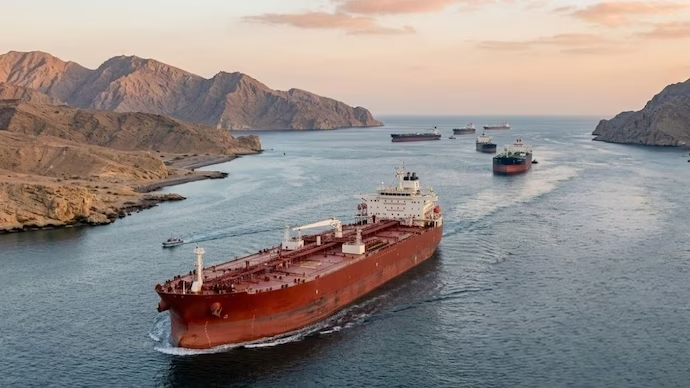
The Indian Navy has deployed two heavily armed task forces directly into the Gulf of Oman and the Arabian Sea. The escort missions are being spearheaded by India’s most advanced Visakhapatnam-class guided-missile destroyers:
- INS Surat
- INS Imphal
- INS Visakhapatnam
Equipped with BrahMos cruise missiles and advanced anti-air defense systems, these destroyers are physically shielding the slow-moving LPG and crude tankers from drone swarms and asymmetric naval threats. By sailing under the Indian flag and completely outside the U.S. coalition, India is explicitly signaling to Iran that its military presence is strictly defensive and non-hostile.
The Diplomatic Backchannel: The “Tanker Swap”
Military escorts are only half the equation. The successful passage of the Shivalik and Nanda Devi was largely paved by intense diplomatic backchannels at the highest levels of government.
On March 12, Indian Prime Minister Narendra Modi held a direct phone call with Iranian President Masoud Pezeshkian, stressing that the unhindered transit of Indian energy resources was a top priority. Concurrently, External Affairs Minister S. Jaishankar has been negotiating to keep Indian vessels off Iran’s target list.
However, international intelligence sources indicate this safe passage is not entirely free. Iran has reportedly demanded a “tanker swap.” In exchange for letting Indian ships traverse the Strait of Hormuz safely, Tehran is requesting the release of three specific tankers—Asphalt Star, Al Jafzia, and Stellar Ruby (an Iranian-flagged vessel)—which India had previously seized in February for allegedly conducting illegal ship-to-ship oil transfers.
Future Outlook: A High-Wire Act
India relies on the Strait of Hormuz for roughly 40% of its crude oil and a staggering 90% of its LPG imports. The successful extractions over the last few days prove that India’s dual strategy—independent naval projection combined with pragmatic diplomacy—is currently working.
However, with 22 ships still trapped in the Persian Gulf and hundreds of Indian seafarers in the crossfire, the Indian Navy will be forced to maintain a grueling, high-alert operational tempo for the foreseeable future.
Frequently Asked Questions
Are Indian ships safe in the Strait of Hormuz & are Indian ships passing through Strait of Hormuz?
No commercial vessel is entirely safe in the region right now. However, Indian-flagged vessels currently have a much higher survival rate because they are being actively escorted by Indian Navy guided-missile destroyers, and India has secured a tentative diplomatic understanding with Iran to avoid targeting its energy carriers.
Why isn’t India joining the US coalition in the Middle East?
India operates on a strict policy of strategic autonomy. Joining a U.S.-led military coalition against Iran would categorize India as a hostile combatant, immediately making all Indian merchant ships legitimate military targets for the IRGC. By operating independently under Operation Sankalp, India protects its energy lifelines without getting dragged into a broader geopolitical war.
How many Indian ships are stuck in the Persian Gulf?
As of mid-March 2026, roughly 22 Indian-flagged merchant vessels (including crucial LPG and crude oil tankers) remain west of the Strait of Hormuz, waiting for conditions to safely exit the Gulf.
ALSO READ: What is Kharg Island? How the US Attack On Kharg Island Impacts Iran & the World
ALSO READ: The Complete History of Iran Israel Relations: From Secret Allies to Arch-Rivals
Russia China trade relations 2026: Sanctions Evasion, Dual-Use Tech, and the Putin-Xi Summit
Russia China trade relations 2026: Sanctions Evasion, Dual-Use Tech, and the Putin-Xi Summit Executive Briefing…

What is Hantavirus Outbreak 2026: Symptoms, Vaccine Status, and the Climate Vector
What is Hantavirus Outbreak 2026: Symptoms, Vaccine Status, and the Climate Vector The Immediate Trigger:…

Starlink & SpaceX IPO 2026: Everything You Need to Know
Starlink & SpaceX IPO 2026: Everything You Need to Know The Valuation: According to Institutional…
What is OPEC? How the Oil Cartel Functions and Why It’s Fracturing in 2026
What is OPEC? How the Oil Cartel Functions and Why It’s Fracturing in 2026 The…
Why the UAE Quit OPEC and the Birth of the Petro-Rupee
Why the UAE Quit OPEC and the Birth of the Petro-Rupee The Rupture: The United…

Microsoft OpenAI Partnership Ends: Why Microsoft is Dropping OpenAI’s Exclusive License
Microsoft OpenAI Partnership Ends: Why Microsoft is Dropping OpenAI’s Exclusive License The Announcement: On April…

Ibrahim is the Founder and Lead Analyst at The Global Angle, an independent digital platform dedicated to factual geopolitical analysis and international affairs. Based in India, he combines an engineering background with a deep focus on global markets, diplomacy, and strategic security. Ibrahim leverages a data-driven, analytical approach to break down complex international conflicts and economic shifts, helping readers see beyond standard news narratives. When he isn’t researching global policy, he focuses on digital publishing, search engine optimization, and platform architecture.