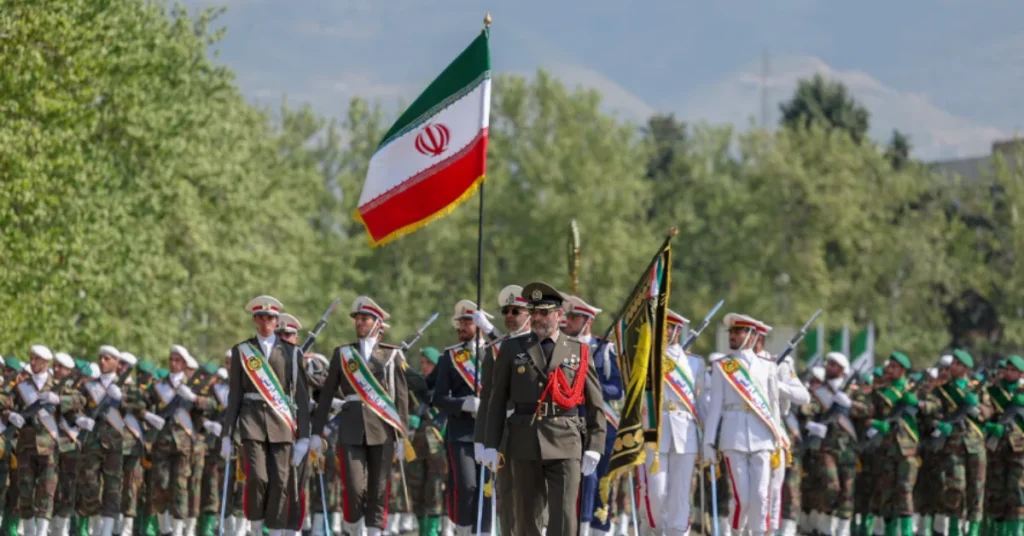
Executive Briefing (Update: March 22, 2026)
As the 2026 Middle East conflict grinds on, global shipping companies are facing an unprecedented crisis. Insurance premiums have surged to unsustainable levels, and the rules of maritime engagement have been completely rewritten. But despite the headlines declaring a total blockade, oil is still flowing for a select few. So Who Can Pass Through Strait of Hormuz?
- The Chokepoint: Following the escalation of the US Iran conflict, the Islamic Revolutionary Guard Corps (IRGC) has effectively blockaded the 21-mile-wide Strait of Hormuz to Western commercial shipping.
- The Backlog: An estimated 140+ massive oil and LNG tankers are currently idling in the Arabian Sea and the Persian Gulf, waiting for diplomatic clearance or military escorts.
- The Exceptions: Passage is not universally banned. Non-aligned nations, specifically India and China, are successfully moving vessels through the strait under strict diplomatic conditions and heavy naval protection.
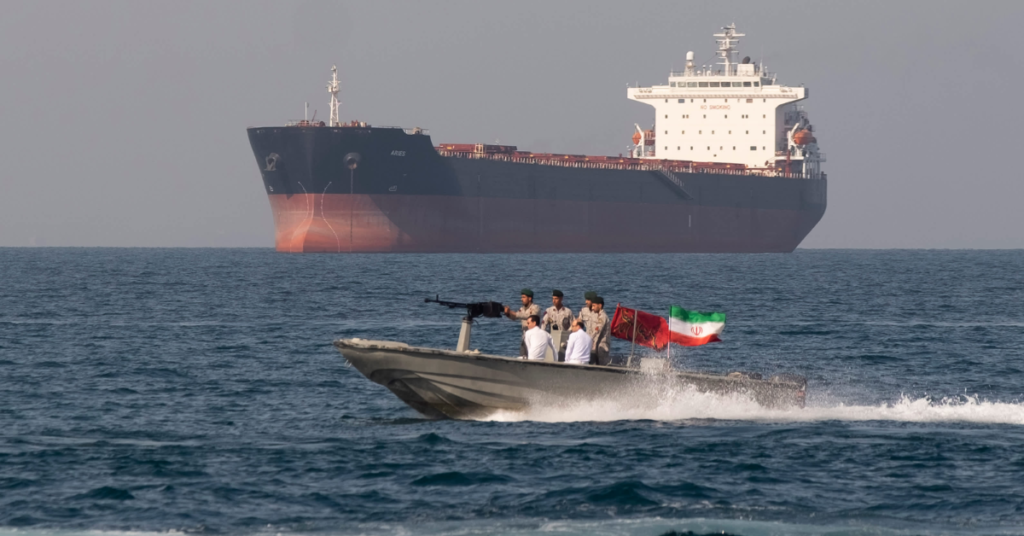
The Strait of Hormuz—the maritime artery responsible for 20% of the world’s liquid energy supply—is currently the most heavily militarized waterway on the planet.
Here is the definitive geopolitical breakdown of exactly who is allowed to pass, the conditions Tehran has set, and the staggering backlog of global tankers trapped in the crossfire.
1. Which Countries Are Allowed to Pass?
The IRGC has not closed the strait entirely; they have selectively weaponized it. Access is now strictly dictated by a nation’s geopolitical alignment regarding the ongoing US-Iran war.
The Banned Bloc (Western & Allied Shipping)
Any vessel flying the flag of, owned by, or destined for the United States, the United Kingdom, Israel, or the broader European Union is currently considered a hostile target by Iranian naval forces. These ships face immediate threats of drone swarms, boarding, or seizure.
The Permitted Bloc (Non-Aligned & Eastern Nations)
Nations that have maintained strict strategic autonomy and refused to join the US-led military coalition are negotiating windows of safe passage.
- India: Moving critical LPG and crude tankers under heavy Indian Navy escorts (Operation Sankalp) and high-level bilateral diplomacy.
- China: Benefitting from its massive energy investments in Iran and the broader BRICS economic alliance, Chinese mega-tankers are largely passing unhindered.
- Russia: Russian vessels, often utilizing the “shadow fleet” infrastructure, continue to transit without IRGC interference.
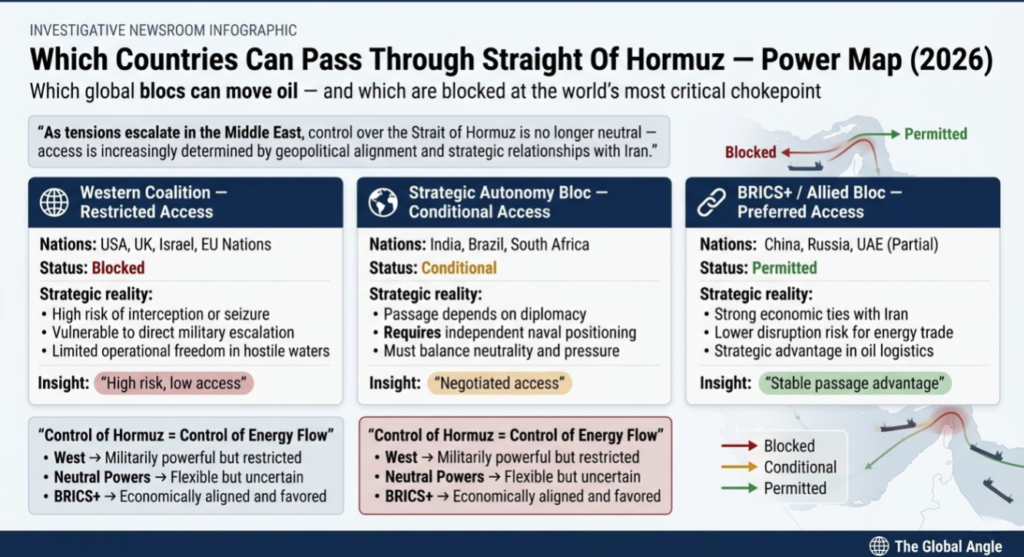
Who Can Pass Through Strait of Hormuz?
| Geopolitical Bloc | Primary Nations | Current Passage Status |
| Western Coalition | USA, UK, Israel, EU Nations | Blocked. High risk of seizure or direct attack. |
| Strategic Autonomy | India, Brazil, South Africa | Conditional. Allowed via direct diplomacy and independent naval escorts. |
| BRICS+ / Allies | China, Russia, UAE (Partial) | Permitted. Generally granted unhindered passage due to economic ties with Tehran. |
2. What Are the Conditions for Passage? (Blockade Rules)
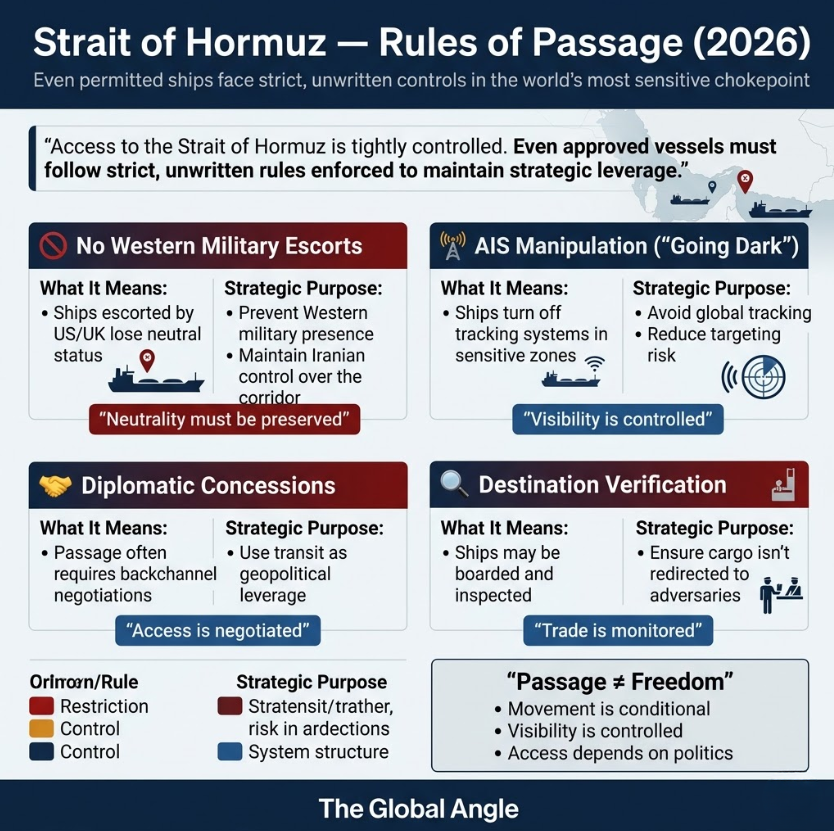
For the nations permitted to cross, passage is far from simple. Iran has instituted unwritten but strictly enforced “rules of the road” to maintain its leverage:
- No Western Military Escorts: If a neutral commercial ship requests a US or UK destroyer for an escort, it immediately loses its neutral status and becomes a target. (This is why India operates its destroyers entirely independently).
- AIS Manipulation (“Going Dark”): Many permitted ships are required to turn off their Automatic Identification System (AIS) transponders while transiting the most vulnerable sectors, entering a “digital darkness” to prevent their coordinates from being broadcast globally.
- Diplomatic Concessions (The “Tanker Swap”): Passage often requires behind-the-scenes leverage. For example, India’s recent successful crossings reportedly involved negotiations regarding the release of previously seized Iranian vessels.
- Destination Verification: IRGC fast-attack boats are frequently boarding neutral vessels to inspect manifests and ensure the crude oil is not being secretly rerouted to European or American ports.
3. The Bottleneck: How Many Tankers and Countries Are Waiting?
For nations without the naval firepower of India or the geopolitical weight of China, the situation is catastrophic. Commercial fleets from dozens of countries are anchored just outside the conflict zone, bleeding millions of dollars a day in delays.
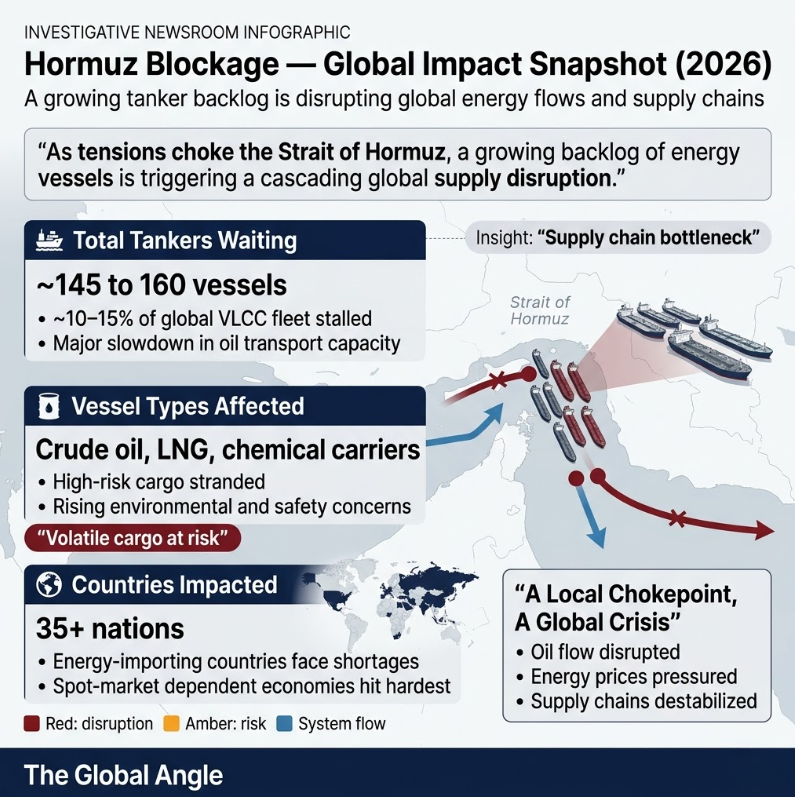
The Strait of Hormuz Backlog (As of Late March 2026)
| Metric | Estimated Data | Impact |
| Total Tankers Waiting | ~145 to 160 Vessels | Represents roughly 10% to 15% of the global active VLCC (Very Large Crude Carrier) fleet currently paralyzed. |
| Vessel Types | Crude Oil, LNG, and Chemical Carriers | Stranding highly volatile cargo, raising severe environmental and safety concerns. |
| Countries Impacted | Over 35 Nations | From South Korea to Germany, nations relying on open spot-market energy purchases are facing critical domestic fuel shortages. |
4. How Many Ships Have Passed Till Date?
Despite the immense backlog, the chokepoint is not entirely sealed. By utilizing diplomatic backchannels and independent military escorts, a steady—albeit severely reduced—trickle of energy is making it out of the Persian Gulf.
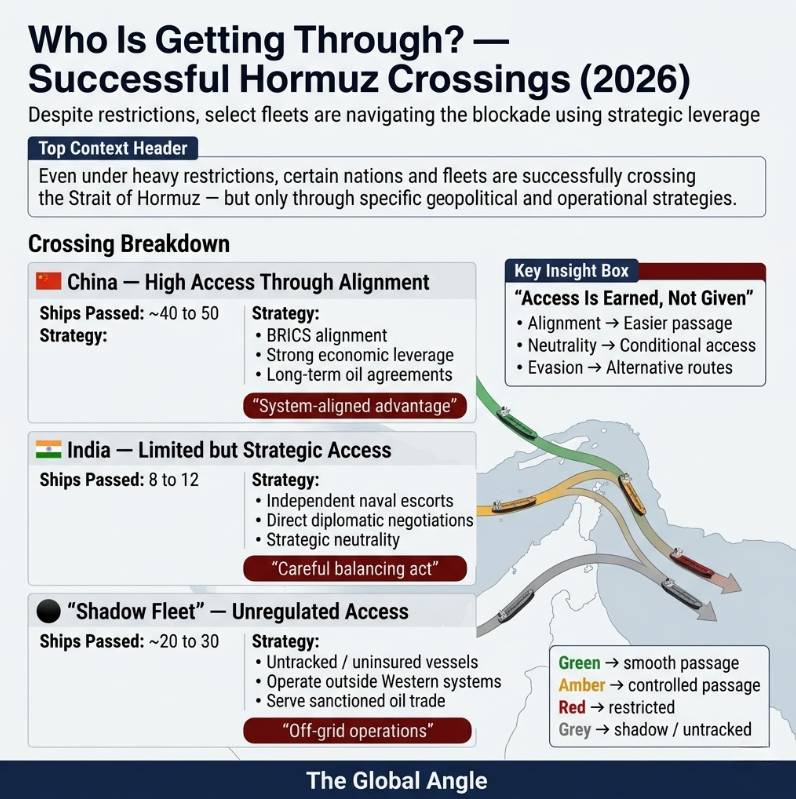
Strait of Hormuz Shipping Status (Estimated March 2026 Data)
| Nation/Fleet | Estimated Ships Passed (Since Blockade Began) | Strategy Used |
| China | ~40 to 50 | BRICS alignment, economic leverage, and long-term oil purchase agreements. |
| India | 8 to 12 | Heavy, independent naval escorts (Visakhapatnam-class destroyers) and direct state-to-state negotiations. |
| “Shadow Fleet” | ~20 to 30 | Uninsured, untracked vessels operating outside Western financial systems, primarily servicing Russian and Iranian exports. |
The Bottom Line: The Strait of Hormuz has transformed from an international global commons into a heavily toll-gated waterway. Until a diplomatic off-ramp is found to end the broader military conflict, global supply chains will remain fractured, and energy prices will continue to be dictated by exactly whose flag is flying on the mast.
Frequently Asked Questions
Is the Strait of Hormuz completely closed?
No. While Western commercial shipping (US, UK, EU) is effectively blocked by the IRGC, non-aligned nations like China and India are still successfully moving oil and LNG tankers through the strait using independent diplomacy and naval escorts.
How many ships pass through the Strait of Hormuz daily?
Before the 2026 conflict, roughly 20 to 30 massive crude and product tankers passed through the strait every single day. Currently, that number has plummeted to a fraction of its normal volume, restricted primarily to Eastern and non-aligned fleets.
Why is India allowed to pass through the Strait of Hormuz?
India operates under a strict policy of strategic autonomy. By refusing to join the US-led maritime coalition and deploying its own independent naval warships under Operation Sankalp, India has signaled to Iran that its presence is non-hostile, allowing for negotiated safe passage of its energy lifelines.
ALSO READ: Are Indian Ships Passing Through Strait of Hormuz? A Complete March 2026 Analysis
ALSO READ: Russian vs Gulf Crude Oil: Price, Refining, and Efficiency Compared
Russia China trade relations 2026: Sanctions Evasion, Dual-Use Tech, and the Putin-Xi Summit
Russia China trade relations 2026: Sanctions Evasion, Dual-Use Tech, and the Putin-Xi Summit Executive Briefing…

What is Hantavirus Outbreak 2026: Symptoms, Vaccine Status, and the Climate Vector
What is Hantavirus Outbreak 2026: Symptoms, Vaccine Status, and the Climate Vector The Immediate Trigger:…
Starlink & SpaceX IPO 2026: Everything You Need to Know
Starlink & SpaceX IPO 2026: Everything You Need to Know The Valuation: According to Institutional…
What is OPEC? How the Oil Cartel Functions and Why It’s Fracturing in 2026
What is OPEC? How the Oil Cartel Functions and Why It’s Fracturing in 2026 The…
Why the UAE Quit OPEC and the Birth of the Petro-Rupee
Why the UAE Quit OPEC and the Birth of the Petro-Rupee The Rupture: The United…

Microsoft OpenAI Partnership Ends: Why Microsoft is Dropping OpenAI’s Exclusive License
Microsoft OpenAI Partnership Ends: Why Microsoft is Dropping OpenAI’s Exclusive License The Announcement: On April…

Ibrahim is the Founder and Lead Analyst at The Global Angle, an independent digital platform dedicated to factual geopolitical analysis and international affairs. Based in India, he combines an engineering background with a deep focus on global markets, diplomacy, and strategic security. Ibrahim leverages a data-driven, analytical approach to break down complex international conflicts and economic shifts, helping readers see beyond standard news narratives. When he isn’t researching global policy, he focuses on digital publishing, search engine optimization, and platform architecture.