Executive Briefing (Update: March 2026)
- The Milestone: As of March 2026, the gross national debt of the United States has officially surged past $39.1 trillion, driven by years of compounding deficits, recent tax legislation, and the sudden financial burden of the ongoing U.S.-Iran conflict.
- The Interest Crisis: The U.S. is now spending over $1 trillion annually just to pay the interest on this debt. This is more than the government spends on the entire National Defense budget or Medicare.
- The Household Burden: To put this astronomical number into perspective, $39.1 trillion equates to roughly $116,000 for every single U.S. citizen, or over $288,000 per American household. Therefor read 39 Trillion Dollar U.S. National Debt Explained

When a number reaches 13 digits, it stops feeling like real money and starts looking like abstract math. But the U.S. national debt is not an abstract concept—it is the heaviest anchor on the global economy.
As the debt clock spins faster—adding a new trillion dollars roughly every 90 days in 2026—investors, businesses, and everyday citizens are asking the same questions: How did we get here, who actually owns this debt, and how does it end?
Here is the complete, plain-English breakdown of the $39+ trillion U.S. national debt.
1. What is the National Debt?
Simply put, the national debt is the total amount of outstanding borrowing by the U.S. Federal Government accumulated over the nation’s history.
Every year that the government spends more money than it brings in through taxes and revenue, it runs a budget deficit. To cover that shortfall, the U.S. Treasury has to borrow money by issuing and selling securities (like Treasury bills, notes, and bonds). The national debt is the grand total of all those yearly deficits combined, plus the interest owed to the investors who bought those securities.
2. To Whom Does the U.S. Owe $39 Trillion?
There is a common misconception that the U.S. owes all of its debt to foreign adversaries. In reality, the U.S. owes the vast majority of this money to itself and its own citizens.
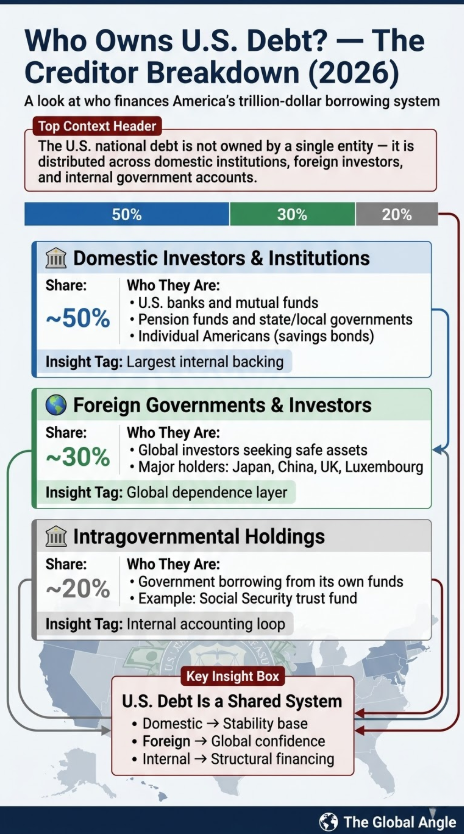
The debt is divided into two main categories: Debt Held by the Public (roughly 80%) and Intragovernmental Holdings (roughly 20%).
The Creditors of the United States
| Creditor Category | Share of Total Debt | Who Are They? |
| Domestic Investors & Institutions | ~50% | U.S. banks, mutual funds, state/local governments, pension funds, and individual Americans holding savings bonds. |
| Foreign Governments & Investors | ~30% | International buyers who use U.S. debt as a safe haven. Japan is the largest foreign holder (>$1.1T), followed by China (~$800B), the UK, and Luxembourg. |
| Intragovernmental Holdings | ~20% | The government owing money to itself. For example, when the Social Security trust fund has a surplus, the government borrows that cash to fund other things and replaces it with Treasury bonds. |
3. The Interest Rate Crisis
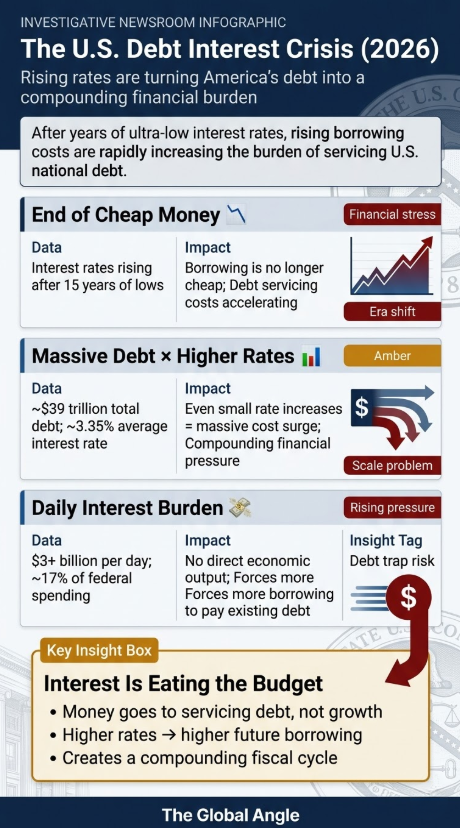
For the last 15 years, the U.S. government enjoyed historically low interest rates, meaning borrowing money was incredibly cheap. That era is over.
Following aggressive rate hikes to combat inflation, the average interest rate across all federal interest-bearing debt climbed to over 3.35% by early 2026. Because the principal debt is so massive ($39 trillion), even a relatively low 3.35% interest rate yields catastrophic costs.
The Reality Check: The government now spends over $3 billion every single day just paying interest. This money builds no roads, funds no schools, and buys no military equipment. It is a dead-weight cost that eats up roughly 17% of all federal spending, forcing the government to borrow even more money just to pay the interest on the money it already borrowed.
4. How Does This Impact the U.S. Dollar?
The U.S. dollar is the world’s primary reserve currency, which gives America the “exorbitant privilege” of running massive deficits without immediately collapsing its economy. However, a $39 trillion debt load actively threatens the dollar’s dominance.
- Inflation and Purchasing Power: If foreign investors stop buying U.S. debt, the Federal Reserve may be forced to step in and buy it by essentially “printing” more money. Injecting trillions of new dollars into the economy devalues the currency, which causes inflation. Your dollar buys less at the grocery store.
- De-dollarization: As the debt balloons and the U.S. uses financial sanctions in global conflicts, foreign central banks are getting nervous. Instead of buying U.S. Treasury bonds, many nations (particularly within the BRICS bloc) are dumping their dollar reserves and buying gold at record rates to protect their wealth from a potential U.S. debt crisis.
5. Which Sectors Are Most Impacted?
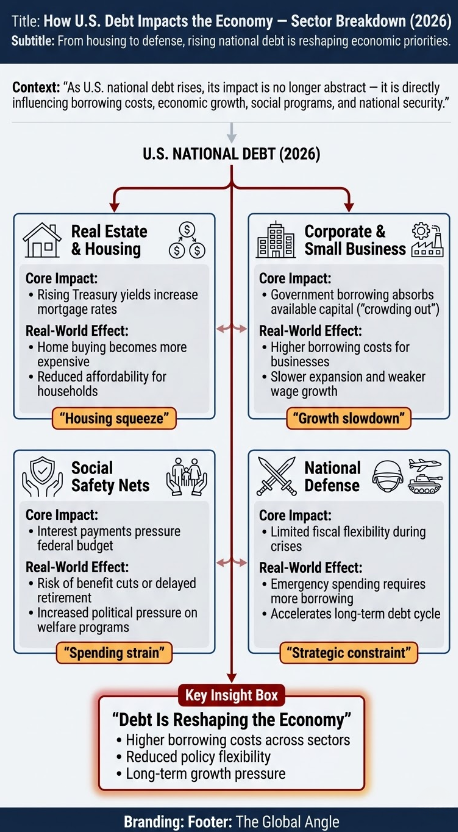
A sovereign debt crisis trickles down into every facet of the domestic economy. When the federal government has to borrow trillions, it competes with private citizens and businesses for available cash, driving up costs for everyone.
Sector by Sector Impact of the National Debt
| Sector | The Direct Impact of High National Debt |
| Real Estate & Housing | Government borrowing drives up the baseline yield on 10-year Treasury notes. Mortgage rates are directly tied to these notes, making buying a home significantly more expensive for average Americans. |
| Corporate & Small Business | “Crowding Out.” When the government absorbs so much of the available investment capital, banks have less money to lend to businesses. This leads to higher corporate borrowing costs, stalled expansion, and lower wage growth. |
| Social Safety Nets | As interest payments consume the federal budget, there is massive political pressure to cut mandatory spending programs. Social Security and Medicare face the highest risk of benefit reductions or delayed retirement ages. |
| National Defense | High debt restricts the government’s ability to respond to international crises. As seen with the 2026 Iran conflict, funding unexpected military operations requires emergency borrowing, further accelerating the debt spiral. |
6. How Can It Be Recovered? (The Solutions)
Sovereign debt is not like a household credit card; it doesn’t need to be paid down to zero. However, it must be brought down to a sustainable percentage of the nation’s Gross Domestic Product (GDP). Currently, the debt-to-GDP ratio is a staggering 137%.
There are only four mathematical ways for a government to recover from a debt crisis of this magnitude:
- Massive Spending Cuts: Drastically reducing the budget. Because most of the budget is mandatory (Social Security, Medicare, Interest), this means making deeply unpopular cuts to the social safety net or gutting the military.
- Substantial Tax Increases: Generating more revenue by raising corporate tax rates, increasing income taxes on the wealthy, or implementing broad national consumption taxes (like a VAT).
- Outgrowing the Debt: Sparking a massive technological or industrial boom (such as an AI-driven productivity renaissance) where the U.S. economy grows much faster than the debt accumulates, naturally lowering the debt-to-GDP ratio.
- “Inflating it Away”: A dangerous historical tactic where a government intentionally allows inflation to run high. Because the $39 trillion is a fixed nominal amount, high inflation devalues the currency, effectively making the debt “cheaper” to pay off with inflated dollars—though this crushes the middle class in the process.
Ultimately, managing a $39 trillion debt requires severe political compromise—a willingness to simultaneously cut beloved programs and raise taxes—a reality Washington has aggressively avoided for the last two decades.
Frequently Asked Questions (39 Trillion Dollar U.S. National Debt Explained)
Will the U.S. ever default on its debt?
A true, catastrophic default—where the U.S. simply refuses or is unable to pay its bondholders—is highly unlikely. Because the U.S. borrows in its own currency, the Federal Reserve can theoretically always print more money to cover the obligations. However, doing so would trigger hyperinflation. The more realistic risk is a “technical default” caused by political gridlock in Congress failing to raise the debt ceiling in time, which would temporarily freeze payments and severely downgrade the U.S. credit rating.
What happens if foreign countries ask for their money back all at once?
Foreign nations, like Japan or China, cannot “call in” their debt all at once. U.S. Treasury bonds are sold with specific maturity dates (e.g., 10 years or 30 years). A foreign government must wait for the bond to mature to get its principal back. However, if major foreign holders simultaneously stop buying new bonds or start selling their existing bonds on the secondary market, it would cause U.S. interest rates to spike dramatically, creating an instant financial crisis.
How much is the U.S. national debt per citizen?
With the gross national debt crossing the $39 trillion mark in early 2026, the burden amounts to roughly $116,000 for every single person living in the United States, or over $288,000 per U.S. household.
Who owns the majority of the U.S. national debt?
Contrary to popular belief, the U.S. owes the vast majority of its debt to itself. Roughly 70% of the national debt is held by domestic entities, including U.S. investors, the Federal Reserve, mutual funds, and intragovernmental trusts (like Social Security and Medicare). Foreign investors and governments hold the remaining 30%.
ALSO READ: US Trade 2026: The Complete Economic Breakdown
ALSO READ: The $1.2 Trillion Shift: Complete China Trade Surplus 2026 Breakdown

Russia China trade relations 2026: Sanctions Evasion, Dual-Use Tech, and the Putin-Xi Summit
Russia China trade relations 2026: Sanctions Evasion, Dual-Use Tech, and the Putin-Xi Summit Executive Briefing…

What is Hantavirus Outbreak 2026: Symptoms, Vaccine Status, and the Climate Vector
What is Hantavirus Outbreak 2026: Symptoms, Vaccine Status, and the Climate Vector The Immediate Trigger:…

Starlink & SpaceX IPO 2026: Everything You Need to Know
Starlink & SpaceX IPO 2026: Everything You Need to Know The Valuation: According to Institutional…
What is OPEC? How the Oil Cartel Functions and Why It’s Fracturing in 2026
What is OPEC? How the Oil Cartel Functions and Why It’s Fracturing in 2026 The…

Why the UAE Quit OPEC and the Birth of the Petro-Rupee
Why the UAE Quit OPEC and the Birth of the Petro-Rupee The Rupture: The United…

Microsoft OpenAI Partnership Ends: Why Microsoft is Dropping OpenAI’s Exclusive License
Microsoft OpenAI Partnership Ends: Why Microsoft is Dropping OpenAI’s Exclusive License The Announcement: On April…

Ibrahim is the Founder and Lead Analyst at The Global Angle, an independent digital platform dedicated to factual geopolitical analysis and international affairs. Based in India, he combines an engineering background with a deep focus on global markets, diplomacy, and strategic security. Ibrahim leverages a data-driven, analytical approach to break down complex international conflicts and economic shifts, helping readers see beyond standard news narratives. When he isn’t researching global policy, he focuses on digital publishing, search engine optimization, and platform architecture.