Executive Briefing (Update: March 2026)
As the 2026 Middle East war shatters historic red lines, the ultimate taboo has been brought to the forefront: the nuclear option. The real question is Can Israel Use Nuclear Weapons?
- The Nuclear Threshold: Despite the unprecedented reciprocal airstrikes on nuclear facilities, military analysts assess that Israel is highly unlikely to detonate an actual nuclear weapon unless the state faces total, imminent destruction.
- The Facility Strikes: Attacking a nuclear facility with conventional missiles (as seen with Israel’s Dimona and Iran’s Natanz/Bushehr) is not the same as a nuclear explosion. However, it severely risks creating a massive radiological hazard.
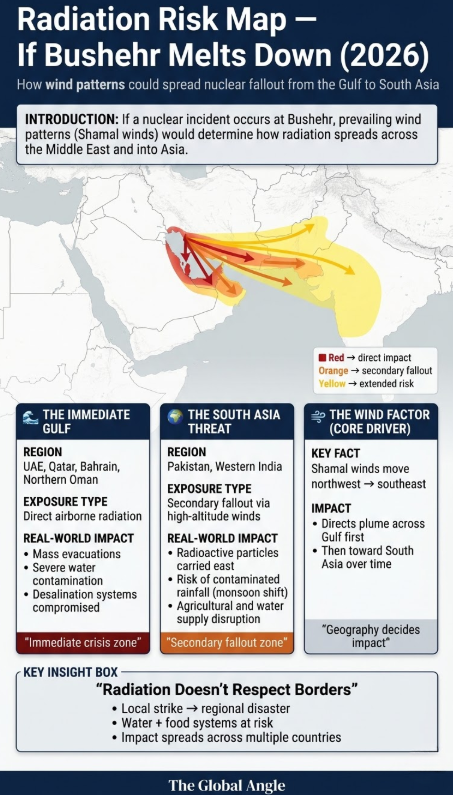
- The Danger to Asia: If the U.S. or Israel critically breaches the active reactor at Iran’s Bushehr power plant, prevailing wind patterns could carry radioactive fallout across the Persian Gulf and toward South Asia (Pakistan and India), triggering an international environmental catastrophe.
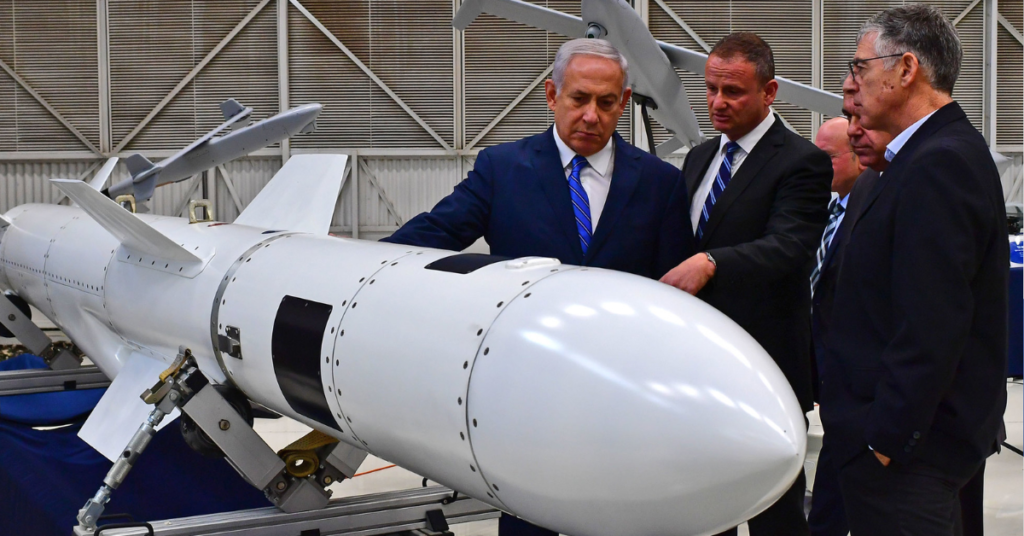
Following reports that Israel launched conventional strikes against Iran’s nuclear infrastructure—and Iran retaliated by targeting the airspace around Israel’s highly classified Shimon Peres Negev Nuclear Research Center (Dimona)—global panic has surged. Search engines are flooded with questions about World War III, radiation leaks, and the survival of the Asian continent.
To cut through the sensationalism, we need to separate the terrifying reality of this conflict from Hollywood fiction. Here is the complete geopolitical and scientific breakdown of the current nuclear threat.
1. Can Israel Use Nuclear Weapons?
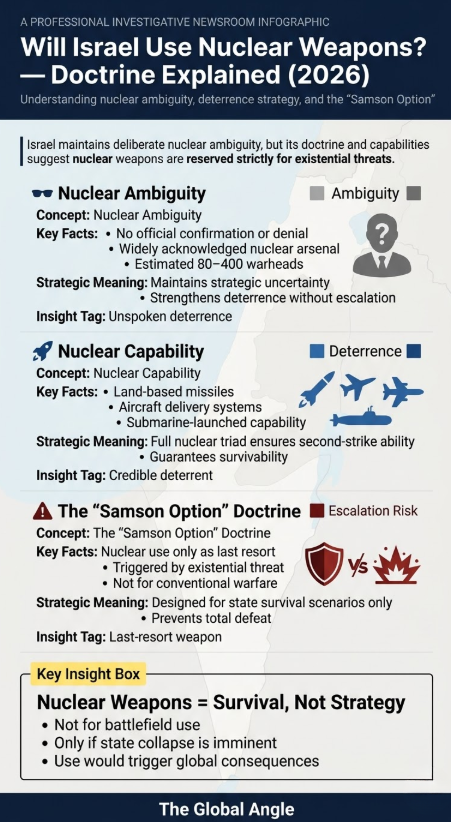
Israel maintains a policy of “nuclear ambiguity”—it has never officially confirmed or denied possessing nuclear weapons. However, global intelligence agencies universally acknowledge that Israel possesses a robust nuclear triad (land-based missiles, aircraft, and submarine-launched cruise missiles), with an estimated stockpile of 80 to 400 warheads.
Will they use them in the current war? Almost certainly not under present conditions. Israel’s nuclear doctrine is widely understood to be defensive, governed by the unwritten “Samson Option.” This doctrine dictates that nuclear weapons are a weapon of absolute last resort. They would only be authorized if the physical survival of the State of Israel were virtually extinguished—for example, if a coalition of hostile armies breached its borders and began overrunning cities, or if a sovereign nation launched a weapon of mass destruction (chemical, biological, or nuclear) directly at Tel Aviv.
While the current drone swarms and ballistic missile exchanges are devastating, Israel’s state apparatus, military command, and territorial integrity remain highly intact. Launching an offensive nuclear strike right now would instantly turn Israel into a global pariah, alienate the United States, and invite catastrophic global retaliation.
2. The Reciprocal Strikes: Hitting Facilities vs. Dropping Nukes
It is crucial to correct a common misconception: Dropping a conventional bomb on a nuclear facility does not cause a nuclear explosion. It does not create a mushroom cloud or a thermonuclear blast.
However, it does create a highly dangerous “dirty bomb” effect.
When Israel attacked Iran’s enrichment facilities (like Natanz or Fordow) and Iran targeted Dimona, they used conventional high-explosive warheads.
- Enrichment Facilities (Natanz/Fordow): These sites house centrifuges spinning uranium gas. If bombed, the primary risk is localized toxic uranium dust contamination. Because these are heavily fortified, deep-underground facilities, a massive radioactive plume is unlikely.
- Research Reactors (Dimona): Dimona is an aging, heavy-water reactor. A direct, bunker-busting hit that breaches the reactor core would release highly radioactive isotopes (like Cesium-137 and Iodine-131) into the immediate Israeli and Jordanian environment, requiring mass evacuations.
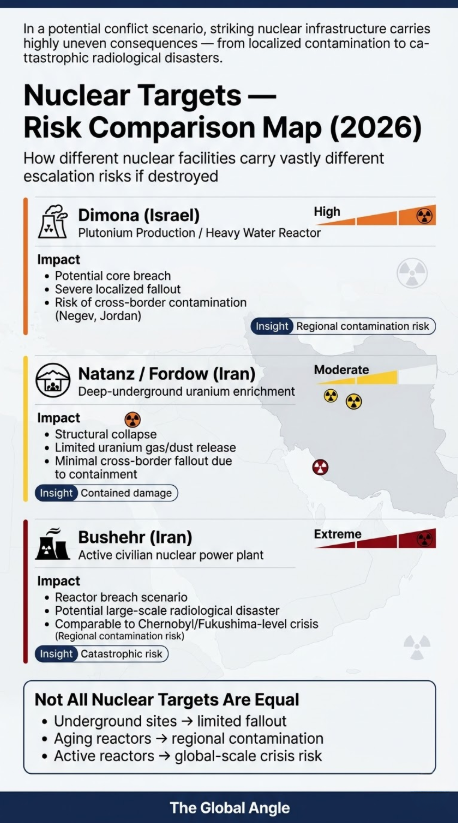
The Nuclear Infrastructure Chessboard
| Target Location | Facility Type | Primary Danger if Conventionally Destroyed |
| Dimona (Israel) | Plutonium Production / Heavy Water Reactor | High. Breach of the aging core could contaminate the Negev desert and neighboring Jordan with severe, localized fallout. |
| Natanz / Fordow (Iran) | Deep-Underground Uranium Enrichment | Moderate. Structural collapse and localized uranium gas/dust release. Minimal cross-border fallout due to underground containment. |
| Bushehr (Iran) | Active Civilian Nuclear Power Plant | Extreme. A breach of the active reactor dome would cause a Chernobyl/Fukushima-style radiological disaster. |
3. What is U.S Nuclear Plant Attack Warning?
This is the nightmare scenario for environmental scientists. While U.S. strikes under Operation Epic Fury have largely targeted military and naval bases, striking the Bushehr Nuclear Power Plant on the Persian Gulf coast would cross a catastrophic threshold.
Bushehr is not a weapons facility; it is an active civilian nuclear reactor (built with Russian assistance) generating electricity. If U.S. or Israeli bunker-busters pierce the reactor’s containment dome while it is active, the coolant systems would fail, leading to a nuclear meltdown. The ensuing fires would spew highly radioactive smoke into the upper atmosphere.
4. The Radiation Leak Threat: Is Asia in Danger?
If a meltdown occurs at Bushehr, the geography and meteorology of the Middle East dictate the victims.
The Wind Factor: Prevailing winds in the Persian Gulf (known as the Shamal winds) predominantly blow from the northwest to the southeast.
If a radioactive plume escapes Bushehr:
- The Immediate Gulf: The airborne radiation would drift directly over the Persian Gulf, forcing mass evacuations in the UAE (Dubai, Abu Dhabi), Qatar, Bahrain, and northern Oman. It would severely contaminate the waters, devastating the region’s desalination plants which provide drinking water for millions.
- The Threat to Asia: As the high-altitude winds carry the plume eastward, Pakistan and western India would be in the direct path of the secondary fallout. While the radiation would dilute as it travels across the Arabian Sea, a shift in seasonal monsoons could bring radioactive rain to agricultural heartlands in South Asia, severely compromising the food and water supply for hundreds of millions of people.
The Verdict: While the world is not currently facing a thermonuclear war, the conventional targeting of active nuclear infrastructure is playing Russian roulette with the global environment. A direct hit on an active reactor wouldn’t just be an act of war; it would be a generational ecological disaster spanning from the Middle East to the borders of India.
Frequently Asked Questions
Can a conventional bomb cause a nuclear explosion?
No. Dropping a standard explosive bomb (even a massive bunker-buster) on a nuclear power plant or enrichment facility cannot trigger a thermonuclear chain reaction or a “mushroom cloud.” However, it can destroy the containment structures, causing a meltdown and releasing deadly radioactive gas and debris into the atmosphere.
What is the Samson Option?
The “Samson Option” is the name given to Israel’s unacknowledged deterrence strategy. It implies massive, overwhelming nuclear retaliation against enemy nations if the State of Israel is facing total military defeat and imminent destruction.
Is radiation from Iran dangerous to India or Pakistan?
If the Bushehr nuclear power plant in Iran suffers a catastrophic containment breach, yes. Prevailing weather patterns and high-altitude winds often move from the Middle East eastward toward South Asia. Radioactive particles could be carried across the Arabian Sea, potentially falling as radioactive rain over Pakistan and western India.
ALSO READ: Who Can Pass Through Strait of Hormuz? Blockade Rules & Strait of Hormuz Shipping Status
ALSO READ: The Complete History of Iran Israel Relations: From Secret Allies to Arch-Rivals
Russia China trade relations 2026: Sanctions Evasion, Dual-Use Tech, and the Putin-Xi Summit
Russia China trade relations 2026: Sanctions Evasion, Dual-Use Tech, and the Putin-Xi Summit Executive Briefing…

What is Hantavirus Outbreak 2026: Symptoms, Vaccine Status, and the Climate Vector
What is Hantavirus Outbreak 2026: Symptoms, Vaccine Status, and the Climate Vector The Immediate Trigger:…

Starlink & SpaceX IPO 2026: Everything You Need to Know
Starlink & SpaceX IPO 2026: Everything You Need to Know The Valuation: According to Institutional…
What is OPEC? How the Oil Cartel Functions and Why It’s Fracturing in 2026
What is OPEC? How the Oil Cartel Functions and Why It’s Fracturing in 2026 The…

Why the UAE Quit OPEC and the Birth of the Petro-Rupee
Why the UAE Quit OPEC and the Birth of the Petro-Rupee The Rupture: The United…

Microsoft OpenAI Partnership Ends: Why Microsoft is Dropping OpenAI’s Exclusive License
Microsoft OpenAI Partnership Ends: Why Microsoft is Dropping OpenAI’s Exclusive License The Announcement: On April…

Ibrahim is the Founder and Lead Analyst at The Global Angle, an independent digital platform dedicated to factual geopolitical analysis and international affairs. Based in India, he combines an engineering background with a deep focus on global markets, diplomacy, and strategic security. Ibrahim leverages a data-driven, analytical approach to break down complex international conflicts and economic shifts, helping readers see beyond standard news narratives. When he isn’t researching global policy, he focuses on digital publishing, search engine optimization, and platform architecture.