Executive Briefing (Update: March 2026)
- The A$10 Billion Milestone: Following eight years of complex negotiations, the EU Australia Free Trade Agreement has been signed, hailed by both governments as a mutual “win-win” that removes almost all bilateral trade tariffs.
- The Agricultural Compromise: The deal eliminates tariffs on Australian wine and seafood while providing European consumers with cheaper goods. However, complex compromises were struck regarding European food naming rights, and Australian red meat producers received a much smaller export quota than anticipated.
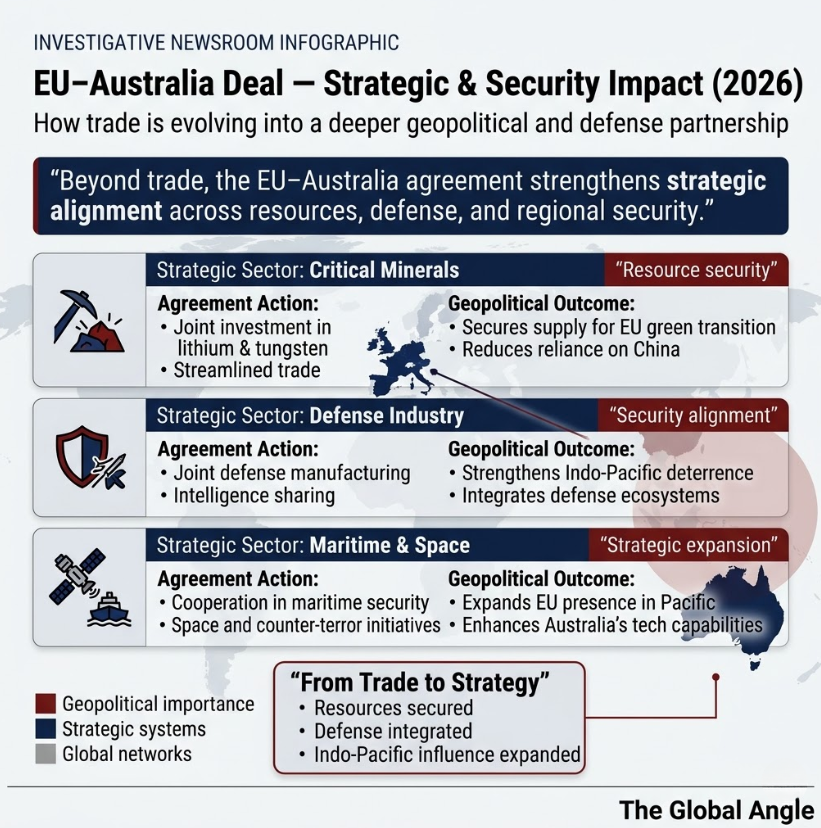
- Strategic Supply Chains: Moving beyond traditional trade, the pact establishes a unified front on defense, maritime security, and the exchange of critical minerals (such as lithium and tungsten), prioritizing “collective resilience” against global supply chain vulnerabilities.
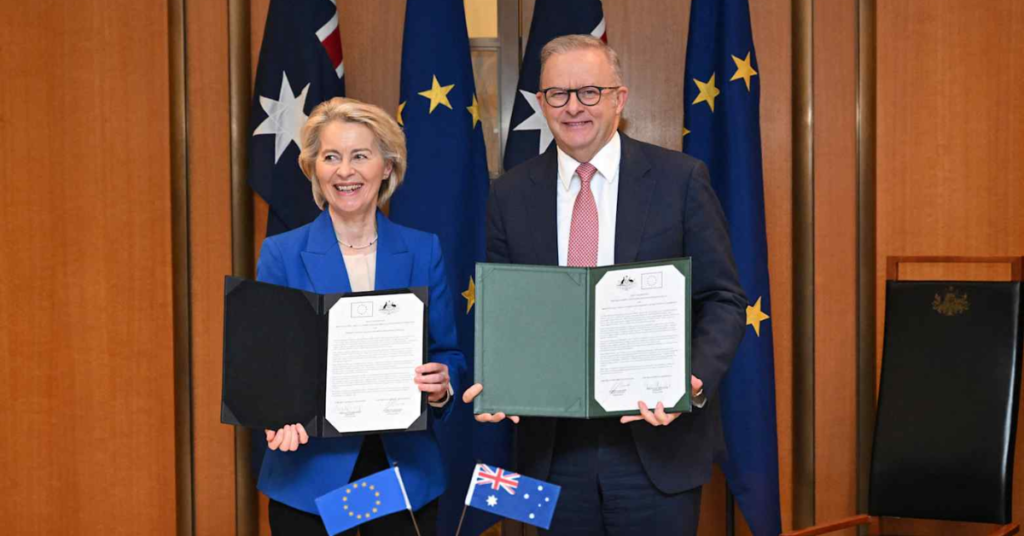
As global markets face unprecedented volatility in early 2026, mid-sized and regional powers are actively searching for economic security. This week, Australian Prime Minister Anthony Albanese and European Commission President Ursula von der Leyen finalized a historic free trade deal that fundamentally alters the economic bridge between Europe and the Indo-Pacific.
With major powers increasingly utilizing tariffs as geopolitical leverage, this A$10 billion (roughly $7 billion USD) agreement signals a strategic pivot for both regions. Here is The Global Angle’s definitive, data-driven breakdown of the EU-Australia trade deal, utilizing comprehensive tables to map out the economic winners, the strategic shifts, and the global impact.
The Macro-Economic Overview of EU Australia Trade Deal
The newly signed trade agreement is a comprehensive bilateral treaty designed to eliminate almost all tariffs on trade between the European Union and Australia. It is the culmination of nearly a decade of negotiations, heavily delayed in previous years by disputes over agricultural quotas and the intellectual property of European food names.
EU Australia Free Trade Agreement Fundamentals
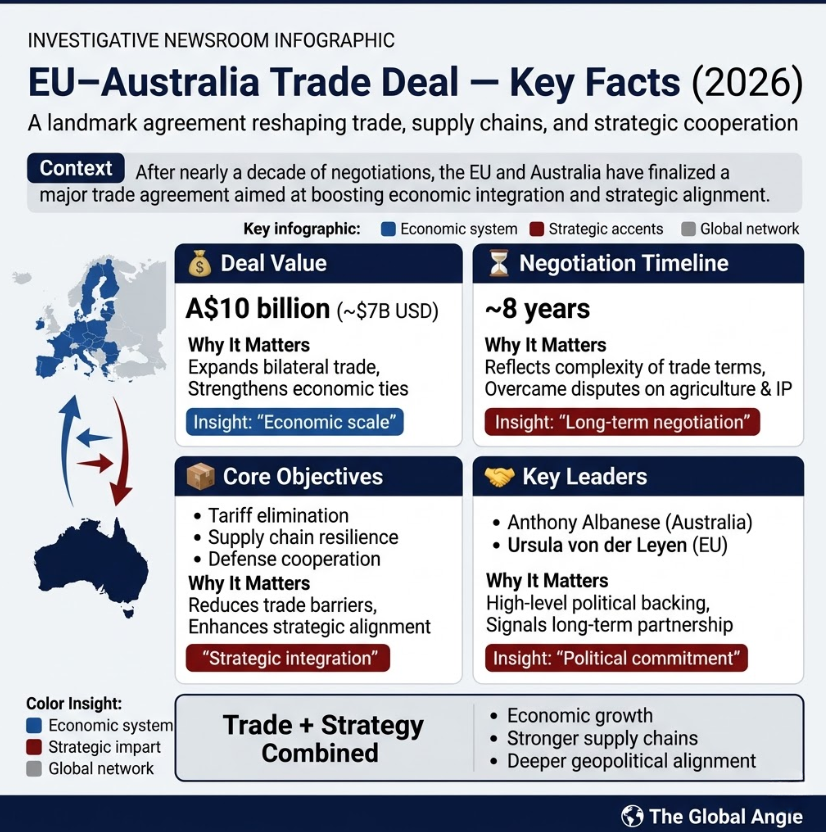
| Metric | Details |
| Total Estimated Value | A$10 billion ($7 billion USD; £5.2 billion) |
| Negotiation Timeline | 8 Years |
| Primary Objectives | Tariff elimination, supply chain resilience, and defense cooperation. |
| Key Signatories | PM Anthony Albanese (Australia) & President Ursula von der Leyen (EU Commission) |
Agricultural Exports and Naming Rights
The most heavily debated aspects of the deal revolved around agriculture. The economic architecture of the treaty is highly reciprocal, though it creates distinct domestic divides, particularly within Australia’s farming sectors.
Australian wine producers are massive beneficiaries, securing an estimated A$37 million in annual tariff savings. However, the Australian red meat sector expressed deep disappointment. Meat and Livestock Australia (MLA) lobbied for an annual quota of at least 50,000 tonnes, but the final agreement capped the quota at roughly 30,000 tonnes.
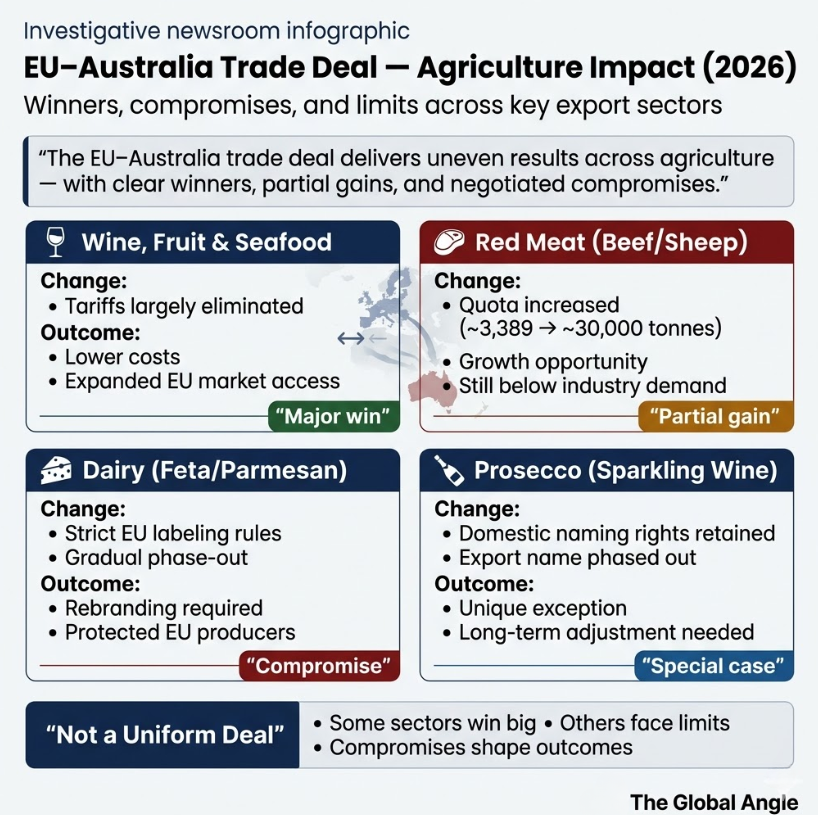
EU Australia Free Trade Agreement Agricultural Impact (Australia to EU)
| Export Sector | Tariff / Quota Changes | Industry Impact & Verdict |
| Wine, Fruit, & Seafood | Almost all EU tariffs completely lifted. | Major Win: Immediate cost reductions and expanded market access for Australian growers. |
| Red Meat (Beef/Sheep) | Quota increased from 3,389 tonnes to roughly 30,000 tonnes. | Missed Opportunity: Significant increase, but falls 40% short of the industry’s 50,000-tonne demand. |
| Dairy (Feta/Parmesan) | Subject to strict “grandfathering” and lengthy phase-out periods for export labeling. | Compromise: Protects European geographical indications while giving Australian producers time to rebrand exports. |
| Sparkling Wine (Prosecco) | Australia retains domestic naming rights; export name phases out over 10 years. | Unique Exemption: Australia remains the only country outside Italy permitted to use the name domestically. |
Consumer Impact and Import Dynamics
For Australian consumers, the immediate benefit will be felt directly at the supermarket. The removal of Australian import tariffs on European manufactured and specialty goods will lower the cost of living for everyday items.
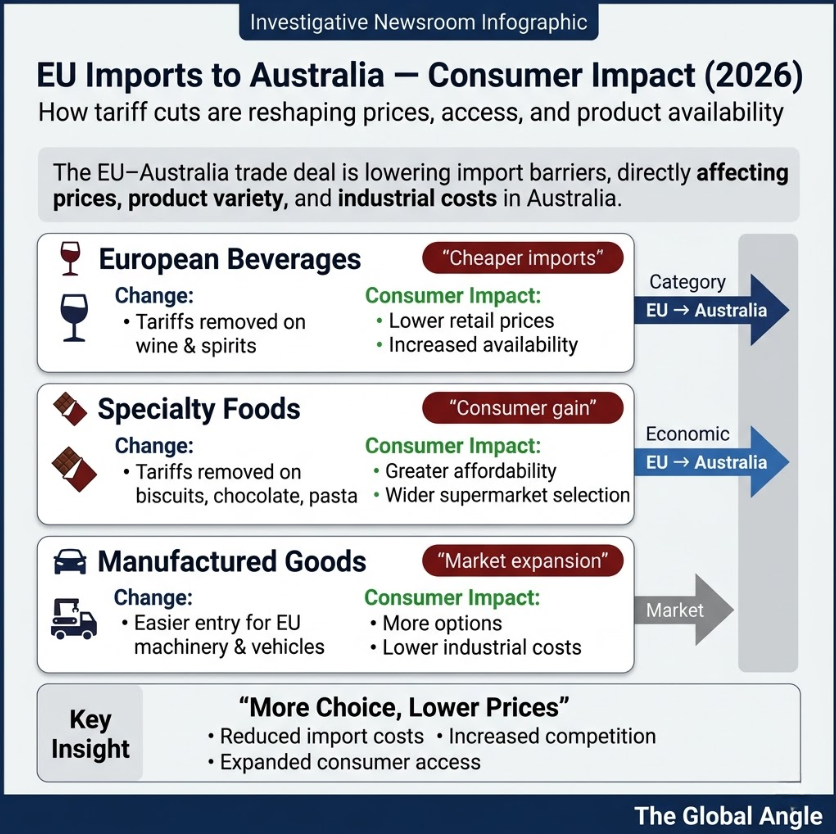
EU Australia Free Trade Agreement Consumer & Import Impacts (EU to Australia)
| Import Category | Tariff Changes | Consumer Impact |
| European Beverages | Tariffs removed on EU wine and spirits. | Lower retail prices for imported European alcohol in Australia. |
| Specialty Foods | Tariffs removed on biscuits, chocolates, and pasta. | Increased affordability and supermarket availability of premium European pantry staples. |
| Manufactured Goods | Easier market entry for EU-made machinery and vehicles. | Broader options and potentially lower costs for Australian industrial and automotive buyers. |
Critical Minerals and Defense
Ursula von der Leyen explicitly framed the deal around “collective resilience” in a world where “great powers are using tariffs as leverage and supply chains as vulnerabilities.” This is a direct geopolitical response to Chinese dominance in critical mineral processing and the rising protectionism of U.S. trade policies.
Beyond agriculture, the treaty unlocks massive, long-term operational frameworks specifically tailored to the security concerns of 2026.
EU Australia Free Trade Agreement Strategic and Security Dimensions
| Strategic Sector | Agreement Provisions | Geopolitical Goal |
| Critical Minerals | Joint investments and streamlined trade for Australian lithium and tungsten. | Secures raw materials for Europe’s green energy transition, bypassing Chinese refining monopolies. |
| Defense Industry | Enhanced joint ventures in defense manufacturing and intelligence sharing. | Bolsters Indo-Pacific deterrence and integrates European defense contractors with Australian procurement. |
| Maritime & Space | Co-operation on counter-terrorism, space exploration, and maritime security. | Expands the EU’s strategic footprint in the Pacific while providing Australia with advanced European aerospace tech. |
Conclusion
The EU-Australia free trade agreement is a perfect reflection of modern macroeconomics. It is no longer just about the price of beef and cheese; it is about securing critical mineral supply chains and hedging against superpower protectionism. While some domestic agricultural sectors feel shortchanged by the quotas, the overarching geopolitical architecture of the deal secures vital, long-term strategic depth and economic resilience for both Brussels and Canberra.
Frequently Asked Questions (EU Australia trade deal)
What is the overall value of the EU Australia trade deal?
The sweeping free trade agreement is valued at approximately A$10 billion (roughly $7 billion USD or £5.2 billion).
Who benefits the most from the EU-Australia agreement?
Australian wine producers, seafood exporters, and critical mineral mining companies are major beneficiaries. Furthermore, consumers in both regions will benefit from cheaper, tariff-free imported goods ranging from European chocolates to Australian olive oil.
Why is the Australian red meat industry unhappy with the deal?
Australian red meat producers wanted an annual export quota of at least 50,000 tonnes to Europe. The final deal only allowed for roughly 30,000 tonnes, which the industry views as an unfair outcome and a missed opportunity for farmers.
ALSO READ: Can China Takeover Taiwan in 2026? Why Does China Wants Taiwan
ALSO READ: The 39 Trillion Dollar U.S. National Debt Explained: Impact, Interest, and Solutions
Russia China trade relations 2026: Sanctions Evasion, Dual-Use Tech, and the Putin-Xi Summit
Russia China trade relations 2026: Sanctions Evasion, Dual-Use Tech, and the Putin-Xi Summit Executive Briefing…
What is Hantavirus Outbreak 2026: Symptoms, Vaccine Status, and the Climate Vector
What is Hantavirus Outbreak 2026: Symptoms, Vaccine Status, and the Climate Vector The Immediate Trigger:…
Starlink & SpaceX IPO 2026: Everything You Need to Know
Starlink & SpaceX IPO 2026: Everything You Need to Know The Valuation: According to Institutional…
What is OPEC? How the Oil Cartel Functions and Why It’s Fracturing in 2026
What is OPEC? How the Oil Cartel Functions and Why It’s Fracturing in 2026 The…
Why the UAE Quit OPEC and the Birth of the Petro-Rupee
Why the UAE Quit OPEC and the Birth of the Petro-Rupee The Rupture: The United…

Microsoft OpenAI Partnership Ends: Why Microsoft is Dropping OpenAI’s Exclusive License
Microsoft OpenAI Partnership Ends: Why Microsoft is Dropping OpenAI’s Exclusive License The Announcement: On April…

Ibrahim is the Founder and Lead Analyst at The Global Angle, an independent digital platform dedicated to factual geopolitical analysis and international affairs. Based in India, he combines an engineering background with a deep focus on global markets, diplomacy, and strategic security. Ibrahim leverages a data-driven, analytical approach to break down complex international conflicts and economic shifts, helping readers see beyond standard news narratives. When he isn’t researching global policy, he focuses on digital publishing, search engine optimization, and platform architecture.