
Executive Briefing (Update: March 2026)
- The Electoral Paradox: As the Denmark Election Results 2026 Show up the Prime Minister Mette Frederiksen’s Social Democrats won the general election with 21.9% of the vote (38 seats), remaining the largest party. However, this marks their weakest showing in over a century, as the left-wing “Red Bloc” failed to secure the 90 seats required for a Folketing majority.
- The “Greenland Gamble” Backfires: Frederiksen called an early election hoping to capitalize on her immense international popularity after successfully rebuffing U.S. President Donald Trump’s aggressive bid to acquire Greenland. Instead, Danish voters punished her for neglecting severe domestic issues.
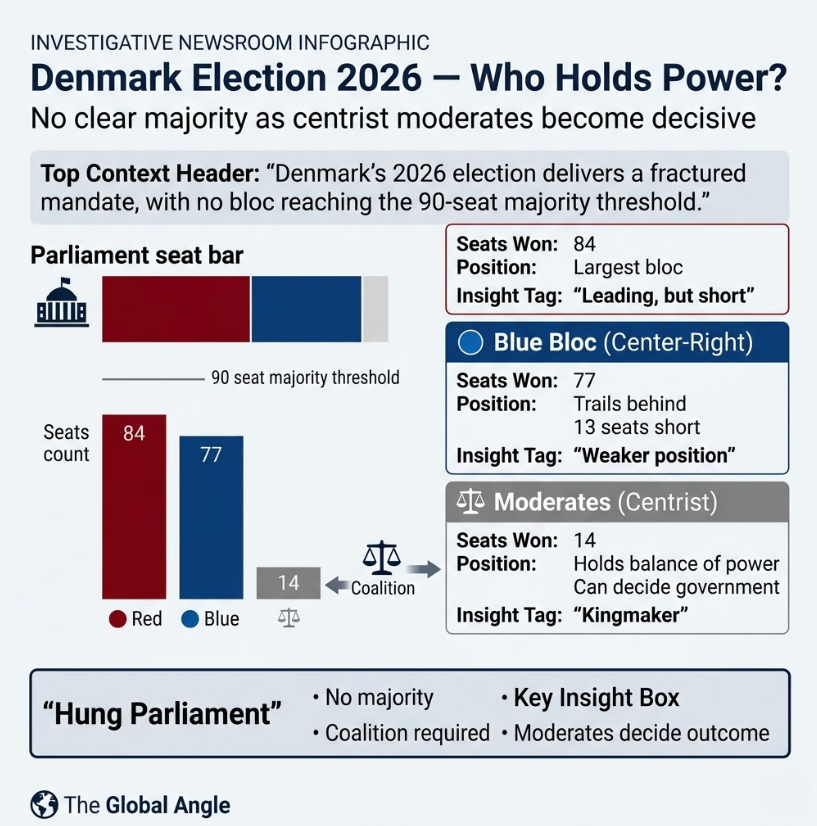
- The Return of the Kingmaker: With the Red Bloc holding 84 seats and the right-wing Blue Bloc holding 77, the centrist Moderates—led by former Prime Minister Lars Løkke Rasmussen (14 seats)—now hold the absolute balance of power to dictate the next coalition government.
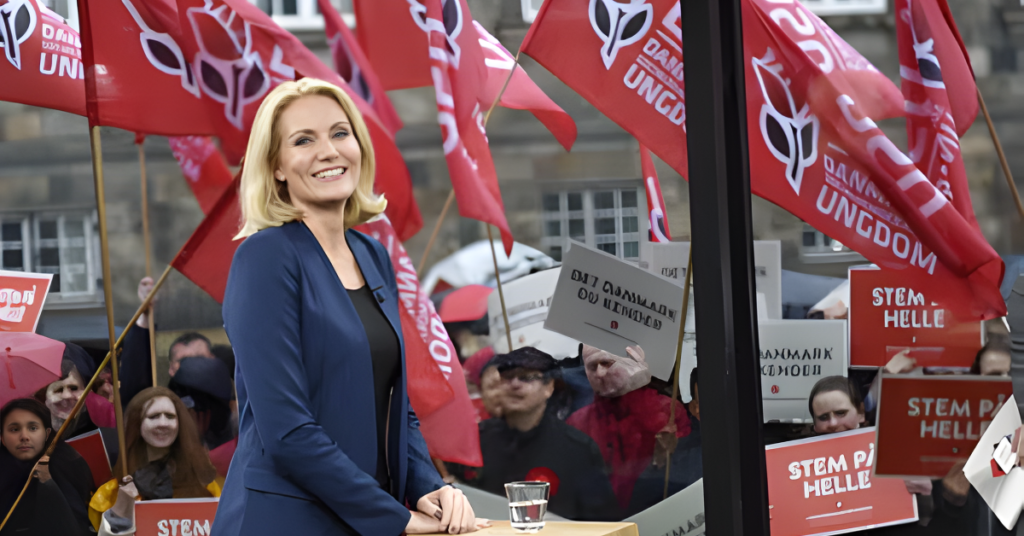
In geopolitical strategy, there is a persistent myth that a triumphant foreign policy crisis guarantees domestic electoral success. This week, Denmark’s general election shattered that illusion.
Prime Minister Mette Frederiksen took a massive political gamble. Riding high on international praise for her staunch defense of Greenland against U.S. annexation pressures, she called an early snap election. Yet, as the final ballots were tallied inside Christiansborg, the results delivered a bruising reality check. While her party finished first, they suffered historic losses.
Here is The Global Angle’s definitive analysis of why geopolitics failed to pay the bills for Danish voters, the environmental crisis driving voter anger, and what comes next in the coalition negotiations.
The Parliamentary Math: A Deadlocked Folketing
Denmark’s parliament, the Folketing, consists of 179 seats. To form a government, a coalition must command a minimum of 90 seats. Historically, Danish politics is divided into two distinct alliances: the left-leaning “Red Bloc” and the right-leaning “Blue Bloc.”
As of March 2026, neither bloc has achieved a governing mandate.
Denmark Election Results 2026
| Political Faction | Total Seats Won | Deficit to Majority (90 Seats) | Key Leadership |
| The Red Bloc (Center-Left) | 84 Seats | – 6 Seats | Mette Frederiksen (Social Democrats) |
| The Blue Bloc (Center-Right) | 77 Seats | – 13 Seats | Troels Lund Poulsen (Liberals) |
| The Moderates (Centrist) | 14 Seats | KINGMAKER | Lars Løkke Rasmussen |
Lars Løkke Rasmussen, who recently went viral for his diplomatic meetings in Washington with U.S. Vice President JD Vance, is now the most powerful man in Denmark. Rasmussen has explicitly stated his desire to form a government “across the center,” rejecting the traditional red/blue divide. However, the leader of the Blue Bloc, Troels Lund Poulsen, has flatly ruled out joining a government that includes Frederiksen’s Social Democrats.
The Unique Angle: Why the “Greenland Gamble” Failed
To international observers, Mette Frederiksen has been a geopolitical titan in early 2026. When the Trump administration aggressively pushed to acquire the semi-autonomous territory of Greenland for U.S. national security and critical mineral extraction, Frederiksen drew a hard line. She unified European allies, protected Danish sovereignty, and looked highly prime ministerial on the global stage.
She called the election banking on a “rally ’round the flag” effect. So why did her party suffer its worst electoral percentage since 1903?
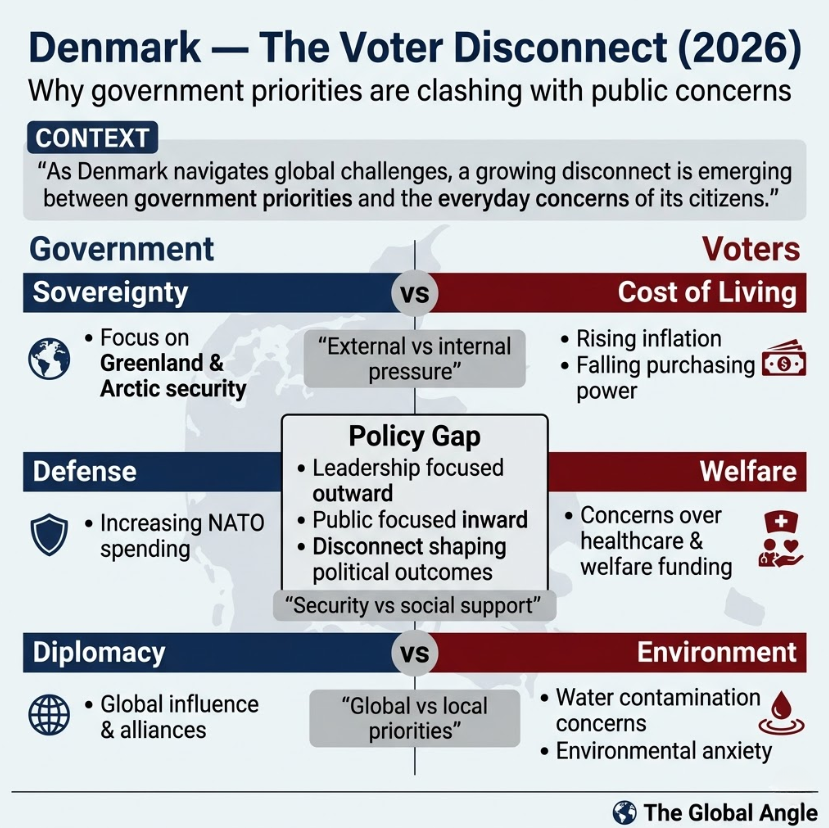
The answer lies in the disconnect between international statesmanship and local reality. While Frederiksen was focused on the Arctic and Washington, average Danes were dealing with a rapidly deteriorating domestic environment.
The Voter Priority Disconnect
| The Prime Minister’s Focus | The Danish Voter’s Reality |
| Greenland Sovereignty: Defending the Arctic from American annexation. | Cost of Living: Soaring inflation, driven partly by global energy shocks, eroding the purchasing power of the Danish Krone. |
| NATO Commitments: Increasing defense spending to meet alliance targets. | Welfare Strain: A perception that Denmark’s famously robust social safety net and public healthcare systems are being underfunded. |
| Global Diplomacy: Projecting Danish soft power in the U.S. and the EU. | The Environmental Crisis: Severe anxiety over drinking water contamination caused by the nation’s massive agricultural sector. |
The Domestic Catalyst: Pigs, Pesticides, and Water
While international media focused on Greenland, a highly localized environmental crisis dominated the Danish campaign trail. Denmark is one of the world’s largest exporters of pork, with an agricultural sector that heavily dominates the nation’s landmass.
Recent domestic reports highlighted critically high levels of agricultural pesticides and nitrate runoff seeping into Denmark’s groundwater—the primary source of the nation’s drinking water. For environmentally conscious Danish voters, the climate footprint of the pig farming industry and the threat to clean water became a defining ballot issue.
Left-wing voters who traditionally support the Social Democrats defected to the Red-Greens and the Social Liberal Party, feeling that Frederiksen had prioritized foreign policy optics over enforcing strict environmental regulations on the powerful agricultural lobby.
Conclusion: The Coalition Horizon
Mette Frederiksen remains ready to lead a third term, but she is entering negotiations from a position of profound weakness. To survive, she will likely have to make massive concessions to Lars Løkke Rasmussen’s Moderates.
The 2026 Danish election serves as a stark warning to Western leaders: successfully navigating a global geopolitical crisis does not grant immunity from domestic economic and environmental anxieties. Geopolitics may win international headlines, but local issues still win elections.
Frequently Asked Questions (Denmark Election Results 2026)
Why did Mette Frederiksen call an early election?
Frederiksen called a snap election hoping to leverage her boosted domestic approval ratings following her successful handling of the diplomatic standoff with the United States over the sovereignty of Greenland.
Who are the Moderates and why are they important?
The Moderates are a centrist political party founded by former Prime Minister Lars Løkke Rasmussen. Because neither the left-wing nor right-wing blocs won enough seats to form a 90-seat majority, the Moderates’ 14 seats give them the “kingmaker” power to decide who forms the next government.
What domestic issues caused the Social Democrats to lose votes?
Voters were primarily concerned with the rising cost of living, strains on the welfare system, and an escalating environmental crisis regarding pesticide contamination in Denmark’s drinking water caused by the intensive pig farming industry.
ALSO READ: Is the U.S. Losing the Iran War? What are Iran’s Demands For Peace Talks
ALSO READ: EU Australia Free Trade Agreement: Tariffs, Critical Minerals, and Global Impact
Russia China trade relations 2026: Sanctions Evasion, Dual-Use Tech, and the Putin-Xi Summit
Russia China trade relations 2026: Sanctions Evasion, Dual-Use Tech, and the Putin-Xi Summit Executive Briefing…

What is Hantavirus Outbreak 2026: Symptoms, Vaccine Status, and the Climate Vector
What is Hantavirus Outbreak 2026: Symptoms, Vaccine Status, and the Climate Vector The Immediate Trigger:…

Starlink & SpaceX IPO 2026: Everything You Need to Know
Starlink & SpaceX IPO 2026: Everything You Need to Know The Valuation: According to Institutional…
What is OPEC? How the Oil Cartel Functions and Why It’s Fracturing in 2026
What is OPEC? How the Oil Cartel Functions and Why It’s Fracturing in 2026 The…
Why the UAE Quit OPEC and the Birth of the Petro-Rupee
Why the UAE Quit OPEC and the Birth of the Petro-Rupee The Rupture: The United…

Microsoft OpenAI Partnership Ends: Why Microsoft is Dropping OpenAI’s Exclusive License
Microsoft OpenAI Partnership Ends: Why Microsoft is Dropping OpenAI’s Exclusive License The Announcement: On April…

Ibrahim is the Founder and Lead Analyst at The Global Angle, an independent digital platform dedicated to factual geopolitical analysis and international affairs. Based in India, he combines an engineering background with a deep focus on global markets, diplomacy, and strategic security. Ibrahim leverages a data-driven, analytical approach to break down complex international conflicts and economic shifts, helping readers see beyond standard news narratives. When he isn’t researching global policy, he focuses on digital publishing, search engine optimization, and platform architecture.

Pingback: The Rest of the World Report | June 1, 2026 — Evening Edition – The Rest of the World Report