Executive Briefing (Update: March 2026)
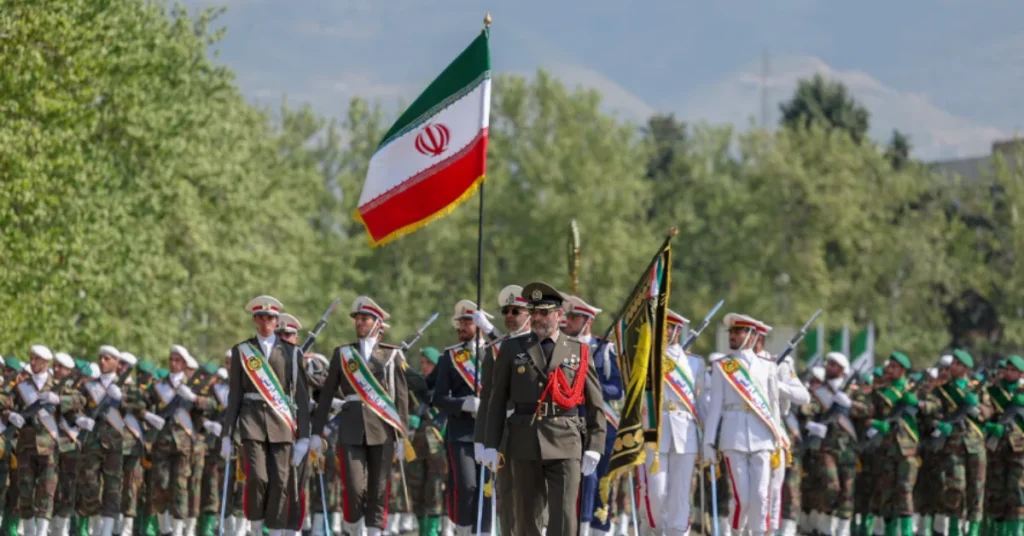
As of March 25, 2026, the intensifying conflict between the United States, Israel, and Iran has reached a critical inflection point. The initial doctrine of relying strictly on aerial bombardment and precision airstrikes has failed to secure a decisive victory or force Tehran into diplomatic submission. So Is U.S. Deploying Troops in Iran?
- The Tactical Pivot: Following weeks of stalled asymmetric warfare and failed indirect peace talks, military planners are reportedly weighing targeted ground deployments. However, this likely means Special Operations Forces (SOF) to secure the Strait of Hormuz, rather than a full-scale, catastrophic invasion of the Iranian mainland.
- The Strategic Blowback: Any introduction of American boots on the ground dramatically escalates the conflict. Iran’s decentralized IRGC is highly prepared for terrestrial combat, threatening to unleash massive missile barrages on U.S. Gulf bases and fully mine the Strait of Hormuz.
- The Domestic Reality: Ahead of the 2026 mid-term elections, the American public is exhibiting severe war fatigue. Driven by inflation and spiking gas prices, polling indicates that a prolonged Middle Eastern ground war would be politically toxic for the current administration.
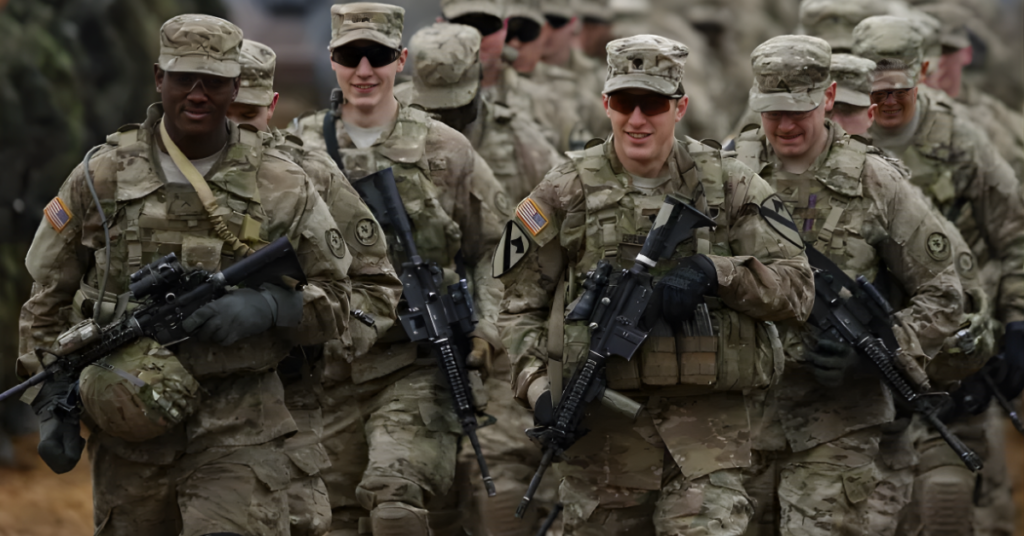
With global energy markets reeling from transit disruptions in the Persian Gulf, rumors are circulating through Washington and international media regarding a potential U.S. troop deployment to the region. Here is The Global Angle’s independent, data-driven analysis of what a ground deployment would actually look like, how Iran’s military is structured to respond, and the profound domestic and global consequences.
Is U.S. Deploying Troops in Iran?
When discussing “deploying troops to Iran,” it is crucial to separate geopolitical reality from hyperbole. A full-scale, D-Day style amphibious invasion of Iran is considered a logistical impossibility under current constraints. Iran’s mountainous geography, massive landmass, and population of nearly 90 million would require a mobilization of over 500,000 U.S. personnel—an operation the U.S. defense industrial base cannot currently support while simultaneously supplying Ukraine.
Instead, the deployments currently being deliberated by the Pentagon involve highly targeted, limited-scope operations designed to break the economic stranglehold Iran has placed on the region.
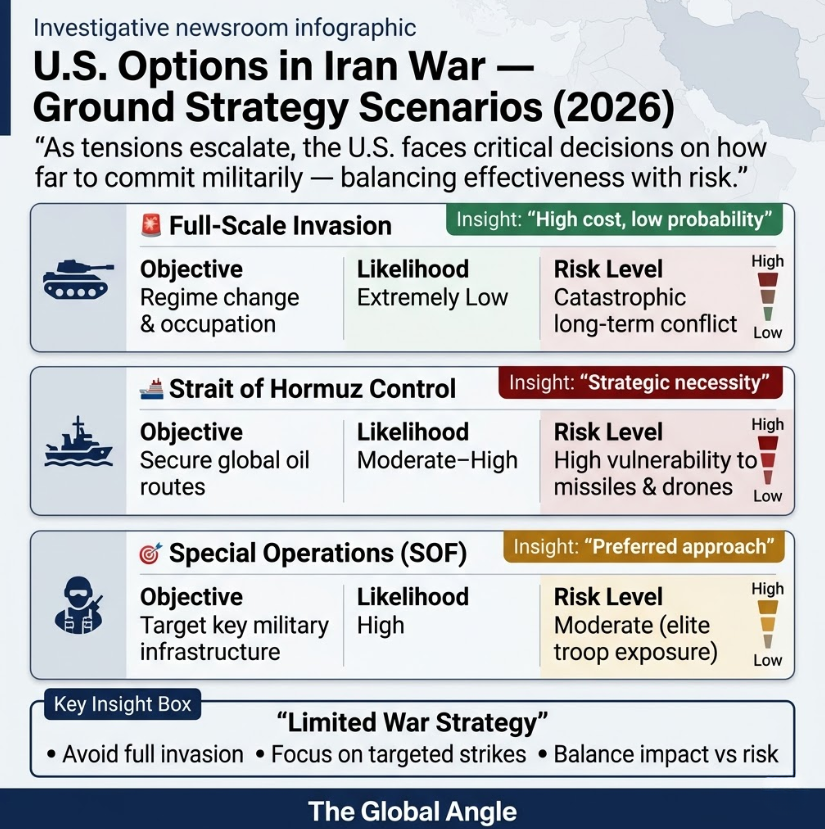
Potential U.S. Ground Troup Deployment Scenarios In Iran War
| Deployment Type | Strategic Objective | Likelihood (March 2026) | Military Risk Level |
| Full-Scale Invasion | Regime change and total occupation of Tehran. | Extremely Low: Requires massive troop mobilization; politically unviable. | Catastrophic: Risks a multi-decade insurgency worse than Iraq or Afghanistan. |
| Strait of Hormuz Securitization | Deploying Marines to seize key coastal batteries or islands (e.g., Qeshm, Abu Musa) to force the Strait open. | Moderate-High: Driven by the urgent need to stabilize global crude oil prices. | High: Troops would be highly vulnerable to Iranian anti-ship missiles and drone swarms. |
| Special Operations (SOF) | Covert raids on hardened IRGC drone manufacturing hubs and underground missile silos. | High: Necessary to degrade Iran’s asymmetric strike capabilities without massive footprint. | Moderate: High risk of elite troop casualties or capture behind enemy lines. |
What Will It Mean and the Global Effects
Any insertion of U.S. ground forces—even limited Special Operations—fundamentally alters the global geopolitical calculus. It signals to international markets that the conflict is transitioning from a contained “tit-for-tat” exchange into a protracted regional war.
The immediate casualty will be the global economy and the European security architecture.
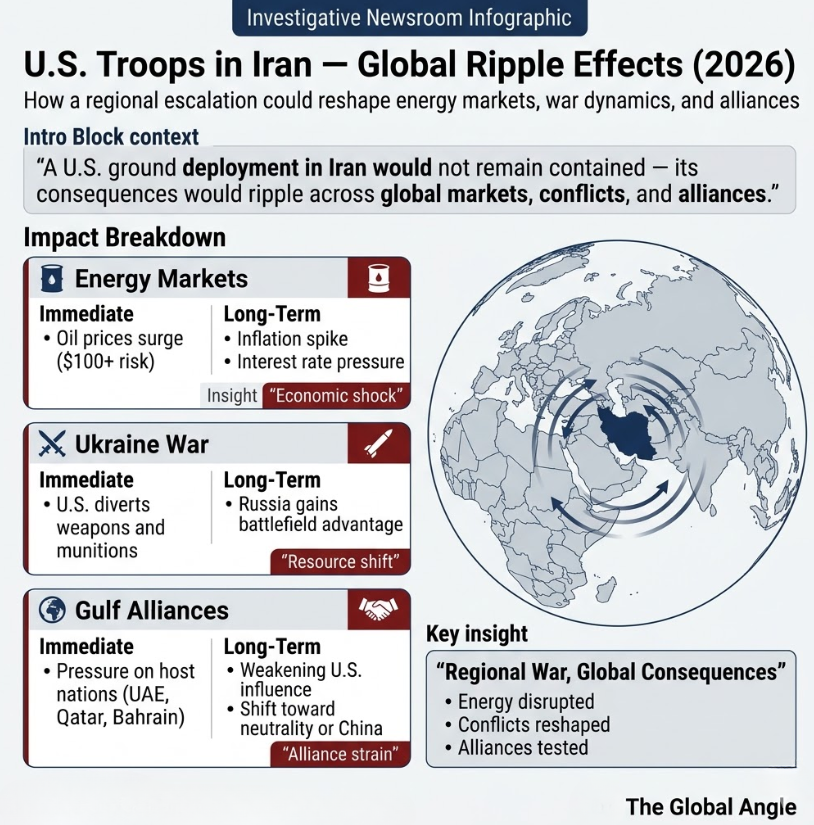
The Global Ripple Effects of U.S. Troop Deployment In Iran
| Global Sector | Immediate Impact | Long-Term Strategic Consequence |
| Energy Markets | Brent crude prices will likely surge past $100/bbl due to fears of total Persian Gulf closure. | Sparks intense cost-push inflation in the West, forcing central banks to hike interest rates. |
| The Ukraine Theater | The U.S. must hoard 155mm artillery and interceptors for its own ground forces. | Ukraine suffers severe munitions rationing, handing Russia a definitive battlefield advantage in the Donetsk offensives. |
| Gulf State Allies | Nations hosting U.S. troops (UAE, Qatar, Bahrain) face intense pressure to evict American forces. | Fractures the U.S. security umbrella in the Middle East as regional powers hedge toward neutrality or Chinese mediation. |
How Will Iran React?
The Islamic Revolutionary Guard Corps (IRGC) has spent four decades preparing for a U.S. ground incursion. Iran’s defense doctrine relies on Anti-Access/Area Denial (A2/AD)—making the cost of entering their territory so devastatingly high that the adversary retreats.
If U.S. boots touch Iranian sovereign territory or contested Gulf islands, Tehran will immediately trigger its decentralized “Ring of Fire” strategy.
- Mining the Strait: Iran’s navy will likely deploy thousands of smart naval mines into the Strait of Hormuz, completely severing the transit of 20% of the world’s daily oil supply.
- Activating Proxies: Hezbollah in Lebanon and various militias in Iraq and Syria will be fully unleashed to overwhelm Israeli and U.S. air defenses simultaneously.
- Ballistic Barrages: The IRGC will shift from targeting empty bases to launching saturation strikes on U.S. troop concentrations and regional desalination plants, aiming to inflict maximum human and economic casualties.
Are U.S. Citizens Happy With This?
Domestically, the prospect of deploying ground troops to the Middle East is politically toxic. The U.S. is entering a highly contentious 2026 mid-term election cycle. President Donald Trump campaigned heavily on an “America First” platform that explicitly promised to avoid foreign entanglements and end “endless wars.”
Public opinion polling across all major demographics shows severe war fatigue. Following the two-decade war in Afghanistan, American voters exhibit little appetite for nation-building or ground combat in the Middle East. Furthermore, average citizens are feeling the direct impact of the conflict at the gas pump and grocery store. A troop deployment that causes global oil markets to panic will immediately translate into crippling domestic inflation, creating a massive electoral liability for the ruling administration.
Conclusion
The U.S. military possesses the capability to project ground forces into the Persian Gulf, but the strategic math is highly unfavorable. Deploying troops to secure the Strait of Hormuz or conduct raids against the IRGC risks pulling Washington into a multi-year quagmire, alienating an inflation-weary domestic electorate, and compromising the defense of Eastern Europe. Unless a critical red line is crossed, Washington will likely continue attempting to exhaust Iran from the air, avoiding the catastrophic risks of terrestrial combat.
Frequently Asked Questions (Is U.S. Deploying Troops in Iran)
Is the U.S. planning a full-scale invasion of Iran?
No. Military experts and defense planners widely agree that a full-scale ground invasion to capture Tehran is logistically unfeasible and politically impossible. Any potential troop deployments would likely be limited to Special Operations or Marines securing vital maritime choke points.
How would U.S. troops in Iran affect the global economy?
An escalation to ground combat would terrify global energy markets. Iran would likely attempt to completely close the Strait of Hormuz, causing oil prices to spike dramatically, which would drive up inflation and the cost of goods worldwide.
Do American citizens support a ground war in Iran?
Overall, the American public heavily opposes deploying ground troops to the Middle East. Exhausted by previous conflicts in Iraq and Afghanistan, and currently struggling with inflation, voters across the political spectrum largely prefer diplomatic or strictly aerial solutions to the crisis.
ALSO READ: Is the U.S. Losing the Iran War? What are Iran’s Demands For Peace Talks
ALSO READ: Iran War Impact On Russia Ukraine War: Battlefield Updates, Middle East Impact, and Peace Talks
Russia China trade relations 2026: Sanctions Evasion, Dual-Use Tech, and the Putin-Xi Summit
Russia China trade relations 2026: Sanctions Evasion, Dual-Use Tech, and the Putin-Xi Summit Executive Briefing…

What is Hantavirus Outbreak 2026: Symptoms, Vaccine Status, and the Climate Vector
What is Hantavirus Outbreak 2026: Symptoms, Vaccine Status, and the Climate Vector The Immediate Trigger:…

Starlink & SpaceX IPO 2026: Everything You Need to Know
Starlink & SpaceX IPO 2026: Everything You Need to Know The Valuation: According to Institutional…
What is OPEC? How the Oil Cartel Functions and Why It’s Fracturing in 2026
What is OPEC? How the Oil Cartel Functions and Why It’s Fracturing in 2026 The…
Why the UAE Quit OPEC and the Birth of the Petro-Rupee
Why the UAE Quit OPEC and the Birth of the Petro-Rupee The Rupture: The United…

Microsoft OpenAI Partnership Ends: Why Microsoft is Dropping OpenAI’s Exclusive License
Microsoft OpenAI Partnership Ends: Why Microsoft is Dropping OpenAI’s Exclusive License The Announcement: On April…

Ibrahim is the Founder and Lead Analyst at The Global Angle, an independent digital platform dedicated to factual geopolitical analysis and international affairs. Based in India, he combines an engineering background with a deep focus on global markets, diplomacy, and strategic security. Ibrahim leverages a data-driven, analytical approach to break down complex international conflicts and economic shifts, helping readers see beyond standard news narratives. When he isn’t researching global policy, he focuses on digital publishing, search engine optimization, and platform architecture.