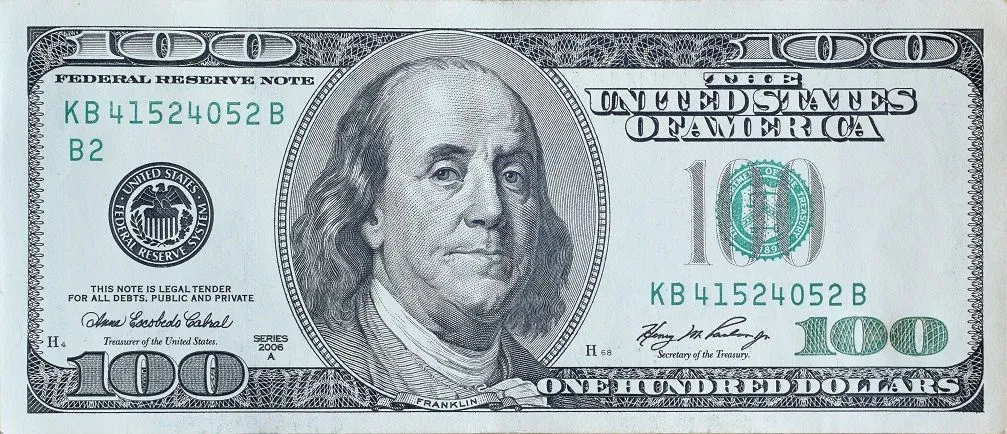
On Thursday, March 26, 2026, the U.S. Department of the Treasury announced that President Donald Trump’s signature on U.S. Currency will appear from June starting with 100 Dollar notes. The move breaks 165 years of precedent, marking the first time in history a sitting president’s signature will feature on official American paper currency.

To accommodate the President’s signature, the Treasury will permanently remove the signature of the U.S. Treasurer. That specific tradition dates back to 1861.
The Rollout and Treasury Justification
The redesign begins at the top of the currency hierarchy. The first bills to feature the new signatures will be $100 notes, with printing scheduled to commence in June 2026. Production of other denominations will follow in the subsequent months.
The Treasury Department framed the decision around the upcoming Semiquincentennial, the 250th anniversary of the United States. Treasury Secretary Scott Bessent, whose signature will appear alongside the President’s, stated the move recognizes the current administration’s economic leadership and historic achievements.
The Economics of a Political Signature
A signature on a banknote is a legal “promise to pay.” In modern financial systems, that promise is issued by the central banking institution, not the head of state.
Shifting the signature from a Treasury official to a sitting president alters the visual messaging of U.S. monetary policy. Global markets look for technocrats and economists on currency as a signal of independent financial management. The core economic principle at play is the separation between the “Power of the Purse” (government spending) and the “Power of the Press” (printing money).
When political leaders act as the guarantors of currency, market risks increase. The historical concern is that presidents with direct influence over the money supply face the temptation to print more money to fund domestic projects or stimulate the economy just before an election. This loss of separation frequently triggers hyperinflation.
Logistical and Political Liabilities
The redesign introduces immediate logistical hurdles. Mandating a presidential signature means the government must redesign currency and manufacture new printing plates every four to eight years.
There is also a strict political risk attached to the ink. A president’s signature acts as a permanent, physical endorsement of the economy at the time of printing. If the economy crashes, the president’s name remains physically tied to depreciating paper, turning the currency into a political liability.
Global Precedents in Fiat Currency
Very few modern economies feature a head of state on their banknotes. Argentina and the Philippines are the primary exceptions where a presidential signature appears on the national currency.
By removing the Treasurer, the United States departs from the standard international model of relying strictly on central banking authorities or designated treasury cashiers.
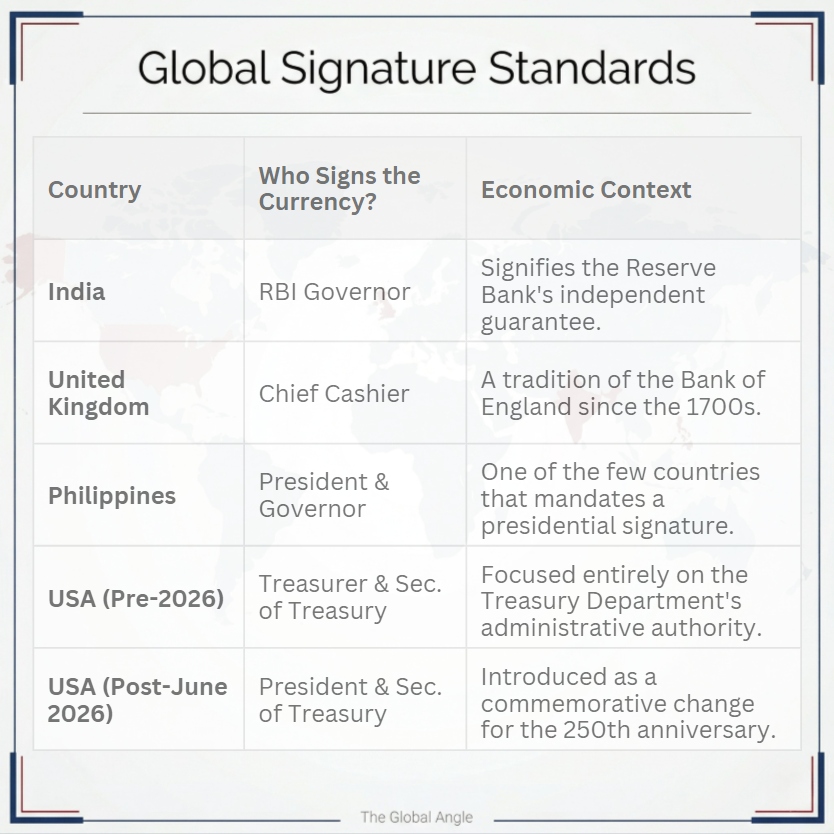
Global Signature Standards
| Country | Who Signs the Currency? | Economic Context |
| India | RBI Governor | Signifies the Reserve Bank’s independent guarantee. |
| United Kingdom | Chief Cashier | A tradition of the Bank of England since the 1700s. |
| Philippines | President & Governor | One of the few countries that mandates a presidential signature. |
| USA (Pre-2026) | Treasurer & Sec. of Treasury | Focused entirely on the Treasury Department’s administrative authority. |
| USA (Post-June 2026) | President & Sec. of Treasury | Introduced as a commemorative change for the 250th anniversary. |
Frequently Asked Questions (Donald Trump’s Signature on U.S. Currency)
When will Donald Trump’s signature appear on U.S. currency?
The initial rollout begins with the redesigned $100 note. Printing is scheduled to commence in June 2026. Production for the remaining denominations will follow in the subsequent months.
Why is the U.S. Treasury changing the signatures on banknotes?
The Treasury Department stated the redesign honors the Semiquincentennial, the 250th anniversary of the United States. Treasury Secretary Scott Bessent initiated the change to recognize the administration’s economic record.
Whose signature is being removed to make room?
The signature of the U.S. Treasurer will be permanently removed from all future paper currency. This ends an uninterrupted 165-year tradition established in 1861.
What are the economic risks of a president signing the national currency?
A political signature removes the visual separation between government spending and currency printing. When markets perceive that a political leader has direct influence over the money supply, the risk of hyperinflation increases. It also introduces logistical inefficiencies, requiring the government to manufacture new printing plates every four to eight years.
Do other countries have their president sign their money?
Very few modern economies mandate a head of state’s signature on fiat currency. Argentina and the Philippines are the primary exceptions. Most nations, including India and the United Kingdom, rely on central banking authorities to signal independent, technocratic financial management.
ALOS READ: EU Australia Free Trade Agreement: Tariffs, Critical Minerals, and Global Impact
ALOS READ: Can China Takeover Taiwan in 2026? Why Does China Wants Taiwan
Russia China trade relations 2026: Sanctions Evasion, Dual-Use Tech, and the Putin-Xi Summit
Russia China trade relations 2026: Sanctions Evasion, Dual-Use Tech, and the Putin-Xi Summit Executive Briefing…

What is Hantavirus Outbreak 2026: Symptoms, Vaccine Status, and the Climate Vector
What is Hantavirus Outbreak 2026: Symptoms, Vaccine Status, and the Climate Vector The Immediate Trigger:…
Starlink & SpaceX IPO 2026: Everything You Need to Know
Starlink & SpaceX IPO 2026: Everything You Need to Know The Valuation: According to Institutional…
What is OPEC? How the Oil Cartel Functions and Why It’s Fracturing in 2026
What is OPEC? How the Oil Cartel Functions and Why It’s Fracturing in 2026 The…

Why the UAE Quit OPEC and the Birth of the Petro-Rupee
Why the UAE Quit OPEC and the Birth of the Petro-Rupee The Rupture: The United…

Microsoft OpenAI Partnership Ends: Why Microsoft is Dropping OpenAI’s Exclusive License
Microsoft OpenAI Partnership Ends: Why Microsoft is Dropping OpenAI’s Exclusive License The Announcement: On April…

Ibrahim is the Founder and Lead Analyst at The Global Angle, an independent digital platform dedicated to factual geopolitical analysis and international affairs. Based in India, he combines an engineering background with a deep focus on global markets, diplomacy, and strategic security. Ibrahim leverages a data-driven, analytical approach to break down complex international conflicts and economic shifts, helping readers see beyond standard news narratives. When he isn’t researching global policy, he focuses on digital publishing, search engine optimization, and platform architecture.