What is Hantavirus Outbreak 2026: Symptoms, Vaccine Status, and the Climate Vector
- The Immediate Trigger: A highly unusual outbreak of the Andes strain of Hantavirus aboard the MV Hondius cruise ship in May 2026 has resulted in multiple fatalities, triggering global contact tracing.
- The Medical Reality: There is currently no licensed vaccine or targeted antiviral cure for Hantavirus. The disease mechanism relies on immune dysregulation rather than direct cell destruction, complicating therapeutic development.
- The Macro Driver: Epidemiologists are explicitly linking the 2026 surge to climate volatility. Erratic rainfall and deforestation are driving reservoir rodents out of traditional habitats and into direct contact with human populations.

The global health apparatus is currently monitoring a localized but highly concerning outbreak of Hantavirus. Unlike standard zoonotic spillovers that remain confined to rural agricultural zones, the May 2026 cluster occurred aboard a luxury cruise ship traversing the Atlantic.
This outbreak has exposed significant blind spots in global pharmaceutical pipelines and international quarantine protocols. To understand the geopolitical and public health risks, we must look past the immediate headlines. Here is the comprehensive briefing on the pathology of Hantavirus, the current state of vaccine development, and the underlying macroeconomic drivers forcing this pathogen into new frontiers.
What is Hantavirus? (Pathology and Symptoms)
Hantavirus is not a novel pathogen like SARS-CoV-2. It is a family of rodent-borne RNA viruses that have coevolved with specific rodent species (such as the deer mouse or the long-tailed pygmy rice rat). The reservoir hosts remain asymptomatic, allowing the virus to persist silently in natural ecosystems.
Human infection primarily occurs through the inhalation of aerosolized viral particles from dried rodent urine, feces, or saliva—for example, when sweeping out a dusty, infested cabin.
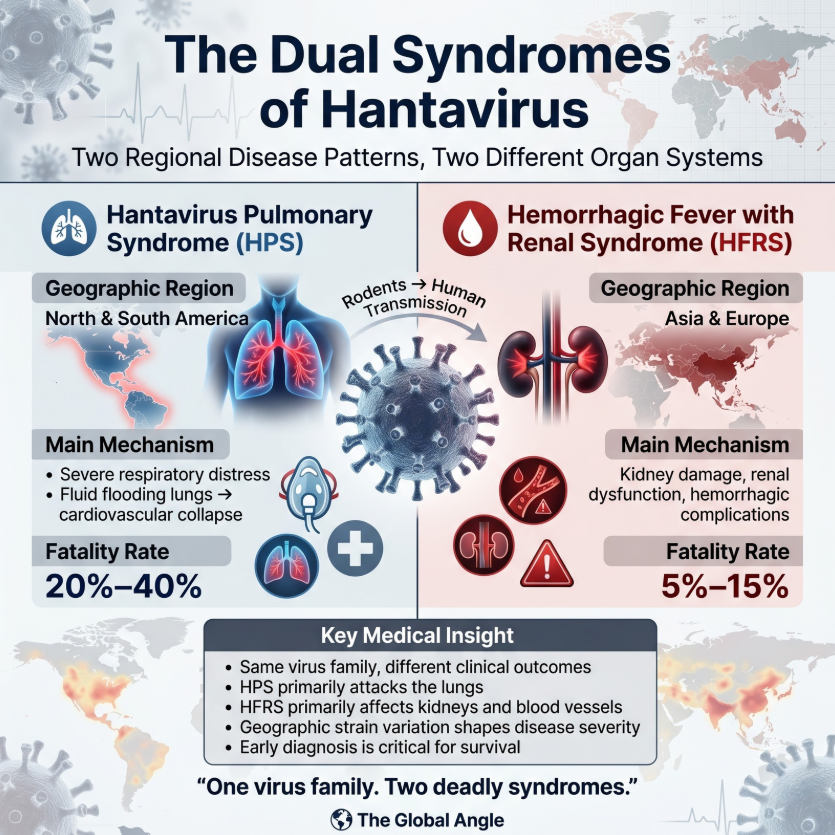
Following an incubation period that can last anywhere from one to eight weeks, patients initially experience non-specific flu-like symptoms: fever, profound fatigue, and severe muscle aches. As the disease progresses, it diverges into two primary, highly lethal syndromes depending on the specific viral strain.
The Dual Syndromes of Hantavirus
| Clinical Syndrome | Primary Geographic Region | Pathological Mechanism | Case Fatality Rate |
| Hantavirus Pulmonary Syndrome (HPS) | The Americas (North and South America) | Severe respiratory distress; fluid floods the lungs leading to cardiovascular collapse. | 20% to 40% |
| Hemorrhagic Fever with Renal Syndrome (HFRS) | Asia and Europe | Acute kidney damage, renal dysfunction, and systemic hemorrhagic complications. | 5% to 15% |
The “Trojan Horse” Immune Response
The defining lethality of Hantavirus is that the virus itself does not destroy human tissue. Instead, it triggers host-mediated dysregulation. The virus prompts the human immune system to overreact, increasing vascular permeability. Essentially, the immune response causes the patient’s own blood vessels to leak plasma into surrounding tissues (lungs or kidneys), leading to organ failure.
Why the 2026 Outbreak is Uniquely Relevant
The outbreak aboard the Dutch-flagged MV Hondius in May 2026 is commanding international attention due to a specific epidemiological anomaly: Human-to-Human Transmission.
The vast majority of Hantavirus strains cannot spread between people. However, the passengers on the MV Hondius were infected with the Andes virus, a specific strain endemic to South America (particularly Argentina and Chile). The Andes strain is the only Hantavirus known to be capable of human-to-human transmission, usually requiring close, sustained contact in poorly ventilated spaces.
Because the incubation period can last up to eight weeks, infected passengers boarded the ship in Argentina feeling perfectly healthy, only to develop symptoms and potentially expose others while isolated at sea. This fundamentally challenges traditional port-of-entry screening methods, as thermal cameras cannot detect a virus with a two-month silent incubation phase.
The Cure and Vaccination Deficit
Currently, there is no cure and no licensed targeted antiviral therapy for Hantavirus. Clinical response is strictly limited to supportive care: mechanical ventilation, dialysis, and aggressive hydration to manage organ failure while the patient’s immune system fights the infection for the cure.
The Vaccine Pipeline
Vaccine development remains severely stalled. While researchers have successfully developed hamster models that replicate human HPS, moving from preclinical trials to deployment faces massive hurdles.
Phase I clinical trials have evaluated a DNA vaccine for the Andes virus. While it successfully induced neutralizing antibodies, the regimen requires at least three doses, making rapid deployment during a localized outbreak highly impractical. Furthermore, because cases are historically rare and geographically scattered, conducting a conventional Phase III efficacy trial involving tens of thousands of participants is mathematically nearly impossible.
The Climate and “Dark Proteome” Vectors

Standard health reporting treats Hantavirus strictly as a medical anomaly. A deeper analysis reveals it is a symptom of macroeconomic and environmental shifts.
The Climate-Driven Rodent Migration
The 2026 surge in Argentina (which preceded the cruise ship outbreak) is directly linked to extreme climate volatility. Prolonged droughts followed by unexpectedly intense rainfall create explosive vegetation growth. This abundance of food triggers massive rodent breeding cycles.
Simultaneously, aggressive deforestation and agricultural expansion are destroying deep-forest habitats. This forces generalist rodent species out of the wild and into human settlements, warehouses, and urban peripheries. Scientists now view ecosystem restoration not just as environmentalism, but as a critical, quantifiable public health intervention. Restoring biodiversity directly dilutes the population of disease-carrying reservoir rodents.
The “Dark Proteome” Pharmaceutical Gap
The lack of a Hantavirus cure highlights a structural market failure in drug discovery for emerging, neglected pathogens. Because Hantavirus does not present a consistent, million-patient market, pharmaceutical capital flows elsewhere.
However, late 2026 biomedical research into the “dark proteome”—the previously overlooked, unmapped regions of human DNA—is revealing microproteins called peptideins. These newly discovered molecules are presenting early, promising preclinical pathways for novel antiviral therapies that could finally target the specific immune dysregulation caused by Hantaviruses, bypassing traditional, stalled drug pipelines.
Sources:
World Health Organization (WHO) – Disease Outbreak News (DON) (Official epidemiological updates on the multi-country Hantavirus cluster linked to the MV Hondius, confirming the Andes strain and human-to-human transmission dynamics)
Centers for Disease Control and Prevention (CDC) – Health Alert Network (HAN) (Clinical guidance and public health alerts regarding the May 2026 Andes virus outbreak, detailing the strict 42-day incubation monitoring protocols)
European Centre for Disease Prevention and Control (ECDC) – Threat Assessment (Comprehensive risk assessment of the Hantavirus-associated cruise ship cluster, detailing the clinical manifestation of HPS versus HFRS)
National Institutes of Health (NIH) / PubMed – Climate Drivers of Zoonotic Spillover (Peer-reviewed biomedical research connecting extreme weather volatility, prolonged droughts, and deforestation to explosive rodent population growth and subsequent viral surges)
Frequently Asked Questions
Is Hantavirus the next COVID-19?
No. While the Andes strain can transmit human-to-human, it is highly inefficient compared to respiratory viruses like SARS-CoV-2. It requires close, sustained contact. The broader global risk remains low, and the virus is not highly contagious in casual, open-air settings.
How do you test for Hantavirus?
Diagnosis is difficult in the early stages because symptoms mimic the flu. If a patient has a history of potential rodent exposure, doctors use serological blood tests (ELISA) to detect specific IgM and IgG antibodies, or RT-PCR tests to detect the viral RNA in the blood.
What is the best way to prevent Hantavirus infection?
Prevention relies entirely on environmental control. Seal holes in homes, use snap traps, and never sweep or vacuum rodent droppings dry. Droppings should be soaked thoroughly with a bleach solution (1 part bleach to 9 parts water) for 5 minutes before being carefully wiped up while wearing a mask and gloves.
ALSO READ: Starlink & SpaceX IPO 2026: Everything You Need to Know
ALSO READ: What is OPEC? How the Oil Cartel Functions and Why It’s Fracturing in 2026

Russia China trade relations 2026: Sanctions Evasion, Dual-Use Tech, and the Putin-Xi Summit
Russia China trade relations 2026: Sanctions Evasion, Dual-Use Tech, and the Putin-Xi Summit Executive Briefing…
What is Hantavirus Outbreak 2026: Symptoms, Vaccine Status, and the Climate Vector
What is Hantavirus Outbreak 2026: Symptoms, Vaccine Status, and the Climate Vector The Immediate Trigger:…

Starlink & SpaceX IPO 2026: Everything You Need to Know
Starlink & SpaceX IPO 2026: Everything You Need to Know The Valuation: According to Institutional…

What is OPEC? How the Oil Cartel Functions and Why It’s Fracturing in 2026
What is OPEC? How the Oil Cartel Functions and Why It’s Fracturing in 2026 The…

Why the UAE Quit OPEC and the Birth of the Petro-Rupee
Why the UAE Quit OPEC and the Birth of the Petro-Rupee The Rupture: The United…

Microsoft OpenAI Partnership Ends: Why Microsoft is Dropping OpenAI’s Exclusive License
Microsoft OpenAI Partnership Ends: Why Microsoft is Dropping OpenAI’s Exclusive License The Announcement: On April…

Ibrahim is the Founder and Lead Analyst at The Global Angle, an independent digital platform dedicated to factual geopolitical analysis and international affairs. Based in India, he combines an engineering background with a deep focus on global markets, diplomacy, and strategic security. Ibrahim leverages a data-driven, analytical approach to break down complex international conflicts and economic shifts, helping readers see beyond standard news narratives. When he isn’t researching global policy, he focuses on digital publishing, search engine optimization, and platform architecture.