$1.2 Trillion China Trade Surplus 2026 Breakdown
- China’s trade surplus hit a record $1.19 trillion in 2025, driven by a strategic pivot to the Global South.
- ASEAN has solidified its spot as China’s largest trading partner, surpassing the EU and USA.
- The “New Three” sectors (EVs, Batteries, Solar) saw a combined export growth of 27.1%, offsetting declines in traditional manufacturing.
- Despite tariffs, the trade surplus with the United States remains massive at over $340 billion, though direct shipments have fallen.
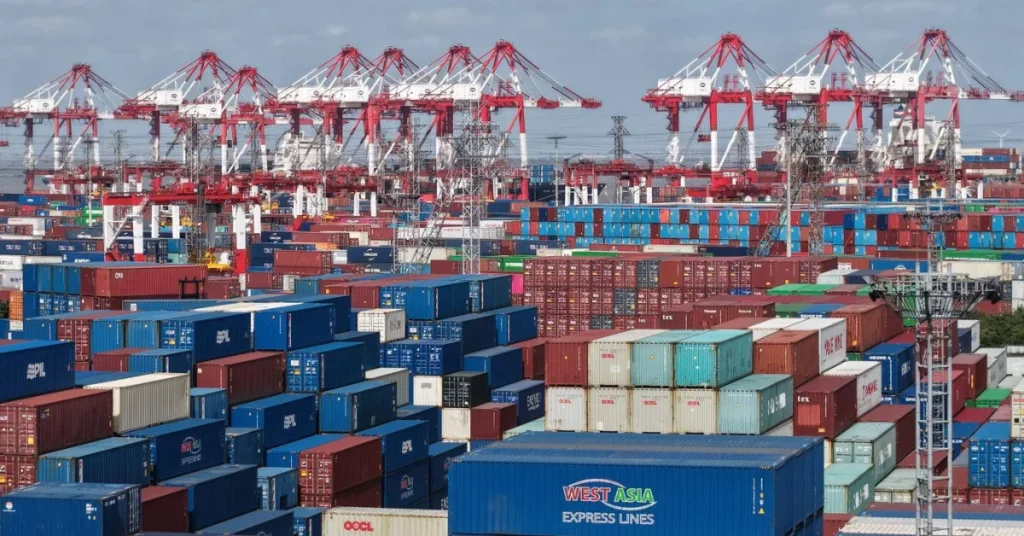
The release of the official China Trade Surplus 2026 breakdown reveals a historic decoupling and recoupling of the global economy. Closing the year with a surplus of nearly $1.2 trillion, Beijing has effectively managed to keep its export engine roaring by substituting Western demand with surging orders from Southeast Asia, Africa, and Russia.
The most important shift is geographical. China is no longer dependent on Western markets. Instead, it has redirected exports toward Southeast Asia, Africa, and Latin America effectively reshaping global trade flows.
Below is a detailed data breakdown of who is buying, what they are buying, and where the money is flowing.
1. Country-Wise Trade Balance: The Winners and Losers
The geography of China’s surplus has shifted. While the surplus with the U.S. remains the largest in absolute terms, the growth is now coming from the developing world.
Top Trade Surplus Partners (2025-26 Data)
| Rank | Trading Partner | Exports (Approx. $B) | Imports (Approx. $B) | Trade Balance (Surplus) | Trend vs. 2024 |
| 1 | United States | $524.7 | $163.6 | **+$361.1 Billion** | 🔻 Decline (Direct) |
| 2 | European Union | $516.5 | $269.3 | **+$247.2 Billion** | 🟢 Stable |
| 3 | ASEAN (Bloc) | $586.5 | $395.8 | **+$190.7 Billion** | 🚀 Rapid Growth |
| 4 | India | $117.7 | $20.5 | **+$97.2 Billion** | 📈 Increasing |
| 5 | Vietnam* | $161.9 | $98.8 | **+$63.1 Billion** | 🚀 Surge (Re-export Hub) |
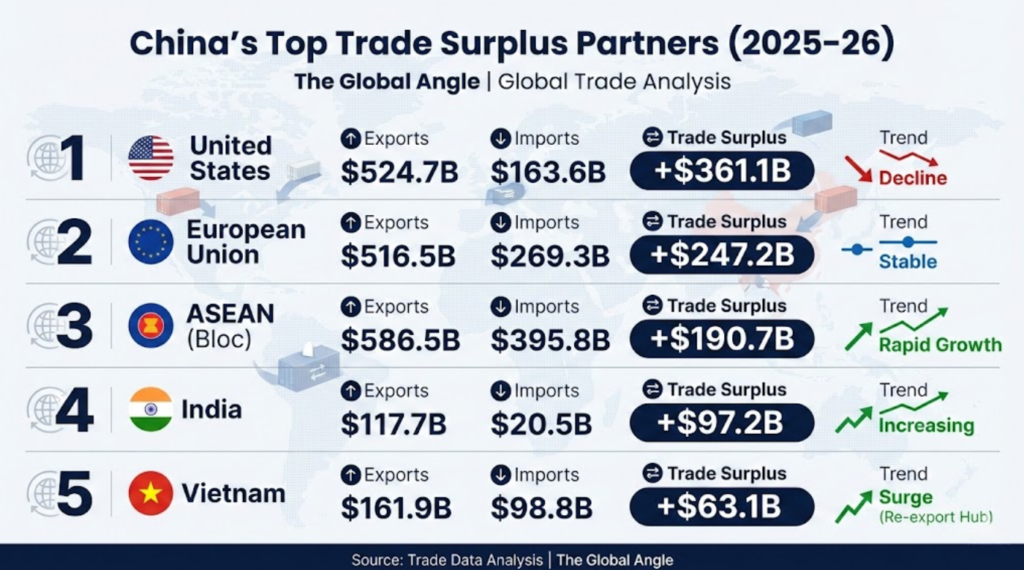
> Note: Vietnam’s surplus is partially attributed to the “Great Reallocation,” where Chinese components are assembled in Vietnam to bypass Western tariffs.
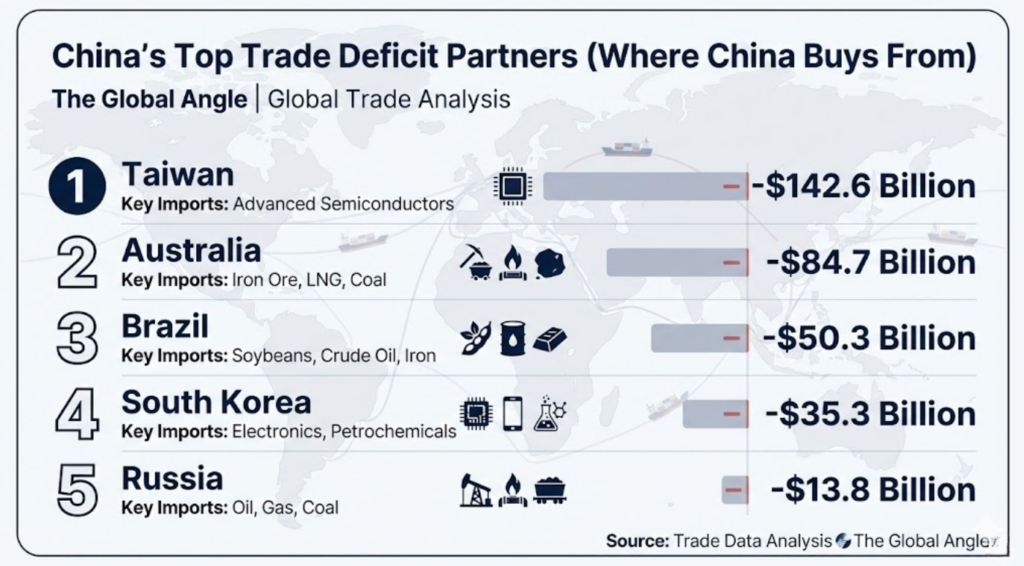
Top Trade Deficit Partners (Where China Buys From)
China runs deficits primarily with countries that supply raw materials (energy, ore) and high-end technology (chips).
| Rank | Trading Partner | Key Imports | Trade Balance (Deficit) |
| 1 | Taiwan | Advanced Semiconductors | -$142.6 Billion |
| 2 | Australia | Iron Ore, LNG, Coal | -$84.7 Billion |
| 3 | Brazil | Soybeans, Crude Oil, Iron | -$50.3 Billion |
| 4 | South Korea | Electronics, Petrochemicals | -$35.3 Billion |
| 5 | Russia | Oil, Gas, Coal | -$13.8 Billion |
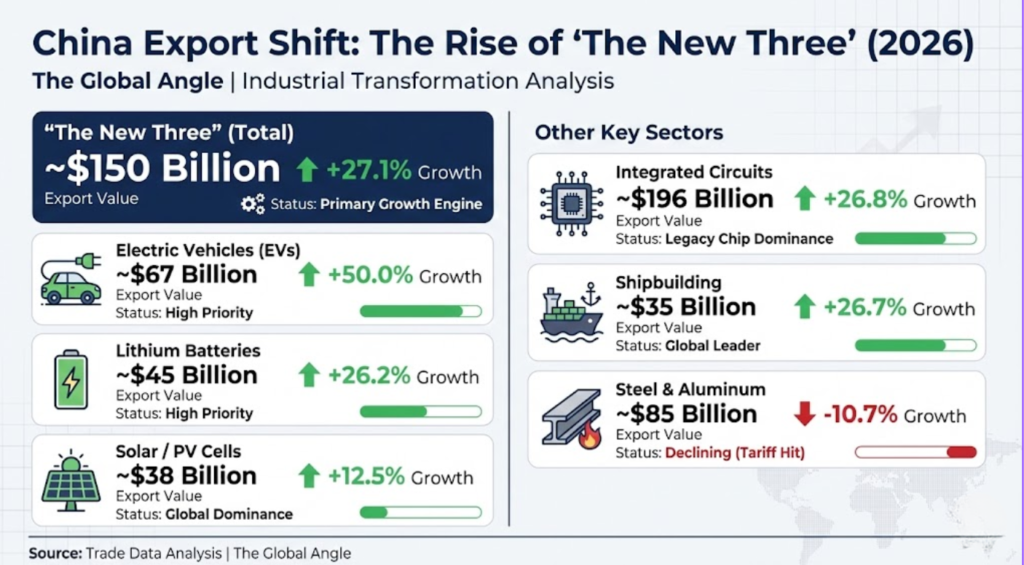
2. Sector Wise China Trade Surplus 2026 Breakdown: The Rise of “The New Three”
The most significant story of 2026 is the industrial upgrade. Low-cost manufacturing (clothing, furniture) is shrinking as a share of total value, replaced by high-tech green energy goods.
Export Growth by Sector (YoY %)
| Industry / Sector | 2025 Export Value | YoY Growth | Strategic Status |
| “New Three” (Total) | **~$150 Billion** | +27.1% | Primary Growth Engine |
| — Electric Vehicles (EVs) | ~$67 Billion | +50.0% | High Priority |
| — Lithium Batteries | ~$45 Billion | +26.2% | High Priority |
| — Solar/PV Cells | ~$38 Billion | +12.5% | Global Dominance |
| Integrated Circuits | ~$196 Billion | +26.8% | Legacy Chip Dominance |
| Shipbuilding | ~$35 Billion | +26.7% | Global Leader |
| Steel & Aluminum | ~$85 Billion | -10.7% | Declining (Tariff Hit) |
3. The Digital Surplus: A Hidden Boom
Often overlooked in goods trade is the booming Digital Services sector.
- Digital Trade Surplus: reached $33 Billion (Doubled from previous year).
- Key Drivers: Cloud computing services, AI software exports, and telecom operations.
- Significance: This helps offset China’s traditional deficit in services (usually caused by tourism).
4. Regional Pivot: The “Global South” Strategy
With the U.S. imposing tariffs of up to 60% on certain goods, China has successfully pivoted.
- Exports to Africa: Surged by 18.4%, driven by heavy machinery and infrastructure projects.
- Exports to Latin America: Grew by 6.5%, deepening ties in industrial equipment and 5G infrastructure.
- The Russia Factor: Bilateral trade with Russia reached a record $244.8 Billion, with China supplying cars and consumer electronics in exchange for discounted energy.
Why China’s surplus is Expanding
China’s trade surplus is not just about exports rising—it is also driven by weak import growth and global demand for manufacturing inputs. As Western economies slow and reduce imports, China has shifted toward emerging markets, maintaining export momentum while keeping imports relatively stable.
Risks to China’s Surplus
A growing trade surplus increases the risk of retaliatory tariffs from major economies like the United States, European Union, and India. This could limit future export growth and accelerate supply chain diversification away from China.
Can the Surplus Last?
Recent data shows China’s exports surged strongly into 2026, with early-year trade surplus already exceeding $200 billion in just two months, highlighting continued export dominance despite global uncertainty.
Ultimately, China’s record trade surplus reflects a structural shift in the global economy. Rather than losing ground due to tariffs, China has adapted by upgrading its industrial base and redirecting exports toward emerging markets.
This suggests that global trade is not shrinking it is being reorganized, with China still at its center.
Sources
- Reuters – China exports surge in early 2026
- Trading Economics – China trade balance data
- McKinsey Global Institute – Global trade shifts and China’s role
- Banque de France – Analysis of China’s trade surplus
- World Bank – Global trade and economic indicators
Frequently Asked Questions
What is China’s total trade surplus for 2026?
Official data for the full calendar year 2025 (released in early 2026) confirms a record surplus of $1.19 Trillion.
Which country has the largest trade deficit with China?
The United States continues to have the largest bilateral trade deficit with China, estimated at over $360 billion, despite ongoing tariff wars.
What are “The New Three” in Chinese exports?
This term refers to Electric Vehicles (NEVs), Lithium-ion Batteries, and Solar products. These three sectors have replaced traditional cheap manufacturing as the main drivers of China’s export growth.
Why is China’s trade with Vietnam increasing so fast?
Vietnam has become a key “connector” economy. Chinese firms export components to Vietnam for final assembly to avoid direct “Made in China” tariffs when selling to Western markets.
ALSO READ: India’s Energy Security 2026: The $190 Billion Import Landscape
ALSO READ: Russian vs Venezuelan Crude Oil: Comparing Oil Quality and Prices for India
Russia China trade relations 2026: Sanctions Evasion, Dual-Use Tech, and the Putin-Xi Summit
Russia China trade relations 2026: Sanctions Evasion, Dual-Use Tech, and the Putin-Xi Summit Executive Briefing…

What is Hantavirus Outbreak 2026: Symptoms, Vaccine Status, and the Climate Vector
What is Hantavirus Outbreak 2026: Symptoms, Vaccine Status, and the Climate Vector The Immediate Trigger:…
Starlink & SpaceX IPO 2026: Everything You Need to Know
Starlink & SpaceX IPO 2026: Everything You Need to Know The Valuation: According to Institutional…
What is OPEC? How the Oil Cartel Functions and Why It’s Fracturing in 2026
What is OPEC? How the Oil Cartel Functions and Why It’s Fracturing in 2026 The…
Why the UAE Quit OPEC and the Birth of the Petro-Rupee
Why the UAE Quit OPEC and the Birth of the Petro-Rupee The Rupture: The United…

Microsoft OpenAI Partnership Ends: Why Microsoft is Dropping OpenAI’s Exclusive License
Microsoft OpenAI Partnership Ends: Why Microsoft is Dropping OpenAI’s Exclusive License The Announcement: On April…

Ibrahim is the Founder and Lead Analyst at The Global Angle, an independent digital platform dedicated to factual geopolitical analysis and international affairs. Based in India, he combines an engineering background with a deep focus on global markets, diplomacy, and strategic security. Ibrahim leverages a data-driven, analytical approach to break down complex international conflicts and economic shifts, helping readers see beyond standard news narratives. When he isn’t researching global policy, he focuses on digital publishing, search engine optimization, and platform architecture.