
Key Takeaways
- The Big Shift in US Trade 2026: Mexico remains America’s top trading partner, with the “friend-shoring” trend cementing North American supply chain dominance over China.
- The Deficit Reality: The U.S. continues to run a massive Goods Deficit (importing physical products) of over $1 Trillion, partially offset by a robust Services Surplus of ~$330 Billion.
- Rising Stars: Vietnam has surged to become a primary source of electronics and textiles, running the third-largest deficit with the U.S., right behind China and Mexico.

In the complex world of global economics, the US Trade Deficit remains the ultimate scorecard of consumption versus production. As we analyze the data from late 2025 and early 2026, a clear picture emerges: the United States is buying heavily from its neighbors and strategic allies, while its service economy continues to be a global export engine.
Recent data shows that both imports and exports are rising in 2026, with exports hitting record levels while imports continue to outpace them. This reflects strong domestic demand and increased investment in sectors like technology and infrastructure.
This report provides a data-driven look at who the US trades with, where the money is going, and which sectors are driving the numbers.
Trade Alliances: Who Does the US Trade With?
The geopolitical landscape has reshuffled the deck. The USMCA (United States-Mexico-Canada Agreement) bloc is now the dominant force. The most significant story of 2026 is the “decoupling” from China, whose share of U.S. imports has dropped significantly due to tariffs and diversification.
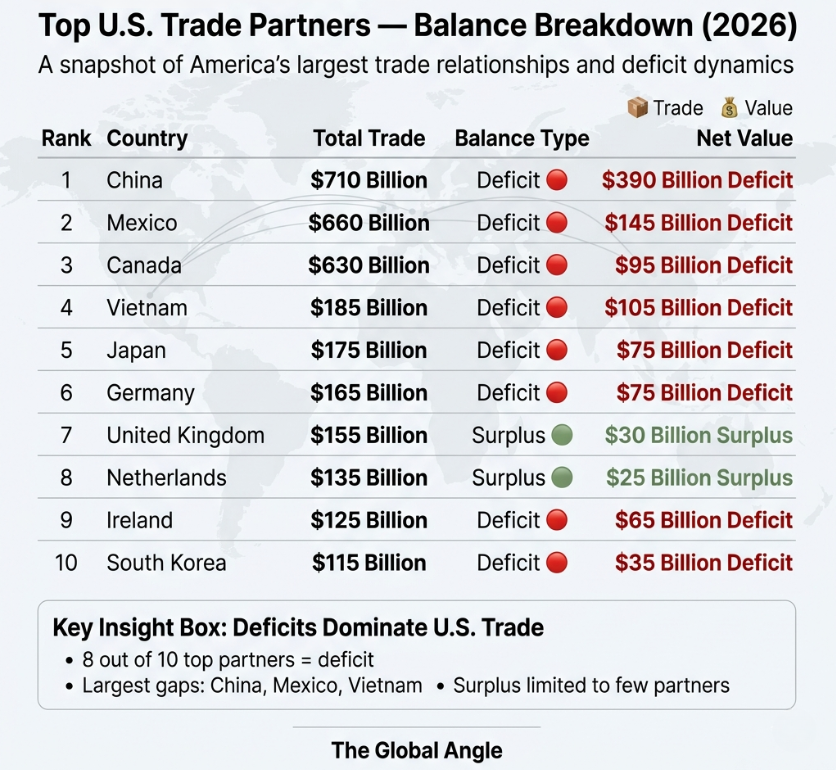
Top US Trade 2026 Partners & Balance (2025-2026 Estimates)
Data reflects annualized estimates based on Census Bureau & BEA reports through late 2025.
| Rank | Partner Country | Total Trade (Imports + Exports) | Trade Balance Status | Net Deficit/Surplus (Approx) |
| 1 | Mexico 🇲🇽 | $810 Billion | Deficit | -$197 Billion |
| 2 | Canada 🇨🇦 | $780 Billion | Deficit | -$60 Billion |
| 3 | China 🇨🇳 | $570 Billion | Deficit | -$260 Billion |
| 4 | Germany 🇩🇪 | $240 Billion | Deficit | -$85 Billion |
| 5 | Japan 🇯🇵 | $230 Billion | Deficit | -$70 Billion |
| 6 | Vietnam 🇻🇳 | $160 Billion | Deficit | -$140 Billion |
| 7 | United Kingdom 🇬🇧 | $150 Billion | Surplus | +$15 Billion |
| 8 | Netherlands 🇳🇱 | $120 Billion | Surplus | +$55 Billion |
| 9 | South Korea 🇰🇷 | $180 Billion | Deficit | -$50 Billion |
| 10 | India 🇮🇳 | $145 Billion | Deficit | -$45 Billion |
Analyst Note: The deficit with Vietnam is disproportionately high compared to its total trade volume. This confirms Vietnam’s role as the new “assembly hub” for electronics and apparel that used to come from China.
Sector Breakdown: Where is the Money Going?
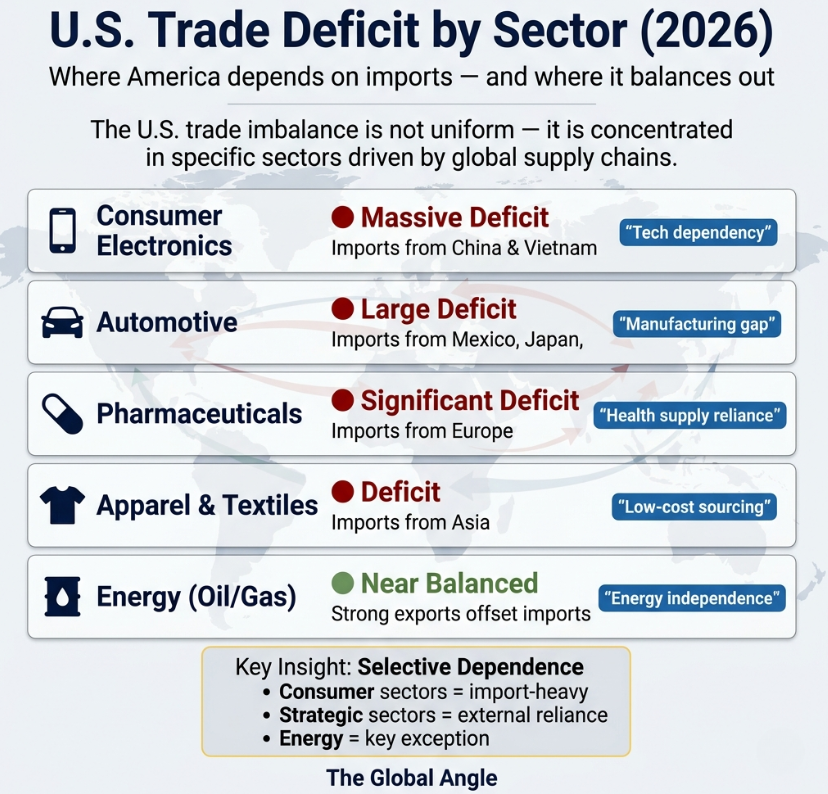
To understand the deficit, we must look at what is being traded. The US is a net importer of physical “stuff” but a net exporter of “expertise.”
The “Goods” Deficit (Physical Products)
The US runs a structural deficit here. Americans consume far more manufactured goods than the country produces domestically.
| Sector | Import/Export Status | Key Drivers |
| Consumer Electronics | Massive Deficit | Smartphones, Laptops (Imports from China/Vietnam). |
| Automotive | Large Deficit | Vehicles & Parts (Imports from Mexico, Japan, Germany). |
| Pharmaceuticals | Significant Deficit | Drugs & Medical compounds (Imports from Ireland, Switzerland). |
| Apparel & Textiles | Deficit | Clothing (Imports from Vietnam, Bangladesh, India). |
| Energy (Oil/Gas) | Near Balanced | The US now exports huge amounts of LNG/Crude, offsetting imports. |
The “Services” Surplus (The Hidden Strength)
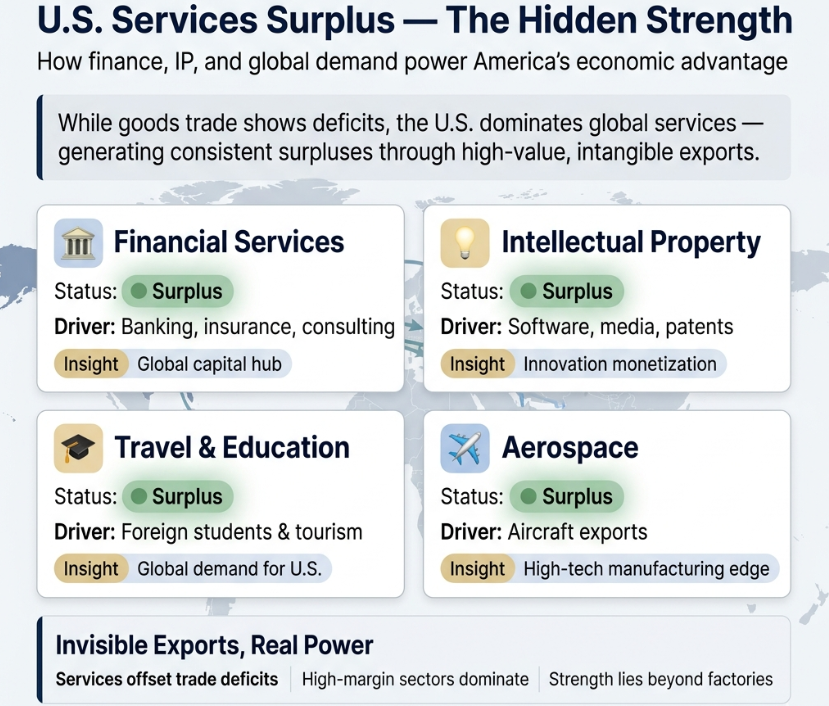
While the news focuses on factories, the US dominates in intangible sales. This surplus helps stabilize the dollar.
| Sector | Import/Export Status | Key Drivers |
| Financial Services | Surplus | Banking, Insurance, Consulting (Sold to UK, EU, Asia). |
| Intellectual Property | Surplus | Royalties for movies, software, and patents. |
| Travel & Education | Surplus | Foreign students paying tuition in US; Tourists visiting US. |
| Aerospace | Surplus | Civil Aircraft (Boeing) remains a top export sector. |
Top Surplus Nations: Who Buys More From the USA?
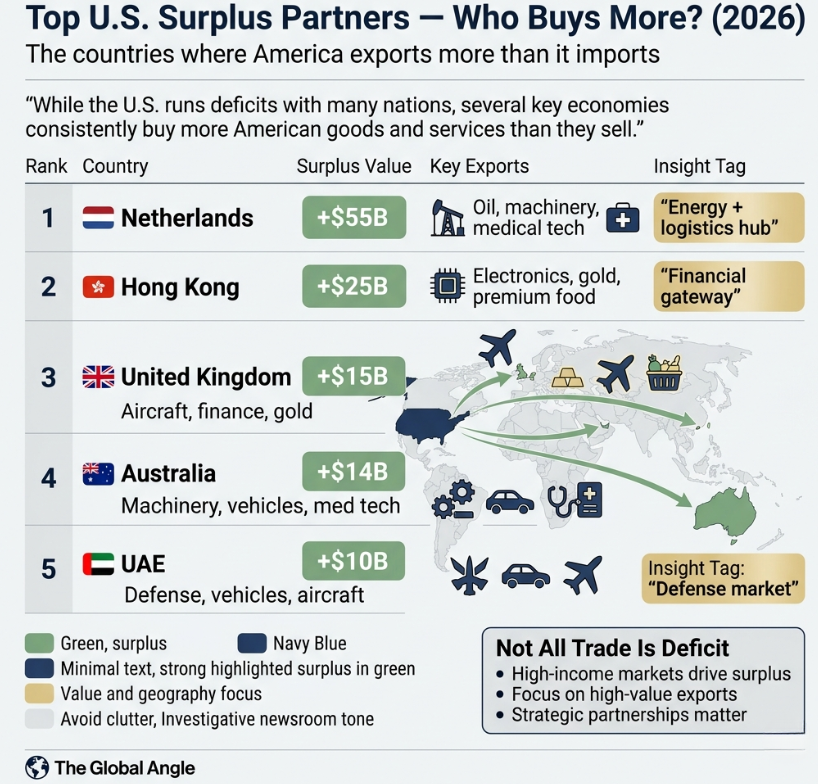
It is a myth that the US runs a deficit with everyone. Several wealthy, developed nations buy more American goods and services than they sell.
| Rank | Country | Surplus Amount (Approx) | Primary US Exports |
| 1 | Netherlands 🇳🇱 | +$55 Billion | Crude Oil, Machinery, Medical Instruments. |
| 2 | Hong Kong 🇭🇰 | +$25 Billion | Electronics, Gold, High-value Food. |
| 3 | United Kingdom 🇬🇧 | +$15 Billion | Gold, Aircraft, Financial Services. |
| 4 | Australia 🇦🇺 | +$14 Billion | Machinery, Vehicles, Medical Tech. |
| 5 | UAE 🇦🇪 | +$10 Billion | Defense Equipment, Cars, Aircraft. |
Why The U.S. Trade Deficit Persists
The U.S. economy is heavily driven by consumer demand. High consumption leads to strong imports, while exports grow more slowly.
As a result, even when exports reach record levels, the trade deficit remains a structural feature of the economy rather than a temporary imbalance.
The role of Tariffs
Recent tariff policies have reshaped trade flows but have not eliminated the trade deficit. Studies show that tariffs often increase costs for domestic consumers and reduce import volumes only partially.
Emerging Trends in 2026
The “Friend-Shoring” Effect
The data clearly shows a move away from geopolitical rivals.
- China’s Decline: High tariffs and tech restrictions have reduced the volume of direct trade. China is no longer the top trading partner, a title it held for over a decade.
- Mexico’s Manufacturing Boom: Proximity and the USMCA free trade deal have turned Mexico into the US’s primary factory floor, especially for automotive and appliances.
The Pharmaceutical Anomaly
One of the fastest-growing deficits is with Ireland and Switzerland. This isn’t about cars or toys; it’s about high-value pharmaceuticals. Many US pharma giants manufacture drugs in these countries for tax and logistical reasons, then import them back into the US.
Sources
U.S. Bureau of Economic Analysis – U.S. International Trade Report February 2026
Reuters – U.S. trade deficit widens as imports rise
Reuters – U.S. consumers bear tariff costs (ECB study)
Frequently Asked Questions (US Trade 2026)
Is a trade deficit bad for the US economy?
Not necessarily. A deficit often means the US economy is strong, with consumers wealthy enough to buy goods from around the world. However, a persistent deficit can lead to higher national debt over time.
Why is the deficit with Vietnam so high?
This is largely due to companies moving assembly lines from China to Vietnam to avoid US tariffs. The goods are still intended for the US market, but the “origin” label has changed.
Does the US export oil?
Yes. The US is now a major exporter of crude oil and LNG, particularly to Europe (Netherlands, UK) and Asia. This has drastically reduced the “energy deficit” that plagued the US economy in the 2000s.
ALSO READ: The $1.2 Trillion Shift: Complete China Trade Surplus 2026 Breakdown
ALSO READ: Russian vs Venezuelan Crude Oil: Comparing Oil Quality and Prices for India
Russia China trade relations 2026: Sanctions Evasion, Dual-Use Tech, and the Putin-Xi Summit
Russia China trade relations 2026: Sanctions Evasion, Dual-Use Tech, and the Putin-Xi Summit Executive Briefing…

What is Hantavirus Outbreak 2026: Symptoms, Vaccine Status, and the Climate Vector
What is Hantavirus Outbreak 2026: Symptoms, Vaccine Status, and the Climate Vector The Immediate Trigger:…
Starlink & SpaceX IPO 2026: Everything You Need to Know
Starlink & SpaceX IPO 2026: Everything You Need to Know The Valuation: According to Institutional…
What is OPEC? How the Oil Cartel Functions and Why It’s Fracturing in 2026
What is OPEC? How the Oil Cartel Functions and Why It’s Fracturing in 2026 The…

Why the UAE Quit OPEC and the Birth of the Petro-Rupee
Why the UAE Quit OPEC and the Birth of the Petro-Rupee The Rupture: The United…

Microsoft OpenAI Partnership Ends: Why Microsoft is Dropping OpenAI’s Exclusive License
Microsoft OpenAI Partnership Ends: Why Microsoft is Dropping OpenAI’s Exclusive License The Announcement: On April…

Ibrahim is the Founder and Lead Analyst at The Global Angle, an independent digital platform dedicated to factual geopolitical analysis and international affairs. Based in India, he combines an engineering background with a deep focus on global markets, diplomacy, and strategic security. Ibrahim leverages a data-driven, analytical approach to break down complex international conflicts and economic shifts, helping readers see beyond standard news narratives. When he isn’t researching global policy, he focuses on digital publishing, search engine optimization, and platform architecture.


Pingback: Imports and Exports Explained Simply: US Trade Basics – liraa