Executive Summary
- The News: The India AI Impact Summit 2026 concluded with a staggering $250 billion in infrastructure commitments and the unveiling of the MANAV ethical AI framework.
- The Hidden Link: India is positioning AI not as a corporate walled garden, but as a Digital Public Infrastructure (DPI), directly challenging the Silicon Valley monetization model.
- The Outlook: Expect a surge in global capital shifting toward Indian data centers and green energy grids as the country expands its GPU capacity beyond the 38,000 mark.

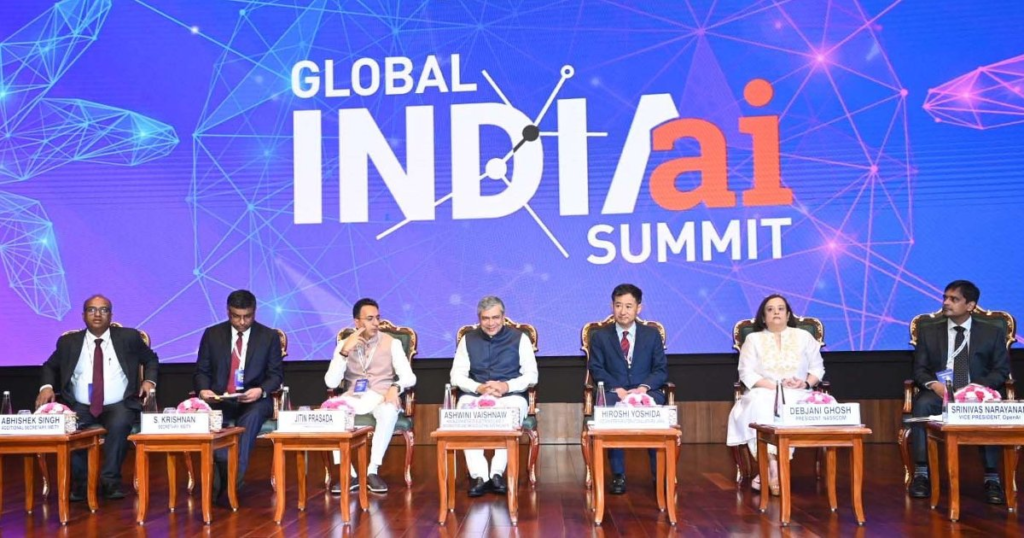
The banners at Bharat Mandapam have been taken down, and the private jets of tech executives have left New Delhi. The India AI Impact Summit 2026 is officially in the history books. But what actually happened behind the closed-door plenary sessions?
Most headlines fixated on the sheer volume of attendees or the guest list featuring Sam Altman and Sundar Pichai. That misses the core strategic shift. India used this summit to declare its intent to build “Sovereign AI.” The country is no longer content being the back-office for global tech giants. It wants to own the compute, train the models on indigenous data, and dictate the governance rules for the Global South.
The Architecture of Sovereign Compute
Let’s look at the numbers that actually matter. The headline figure of the week was Union IT Minister Ashwini Vaishnaw confirming over $250 billion in investment commitments.
Where is that capital going? Not just into software startups. It is flowing directly into hard infrastructure: high-performance computing (HPC) facilities, semiconductor fabrication plants, and data centers. The government announced plans to scale its compute capacity significantly beyond the existing 38,000 GPUs. Concurrently, the introduction of the “MANAV Vision” establishes an ethical framework that forces foreign models to adapt to local data sovereignty laws if they want access to 1.4 billion users.
We also saw the tangible results of the Sovereign AI push. Sarvam AI debuted two large language models trained entirely within India’s borders. Why does this matter? Because a model trained in California fundamentally hallucinates or fails when confronted with the linguistic and cultural density of rural India.
The Economic Effects
The geopolitical tectonic plates shifted on day five when India formally joined the Pax Silica coalition. This aligns Indian semiconductor and AI supply chains directly with US strategic interests, acting as a firewall against Chinese tech dominance.
But the real shockwaves will be felt in adjacent industries.
1. The Energy Bottleneck
You cannot power a $250 billion AI infrastructure expansion with good intentions. AI data centers are notoriously power-hungry. The summit heavily featured “Climate-Smart” AI, but the reality is that India’s grid will face immense strain. We will see a massive secondary boom in green energy deployment, specifically solar and smart grids, to support these new hubs.
2. The Subsea Cable Race
Google’s announcement of the America-India Connect subsea cable is not a standalone philanthropic gesture. It is a vital artery. As India builds out a $15 billion AI Hub in Vizag, the data needs to travel to the US without routing through compromised or highly congested global nodes.
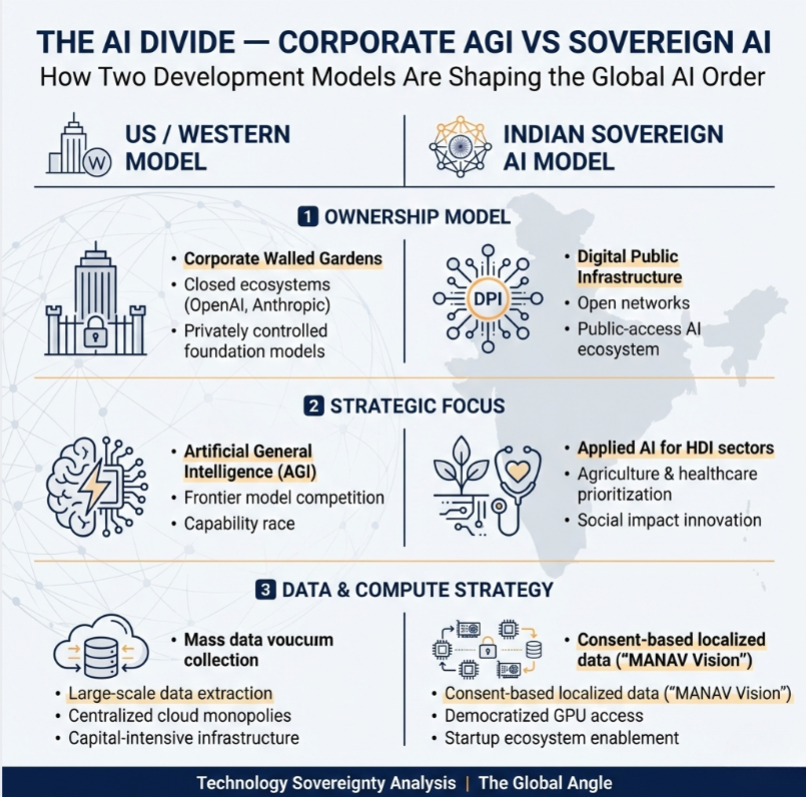
The 2026 AI Geopolitical Matrix
| Metric | The US/Western Approach | The Indian “Sovereign AI” Approach |
| Model Ownership | Corporate Walled Gardens (OpenAI, Anthropic) | Digital Public Infrastructure (Open Networks) |
| Primary Focus | Artificial General Intelligence (AGI) | Applied AI for HDI (Agriculture, Healthcare) |
| Data Governance | Maximizing extraction for model training | “MANAV Vision” – Consent-based & Localized |
| Compute Strategy | Cloud monopolies | Democratized GPU access for startups |
Future Milestones
The true test of the summit’s success lies in execution. Watch these specific milestones.
- May 2026: The rollout of the AI Mission 2.0 framework. Pay attention to how the government subsidizes GPU access for local startups. If the bureaucratic red tape is too thick, the momentum will stall.
- July 2026: Groundbreaking on the newly announced data centers in Dholera and Uttar Pradesh. Track the energy procurement contracts for these sites.
- August 2026: The integration of the New Delhi Frontier AI Commitments into actual legislative drafts. Will India enforce strict guardrails, or keep them voluntary to attract foreign capital?
The global AI narrative is no longer a bipolar contest between Washington and Beijing. A third pole has firmly established itself in New Delhi. The question is whether global capital can adapt to India’s terms.
Frequently Asked Questions
What were the “Three Sutras” mentioned at the summit?
The summit was conceptually organized around People, Planet, and Progress. This framework was designed to pivot the global AI conversation away from existential doomsday scenarios and toward practical, development-oriented solutions for the Global South.
Did any major foreign investments happen?
Yes. Google made significant moves, including the America-India Connect subsea cable, a partnership between Google DeepMind and India’s ANRF for scientific research, and advancing a massive $15 billion AI hub in Vizag
ALSO READ:India AI Impact Summit Day 3 Summary: Google’s Subsea Cable, $50B Pledges & The Viral Exit Chaos
Russia China trade relations 2026: Sanctions Evasion, Dual-Use Tech, and the Putin-Xi Summit
Russia China trade relations 2026: Sanctions Evasion, Dual-Use Tech, and the Putin-Xi Summit Executive Briefing…
What is Hantavirus Outbreak 2026: Symptoms, Vaccine Status, and the Climate Vector
What is Hantavirus Outbreak 2026: Symptoms, Vaccine Status, and the Climate Vector The Immediate Trigger:…
Starlink & SpaceX IPO 2026: Everything You Need to Know
Starlink & SpaceX IPO 2026: Everything You Need to Know The Valuation: According to Institutional…
What is OPEC? How the Oil Cartel Functions and Why It’s Fracturing in 2026
What is OPEC? How the Oil Cartel Functions and Why It’s Fracturing in 2026 The…
Why the UAE Quit OPEC and the Birth of the Petro-Rupee
Why the UAE Quit OPEC and the Birth of the Petro-Rupee The Rupture: The United…
Microsoft OpenAI Partnership Ends: Why Microsoft is Dropping OpenAI’s Exclusive License
Microsoft OpenAI Partnership Ends: Why Microsoft is Dropping OpenAI’s Exclusive License The Announcement: On April…