Executive Briefing
- The core event: The Pakistan Attack on Afghanistan’s Nangarhar and Paktika provinces, shattering a fragile October 2025 ceasefire.
- The primary data point: Islamabad claims the operation eliminated up to 80 militants, while Kabul reports the deaths of 18 civilians, triggering immediate diplomatic condemnation.
- The hidden geopolitical impact: India’s rapid diplomatic intervention signals a deepening strategic alignment between New Delhi and Kabul, fundamentally altering South Asian security dynamics.

The recent Pakistan attack on Afghanistan forces a critical reassessment of border security in South Asia. During the late hours of February 21, 2026, Pakistani military aircraft penetrated Afghan airspace to execute coordinated bombings.
This kinetic military action targeted the Behsud, Barmal, and Urgun districts.
The escalation did not happen in a vacuum. A series of devastating suicide bombings inside Pakistani territory preceded these aerial maneuvers.
Triggers Behind the Pakistan Attack on Afghanistan Soil
Islamabad justified the cross-border incursion as a mandatory act of self-defense.
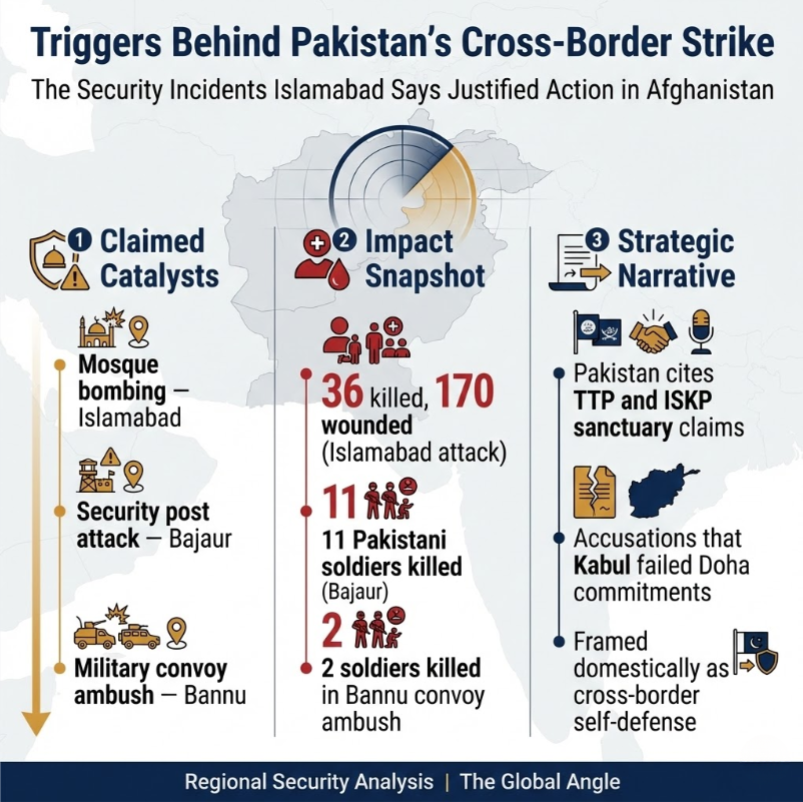
Military officials pointed to a recent surge in domestic terrorism, specifically citing a catastrophic bombing at a Shiite mosque in Islamabad and lethal ambushes in Bajaur and Bannu. The Bajaur incident alone claimed the lives of 11 Pakistani soldiers.
Pakistani intelligence apparatus concluded that these domestic strikes were orchestrated by the Tehreek-e-Taliban Pakistan (TTP) and the Islamic State Khorasan Province (ISKP). Islamabad asserts these syndicates utilize sanctuaries inside Afghan borders to plan operations.
Defense Minister Khawaja Asif explicitly accused Kabul of failing to honor the 2020 Doha Agreement.
| Claimed Catalyst | Location | Impact Metric | Alleged Perpetrator |
| Mosque Bombing | Islamabad | 36 dead, 170 wounded | ISKP / TTP |
| Security Post Ramming | Bajaur | 11 soldiers killed | Afghan National (per Pakistan) |
| Military Convoy Ambush | Bannu | 2 soldiers killed | TTP Affiliates |
The Pakistani Ministry of Information and Broadcasting insisted they possessed “conclusive evidence” of cross-border facilitation. Consequently, the air raids aimed to neutralize seven specific militant encampments.
Kabul’s Rejection and the Civilian Toll Assessment
The Taliban-led government in Kabul immediately rejected Islamabad’s security narrative.
Afghan authorities categorized the aerial bombardment as a blatant violation of national sovereignty and international law. Local intelligence and the Afghan Ministry of Defense reported a vastly different outcome regarding the strike targets.
They maintain the bombs struck civilian infrastructure, not militant training camps.
In the Behsud district, an entire residential compound collapsed. The Afghan Red Crescent Society and local police documented the deaths of at least 18 non-combatants, predominantly women and children.
These conflicting casualty reports highlight the massive intelligence gap between the two nations.
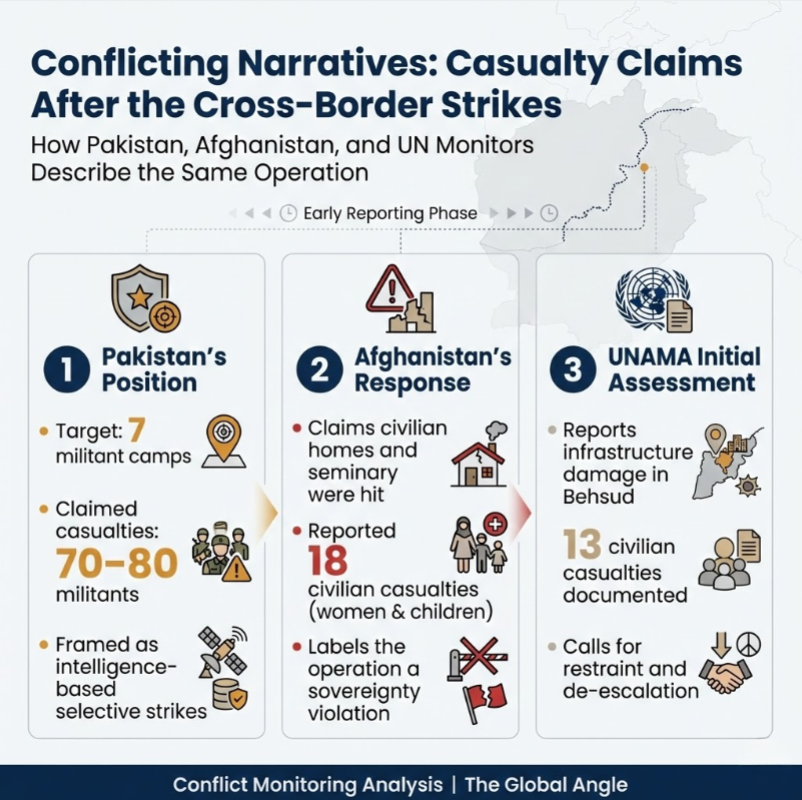
| Reporting Entity | Stated Target | Claimed Casualties | Operational Classification |
| Pakistan Ministry of Defense | 7 Militant Camps | 70-80 Militants | Intelligence-based selective strike |
| Afghan Ministry of Defense | Civilian Homes & Seminary | 18 Civilians (Women/Children) | Sovereignty violation |
| UNAMA (Initial Report) | Infrastructure in Behsud | 13 Civilians | Cause for maximum restraint |
Zabihullah Mujahid, the Afghan government spokesperson, publicly accused the Pakistani military of externalizing its internal security failures.
Assessing the Probability of Afghan Retaliation
The threat of a reciprocal military response is exceptionally high.
The Afghan Defense Ministry officially warned that they will deliver an “appropriate and calculated response” to the incursions. Kabul cannot afford to appear weak domestically.
The Taliban built their political legitimacy on expelling foreign military forces and defending Afghan sovereignty. Ignoring a direct foreign airstrike severely damages that core narrative.
While Afghanistan lacks the air power to match Pakistan, they possess highly asymmetric capabilities. Retaliation will likely manifest through intensified border skirmishes, artillery barrages along the Durand Line, or increased operational freedom for proxy groups.
The regional security apparatus is preparing for a sustained, low-intensity conflict.
India’s Strategic Stance and Regional Realignment
New Delhi seized the diplomatic opening immediately following the bombardment.
The Indian Ministry of External Affairs strongly condemned the airstrikes. Spokesperson Randhir Jaiswal highlighted the civilian casualties during the holy month of Ramadan and formally reiterated India’s support for Afghanistan’s territorial independence.
This rapid diplomatic maneuver serves a dual purpose.
First, it isolates Pakistan on the international stage by framing the operation as an assault on civilians. Second, it accelerates the growing strategic ties between New Delhi and Kabul.
India is actively leveraging this fracture in Pakistan-Afghanistan relations to expand its own geopolitical footprint in Central Asia. The next diplomatic maneuvers will dictate whether this localized conflict expands into a broader regional proxy war.
Frequently Asked Questions
Why did Pakistan initiate this specific military operation?
Islamabad launched the airstrikes in retaliation for a string of deadly suicide bombings inside Pakistan, which they claim were orchestrated by TTP and ISKP militants operating from safe havens inside Afghanistan.
How has the international community reacted to the conflict?
The United Nations Assistance Mission in Afghanistan (UNAMA) called for maximum restraint. Concurrently, India strongly condemned the strikes, criticizing the civilian casualties and voicing support for Afghan sovereignty.
ALSO READ: Pakistan Afghanistan Border Conflict: Why Pakistan Airstrikes on Afghanistan Change Everything
ALSO READ: US-IRAN Tension Makes A Big Impact On Global Energy Sector : The $70 Oil Barrel Hike
Russia China trade relations 2026: Sanctions Evasion, Dual-Use Tech, and the Putin-Xi Summit
Russia China trade relations 2026: Sanctions Evasion, Dual-Use Tech, and the Putin-Xi Summit Executive Briefing…

What is Hantavirus Outbreak 2026: Symptoms, Vaccine Status, and the Climate Vector
What is Hantavirus Outbreak 2026: Symptoms, Vaccine Status, and the Climate Vector The Immediate Trigger:…

Starlink & SpaceX IPO 2026: Everything You Need to Know
Starlink & SpaceX IPO 2026: Everything You Need to Know The Valuation: According to Institutional…

What is OPEC? How the Oil Cartel Functions and Why It’s Fracturing in 2026
What is OPEC? How the Oil Cartel Functions and Why It’s Fracturing in 2026 The…

Why the UAE Quit OPEC and the Birth of the Petro-Rupee
Why the UAE Quit OPEC and the Birth of the Petro-Rupee The Rupture: The United…

Microsoft OpenAI Partnership Ends: Why Microsoft is Dropping OpenAI’s Exclusive License
Microsoft OpenAI Partnership Ends: Why Microsoft is Dropping OpenAI’s Exclusive License The Announcement: On April…

Ibrahim is the Founder and Lead Analyst at The Global Angle, an independent digital platform dedicated to factual geopolitical analysis and international affairs. Based in India, he combines an engineering background with a deep focus on global markets, diplomacy, and strategic security. Ibrahim leverages a data-driven, analytical approach to break down complex international conflicts and economic shifts, helping readers see beyond standard news narratives. When he isn’t researching global policy, he focuses on digital publishing, search engine optimization, and platform architecture.