Executive Briefing (Update: March 2026)
As the United States gears up for the pivotal 2026 midterm elections, the hyper-polarized political climate has reignited intense debates in Washington. With ongoing geopolitical crises and fierce domestic policy battles defining the administration, global search queries are spiking around a singular question: Can Trump Be Impeached In Midterm Elections 2026?
- The Looming Election: The U.S. midterm elections are scheduled for Tuesday, November 3, 2026. All 435 seats in the House of Representatives and 34 Senate seats are on the ballot.
- The Political Math: Impeachment is a purely political process, not a criminal one. A President can only be impeached if the opposing party controls the House of Representatives.
- The Probability: While the odds of the House drafting articles of impeachment could rise significantly if control of the chamber flips, the probability of an actual conviction and removal by the Senate remains statistically close to zero.
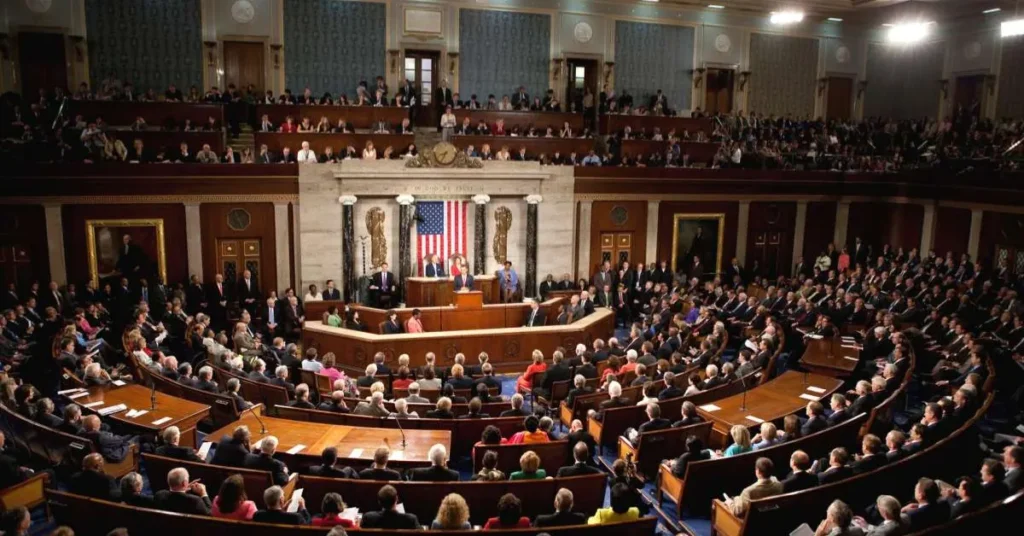
To cut through the partisan noise, we need to look strictly at the U.S. Constitution, the current electoral math, and the structural realities of Congress. Here is the definitive breakdown of how the process works and the true probability of it happening.
When Are the 2026 Midterm Elections?
The midterms will take place on November 3, 2026.
Midterm elections historically serve as a referendum on the sitting President. The party occupying the White House almost always loses seats in Congress during their first midterm. For the current administration, defending their legislative majorities is critical to preventing opposition lawmakers from launching aggressive oversight investigations—or drafting articles of impeachment.
Can Trump Be Impeached In Midterm Elections?
A widespread misconception is that “impeachment” means removing a President from office. It does not.
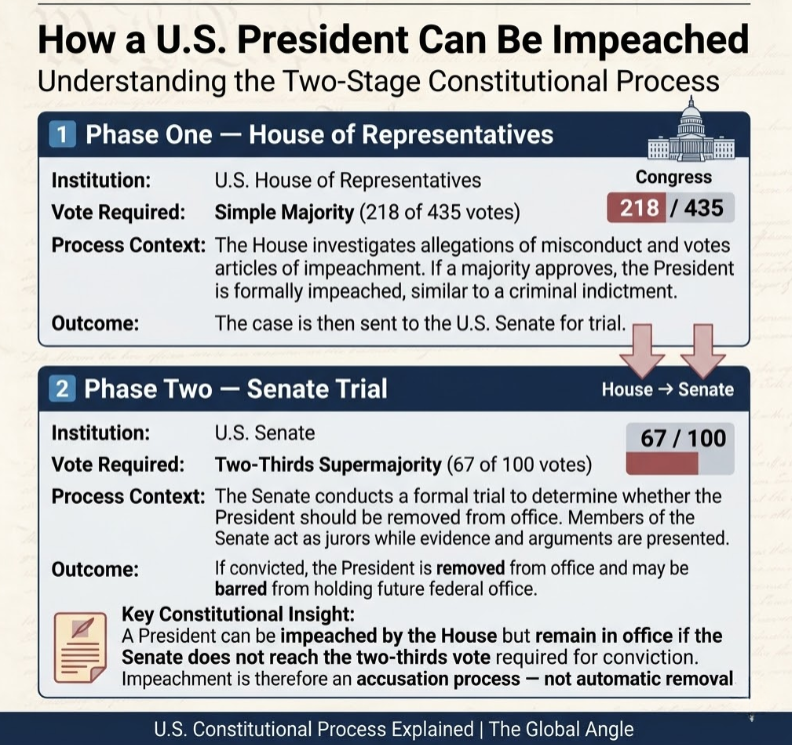
Impeachment is simply the equivalent of a grand jury issuing an indictment. The process is divided into two strict phases split between the two chambers of Congress:
| Phase | Legislative Body | Required Vote | What Happens if it Passes? |
| Phase 1: Impeachment | The House of Representatives | Simple Majority (218 out of 435 votes) | The President is officially “impeached.” The case is then sent to the Senate for a trial. |
| Phase 2: Conviction & Removal | The Senate | Supermajority (67 out of 100 votes) | The President is convicted, immediately removed from office, and potentially barred from holding future office. |
Crucial Takeaway: A President can be impeached by the House and still remain in power if the Senate does not convict them.
The Current Stats: The 2026 Electoral Landscape
To determine the possibility of an impeachment inquiry, we have to look at the current polling and the battleground maps for the upcoming November elections.
The House of Representatives (The Impeachment Trigger)
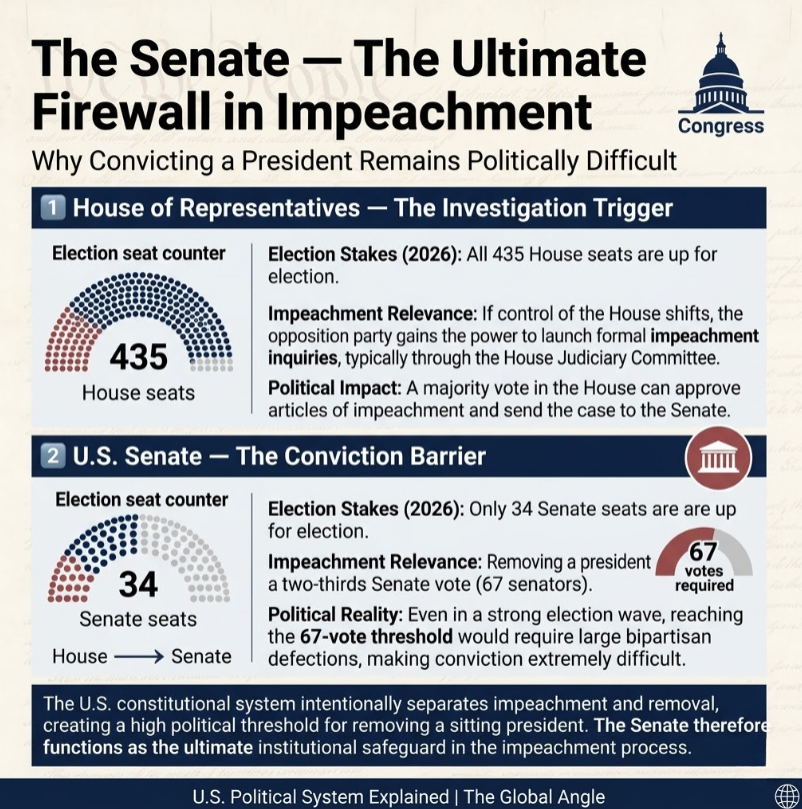
To impeach a President, the opposing party must secure at least 218 seats in the House. Given the historical trend where the President’s party loses an average of 25 to 30 seats in a midterm, the House map is highly competitive. If the opposition captures the House majority on November 3, the structural mechanism to initiate an impeachment inquiry becomes instantly available.
The Senate (The Ultimate Firewall)
Even if the House flips, the Senate math presents a near-impossible hurdle for removal. The 2026 Senate map is notoriously difficult for the opposition party to gain massive ground.
| Chamber | 2026 Election Stakes | Impeachment Relevance |
| House of Representatives | All 435 seats are up for election. | High: A flip in control allows opposition leadership to launch formal impeachment inquiries via the Judiciary Committee. |
| U.S. Senate | 34 seats are up for election. | Low: Even in a “wave” election, no party will secure the 67 seats required to convict. It requires massive bipartisan defection. |
What is the Percentage Possibility?
Political analysts and election modelers separate the probability into two distinct categories: the odds of being impeached versus the odds of being removed.
Based on the current trajectory of the 2026 electoral landscape:
1. Probability of the House flipping control: ~55% to 60%
Midterm environments generally favor the out-party. If economic anxiety or geopolitical fatigue sets in, the House is highly vulnerable to flipping.
2. Probability of the House voting to Impeach: ~35% to 40% (Conditional)
If the House flips, the pressure from the opposition’s base to initiate an inquiry will be immense. However, moderate lawmakers in swing districts are often hesitant to support impeachment without a clear, undeniable constitutional trigger (“Treason, Bribery, or other high Crimes and Misdemeanors”), fearing it will backfire on them in the next election.
3. Probability of Senate Conviction and Removal: < 2%
Because a conviction requires a two-thirds supermajority (67 Senators), a massive contingent of the President’s own party would have to vote to remove him. In the modern era of hyper-partisanship, achieving 67 votes against a sitting President is statistically negligible unless highly unprecedented, undeniable evidence of a severe crime is presented.
The Geopolitical Impact of the Impeachment Threat
For global markets and international allies, the mere threat of an impeachment inquiry following the November 2026 midterms is a major variable.
A paralyzed, divided government in Washington creates friction in foreign policy. If the House flips and spends 2027 engulfed in impeachment hearings, it will severely limit the administration’s ability to pass domestic legislation, fund foreign aid, or project unified strength on the global stage.
Frequently Asked Questions (2026 Midterm Impeachment)
When are the next U.S. midterm elections?
The next U.S. midterm elections will be held on Tuesday, November 3, 2026. During this election, all 435 seats in the House of Representatives and 34 of the 100 seats in the Senate will be contested.
Can a U.S. President be impeached during midterm elections?
A President is not impeached by the voters during an election. Instead, the midterm elections determine which political party controls Congress. If the opposing party wins a majority in the House of Representatives during the 2026 midterms, they gain the constitutional power to initiate an impeachment inquiry and draft articles of impeachment.
How many votes are needed to impeach and remove a President?
The impeachment process requires two different vote thresholds. First, a simple majority in the House of Representatives (218 out of 435 votes) is required to formally “impeach” the President. Second, the Senate holds a trial, where a supermajority (67 out of 100 votes) is required to actually convict and remove the President from office.
What happens if the House flips in 2026?
If the opposition party flips the House of Representatives in November 2026, they will control all legislative committees. This grants them subpoena power to launch aggressive oversight investigations into the administration, which historically serves as the preliminary step before drafting formal articles of impeachment.
ALSO READ: Who Was Arrested From the Epstein Files in 2026? Photos & Facts
ALSO READ: LPG Crisis in India Due to Iran War: Mumbai & Bengaluru Restaurants Face Imminent Closure

Russia China trade relations 2026: Sanctions Evasion, Dual-Use Tech, and the Putin-Xi Summit
Russia China trade relations 2026: Sanctions Evasion, Dual-Use Tech, and the Putin-Xi Summit Executive Briefing…

What is Hantavirus Outbreak 2026: Symptoms, Vaccine Status, and the Climate Vector
What is Hantavirus Outbreak 2026: Symptoms, Vaccine Status, and the Climate Vector The Immediate Trigger:…

Starlink & SpaceX IPO 2026: Everything You Need to Know
Starlink & SpaceX IPO 2026: Everything You Need to Know The Valuation: According to Institutional…

What is OPEC? How the Oil Cartel Functions and Why It’s Fracturing in 2026
What is OPEC? How the Oil Cartel Functions and Why It’s Fracturing in 2026 The…

Why the UAE Quit OPEC and the Birth of the Petro-Rupee
Why the UAE Quit OPEC and the Birth of the Petro-Rupee The Rupture: The United…

Microsoft OpenAI Partnership Ends: Why Microsoft is Dropping OpenAI’s Exclusive License
Microsoft OpenAI Partnership Ends: Why Microsoft is Dropping OpenAI’s Exclusive License The Announcement: On April…

Ibrahim is the Founder and Lead Analyst at The Global Angle, an independent digital platform dedicated to factual geopolitical analysis and international affairs. Based in India, he combines an engineering background with a deep focus on global markets, diplomacy, and strategic security. Ibrahim leverages a data-driven, analytical approach to break down complex international conflicts and economic shifts, helping readers see beyond standard news narratives. When he isn’t researching global policy, he focuses on digital publishing, search engine optimization, and platform architecture.