Microsoft OpenAI Partnership Ends: Why Microsoft is Dropping OpenAI’s Exclusive License
- The Announcement: On April 27, 2026, Microsoft officially confirmed it will end its exclusive commercial license to OpenAI’s underlying technology, dismantling the most powerful corporate partnership of the AI boom.
- The Regulatory Guillotine: The move effectively neutralizes the aggressive antitrust investigations led by the FTC and the European Commission, preventing a 1990s-style regulatory death spiral for Microsoft.
- The Strategic Pivot: Microsoft no longer needs OpenAI to be the “only” model. The company has shifted its strategy toward the “Azure Tollbooth” model—commoditizing foundation models while forcing the world to pay for its compute infrastructure.
If you read the mainstream financial press this morning, you are being sold a narrative of a tragic corporate divorce. The headlines suggest Microsoft is losing its golden goose.
That narrative is entirely backwards.
The news that Microsoft is ending its exclusive license to OpenAI’s technology is not a retreat. It is the final stage of a highly calculated, multi-year extraction strategy by CEO Satya Nadella. Microsoft didn’t lose OpenAI; they commoditized them.
Here is the unvarnished analysis for The Global Angle’s Strategic Technologies desk. We are looking past the Reuters wire to explain the real mechanics of this uncoupling, why Microsoft initiated it, and the existential danger this poses to Sam Altman’s empire.
The Antitrust Escape Hatch
To understand the timing, you have to look at the legal realities of early 2026. Both the U.S. Federal Trade Commission (FTC) and the European Commission had cornered Microsoft. Regulators spent the last two years arguing that Microsoft’s $13 billion “partnership” with OpenAI was a shadow-acquisition designed to bypass merger laws.
Microsoft remembers the late 1990s. Fighting the DOJ over Internet Explorer almost destroyed the company. Nadella refuses to fight a decade-long antitrust war over AI.
By voluntarily dropping the exclusivity clause, Microsoft immediately deflates the antitrust argument. They can look regulators in the eye and say, “OpenAI is an independent company, and we do not have a monopoly on their technology.” It is a brilliant, zero-cost legal maneuver that protects Microsoft’s core cloud business from structural breakup.
The “Azure Tollbooth” Strategy
Here is what the standard tech coverage is missing. Microsoft is dropping the exclusive license because they no longer need it. In 2023, Microsoft needed OpenAI’s GPT-4 to shock the market, integrate Copilot into Windows, and force enterprise customers onto Azure. OpenAI was the bait.
By 2026, that mission is accomplished. Enterprise lock-in is secured. Microsoft’s strategy has now shifted from Model Exclusivity to Model Aggregation.
Welcome to the Azure Tollbooth.
The Shifting AI Power Dynamic
| Strategic Metric | The 2023 Strategy (The Honeymoon) | The 2026 Strategy (The Commoditization) |
| Model Reliance | Absolute dependency on OpenAI’s GPT series for all flagship products. | Model-agnostic. Azure hosts Llama, Mistral, Cohere, and OpenAI side-by-side. |
| Margin Economics | High cost. Paying OpenAI massive licensing fees to run massive models. | High margin. Pushing clients toward smaller, cheaper, locally-run SLMs (Small Language Models). |
| Regulatory Risk | Extremely high. Viewed as a shadow-monopoly by the FTC and EU. | Neutralized. By dropping exclusivity, Microsoft removes the antitrust target from its back. |
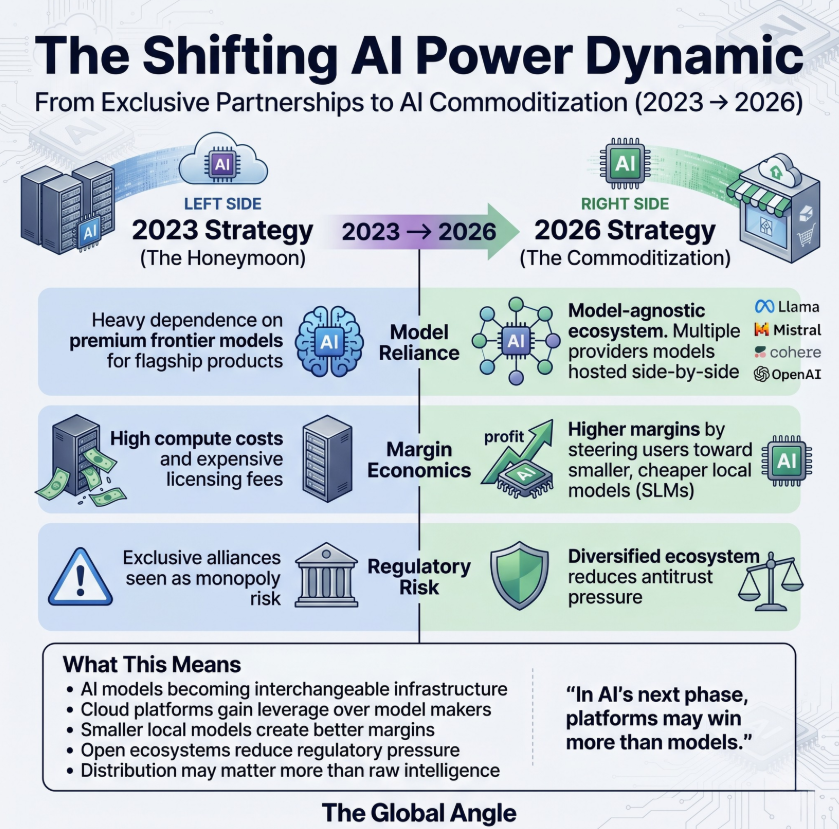
Microsoft realized a fundamental truth of the current tech cycle: The foundational model is becoming a commodity. The real monopoly is the compute. Whether an enterprise uses OpenAI, an open-source model from Meta, or a European model like Mistral, Microsoft does not care. As long as that model is rented through an Azure server, Microsoft collects the toll. OpenAI has been downgraded from a privileged partner to just another vendor on the Azure shelf.
The Small Language Model (SLM) Pivot
The second reason Microsoft is comfortable walking away from the exclusive license is the evolution of their own internal engineering.
Running massive AGI-level models (like GPT-5) for everyday enterprise tasks—like drafting a quick email or summarizing a PDF—is economically insane. The compute burn rate is too high.
Over the last two years, Microsoft aggressively poached talent (including Inflection AI’s leadership) to build out its own “Phi” series of Small Language Models. These SLMs are highly capable, incredibly cheap to run, and don’t require OpenAI’s IP. Microsoft is quietly replacing OpenAI’s heavy models on the backend of its Office 365 products with its own proprietary, lightweight tech.
The Existential Threat to OpenAI
If Microsoft is the winner here, OpenAI is suddenly highly exposed.
For years, OpenAI operated under a protective financial shield. They could burn billions of dollars on research and supercomputing because Microsoft was footing the bill and locking out competitors.
With the exclusivity gone, OpenAI is suddenly thrust into a brutal open market.
- Pricing Wars: They now have to compete directly on price against open-source models that are functionally free.
- Distribution: They no longer have a guaranteed monopoly inside the world’s largest enterprise software ecosystem.
- Compute Costs: They still rely on Azure for compute, but they are losing their preferential patron.
Sam Altman’s company is still the most recognizable brand in AI. But without Microsoft acting as its exclusive distributor and financial bodyguard, OpenAI transitions from an untouchable titan into a software company with a terrifyingly high overhead.
The era of the “Wintel of AI” is officially over. The infrastructure layer won.
OpenAI’s Threat Matrix
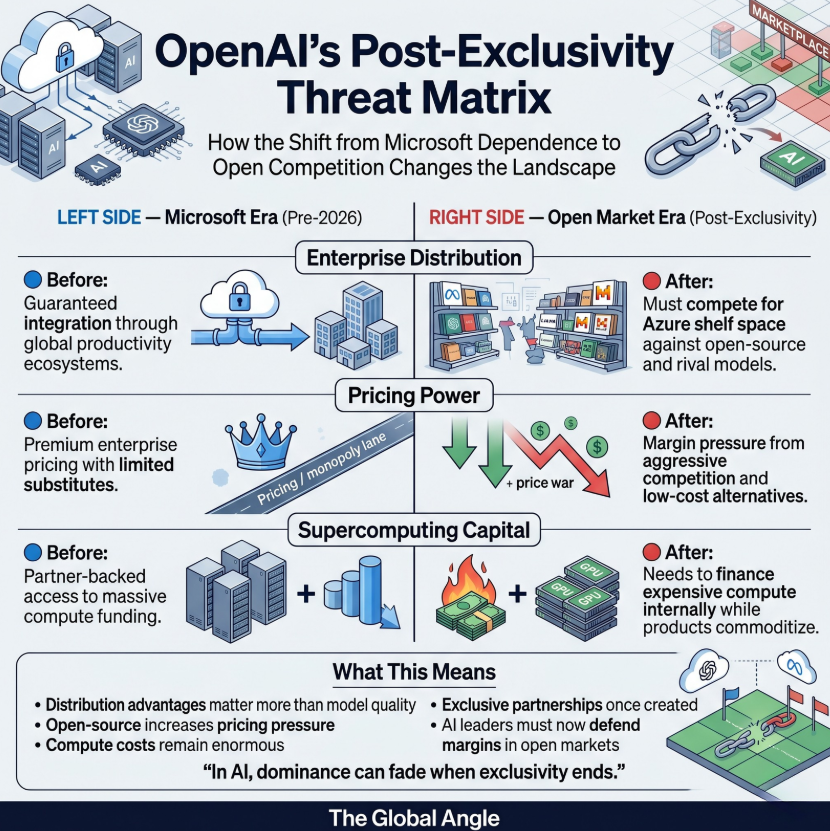
Without Microsoft acting as its financial bodyguard and exclusive distributor, OpenAI is suddenly highly exposed to market forces. The foundational model is becoming commoditized, and Sam Altman’s company must now fight a multi-front war just to maintain its valuation.
OpenAI’s Post-Exclusivity Threat Matrix
| Vulnerability Sector | The Microsoft Era (Pre-2026) | The Open Market Era (Post-Exclusivity) |
| Enterprise Distribution | Guaranteed default integration into the global Windows and Office ecosystem. | Forced to fight for shelf space on the Azure cloud against highly capable open-source models (Llama, Mistral). |
| Pricing Power | Monopoly pricing. Enterprises had no equivalent, secure alternative inside Azure. | Margin Collapse. Forced into brutal price wars to compete with foundation models that are functionally free to download. |
| Supercomputing Capital | Microsoft subsidized the billions required to train the next generation of models. | OpenAI must now fund its own staggering compute costs while its core product is simultaneously commoditized. |
Sources:
U.S. Federal Trade Commission (FTC) – Cloud Computing and AI Inquiry (Official regulatory filings and press documentation regarding the FTC’s antitrust investigation into generative AI investments and cloud provider monopolies)
UK Competition and Markets Authority (CMA) – AI Foundation Models Report (Comprehensive international regulatory analysis on the market dynamics, compute bottlenecks, and competition risks of AI foundation models)
Microsoft Research – Small Language Models (SLMs) (Official technical documentation from Microsoft detailing the development, compute efficiency, and enterprise deployment of the “Phi” series models)
Center for Strategic and International Studies (CSIS) – AI and Compute (Geopolitical think tank analysis on how control over compute infrastructure, rather than software, dictates the balance of power in the global tech war)
Frequently Asked Questions
Why is Microsoft ending its exclusive license with OpenAI?
The decision is a calculated legal and strategic maneuver. By dropping the exclusive license, Microsoft effectively neutralizes aggressive antitrust investigations from the FTC and the European Union, who viewed the partnership as an illegal shadow-monopoly. Strategically, Microsoft no longer needs exclusivity; it has successfully transitioned to an “aggregation” model, hosting multiple AI models on its Azure cloud.
Does this mean Microsoft will stop using ChatGPT and OpenAI tech?
No. Microsoft will still host OpenAI’s models and offer them to customers. However, OpenAI will no longer be the only option. Microsoft’s cloud platform, Azure, will now actively push cheaper, alternative models (including their own proprietary Small Language Models and open-source models from Meta or Mistral) right alongside GPT-4.
What is a Small Language Model (SLM) and why does Microsoft care?
Massive models like ChatGPT are incredibly expensive to run because they require massive amounts of computing power. Small Language Models (like Microsoft’s “Phi” series) are lightweight, highly efficient AI models trained on highly curated data. Microsoft is pivoting to SLMs because they can perform 90% of daily office tasks (like summarizing an email) at a fraction of the cost, eliminating the need to pay OpenAI for basic enterprise functions.
How does this impact OpenAI’s future?
It presents an existential threat to their profit margins. For years, OpenAI was shielded from open-market competition because Microsoft was their exclusive distributor. Now, OpenAI must compete directly on price and performance against well-funded competitors and free open-source models, all while trying to pay for the massive supercomputers required to build their next generation of AI.
ALSO READ: Evaluating Iran Military Power 2026: Asymmetric Warfare and Ballistic Might
ALSO READ: Global Debt Report 2026 Analysis and the $348 Trillion World Debt Crisis
Russia China trade relations 2026: Sanctions Evasion, Dual-Use Tech, and the Putin-Xi Summit
Russia China trade relations 2026: Sanctions Evasion, Dual-Use Tech, and the Putin-Xi Summit Executive Briefing…

What is Hantavirus Outbreak 2026: Symptoms, Vaccine Status, and the Climate Vector
What is Hantavirus Outbreak 2026: Symptoms, Vaccine Status, and the Climate Vector The Immediate Trigger:…
Starlink & SpaceX IPO 2026: Everything You Need to Know
Starlink & SpaceX IPO 2026: Everything You Need to Know The Valuation: According to Institutional…
What is OPEC? How the Oil Cartel Functions and Why It’s Fracturing in 2026
What is OPEC? How the Oil Cartel Functions and Why It’s Fracturing in 2026 The…

Why the UAE Quit OPEC and the Birth of the Petro-Rupee
Why the UAE Quit OPEC and the Birth of the Petro-Rupee The Rupture: The United…
Microsoft OpenAI Partnership Ends: Why Microsoft is Dropping OpenAI’s Exclusive License
Microsoft OpenAI Partnership Ends: Why Microsoft is Dropping OpenAI’s Exclusive License The Announcement: On April…

Ibrahim is the Founder and Lead Analyst at The Global Angle, an independent digital platform dedicated to factual geopolitical analysis and international affairs. Based in India, he combines an engineering background with a deep focus on global markets, diplomacy, and strategic security. Ibrahim leverages a data-driven, analytical approach to break down complex international conflicts and economic shifts, helping readers see beyond standard news narratives. When he isn’t researching global policy, he focuses on digital publishing, search engine optimization, and platform architecture.